Related Posts

12–18 Years The Adolescent Years
For all typically developing children, the transition from childhood to adolescence and eventually to adulthood, with all its expectations and responsibilities, requires a lot of learning. Now, perhaps more than at any other time in human history, the level of expectation, both in productivity and speed of transition into adulthood, is higher. In recognizing the potential of all children, we often assume that teenagers and young adults should behave, respond, and act in a certain way because they are physically able to and have likely demonstrated the cognitive ability to do so.
Many young adults look and seem like full-grown adults, and we can’t help but have preconceived notions that they
should behave like adults. What neuroscience has discovered is that the brain does not develop at the same rate as the rest of the body and that it does not develop uniformly. For example, the limbic system (responsible for emotions) develops before the prefrontal cortex (responsible for logic and decision-making).
In working with teens, the world often places unfair and unrealistic expectations on them because people can’t help but see them as adults. So, when it comes to driving cars or making risky decisions, etc., adolescents are often expected to think, behave, respond, and make decisions that they don’t yet have the experience to make responsibly.
In Secondary Montessori education, we both recognize this and develop curricula to address adolescents’ developmental needs, then provide opportunities for them to fulfill them. This raises the question, what does that even mean? What do they need?
Society and the Department of Education (or international equivalent) support the notion that all students need a certain level of general knowledge about history, science, and culture. There is also agreement that literacy is necessary, as it is the gateway for the acquisition of other skills. The long-held belief in the universal necessity of traditional, isolated academic subjects, such as algebra II and chemistry, is being challenged by rapid technological advances, such as AI, advanced word processing, and calculators in everyone’s palms, with some considering these subjects to be increasingly obsolete.
What is the Work of Adolescents?
Dr. Montessori viewed adolescence as a period of profound inner change, not only physical but also psychological. Adolescents are grappling with urgent questions, such as:
Who am I becoming? What matters to me?
Where do I belong in the adult world?
How can I contribute meaningfully to society?
What brings value to my world?
While textbooks offer context and insight into the world around and before them, these critical questions cannot be answered through typical education alone. Adolescents need real opportunities to test themselves, encounter limits, take responsibility, and experience the consequences of their actions.
It is worth mentioning that limits and consequences are frequently accompanied by failure. Despite failure’s status in many spheres as an unacceptable curse word, any adult can tell a casual observer that it is an inevitable part of life. How do Montessori guides enable teens to constructively address failure, especially if they have been sheltered from it since infancy?
How do Montessori guides enable teens to constructively address failure, especially if they have been sheltered from it since infancy?
Adolescents will inevitably fail, but they must do so in an environment that doesn’t result in a deep-rooted fear of failure. Without intervention, such a fear could evolve into a more debilitating dread of taking on new challenges and prevent these future adults from developing the growth mindset that is essential to their valorization. At the adolescent level, with careful planning (informed by rigorous observation), opportunities are created for teens to take risks and experience failure in a fairly low-stakes environment. This failure, while certainly feeling impactful for the adolescents themselves, is usually limited to those related to academic, physical, and relationship challenges.
Montessori believed that work provides the mirror adolescents need to discover not only skills but also character. She called this process valorization: the development of a sense of self-worth through meaningful contribution. Notably, whether or not something counts as ‘meaningful contribution’ is not determined by its ability to result in good grades or to inspire praise, but by how much it matters. Ideally, this work not only matters to the student but also to a larger group. Students are put in a position in which others depend on them, and they, therefore, have the opportunity to experience the benefits of success and the consequences of unreliability.
What Real-World Work Looks Like
Montessori Adolescent programs don’t simply send students out to “get jobs.” The work of the Secondary environment is carefully chosen, supervised, and connected to academic learning.
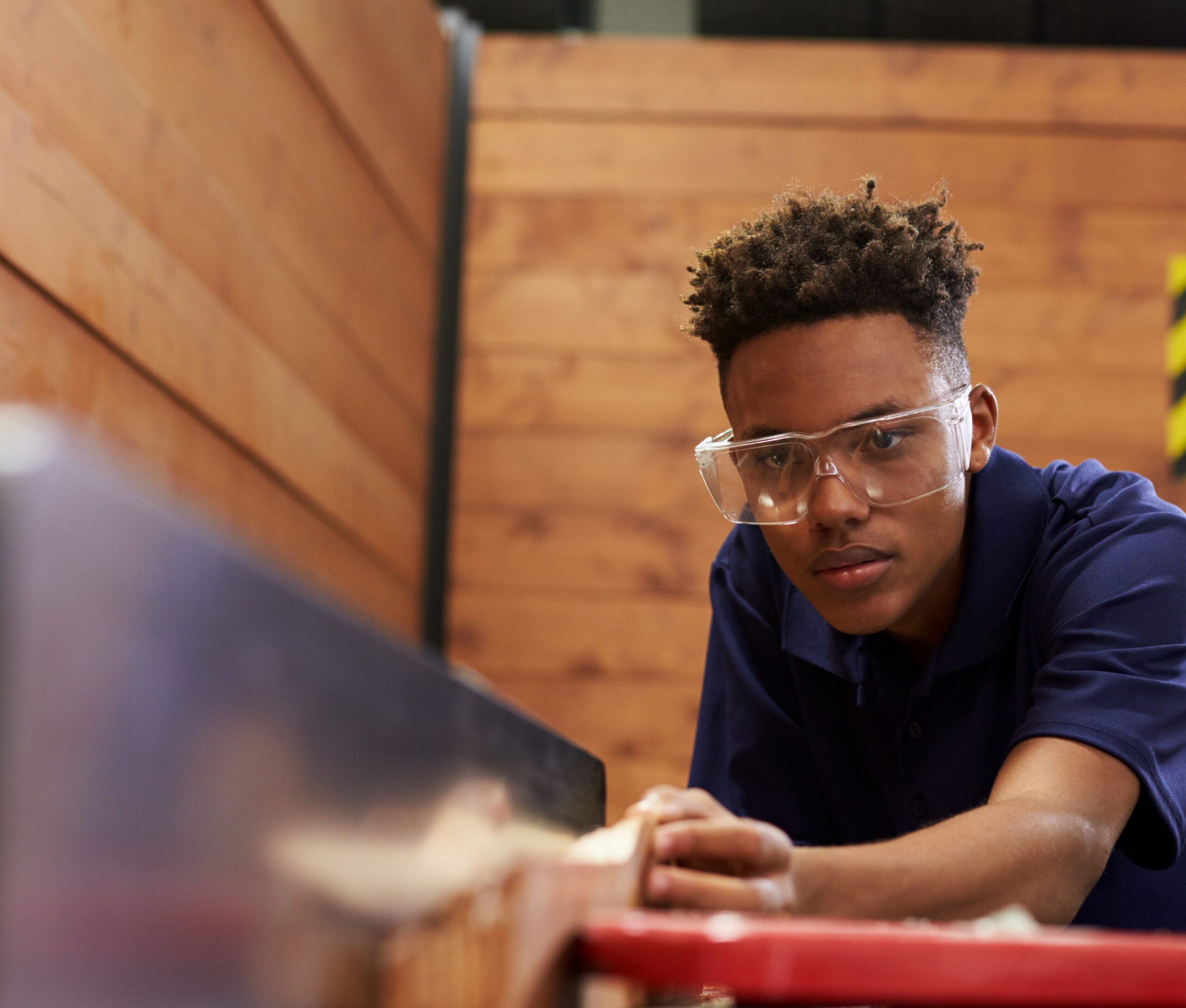
Students run real businesses, such as cafés, farm stands, service ventures, tutoring services, and childcare. They experience situations in which they have the opportunity
to handle actual money or exchange currency, engage with customers and clients, and even learn about business-specific components, such as inventory, profit, and loss.
Many Adolescent Montessori programs offer (and sometimes require) the opportunity to participate in an internship program. The students may spend regular time in internships at places such as veterinary clinics, law offices, elementary schools, nonprofit organizations, co-ops, and design studios, contributing meaningfully to the business with professional guidance. Many programs include landbased work, such as farming, gardening, or environmental restoration, where students’ effort produces visible, tangible results.
The common thread of these experiences is responsibility. Outcomes matter. Other people depend on them. Their effort contributes directly to results. Students are allowed to answer the questions posed above: Who am I becoming? What matters to me? Where do I belong in the adult world? How can I contribute meaningfully? What brings value to my world? Students are encouraged to participate in different activities and, while they may not discover their lifelong passion or calling, these experiences serve to add insight into the direction (or directions) they want to pursue as they continue their journey into adulthood.
Why This Isn’t Vocational Training
Parents sometimes worry that this approach sounds like vocational education. It isn’t.
The goal of these real-world work experiences is not to prepare adolescents for specific careers. Rather, it is to help them develop capacities and transferable skills that will benefit them in any future path: perseverance, realistic self-knowledge, clear communication, collaboration, problem-solving, and resilience.
Through real work, adolescents discover what genuinely interests them and what doesn’t. They learn how organizations actually function. They experience manageable failure and learn to recover, reflect, adjust, and try again. They learn how to work with others in contexts that more closely mirror those that they will encounter in their professional, adult lives.
Most Montessori adolescents go on to attend academically rigorous high schools and colleges. This type of work doesn’t replace academics; instead, it provides context, motivation, and purpose to learning that classroom instruction alone often lacks.
How Academics Fit In
In contrast with traditional education programs, Montessori Adolescent programs aim to integrate academics with work rather than teaching them separately.
Running a business creates genuine mathematical needs: calculating costs, managing cash flow, analyzing profit, and forecasting demand. Writing becomes purposeful when students draft proposals, communicate with customers, and reflect on internships. In this environment, economics, history, and science become lived experiences rather than abstract concepts.
As a result, instead of asking Why do I need to learn this? adolescent students see how knowledge functions in the real world, and their motivation shifts from external pressure to internal relevance.
What This Develops That Classrooms Often Don’t
Sustained real-world work builds capacities that traditional classrooms struggle to cultivate:
- Initiative: seeing what needs doing and acting without being told;
- Time management – meeting deadlines that aren’t negotiable;
- Authentic collaboration – everyone’s contribution truly matters.
- Professional identity – seeing oneself as capable of contributing to adult work.
- Confidence – earned from accomplishment, not praise.
Perhaps, most importantly, adolescents develop resilience. They encounter challenges in manageable doses and learn, through experience (including failure), that they can recover, adapt, keep going, improve, and ultimately succeed.
What About College?
This is often parents’ central concern: Will this prepare my child for competitive high schools and colleges? The integration of work and academics doesn’t weaken preparation; it strengthens it. While many schools still value the high GPA, more and more schools are looking for students that took on greater challenges, even if doing so had a higher likelihood of failure and imperfection. Many guidance counselors and admissions committees are now looking for students who can finish college, rather than simply get in. These real-world experiences provide the skills needed for success in a world no longer structured by parents or teachers.
In this regard, Montessori adolescents usually stand out. They speak with maturity and clarity about their experiences. They demonstrate genuine interest in hobbies rather than engaging in activities solely for their résumé-building value. They show strong work habits, self-direction, and realistic self-knowledge, qualities colleges increasingly value.
What Parents Can Expect to Observe
If you’re wondering whether your adolescent is truly benefiting in their Montessori Secondary program, you should look for the following: increased engagement with their work; growing competence and independence; thoughtful self-assessment; and genuine pride in meaningful contributions. These indicators suggest that students’ work is doing what Montessori intended: supporting development of identity, confidence, and purpose alongside academic growth.
When observing and interacting with your teens, this rich development may appear as contentment, happiness, or pride. However, like all other humans, your adolescent may not display these emotions one-hundred percent of the time. Nevertheless, consistent interaction and engagement with your teen will reveal that these emotions are present and, frequently, that they are partly tied to the work they are doing in their Montessori program.
Trusting the Adolescent Process
Montessori’s approach asks parents to trust something that looks very different from conventional schooling. It rests on a simple belief: Adolescents grow not just by absorbing information, but by testing themselves against reality.
Young people who emerge from Secondary Montessori experiences tend to know who they are, what they can do, and how to contribute meaningfully to their community. They’re prepared not only for the next stage of schooling but also to be engaged and capable young adults living a purposeful life. In a world that is rapidly changing, is increasingly accessible to vast amounts of information and technology, and requires skills we cannot yet imagine, this kind of preparation may be the most important education of all.
Dr. Robin Howe began his Montessori career at the age of two at the Barrie School in Silver Spring, MD, which he attended through the eighth grade. Graduating from Dickinson College with two majors (Spanish and Religion), he went on to earn a Master’s Degree in Bioethics from the University of South Florida.
After successfully pursuing a career in restaurant management, Robin decided to return to his Montessori roots. He earned his Primary certification from Palm Harbor Montessori School (AMS) and then attended St. Catherine’s University to earn his Lower and Upper Elementary Certification (AMS). He also attended NAMTA’s Orientation to Adolescent Studies (AMI). Robin holds a Doctorate in Educational Leadership from Argosy University and works with The Montessori Foundation Senior Montessori School Consultant.
Adele Bovis has spent a decade in education in the United States, Peru, and England. She holds a Bachelor’s in Philosophy and Spanish from Washington College and a Master’s in Cross-Cultural Communication and Education from Newcastle University. Adele became interested in Montessori philosophy while completing her graduate studies and, after teaching during the COVID-19 pandemic, committed to the methodology because of its emphasis on student autonomy and preparation for a changing world. She has repeatedly witnessed the partnership-oriented Montessori model’s merit in creating capable, global-minded students and believes wholeheartedly in its peacemaking value. Adele is completing her Secondary credential through the Center for Guided Montessori Studies and is currently working to grow the adolescent program at Desert Garden Montessori in Phoenix, Arizona.