Related Posts

What a Good Montessori Observation Actually Tells Us
Snapshot
Observation is one of the most powerful tools available to Montessori educators. Yet meaningful observation involves far more than tracking lessons or recording which materials a child has mastered. It helps us understand how children think, learn, respond to challenges, develop relationships, and become increasingly independent. It also invites us to examine whether our own behavior and the environment are supporting or interfering with their development.
Watching Is Not Necessarily Observing
Spend a morning in a Montessori classroom, and you will see children engaged in a remarkable variety of activities. Some will be working independently. Others will be collaborating with friends. A few may be watching what is happening around them or moving from one area of the classroom to another.
An experienced Montessori educator sees more than a collection of children completing activities. She is learning to recognize the subtle signs of human development unfolding before her.
There is an important difference between watching children and observing them.
Watching tells us what is happening. Thoughtful observation helps us begin to understand what may be happening beneath the surface.
This requires patience, curiosity, and a willingness to set aside our assumptions.
Looking Beyond the Lesson
Consider a young child working with the Pink Tower. From an academic perspective, we might note whether the child can arrange the ten cubes in their correct sequence.
But the observation becomes far more interesting when we consider how the child approaches the experience.
Does she carefully examine the cubes before beginning? Does she notice when something is out of sequence? Does she attempt to correct it independently? Does she repeat the activity several times? How does she respond when the tower falls?
Perhaps another child comes over to watch. Does she welcome the companionship or prefer to continue working alone?
In a few minutes, we may learn something about visual discrimination, motor coordination, concentration, problem-solving, emotional regulation, social development, and the child’s growing sense of competence.
The material is important, but the child is the real subject of our observation.

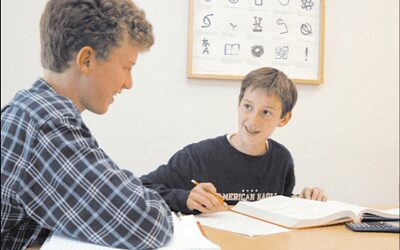
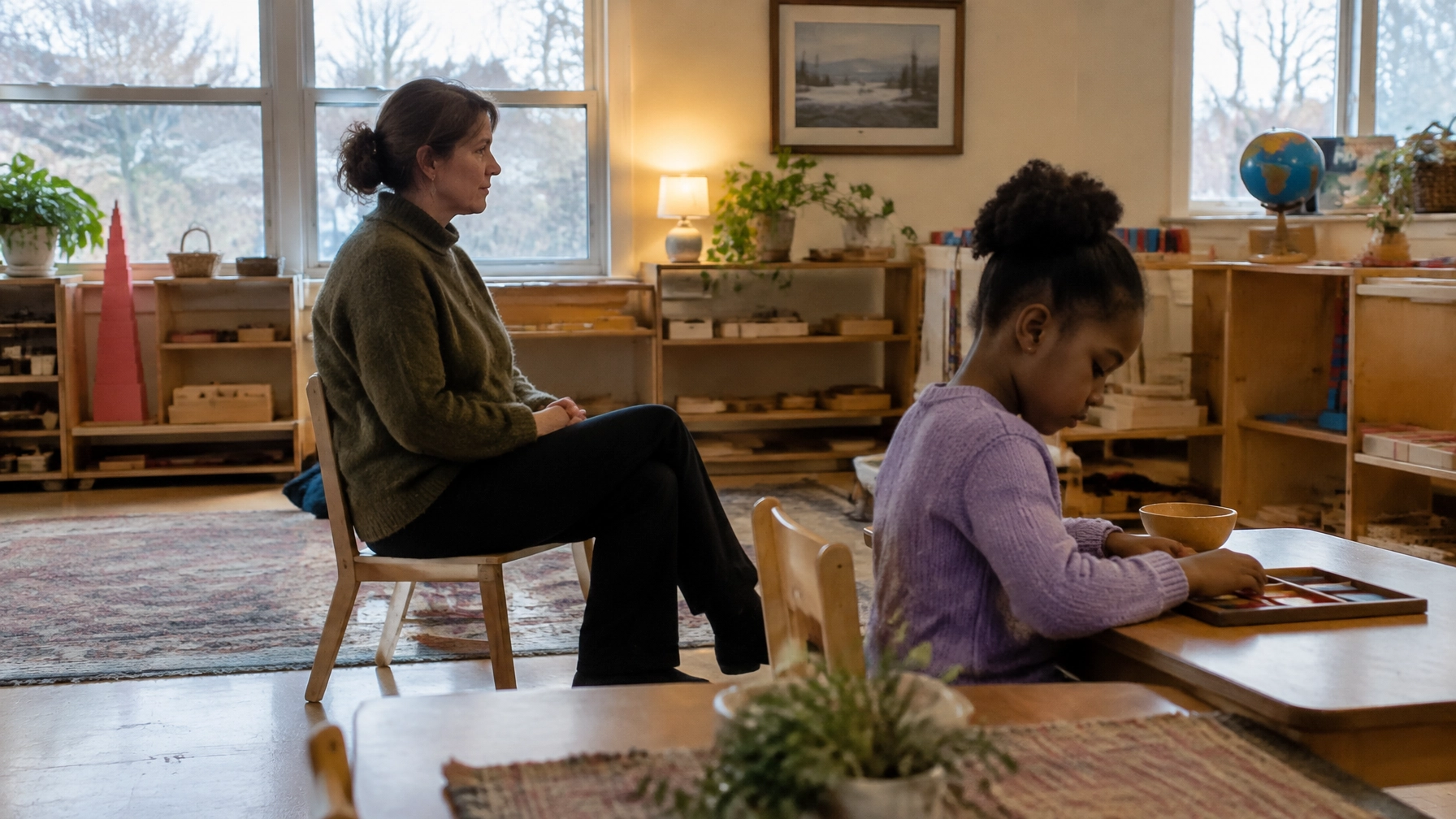
The child and the complete Pink Tower are in view; the guide waits without intervening.
What Should We Be Looking For?
One useful way to think about Montessori observation is to consider several dimensions of development.
Interest and engagement. What attracts the child’s attention? Which activities does the child return to spontaneously? What seems to spark curiosity?
Concentration. Under what circumstances does the child become deeply absorbed? What tends to interrupt that concentration?
Independence. What can the child initiate, organize, and complete without adult assistance? When is help genuinely needed?
Response to difficulty. Does the child experiment, persist, ask for assistance, become discouraged, or abandon a challenging task?
Social development. How does the child approach others, negotiate disagreements, share space, participate in collaborative work, and respond to the community’s needs?
Emotional well-being. When does the child appear comfortable, confident, joyful, anxious, or overwhelmed?
Academic understanding. What does the child’s activity reveal about emerging concepts, skills, misconceptions, and readiness for new experiences?
These dimensions are interconnected. A child who appears to be struggling academically may be experiencing social uncertainty. A child who seems restless may need more challenging work, greater opportunities for movement, or help finding an activity that captures their interest.
Separating Observation from Interpretation
One discipline of good observation is learning to distinguish between what we see and what we conclude.
Imagine two entries in an educator’s observation notebook:
Oliver is disruptive and has difficulty concentrating.
Between 9:10 and 9:30, Oliver selected three activities, completed none, and approached four other children while they were working. At 9:35, he began working with the geometric solids and remained engaged for fifteen minutes.
The second entry is much more useful.
Rather than assigning a characteristic to Oliver, it provides information that allows us to ask better questions. Why did the geometric solids capture his attention? Was he initially looking for a particular kind of experience? Was he seeking social connection?
Interpretation is necessary, but it should remain open to revision as we gather additional information.
Children deserve to be understood as developing human beings, not defined by labels based on isolated moments.
Looking for Patterns Over Time
A single observation is a snapshot, not a complete portrait.
Children have difficult mornings. They experience changes at home. They become tired, hungry, excited, or worried. They respond differently to different adults and social situations.
Meaningful observation therefore requires us to look for patterns over days and weeks.
A child who avoids writing on Monday may eagerly write on Thursday. A child who rarely speaks during group gatherings may become wonderfully articulate while working with a friend.
When we observe consistently, we begin to understand not only what children can do but also the conditions under which they flourish.
Observation Should Lead to Thoughtful Action
Observation is not an end in itself. Its purpose is to improve the child’s experience.
Sometimes it leads us to introduce a new lesson. Sometimes it suggests that we need to simplify a task, rearrange part of the environment, offer a different material, or help a child develop a particular social skill.
At other times, the most appropriate response is to do nothing.
A child who is productively struggling may be developing persistence. A child who is repeating a familiar activity may be consolidating an important skill. Our intervention, however well-intentioned, could interrupt that process.
When concerns persist, observations can also help educators communicate clearly with families and, when appropriate, seek additional professional guidance. Observation is not, in itself, a clinical assessment or diagnosis.
Observing Ourselves and the Environment
Experienced Montessori educators gradually discover that observation is as much about understanding the adults and the environment as it is about understanding children.
Are our classroom routines creating unnecessary interruptions? Are children able to find and return materials independently? Are we providing enough interesting work? Are our expectations consistent? Do we step in too quickly when children encounter difficulty?
Before asking what is wrong with a child, consider what might need to change in the child’s surroundings.
This is one of Montessori’s most enduring contributions to education.

The prepared environment is part of what we learn to observe.
Learning to See
Maria Montessori approached education with a scientist’s curiosity and a profound respect for the developing human being.
She understood that children often reveal their capabilities when adults create the right conditions and then allow them sufficient freedom to act.
Learning to observe in this way takes practice. It requires us to become comfortable with silence, uncertainty, and the possibility that our initial assumptions may be mistaken.
The ultimate measure of a good observation is not the quantity of information we collect.
It is the quality of the understanding we develop and the wisdom with which we respond.
When we learn to see children more clearly, we become better equipped to help them become themselves.