Related Posts



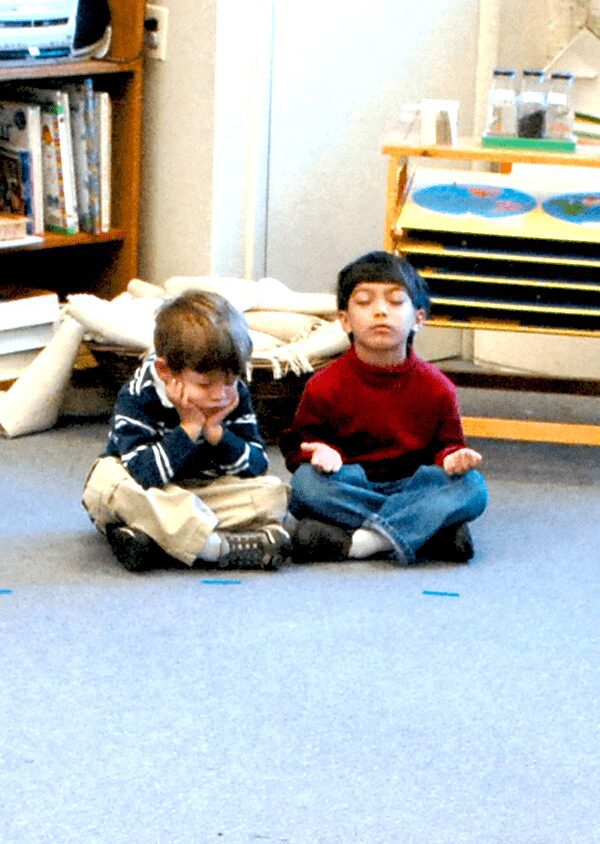
Last week, a school administrator confided her frustration about a situation many of us have seen. One of her assistants said she “just loves” when a teacher plays the Silence Game. In this version, when the children become noisy, the teacher calls the Silence Game to help them calm down — but then rewards each silent child with a sticker.
At first glance, this might look like a creative classroom management strategy: noise → silence → reward. But in a Montessori classroom, this picture is troubling for a few reasons.
The Real Purpose of the Silence Game
Dr. Montessori created the Silence Game as an exercise in self-mastery and joyful discovery, not as a behavior-control tactic. Children are invited to create silence together — a state of stillness, concentration, and awareness. This is not “Simon Says” with a bribe at the end.
The game is most powerful when:
- It’s presented as a privilege and a shared experience, not a punishment or an emergency brake for noise.
- It taps into children’s natural curiosity (“Can we be so still we hear a bird outside?”) rather than their compliance.
- It becomes a moment of collective mindfulness that children help co-create.
When played this way, the Silence Game builds self-regulation, inner discipline, and a sense of community. Children feel the intrinsic satisfaction of calmness and control — and that’s the whole point.
Why Rewards Undermine the Goal
Giving stickers for silence sends the opposite message. It turns an experience of inner discovery into an external transaction. Instead of practicing self-control for its own sake, children learn: “Be quiet and you’ll get a prize.” Over time, this undermines intrinsic motivation, making the game far less effective.
Montessori education is built on the principle that children develop self-discipline through freedom within limits, purposeful activity, and respect for the environment. When we add extrinsic rewards, we teach children to rely on someone else’s approval rather than building their own inner compass.
Classroom Management vs. Child Development
It’s understandable why teachers reach for tools like stickers — they’re simple, quick, and often seem to “work.” But in Montessori our goal is to support development. The Silence Game isn’t a shortcut to quiet; it’s a tool for cultivating concentration and communal grace.
A more authentic approach might look like this:
- Invite the children to gather for the Silence Game at a neutral time, not as a reaction to noise.
- Make it playful: dim the lights slightly, sit together, whisper, “Let’s see if we can hear the clock ticking.”
- Allow the silence to emerge organically, without dangling a reward.
- Reflect briefly afterwards: “Did you notice how peaceful it felt? What sounds did you hear?”
This keeps the activity aligned with its Montessori roots — emphasizing self-discovery over compliance.
The Deeper Value of Silence
The Silence Game has a profound place in Montessori education. It can:
- Strengthen concentration and impulse control.
- Heighten sensory awareness (“I can hear my heartbeat!”).
- Create a sense of unity (“We made the silence together!”).
- Offer children a moment of calm and wonder in a busy day.
When done well, it’s a magical experience children cherish. Many Montessori graduates remember the Silence Game decades later as a high point of their classroom life.
Bottom Line
Using the Silence Game as a behavior-management tool with stickers misses its essential purpose. Montessori classrooms thrive on intrinsic motivation, mutual respect, and self-discipline — not prizes for compliance. By honoring the true spirit of the Silence Game, we help children discover the satisfaction of calmness, focus, and community from within.
Ask Ms. Montessori Practical Wisdom for Parents
In this column, we invite parents to bring their questions about raising children the Montessori way. Ms. Montessori offers gentle yet firm counsel rooted in deep respect for the child’s natural development. Whether the concern is about discipline, learning, family pressures, or the challenges of modern life, these answers are meant to reassure and guide with timeless principles.
Ms. Montessori believed that every child carries within them the blueprint of their own growth, and that the role of adults is not to mold them by force, but to prepare an environment in which their fullest potential may unfold. Her replies aim to honor that vision while giving parents practical strategies they can use today.
Ms. Montessori is actually the voice of many Montessori teachers, women and men, who channel their inner Montessori voice to offer some gentle parenting tips.
Grandparent Pressure
Dear Ms. Montessori, my mother insists that my three-year-old should already be learning to read. She continues to buy flashcards and drill him when she visits. I don’t want to offend her, but I feel this isn’t right. How do I handle it? – Conflicted Daughter
Dear Conflicted, your mother’s eagerness stems from love, but her methods reflect a misunderstanding of the natural development of young children. At three years of age, your son is in a “sensitive period” for language development. During this period, the child absorbs the spoken word, the rhythms of conversation, and the joy of storytelling effortlessly. He learns in the way he learns to walk—by living, imitating, and joyfully repeating what he sees and hears around him.
The danger of flashcards and drills is that they ask the child to perform before a solid foundation has been built. Reading must grow out of the child’s own inner readiness, not from an adult’s insistence. If we compel a child to recite what he does not yet understand, we replace joy with anxiety. Worse still, the child may come to believe that learning is about pleasing adults rather than discovering truth for himself.
How then can you respond with kindness to your mother while protecting your child? Begin by acknowledging her intention: “I see how much you want to help him.” Then gently explain: “Right now, he is preparing for reading through conversation, singing, and listening to stories. When the time comes, he will learn with enthusiasm.” If she can visit his classroom, the experience will speak louder than any words. She will see children joyfully tracing letters in sand, building words with movable alphabets, and reading with delight—not under pressure, but out of inner discovery. Ms. Montessori
You may also guide her energy into more fruitful channels. Invite her to read aloud to him, to sing songs from her childhood, or to tell him stories of the family. These activities are not only precious in their own right, but they nourish the very faculties that will enable him to read naturally in due time.
Never forget: the task of the parent is to safeguard the child’s freedom to grow according to his inner plan. To resist pressure—whether from grandparents, neighbors, or society at large—is often the most loving thing we can do. When we trust the child’s rhythm, we allow him to become a reader not by compulsion, but by joy. – Ms. Montessori