Related Posts



This article is part of an ongoing series from the Montessori Foundation exploring how schools can attract, enroll, and retain families who truly value Montessori education.
Through the Montessori Foundation’s Enrollment Accelerator Program, schools receive strategic support with marketing, admissions systems, websites, landing pages, advertising, parent communication, and enrollment growth strategy.
Through the Montessori Family Alliance, schools can provide families with ongoing Montessori parent education, practical parenting guidance, videos, articles, and AI-supported resources designed to help parents better understand Montessori and remain engaged for the long term.
Parent Ambassadors: One of the Most Powerful — and Underused — Strategies in Montessori School Growth
By Tim Seldin
For many Montessori schools, enrollment and retention are constant concerns. School leaders invest heavily in websites, social media, advertising, open houses, and admissions events, yet often overlook one of the most effective resources already sitting inside the community: their parents.
Parents talk.
They talk at soccer games, neighborhood gatherings, birthday parties, workplaces, playgrounds, churches, and online community groups. They talk with friends who are searching for schools, worried about their child, frustrated with traditional education, or simply wondering if there might be a better fit somewhere else.
And when parents speak authentically about a school they genuinely love, people listen in a way they rarely listen to advertising.
This is why a thoughtfully designed Parent Ambassador program can become one of the most important parts of a Montessori school’s admissions, enrollment, onboarding, and retention strategy.
A Parent Ambassador program is not simply a volunteer committee. Done well, it becomes a structured system for building relationships, extending the school’s reach into the community, and helping new families feel connected from the very beginning.
As I’ve worked with Montessori schools around the world, I’ve seen Parent Ambassador programs quietly transform schools. They strengthen word-of-mouth referrals, improve family retention, ease the anxiety of new parents, and help schools create the kind of warm, welcoming culture that families are seeking today.
Most importantly, Parent Ambassadors help prospective and new families feel that they are joining a community — not merely purchasing a service.
Parents Trust Parents
One of the realities of school admissions is that prospective parents often trust current parents more than they trust the school itself.
That may sound uncomfortable, but it is true.
Schools naturally present themselves in the best possible light. Parents understand that. What they really want to know is:
“What is it actually like to be part of this school?”
They want honest answers to questions such as:
• Does the school communicate well?
• Are the teachers warm and responsive?
• Will my child feel safe and happy?
• Will my family fit in socially?
• Do parents know one another?
• Is the community welcoming?
• Are people kind?
• Are families genuinely satisfied?
These are emotional and relational questions more than academic ones.
A Parent Ambassador program allows prospective families to hear authentic stories from parents who have already walked the path they are considering.
That kind of parent-to-parent conversation is extraordinarily powerful.
The Role of Parent Ambassadors in Admissions and Recruitment
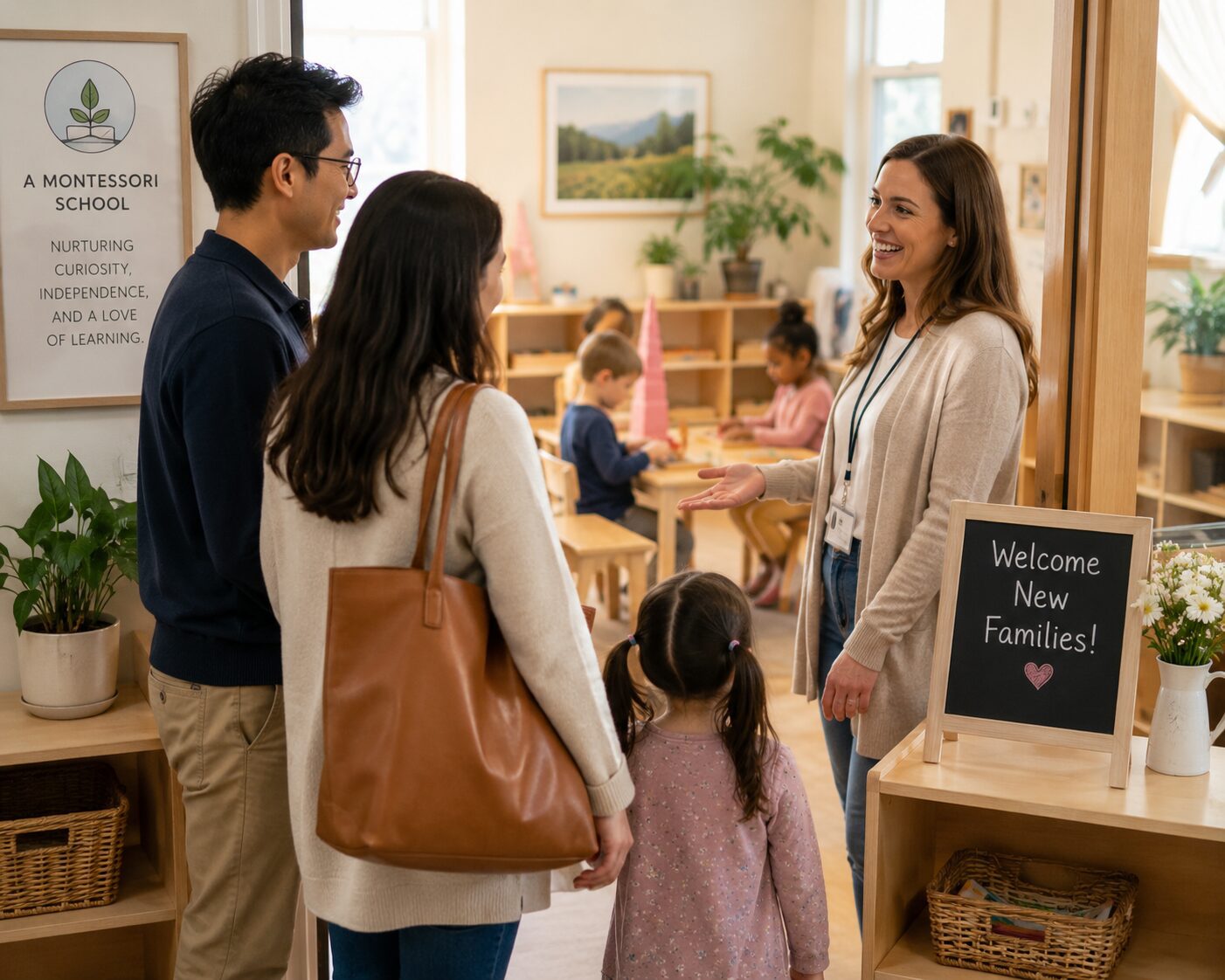
Many schools think of Parent Ambassadors primarily as helpers at open houses. While they can certainly play that role, the strongest programs go much deeper.
A well-designed Parent Ambassador program supports admissions and recruitment in many ways:
• Welcoming prospective parents at school events
• Assisting with campus tours
• Hosting small coffee gatherings in homes or local cafés
• Connecting personally with inquiry families
• Following up after tours
• Sharing school content online
• Writing positive online reviews
• Attending community events
• Reaching out to friends and neighbors
• Helping explain Montessori to curious parents
• Offering reassurance during the decision-making process
Importantly, Parent Ambassadors are not “salespeople.”
The goal is not to pressure families. The goal is to build trust, answer questions honestly, and help families envision themselves becoming part of the school community.
The most effective ambassadors are warm, genuine, approachable people who naturally enjoy helping others feel comfortable.
Not Every Parent Needs the Same Role
One mistake schools sometimes make is assuming that every Parent Ambassador should do the same thing.
In reality, parents have different personalities, schedules, and strengths.
Some parents are natural hosts. Others are great organizers. Some are comfortable speaking publicly. Others are more comfortable quietly reaching out one-on-one to a new parent who seems uncertain or overwhelmed.
A successful Parent Ambassador program recognizes different levels of involvement and allows parents to contribute in ways that fit their lives.
Some ambassadors may simply agree to:
• Make a few welcoming phone calls each year
• Help one new family during onboarding
• Attend one admissions event
• Write a few online reviews
• Share social media posts occasionally
• Host one coffee gathering annually
That may be enough.
Schools should avoid turning Parent Ambassadors into an unpaid part-time workforce. Parents are volunteers. Most are already busy balancing careers, children, and family responsibilities.
The key is not asking a few parents to do everything.
The key is building a culture where many parents each contribute something manageable.
The First Year Matters More Than Schools Realize
One of the most important — and often overlooked — roles of Parent Ambassadors is helping onboard and support new families during their first year.
This is especially important in Montessori schools.
Many families arrive excited but uncertain. Montessori may feel unfamiliar. Parents may not fully understand mixed-age classrooms, the work cycle, observation, independence, normalization, or why children are not constantly bringing home worksheets and tests.
Even families who are enthusiastic about Montessori often experience moments of anxiety during the first year.
They wonder:
“Is this normal?”
“Is my child adjusting?”
“Why does Montessori look so different from what I expected?”
“What should I be doing at home?”
At the same time, many new parents are quietly trying to determine whether they socially belong in the community.
This is where Parent Ambassadors can make an enormous difference.
A warm phone call.
An invitation to sit together at a school event.
A reminder about an upcoming parent meeting.
An offer to meet for coffee.
A reassuring conversation after a difficult drop-off week.
These simple human gestures often determine whether a family begins to feel connected or isolated.
Schools sometimes underestimate how emotionally vulnerable new families can feel during their first months.
The families who stay for many years are often the families who quickly develop friendships and relationships inside the school community.
Building an Onboarding Playbook
One of the ideas we have been developing through the Montessori Family Alliance is the concept of a Parent Onboarding Playbook.
Most schools have admissions systems. Many have orientation events.
Far fewer have a systematic process for helping families successfully transition into the life and culture of the school during the entire first year.
An onboarding playbook helps schools intentionally guide new families through that experience.
This can include:
• Welcome email sequences
• Parent education resources
• Montessori orientation videos
• Weekly or monthly parent newsletters
• Classroom transition support
• Parent mentors or ambassadors
• Invitations to community events
• Parent coffees and discussion groups
• Guidance about Montessori at home
• Suggestions for helping children adjust
• Explanations of Montessori terminology and philosophy
The goal is not simply to inform parents.
The goal is to help parents feel confident, connected, and supported.
The Montessori Family Alliance has been developing tools and services specifically designed to help schools strengthen these kinds of school-family partnerships and onboarding systems.
Schools that intentionally support parents during the first year often see stronger retention, deeper parent engagement, and more positive word-of-mouth referrals over time.
Common Mistakes Schools Make
Over the years, I’ve also seen schools unintentionally weaken their Parent Ambassador programs through avoidable mistakes.
One common mistake is treating the program as a short-term initiative rather than an ongoing strategy. Another is holding too many meetings and over-organizing volunteers until enthusiasm fades.
Some schools also make the mistake of sending a mass email asking for volunteers.
Strong Parent Ambassador programs are usually built intentionally by personally inviting parents who:
• Love the school
• Have credibility with other families
• Communicate warmly and positively
• Understand the school’s culture
• Want to help others feel welcome
Equally important, the program should not simply be handed over to the parent association or left entirely volunteer-led. Effective programs require staff guidance and coordination, usually through admissions, advancement, or community engagement leadership.
A Culture of Partnership
At its heart, a Parent Ambassador program is really about partnership.
Montessori schools work best when families and schools see one another as collaborators rather than consumers and service providers.
When parents feel genuinely welcomed, informed, and valued, they become invested in the life of the school.
And invested parents naturally become advocates.
They tell friends.
They invite neighbors.
They defend the school when misconceptions arise.
They encourage uncertain new families.
They stay longer.
They help strengthen the community culture for everyone.
In many ways, the strongest admissions strategy is not marketing at all.
It is creating such a warm, authentic, mission-driven community that parents cannot help talking about it with others.
A thoughtful Parent Ambassador program helps make that possible.
Copyright 2026 The Montessori Foundation