Related Posts



This article is part of an ongoing series from the Montessori Foundation exploring how schools can attract, enroll, and retain families who truly value Montessori education. Through the Montessori Foundation’s Enrollment Accelerator Program, schools receive strategic support with marketing, admissions systems, websites, landing pages, advertising, parent communication, and enrollment growth strategy. Through the Montessori Family Alliance, schools can provide families with ongoing Montessori parent education, practical parenting guidance, videos, articles, and AI-supported resources designed to help parents better understand Montessori and remain engaged for the long term.
Most Montessori school leaders entered the field of education because they care deeply about children, learning, and human development. Very few entered education because they wanted to think about marketing budgets, enrollment funnels, conversion rates, or financial forecasting.
Unfortunately, schools do not run on passion alone.
A school can have extraordinary teachers, beautiful classrooms, a powerful mission, and deeply committed leadership — and still struggle financially if enrollment is unstable. This is one of the hardest realities many school leaders eventually face. Good education alone does not guarantee strong enrollment. And without healthy enrollment, even genuinely excellent schools become vulnerable.
Empty Seats Are Expensive
One of the most important mindset shifts school leaders must make is understanding that every unfilled seat carries a real financial cost.
In most schools, the majority of operating expenses remain relatively fixed whether classrooms are full or partially empty. Rent or mortgage, insurance, utilities, payroll, benefits, technology, maintenance, supplies, licensing, and administrative overhead do not drop significantly because a classroom is missing a handful of children. A classroom running at eighty-five percent capacity costs almost as much to operate as one that is completely full.
This creates a powerful and often painful financial reality: small enrollment declines can produce disproportionately large financial stress. Losing five students, or failing to fill a toddler classroom, or watching a few elementary families choose not to reenroll can represent tens or even hundreds of thousands of dollars in lost revenue over time. And in most cases, schools cannot reduce staffing or facility costs proportionally without weakening the very program families came for in the first place.
This is why enrollment stability matters so much — not as a business goal separate from the mission, but as the financial foundation the mission depends on.
Marketing Is Not an Extra Expense
Many schools still treat marketing as optional or secondary. The thinking often goes: we will market more if enrollment drops, or we cannot afford marketing right now, or word of mouth has always been enough. But this framing has things exactly backward.
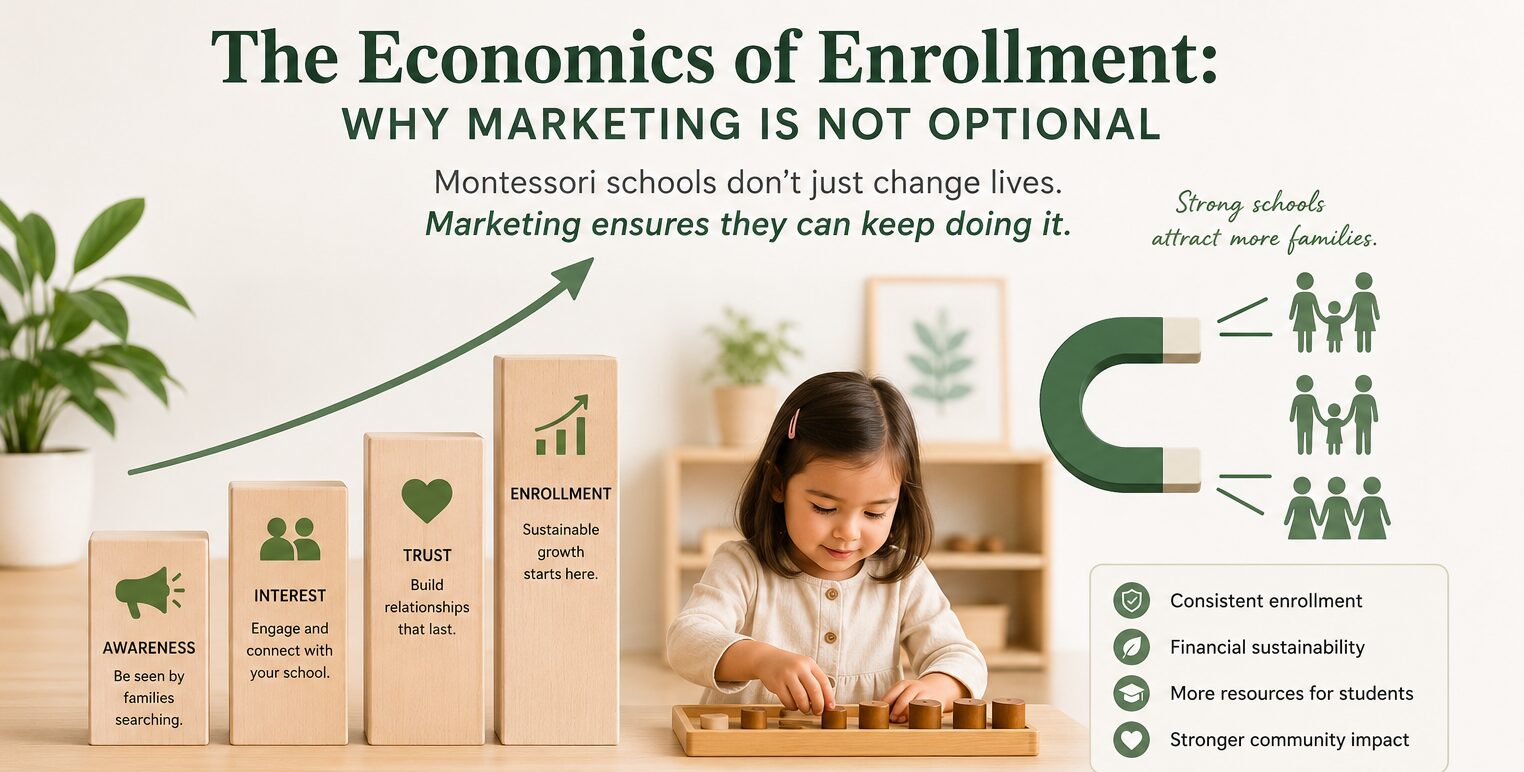
Strong marketing is not merely an expense. It is part of the infrastructure that supports enrollment stability and long-term sustainability. In most industries, organizations routinely invest meaningful percentages of revenue into marketing and audience development. Many schools spend surprisingly little while hoping for full classrooms.
The danger is a cycle that is easy to slide into without noticing. Enrollment softens. Finances tighten. Marketing gets reduced. Visibility declines. Inquiries slow further. Stress increases. Reactive decision-making takes over. By the time the problem feels urgent, the options available have narrowed considerably.
Healthy schools tend to approach marketing more proactively and consistently. They understand that visibility, communication, parent engagement, and admissions systems require steady ongoing investment — not emergency intervention after a crisis has already developed.
Reputation Alone Rarely Sustains Growth
Many Montessori schools were built during periods when reputation and word of mouth generated steady enrollment almost automatically. Some communities still benefit from this. But today’s landscape is meaningfully different.
Families now have more educational choices, more digital distractions, more competing messages, and often far less prior understanding of Montessori than earlier generations of parents. Birth rates have declined in many regions. Public pre-kindergarten programs have expanded. Charter schools and other alternatives market themselves actively. And parents increasingly begin their search online long before they ever contact a school directly.
Schools that rely entirely on reputation may gradually discover that fewer families are entering the pipeline each year — not because the school has changed, but because the environment around it has. Even schools with strong community standing increasingly need clear and current websites, effective follow-up systems, meaningful online visibility, compelling messaging, intentional parent education, and a thoughtful admissions strategy.
Marketing Is Broader Than Advertising
One reason school leaders sometimes resist the word marketing is that they associate it with advertising or salesmanship, neither of which fits easily with the values of most Montessori educators. But effective school marketing is much broader than advertising, and far more relational.
Your marketing includes the way inquiries are answered and how quickly calls are returned. It includes the tone of your emails, the clarity of your website, the quality of your photography, the experience of your school tour, your presence on social media, your parent events, your community partnerships, your alumni relationships, your online reviews, your newsletters, and the overall impression families carry away from every interaction with your school.
Everything communicates. And everything either builds trust or quietly erodes it.
Healthy enrollment growth is almost never the result of a single campaign or a burst of advertising. It usually comes from many smaller systems working together consistently and intentionally over time.
Even Grassroots Marketing Has Real Costs
Some schools respond to the marketing conversation by noting that they rely on grassroots efforts rather than paid advertising. Parent ambassadors, community events, partnerships, referral systems, open houses, workshops, local sponsorships, and school fairs can all be genuinely effective. But these approaches are not free.
They require planning, coordination, volunteer management, follow-up, staff time, creative materials, and sustained organizational discipline. The investment may not appear as an advertising line item in the budget, but it is still very real. Many schools unintentionally underestimate the true cost of generating and sustaining enrollment momentum — and then wonder why their efforts feel exhausting without producing the results they hoped for.
The Hidden Cost of Misalignment
There is another economic challenge that receives far less attention than it deserves: the cost of enrolling families who are not truly aligned with the school.
When schools feel pressure to fill seats, they sometimes lower expectations, oversimplify Montessori, or enroll families who do not genuinely understand the program. This may temporarily improve revenue. But it frequently creates longer-term problems — higher attrition, parent dissatisfaction, unrealistic expectations, classroom tension, teacher stress, and gradual damage to the school’s culture.
Not all enrollment growth is healthy growth.
The strongest schools tend to focus not simply on filling seats, but on attracting families who are genuinely likely to understand Montessori, engage positively with the community, support the culture, and remain enrolled for many years. Retention is one of the most powerful economic drivers in school sustainability. A family that enters a toddler and remains through the elementary years represents dramatically more financial stability — and community strength — than a family that leaves after one or two years, feeling confused or disappointed.
Parent Education Is an Economic Strategy
This is one of the most consistently overlooked realities in Montessori school leadership: parent education is not merely an enrichment offering. It is a retention strategy.
Parents who deeply understand Montessori tend to feel more confident, stay enrolled longer, support teachers more effectively, refer friends and colleagues, and become genuine ambassadors for the school. Parents who do not understand Montessori often become anxious when the experience differs from the conventional academic model they grew up expecting. That anxiety, left unaddressed, leads to attrition.
This is one of the core reasons the Montessori Foundation developed the Montessori Family Alliance — to help schools provide families with ongoing Montessori parent education, developmental guidance, parenting support, articles, videos, and AI-assisted resources designed specifically for busy modern families. The goal is not simply delivering information. The goal is to strengthen long-term parent understanding, confidence, engagement, and retention.
The Foundation’s Enrollment Accelerator Program works alongside these efforts to help schools build the systems that drive healthy enrollment: clear messaging, effective websites and landing pages, a strong admissions process, consistent follow-up, social media presence, digital advertising, and a thoughtful long-term enrollment strategy.
Enrollment Stability Creates Educational Stability
The economics of enrollment and the mission of the school are not separate concerns. They are deeply connected.
Strong enrollment allows schools to retain talented teachers, improve compensation, invest in facilities, expand programs, maintain healthy class sizes, and support meaningful professional development. It allows leaders to make decisions from a position of confidence rather than fear. Schools with stable enrollment can focus more fully on children and community because they are not constantly operating in survival mode — managing every small attrition event as a potential crisis.
Marketing, admissions, parent education, and retention systems are not distractions from the work of Montessori education. Done well and sustained over time, they are what make it possible.
Copyright 2026 The Montessori Foundation