Related Posts

Why the Early Years Matter Far More Than We Realize
SNAPSHOT
When we think about the early years, we naturally think about reading, writing, and numbers. These matter. But something even more important is happening: children are learning how to learn. They are building the habits and attitudes that will shape how they handle challenges, follow their interests, and gain new knowledge for the rest of their lives. Drawing on Maria Montessori’s insights and on Angela Duckworth’s research on perseverance, this article explores why independence, concentration, mistakes, repetition, curiosity, and inner motivation matter so much. It also offers simple ways parents can nurture a lifelong love of learning at home, without rushing childhood.
More Than Reading, Writing, and Numbers
When parents think about what their children should learn in the early years, they naturally think about reading, writing, numbers, and the other skills that will help them do well in school.
These are important, of course. We want our children to have strong academic foundations, and there’s something wonderful about watching a child read a book on their own or solve a math problem for the first time.
But I believe something even more important is happening during these years. Children are learning how to learn.
They’re developing habits of mind and attitudes that will shape how they approach challenges, follow their interests, solve problems, and gain new knowledge throughout their lives. A child who learns to:
Concentrate,
Become absorbed in meaningful work,
Experiment with ideas, and
Keep going when things get a little hard
is building something that goes far beyond any single academic skill. And a child who discovers that learning can be deeply satisfying has received a gift that may last a lifetime.
This is one of the most important things I wish every parent understood about Montessori education.
What Does It Mean to Learn How to Learn?
Think about how young children approach the world:
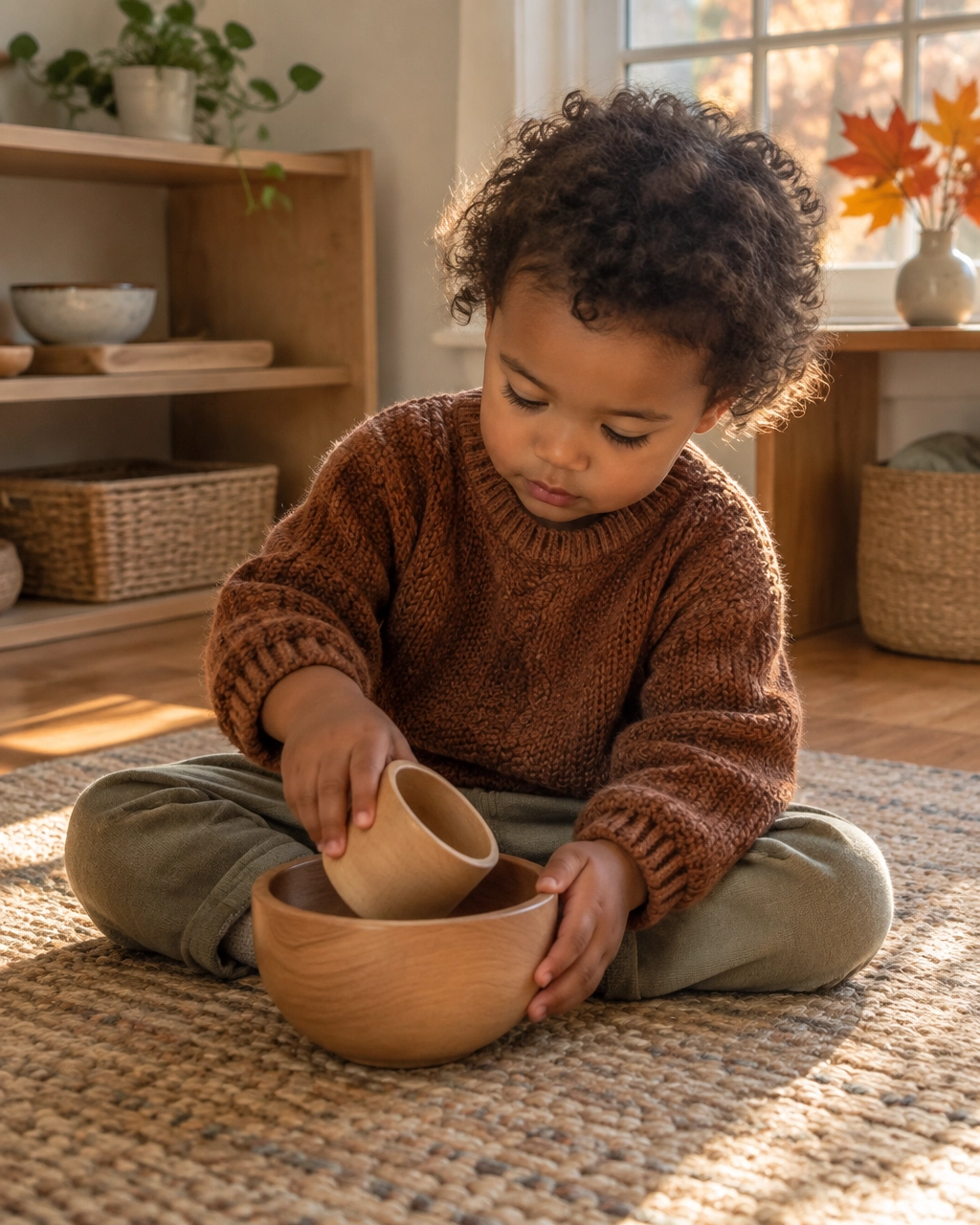
A toddler discovers that one container fits inside another. She tries to put them together, turns one around, tries again, and finally succeeds.
A three-year-old is fascinated by pouring water. He pours it from one pitcher to another, spills some, wipes it up, and starts again.
A four-year-old arranges a set of wooden materials, noticing differences and making adjustments until she’s satisfied.
A five-year-old meets a math problem that doesn’t make sense right away. Instead of giving up, he goes back to the materials, tries different possibilities, and gradually finds the answer.
In each case, the child is learning something specific. But something else is happening, too. The child learns how to approach a problem, experiment, spot a mistake, and keep going when the answer isn’t obvious.
These experiences build attention, self-control, flexible thinking, and confidence. They also shape the child’s relationship with learning itself. Does learning feel like something adults impose, where success means earning approval or rewards? Or does it become something interesting, meaningful, and personally satisfying?
That difference matters enormously.
What Angela Duckworth’s Research Helps Us Understand
Psychologist Angela Duckworth is well known for her research on what she calls grit: passion and perseverance toward long-term goals. Her work has encouraged parents and educators to look beyond intelligence and natural talent when thinking about what helps people succeed.
One useful lesson is that children’s approach to learning matters. Children need chances to:
Develop interests.
Practice skills.
Experience difficulty.
Discover that progress often comes gradually.
They need to learn that not knowing something yet isn’t failure. It’s simply the beginning of learning.
Duckworth’s research doesn’t mean every child should be pushed to work harder, or that determination alone guarantees success. Children’s opportunities, relationships, developmental needs, and life circumstances matter a great deal. Researchers have also debated how much grit adds beyond other well-known personality traits.
Still, her work raises an important question: What experiences help children become willing and able to learn?
Maria Montessori asked a similar question more than a century ago, and her approach offered compelling answers.
The Child Who Says, “I Can Do It Myself”
Anyone who has spent time with a toddler knows how strongly young children want to do things on their own. “I do it!”
Sometimes this comes at inconvenient moments:
We’re trying to get out the door, and our child insists on putting on their own shoes.
We’re making breakfast, and a three-year-old wants to pour the milk.
We’re cleaning up, and a young child wants to help, even though it will take twice as long.
It’s tempting to step in. We can usually do it faster and better. But when we keep doing for children what they’re starting to do themselves, we may accidentally take away valuable chances to learn.
Think about a child learning to put on a jacket. The child has to remember the steps, coordinate their hands and arms, notice when something isn’t working, and adjust. They may get frustrated. They may need encouragement or a little help. But when they finally succeed, they feel capable, and that feeling carries into the next challenge.
Montessori recognized that independence isn’t just a convenience. It’s a foundation for learning. Children who get to do things for themselves gradually gain confidence in their ability to solve problems and master new skills. They begin to trust themselves as learners.

Everyday tasks give children meaningful chances to practice.
Why Concentration Matters So Much
One of the most remarkable things you can see in a Montessori classroom is a young child completely absorbed in an activity. The child might be:
Building the Pink Tower, a set of ten cubes that stack from largest to smallest.
Fitting a set of wooden cylinders into the matching holes in a block.
Tracing sandpaper letters, letters cut from sandpaper that children trace with their fingers to feel the letter’s shape.
Carefully washing a table.
The work may look simple to an adult, but the child’s attention is extraordinary. They may repeat the activity several times, becoming more precise and confident each time.
Montessori believed this ability to concentrate deeply was central to children’s development, and modern research on attention and self-control helps explain why. Learning requires us to:
Focus on what matters.
Resist distractions.
Hold ideas in mind.
Direct our actions toward a goal.
These abilities develop gradually throughout childhood. Growth, relationships, experiences, and the places where children spend their time shape them.
Young children can’t simply be told to concentrate. They need chances to become genuinely interested in something and stay with it long enough to explore it. That’s why Montessori classrooms are designed to protect children’s concentration. Teachers avoid unnecessary interruptions. Children have time to finish activities and repeat them if they want. Materials are arranged so children can work more and more independently.
At home, we can support the same growth by giving children time to become absorbed in play and meaningful activities. We don’t always need to entertain them, redirect them, or offer something new. Sometimes the most valuable thing we can do is simply let them keep going.
The Importance of Making Mistakes
Most adults naturally want to protect children from frustration. When we see a child struggling, our instinct is to help. Sometimes that’s exactly right. But children also need chances to face manageable difficulties and work through them.
Imagine a child doing a puzzle. The child tries to fit a piece into the wrong space, and an adult immediately says, “No, that one goes over here.” The child moves the piece and finishes the puzzle. But what has the child learned?
Now imagine the adult waits. The child turns the piece, tries another space, looks closely at the shape, and finally discovers where it belongs. That takes longer, but it gives the child a chance to think.
Many Montessori materials are designed so children can see and fix certain mistakes on their own:
A cylinder that doesn’t fit its hole tells the child something.
A tower that doesn’t balance invites another try. Math materials let a child see and handle number relationships instead of just being told the answer.
This doesn’t mean children should always be left to struggle. A skilled adult knows the difference between a healthy challenge and overwhelming frustration. The goal isn’t to make learning harder than it needs to be. It’s to help children discover that mistakes give us useful information, and that problems can often be solved by looking carefully, trying things out, and practicing.
Over time, children develop a different attitude toward difficulty. Instead of thinking a mistake means they’re “not good at” something, they begin to see it as a normal part of learning.

Patient observation gives a child room to think and try another way.
Repetition Is How Mastery Develops
Parents sometimes worry when children want to do the same thing again and again:
A toddler wants the same bedtime story every night.
A preschooler builds the same structure over and over.
A child keeps practicing a letter or number long after an adult thinks they’re ready to move on.
But repetition is one of the most important ways children learn. Think about learning to play an instrument. At first, even simple movements take a lot of attention. With practice, they become familiar, freeing us to focus on more complex parts of the music. The same is true for much of childhood learning. A child who repeats an activity refines their movements, strengthens their understanding, and builds a sense of mastery.
Montessori teachers understand that children often repeat work because of an inner need to master it. Rather than constantly urging children to move on, they give them time to practice.
That doesn’t mean repetition should become mindless, or that children should never be encouraged to try something new. It means recognizing that learning isn’t always about covering more material. Sometimes it’s about going deeper. Sometimes the child who seems to be doing the same thing again and again is making extraordinary progress.
Learning Is Not a Race
Parents today often feel pressure to help children achieve more at younger and younger ages. Advertisements promise early reading, advanced math, and a head start in academics. Naturally, we want to give our children every advantage.
But we need to be careful about what we mean by “getting ahead.” A child who reads at four isn’t necessarily better prepared for lifelong learning than a child who becomes a fluent reader at six. Children develop at different rates, and early success in one area doesn’t tell us everything about a child’s intellectual, emotional, or social growth.
I would much rather know whether a child:
Enjoys learning.
Approaches new challenges with curiosity.
Is learning to concentrate.
Is learning to think independently.
These qualities are the foundation for continued growth.
Of course, children need strong academic instruction, and Montessori education should never excuse neglecting essential skills. But the goal isn’t to introduce harder and harder material as early as possible. The goal is to help children build strong foundations and a healthy relationship with learning.
We should ask not only what our children know today, but how they’re becoming able to learn tomorrow.
Curiosity Is the Beginning of Learning
Young children are naturally curious. They want to know why the sky changes color, where bugs go at night, how a clock works, and what happens when they mix paint colors. Sometimes their questions seem endless, and when we’re tired or busy, it’s tempting to give a quick answer and move on.
But curiosity is one of the great engines of learning. A child who asks a question recognizes something they don’t yet understand, and that recognition opens the door to discovery.
Montessori classrooms are designed to encourage this curiosity. Materials invite exploration. Teachers introduce ideas that spark interest. Children are encouraged to investigate, experiment, and make connections. As children grow older, especially in the elementary years, their questions become more complex. They begin to wonder not just what something is, but why it happens and how things are connected.
At home, we can nurture curiosity in simple ways. When your child asks a question, you don’t always have to answer right away. You might say:
“That’s an interesting question. What do you think?”
“How could we find out?”
Then you might look it up together, visit the library, try a simple experiment, or ask someone who knows more. What matters is that children begin to see questions as invitations to investigate. They discover that learning isn’t limited to school; they can pursue it all their lives.
Motivation Comes From Within
One of Montessori’s most important insights was that children often find deep satisfaction in mastering a skill or understanding something new. They don’t always need prizes, grades, or elaborate reward systems.
Think about a baby learning to walk. The child falls, gets up, and tries again. We cheer them on, of course, but they don’t need a sticker chart for every attempt. They want to walk because walking opens up an exciting new world.
Much of early learning begins with this kind of inner motivation. Children want to explore, become capable, and take part in the world around them. Montessori education tries to protect and strengthen that motivation by offering children meaningful choices, opportunities for independence, and activities that give them a real sense of accomplishment.
That doesn’t mean children will enjoy every task, or that they should never be expected to do hard things. Learning also takes responsibility, discipline, and sometimes a lot of effort.
But there’s an important difference between a child who works mainly to please an adult and a child who finds real satisfaction in learning. The second child is developing a source of motivation that will keep going long after the adult is no longer standing nearby.
What Parents Can Do at Home
The encouraging news is that helping children learn how to learn doesn’t require expensive materials, elaborate activities, or a home that looks like a Montessori classroom. Much of it happens through ordinary family life:
Give your child time to become absorbed in play without constantly interrupting or directing.
Invite them to help with real household tasks, even when it would be faster to do it yourself.
When they hit a manageable problem, resist the urge to solve it right away. Give them time to think and try another way.
Encourage their questions, and let them see that adults don’t know everything.
Let them see you learn something new, whether you’re fixing something around the house, trying a new recipe, or reading about an unfamiliar subject.
Let them see you make mistakes, look for information, practice, and improve. You might say, “I haven’t figured this out yet. Let me try another way.”
That simple statement says something powerful: learning doesn’t stop when we grow up, and there’s nothing to be ashamed about not knowing something.
Most importantly, pay attention to what genuinely interests your child. Those interests can become doorways into reading, math, science, history, art, and much more. We don’t need to turn every experience into a lesson. Sometimes we simply need to make room for curiosity to grow.
Preparing Children for a World We Can’t Predict
The world our children are growing up in is changing faster than ever. Technology has transformed how we communicate, work, and find information, and the pace of change keeps speeding up. We can’t know what jobs will exist when today’s preschoolers grow up, or what challenges they’ll face.
That uncertainty makes learning how to learn more important than ever. Children will certainly need knowledge and skills. But they’ll also need to be able to:
Learn new things throughout their lives.
Rethink their assumptions.
Adapt to changing circumstances.
Solve problems they’ve never seen before.
Recognize when they don’t understand something, and know how to get help or find reliable information.
They’ll need curiosity, flexibility, good judgment, and the confidence to keep learning.
These abilities don’t suddenly appear in high school or on the first day of a job. Their foundations are laid much earlier:
When a toddler experiments with an unfamiliar object.
When a preschooler discovers that practice leads to mastery.
When an elementary child pursues a question that truly interests them.
When a teenager learns to take more responsibility for their own work and decisions.
The early years matter not because we need to hurry children toward adult accomplishments, but because they offer extraordinary chances to build the foundations of lifelong learning.
The Gift That Lasts a Lifetime
Think about the children in any classroom. Some read early, while others take longer to feel confident with words. Some are drawn to math, while others discover their strengths in art, science, music, or working with people. Their interests and abilities unfold in different ways and at different times. We don’t simply hope that they’ll remember the lessons we taught. We hope they’ll leave school:
Believing they’re capable of learning.
Still curious.
Knowing how to approach a challenge, find information, practice a skill, and ask for help when they need it.
Seeing learning not just as something required of them, but as one of the great pleasures of being alive.
Angela Duckworth’s work reminds us that achievement takes more than natural talent. Montessori’s work reminds us that effort, concentration, independence, and a love of learning begin early in life.
Together, these ideas offer parents an important message. We don’t need to rush childhood to prepare children for the future. We need to give them meaningful chances to explore, practice, think, and discover what they’re capable of.
The greatest gift we can give our children may not be how much they know when they leave school, but the confidence, curiosity, and ability to keep learning throughout their lives.