Related Posts
Why Gratitude Is About Much More Than Saying Thank You
SNAPSHOT
We often think of gratitude as remembering to say thank you. Good manners matter, but real gratitude goes much deeper. It means recognizing that other people’s work, kindness, and care enrich our lives, many of whom we will never meet. Drawing on Maria Montessori’s view that everything in the world is connected, this article explores how parents can nurture genuine gratitude rather than demand it. It examines how to help children notice what they take for granted, why guilt isn’t the same as gratitude, what gratitude looks like at different ages, and how appreciation can grow into a lifelong desire to give back.
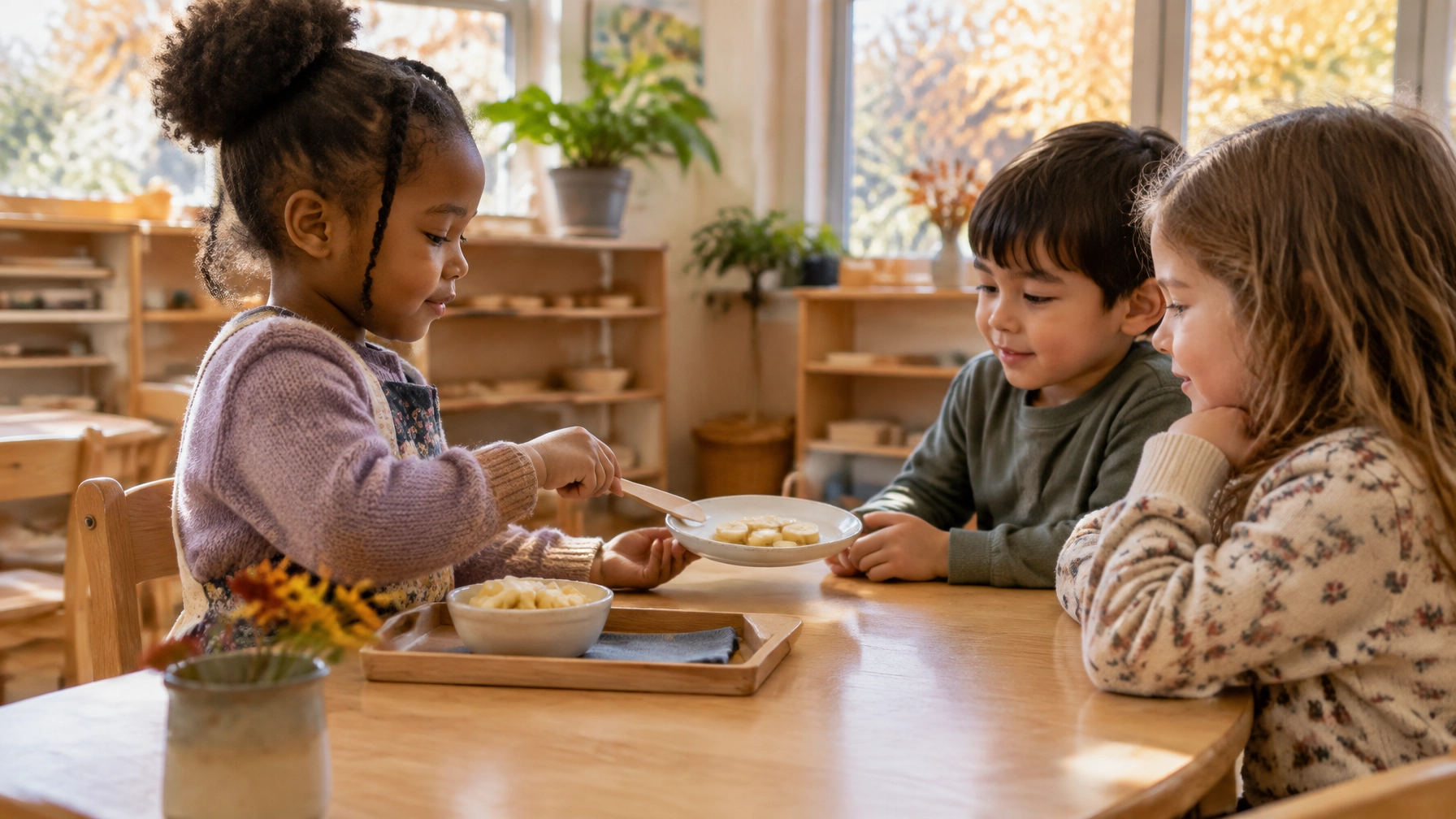
Picture a young child in a Montessori classroom carefully preparing a snack for her classmates. She slices a banana, arranges the pieces on a small plate, and carries it to a table where two other children are working. She offers each of them a piece, smiles, and goes back to clean up.
Scenes like this happen every day in Montessori classrooms worldwide. But this simple moment captures something important.
The child isn’t expecting a reward. She isn’t working for a sticker or a compliment. She seems genuinely happy to have made something other people will enjoy. The children who accept the snack do so easily, like people in a community where helping one another is simply part of everyday life.
That’s what gratitude really is. It’s more than remembering to say thank you. Gratitude means:
Recognizing that other people’s efforts, generosity, and care make our lives better.
Understanding that we are connected to others, and that much of what we enjoy comes from work we may never see.
Feeling a desire to give something back.
Beyond Please and Thank You
Most parents start teaching manners when their children are very young:
“What’s the magic word?”
“What do you say when Grandma gives you a present?”
“Remember to thank your teacher.”
There’s nothing wrong with this. Courtesy helps children get along with others and show respect. But I believe we sometimes focus too much on the words and not enough on the feelings behind them.
A child can say thank you perfectly without feeling grateful at all. Another child may be deeply thankful but too shy, excited, or distracted to say so the way adults expect.
Young children are still learning to understand why others do things and to recognize the effort behind an act of kindness. Their capacity for gratitude grows slowly, along with empathy and emotional maturity.
That’s why I encourage parents to nurture gratitude rather than demand it. We can teach polite words while also helping children discover what it means to truly appreciate someone’s kindness.
Instead of insisting, “Say thank you,” we might sometimes say, “That was so thoughtful of Grandma. She remembered how much you love drawing and picked out those pencils just for you.”
Now we’re helping the child notice something they might otherwise miss:
Someone was thinking about them.
Someone made an effort.
Someone wanted to make them happy.
That awareness is the beginning of real gratitude.
The Invisible People Who Make Our Lives Possible
One wonderful thing about Montessori education is how it helps children discover connections.
In the elementary years, Maria Montessori introduced what she called Cosmic Education. The name sounds grand, but the idea is beautifully simple: everything is connected.
The natural world is a huge web of relationships. Plants depend on sunlight, water, soil, and countless tiny living things. Animals depend on plants and on other animals. People depend on the natural world and on one another. And much of what makes our everyday lives possible comes from the work of people we will never meet.
Think about something as ordinary as a loaf of bread. Most children know bread comes from a bakery or a store. But what happened before that?

Someone prepared the soil and planted the wheat.
Someone cared for the growing crop.
Others harvested the grain, hauled it away, ground it into flour, and delivered it to the baker.
The baker mixed the dough and baked the bread.
Still others brought it to the store where your family bought it.
And that’s only part of the story. What about the people who designed and built the farm equipment, repaired the roads, and supplied clean water and electricity? A simple piece of toast connects us to an amazing number of people.
Montessori believed that when children begin to understand these connections, they develop a deeper appreciation for what others contribute. I think she was right. Gratitude means much more when children realize the world doesn’t provide everything they need as if by magic. People make things happen. People work, create, solve problems, and care for one another, and we all benefit from their efforts.
Helping Children Notice What They Take for Granted
Young children naturally see the world from their own point of view. When they’re hungry, they want food. When they’re cold, they want a sweater. When something breaks, they expect an adult to fix it.
This isn’t selfishness. It’s part of growing up. But little by little, children can begin to notice the effort and care that go into meeting their needs.
Many parents feel frustrated that their children seem to take everything for granted. They work long hours, run the household, make meals, and make sure their children have what they need, and yet their children rarely seem to notice.
The answer usually isn’t reminding children how hard we work. It’s inviting them to take part:
Children who help make dinner begin to understand that meals don’t just appear on the table.
Children who help with laundry discover that clean clothes take time and effort.
Children who help in the garden learn that vegetables and flowers don’t grow without care.
This is why Montessori classrooms emphasize what Montessori teachers call practical life activities, such as preparing food, cleaning, and caring for plants and shared spaces. These activities help children become capable and independent. They also help children appreciate what others contribute and show them they can contribute, too.
There’s something wonderful about watching a child who has just helped cook a meal suddenly appreciate the person who usually does the cooking. They understand something new, not because someone lectured them about gratitude, but because they did the work themselves.
Gratitude Is Not the Same as Guilt
Sometimes adults try to teach gratitude by reminding children how lucky they are compared with others:
“Do you know how many children would love to have what you have?”
“Some children don’t have enough to eat, and you’re complaining about dinner.”
“You’re lucky to have these opportunities. You should appreciate them.”
I understand why we say these things. We want children to recognize their good fortune and feel compassion for people whose lives are harder.
But guilt isn’t the same as gratitude. A child who feels ashamed for wanting something or being disappointed may learn to hide those feelings without appreciating anything more deeply.
We can still help children understand that people live in very different circumstances. We can:
Talk honestly about hardship and unfairness.
Encourage generosity and a willingness to help.
Do all of this without making children feel guilty for having a comfortable home or a loving family.
The goal isn’t to make children feel bad about what they have. It’s to help them see its value and think carefully about how they use their opportunities.
What Gratitude Looks Like at Different Ages
Gratitude grows over time, and our expectations should grow as our children’s understanding does.
Toddlers may show appreciation with a smile, a hug, or the joy of sharing something they love with someone they love.
Preschoolers begin to understand that other people have feelings and intentions. They may realize someone has done something kind for them, even if they still need help saying so.
Elementary-age children can better understand the effort behind what others do and begin to see the many people who make their lives possible. This is a wonderful age to explore the stories behind everyday objects, learn about community helpers, and take part in projects that help others.
Teenagers can think about even bigger questions, such as fairness, opportunity, responsibility, and how their choices affect others. They may also become more aware of the sacrifices their parents and families have made, though, as many parents tell you, they may not always say so right away!
I wouldn’t worry too much about that. Sometimes the lessons we hope our children are learning don’t fully show until years later.
The Gratitude We Model
Children learn a great deal about gratitude by watching us. It’s worth asking ourselves:
Do we thank the server who brings our meal at a restaurant?
Do we appreciate the people who keep our homes, schools, and communities running?
Do we thank our partners, friends, and family?
Or do we sometimes treat what others do for us as something we’re simply owed?
It’s especially valuable for children to hear adults thank one another. A parent might say to a partner, “Thank you for making dinner tonight. I know you had a long day.” A child might hear us tell a teacher, “I really appreciate the time you took to help with that.” We might thank a neighbor who brings in a package or a friend who remembered something important to us.
These moments don’t need to be elaborate. In fact, their ordinariness is part of what makes them meaningful. Children learn that appreciation is woven into everyday relationships, and that gratitude doesn’t require someone to do something extraordinary. Sometimes it’s simply noticing the quiet kindnesses that make life better.

Learning to Receive With Grace
We talk a lot about teaching children to give, but learning to receive matters too.
Some children are uncomfortable accepting help. Others feel embarrassed when someone gives them something or does something kind. As children grow older, they may start to think independence means never needing help.
But no one can do everything on their own. We all rely on friends, family, coworkers, neighbors, and sometimes strangers. Learning to accept kindness graciously is part of healthy relationships.
A child who can say, “Thank you for helping me,” without feeling smaller has learned something valuable. So has a child who understands that someone’s generosity doesn’t mean they have to pay it back right away. Healthy relationships aren’t a trade where every favor must be matched. They’re built on caring, trust, and a willingness to both give and receive.
I hope our children will become generous people. I also hope they’ll be comfortable accepting love and support when they need it.
When Gratitude Becomes Generosity
Perhaps the most beautiful expression of gratitude is wanting to give something back. When children begin to see how much they receive from others, they often start to wonder what they can offer in return:
A child who appreciates a grandparent’s care may want to make a card or help with a chore.
An elementary student who learns about the people who grow our food may become interested in gardening or in wasting less food.
A teenager who recognizes the opportunities they’ve been given may decide to tutor younger students or volunteer in the community.
These actions don’t have to be big. What matters is that children begin to see themselves as part of a larger web of relationships. They aren’t just receiving the benefits of other people’s work. They have something to give.
This connects beautifully with Montessori’s view of independence. Independence isn’t the same as being alone. As children become more capable, they also become more able to help others:
The child who learns to prepare food can one day make a meal for the family.
The child who learns to read can share a story with a younger sibling.
The child who grows in confidence and skill can use those abilities to make someone else’s life better.
In this way, gratitude and generosity feed each other. We recognize what others have given us, and we discover the joy of giving ourselves.

Making Gratitude Part of Family Life
Many families have traditions that encourage gratitude. Some give thanks before meals. Others share something they appreciated about their day. Some write thank-you notes, take part in religious observances, or celebrate gratitude-centered holidays. These traditions can be meaningful, especially when they invite real reflection rather than becoming one more obligation.
But gratitude doesn’t have to wait for special occasions. It can be part of everyday life. You might:
At dinner, ask whether anyone noticed something kind that happened that day.
Talk now and then about the people whose work made a particular meal possible.
Visit a farm, bakery, or farmers market so your children can meet the people who produce your food.
When someone helps your family, invite your child to think of a good way to show appreciation.
Thank your children when they help. A simple “I appreciated your help today” tells a child their effort was noticed.
That last one matters more than we may realize. It reinforces the idea that everyone in the family has something valuable to offer.
Gratitude in a World That Always Wants More
Today’s children are growing up surrounded by messages telling them to want more: more toys, more clothes, more technology, more experiences. Advertising and social media can make it seem like happiness is always just beyond the next purchase.
Wanting things is part of being human, and there’s nothing wrong with enjoying something new. But when children are always looking ahead to the next thing they want, it can be hard for them to appreciate what they already have.
I don’t think the answer is to lecture children about materialism or insist they be satisfied with everything they have. Instead, we can help them discover other sources of joy:
The pleasure of mastering a new skill.
Time spent with people they love.
The beauty of a walk in nature.
The pride of finishing a hard project.
The satisfaction of helping someone else.
These experiences remind children that a meaningful life isn’t measured by how many things we own. They help children treasure experiences and relationships that money can’t buy.
A Larger Sense of Belonging
One of Maria Montessori’s most important insights was that education should help children understand their place in the larger world. She wanted them to appreciate nature, the history of human achievement, and the amazing ways people depend on one another. She believed that understanding these connections could help children develop a sense of responsibility toward humanity and the Earth.
I believe gratitude is essential to that understanding. When children recognize how much their lives depend on others, they begin to see the world differently. The people who grow their food, build their homes, teach them, care for them, and keep their communities running are no longer invisible. Their work matters. Their lives matter.
And children begin to understand that they, too, have a place in this larger human story. That awareness can become a foundation for compassion, responsibility, and a desire to contribute.
The Gift of Appreciation
I believe some of childhood’s most important lessons are also the simplest. We want our children to:
Know that they are loved.
Recognize the kindness of others.
Appreciate the beauty and opportunities around them.
Discover that they have something worthwhile to give.
We can’t make children feel grateful just by telling them they should be. But we can help them notice the people who care for them, understand the work that makes their lives possible, and experience the joy of giving to others. We can model appreciation in our own relationships and make gratitude part of the ordinary rhythm of family life.
And perhaps, as our children grow, they’ll come to understand something that becomes clearer with age: very little of what makes life meaningful is something we accomplish entirely on our own. Our lives are enriched by the love, work, kindness, and generosity of countless other people.
The deepest gratitude isn’t just saying thank you for what we’ve received. It’s recognizing how much we owe others and letting that appreciation shape how we live.
That is a lesson worth teaching our children, wherever in the world they may grow up.