How Boredom Can Be One of the Most Valuable Experiences for Kids
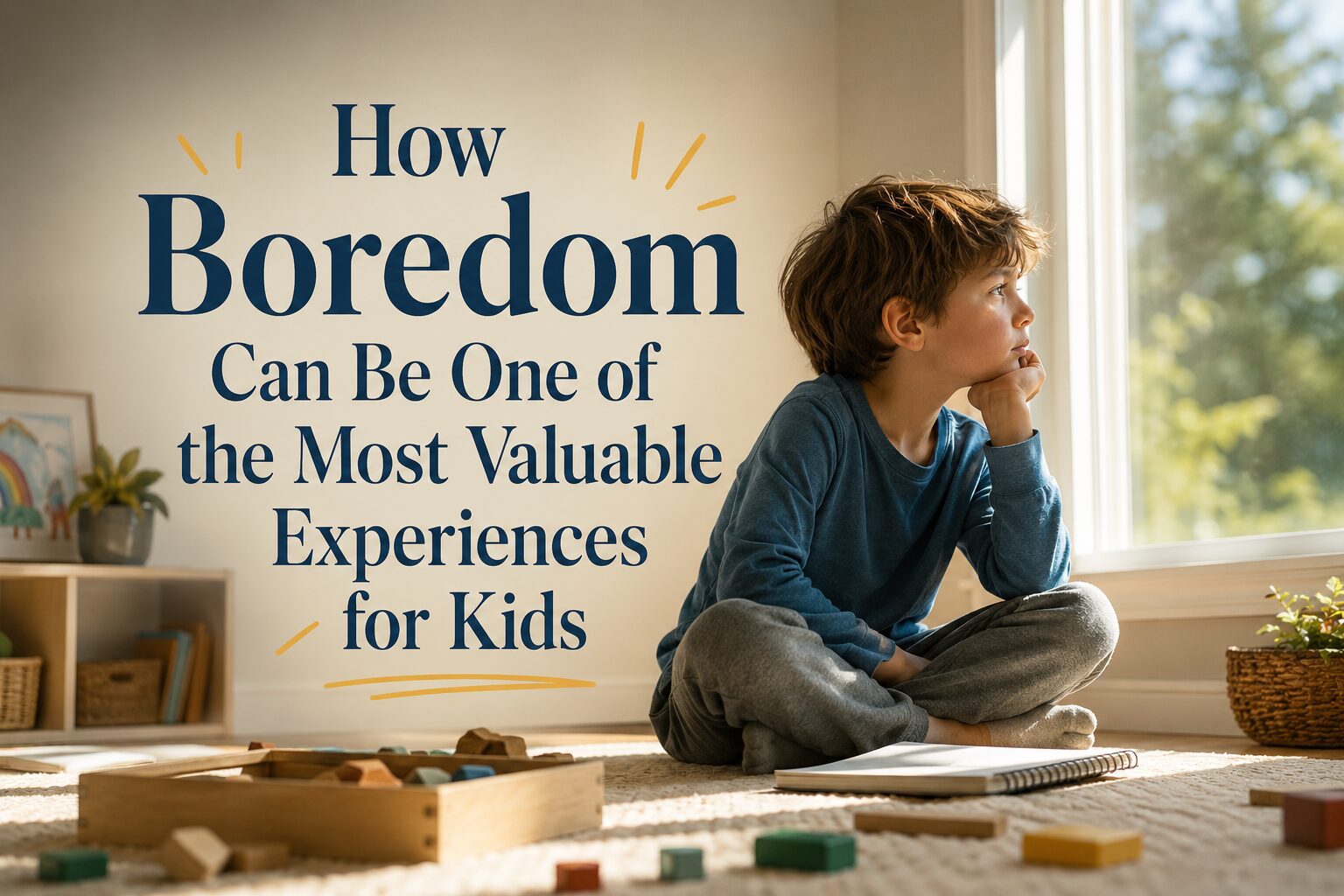
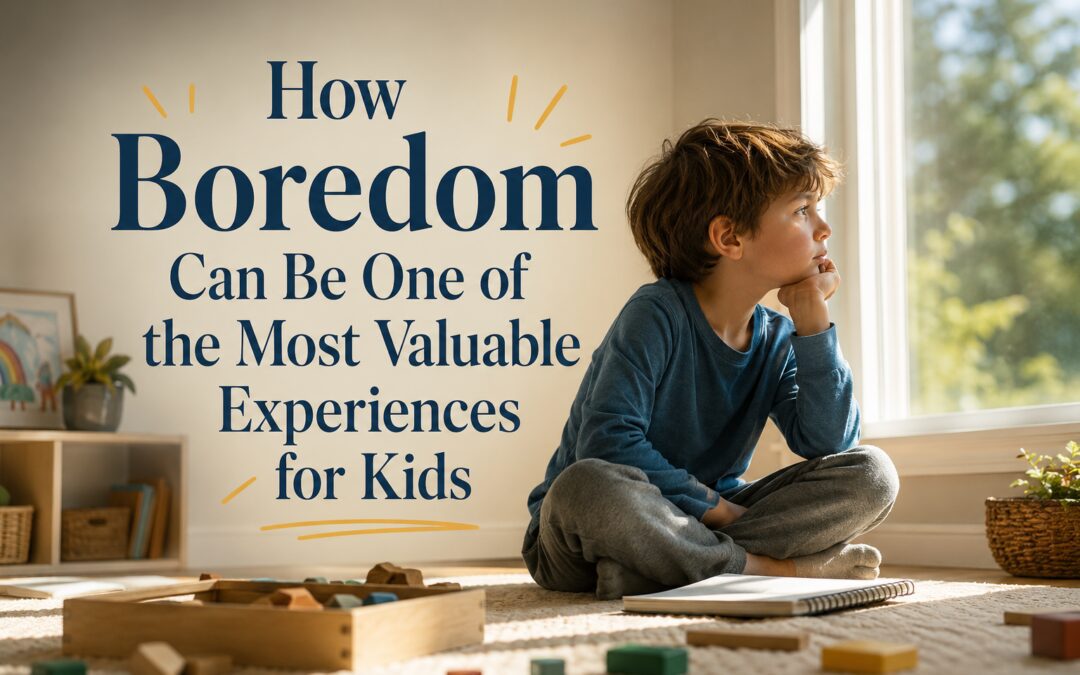
A kid sitting down, saying, “I’m bored,” is one of the most common things parents hear time and time again. Many parents find themselves pressured to provide some sort of response. That might take the form of a suggestion, an activity, or a distraction. There is a common misconception that boredom creates a hole that should be filled. However, if you look more closely and consider it from a Montessori perspective, it is apparent that boredom is not always a bad thing. In many instances, boredom marks the start of an exceptionally significant experience in a child’s developmental journey.
Boredom is not typically a pleasant feeling, and that is precisely what makes it valuable. Clinical Psychologist Stephanie Lee describes boredom as a moderate level of discomfort, not excessive enough to overwhelm, but enough to require the individual to expend some energy to get beyond it. The importance of that statement lies in recognizing that while boredom is not inherently negative, it offers an opportunity for kids to learn how to respond when they are not immediately interested in what they are doing. When kids are able to stay in those spaces without being rapidly diverted elsewhere, they develop their ability to emotionally regulate, practice patience and develop a capacity to tolerate non-immediately rewarding experiences. Those are not abilities that can be explicitly taught; however, they lay the groundwork for developing resilience and lifelong learning.
When kids are bored, something else is going on inside of them. While it may appear that nothing is happening, kids are actually transitioning to a different way of thinking. Research highlighted in Building Brains explores the neuroscience behind boredom; that constant stimulation, particularly from fast-paced digital media (cell phones, social media, etc.), can alter how the brain responds to everyday experiences by increasing its expectation for novelty and immediate reward. When children become accustomed to high levels of novelty and rapid feedback, slower or quieter activities may begin to feel less engaging. Over time, this can make it more difficult for children to sustain attention or find satisfaction in self-directed play. In this context, boredom serves an important role. It allows the brain to reset, bringing attention back to simpler forms of engagement and creating the conditions for deeper focus.
Ultimately, boredom is fundamentally related to the search for meaning. A study published in the National Institutes of Health described boredom as “the aversive experience of wanting but being unable to engage in satisfying activity.” The authors highlight that boredom is not merely a lack of action but an active pursuit of satisfaction. This perspective also changes how we view our children’s reactions. Rather than viewing boredom as a lack of choices, we can now see it as an active evaluation process. The child is not simply idle; they are actively searching. Philosophers have acknowledged this relationship for years. Friedrich Nietzsche viewed boredom as “windless calm”, indicating that boredom is not an endpoint; it is an entry point into something potentially more creative. When children are given the freedom to exist within these spaces, they will begin to create their own meaning rather than waiting for others to supply it.
The connection between boredom and curiosity is also deep-rooted. Jamie Jirout, a researcher on child development at the University of Virginia, defines curiosity as the recognition of a gap in someone’s knowledge that compels them to seek additional information. She writes in her work on the subject that unstructured time affords children opportunities to explore those gaps autonomously. When no constant direction is provided by another party, children are free to pose their own questions, test their own hypotheses, and pursue their own areas of interest. She further noted that children are most motivated when they have control over their own decision-making, and that this motivation leads to increased involvement/engagement and enhanced learning outcomes. This aligns closely with Montessori principles, in which children are encouraged to direct their own actions and develop independence through self-directed exploration.
A major concern about boredom today is that it is becoming increasingly hard for many children to experience it due to their busy, overstructured lives. Many children have so much going on (such as school, sports, etc.) that even when they do get a break, they use technology or some form of passive entertainment. According to research on Building Brains, which studies the neuroscientific basis of boredom, exposure to constant stimuli (such as digital media), especially when fast-paced and frequent, will affect how you respond to your daily life. Constant stimulation leads you to expect new things and instant rewards, making slow or quiet experiences seem less appealing. This makes it harder for children to concentrate and to pursue personal interests in self-directed play. As a result, boredom helps the brain ‘reset’ and refocuses on simpler forms of engagement that foster concentration.
Additionally, having a child move through boredom develops their feeling of autonomy. In a recent Psychology Today article, “Are Bored Kids Happier?”, the author discusses how when children don’t have constant entertainment, they start to figure out what they like, what keeps their attention, and what doesn’t. This self-discovery is critical, but it doesn’t happen unless children are provided time to investigate without adult interference. The article also states that the idea that parents are required to keep their children continuously engaged/entertained is recent and that previous generations were able to gain independence through long stretches of unstructured time. Those times helped children build both creativity and confidence in their ability to control their own actions.
Lastly, there are social and practical considerations to consider. Unstructured time spent playing with other children forces them to negotiate, share resources, and collaborate in unpredictable ways. In her research, Jamie Jirout states that during these collaborations, children grow socially by learning to listen, adjust, and resolve conflicts. Additionally, children who spend time in unstructured settings tend to interact more directly with their environment. Whether they are constructing, creating, or exploring outside, they are developing through experience rather than through instructions. These developmental processes aren’t always visible in the moment, but they greatly contribute to a child’s overall growth.
In educational settings, we evaluate progress primarily based on observable measures (completed assignments, tasks, etc). Although these measures provide valuable data on student achievement, they don’t tell the whole story of student growth. Much of our students’ greatest growth occurs during periods of invisible learning. A child may appear to be doing nothing at all; however, internally, they are processing information, connecting concepts, and generating new ideas. Also, according to the same Psychology Today piece, it is within the realm of boredom that the greatest mental thinking occurs. During boring moments, children begin to engage internally with their thoughts, reflect on them, and generate original ideas independent of external stimuli. Recognizing the significance of these experiences calls for a paradigmatic shift toward valuing the internalization of knowledge rather than solely focusing on visibly productive behaviors.
Responding to boredom thoughtfully does not necessarily mean eliminating structured time altogether; instead, it means striking a balance between structured and open-ended time. When a child exhibits signs of boredom, it is useful to suggest alternatives rather than determine how the child should act. Examples include suggesting the child build something, create a story, or go explore outside. This provides a launching pad for the child while giving him/her complete freedom to choose the direction they want to go. Over time, children come to realize that boredom is not something to be avoided but something to be navigated and transformed.
Within Montessori Philosophy, there is significant emphasis placed on children working at their own pace within their environment. This includes recognizing when to step back and allowing the child to take the lead. Boredom, in this context, can be seen as part of the child’s natural process of exploration. Boredom allows children to reflect inwardly, contemplate, and create. By allowing these moments to unfold without interruption, we support the development of independence, creativity, and intrinsic motivation.
Overall, boredom is not an impediment to learning but a little-recognized path into learning. Boredom stimulates children to think creatively, imagine, and identify what sparks their interests. Once we recognize boredom in this manner, it becomes easier to give it the space it needs. In doing so, we give children the opportunity to build skills that extend far beyond any single activity, shaping not only how they learn, but how they understand themselves and the world around them.
This was written by Lena Michaels, who works for Alphabet Trains, which offers research-based resources and products to support families and educators as they work together to create an environment where kids thrive and develop a lifelong passion for learning.