Related Posts



This article is part of an ongoing series from the Montessori Foundation exploring how schools can attract, enroll, and retain families who truly value Montessori education.
Through the Montessori Foundation’s Enrollment Accelerator Program, schools receive strategic support with marketing, admissions systems, websites, landing pages, advertising, parent communication, and enrollment growth strategy.
Through the Montessori Family Alliance, schools can provide families with ongoing Montessori parent education, practical parenting guidance, videos, articles, and AI-supported resources designed to help parents better understand Montessori and remain engaged for the long term.
Montessori Through a Parent’s Eyes
What Parents See First
One of the greatest enrollment and retention challenges Montessori schools face is surprisingly simple: most parents do not yet fully understand what they are looking at.
This is not because parents are unintelligent or uninterested. It is because Montessori education operates from a fundamentally different understanding of children, learning, motivation, discipline, and human development than conventional education. Parents arrive carrying years of assumptions about what school is supposed to look like — rows of desks, teacher-led instruction, homework, grades, rewards, constant correction, and adults directing most activity. Then they walk into a Montessori classroom.
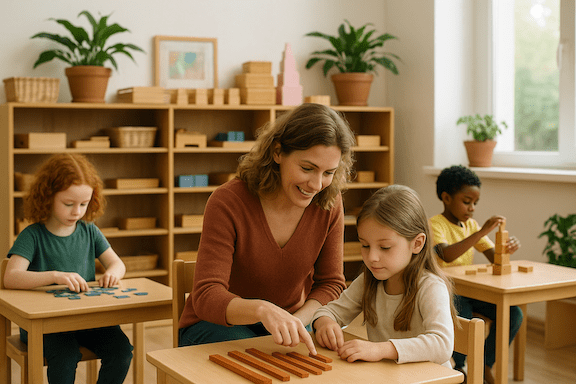
Children may be moving freely. Some are working independently. Others are collaborating quietly. One child is carefully polishing silver. Another is tracing sandpaper letters. A younger child is observing an older child work with quiet concentration. The teacher is not standing at the front of the room controlling every movement.
To Montessori educators, this environment reflects deep order, concentration, independence, and purposeful activity. To many parents seeing it for the first time, it may simply feel unfamiliar. And unfamiliarity often creates uncertainty.
Parents Naturally Interpret Montessori Through Conventional Assumptions
One of the biggest challenges Montessori schools face is that parents tend to interpret Montessori environments through the lens of their own educational experiences. Independence may initially look like lack of structure. Calm classrooms may seem less academically rigorous. Mixed-age groupings may feel unusual. Freedom within limits may appear overly permissive. Practical life activities may look simplistic. Uninterrupted work cycles may seem inefficient.
Parents are not wrong for asking these questions. In most cases, they are trying to reconcile what they are observing with deeply ingrained beliefs about how learning is supposed to work. Schools often lose families not because parents reject the philosophy, but because parents never fully understood what the school was trying to accomplish in the first place. The Hechinger Report
This is why interpretation matters so much. Montessori schools cannot simply show Montessori. They must explain it.
Most Parents See the Surface Before They Understand the Purpose
During school visits, parents tend to notice visible things first — classroom aesthetics, noise levels, student behavior, teacher interactions, materials, and the general level of movement in the room. What they usually do not yet see are the deeper developmental goals operating beneath the surface.
They may not realize they are observing executive function development, self-regulation, concentration, intrinsic motivation, emotional growth, social leadership, and the slow, steady building of genuine independence. A parent watching a child wash a table may quietly wonder why a school would have children doing chores. What that parent may not yet understand is that practical life activities are among the most cognitively and developmentally rich experiences in a Montessori environment — building sequencing, coordination, order, concentration, precision, and confidence in ways that transfer broadly into everything that follows.
Similarly, a parent watching children choose their own work may quietly wonder what happens when a child avoids difficult things. What they may not yet understand is that authentic Montessori environments are intentionally designed to cultivate internal discipline and responsibility over time, precisely because children who develop genuine intrinsic motivation become far more capable learners than those who work only to please an external authority.
Without thoughtful interpretation, parents often misread what they are seeing.
Montessori Also Requires a Different Definition of Success
Many parents unconsciously expect learning to look externally driven — grades, tests, homework, praise, competition, rewards, and visible teacher evaluation. Montessori environments focus instead on mastery, concentration, independence, self-correction, internal motivation, collaboration, and developmental readiness. This can feel genuinely uncomfortable for families whose entire educational history was structured around conventional measures of achievement.
Some parents quietly wonder how they will know their child is succeeding. They worry about falling behind. They question why there are not more tests or more visible evaluations. These concerns are understandable, and schools that dismiss them — or address them too briefly — often find families gradually drifting toward doubt. The challenge for schools is helping parents understand, over time and through repeated touchpoints, that Montessori is not the absence of rigor. It is a different path toward deep and lasting competence.
One of the Biggest Challenges Today: Parents Are Exhausted
At the same time, Montessori schools must recognize a major modern reality. Today’s parents are overwhelmed.
Many families are balancing demanding careers, financial pressure, long commutes, overscheduled lives, digital overload, emotional exhaustion, and constant decision fatigue — often all at once. Research spanning hundreds of independent studies consistently shows that family engagement leads to higher student achievement and better social-emotional outcomes. And yet schools everywhere are reporting declining attendance at parent education events, community meetings, workshops, conferences, volunteer activities, and school gatherings. PowerSchool
This does not necessarily mean parents no longer care. In many cases, it means they are simply depleted. Many parents genuinely intend to attend school events, read communications carefully, and participate more fully. But by the end of the day, they may feel mentally exhausted and unable to absorb one more long presentation or evening commitment.
Schools that fail to recognize this reality sometimes misinterpret low participation as lack of commitment. Often, the issue is not a lack of willingness. It is bandwidth.
Traditional Parent Education Models Often No Longer Work Well
Many Montessori schools still rely heavily on traditional parent education formats — evening lectures, long in-person workshops, extensive reading assignments, or daytime events that working parents cannot attend. Some families absolutely value these opportunities and participate enthusiastically. But many modern families simply cannot sustain that level of involvement consistently.
When schools rely primarily on these formats, they sometimes unintentionally create a divide between highly engaged core families and overwhelmed parents who quietly disengage because they feel behind, guilty, intimidated, or simply out of energy. Research on parent engagement increasingly suggests that schools often overestimate families’ capacity for formal involvement while underestimating barriers such as stress, social anxiety, scheduling conflicts, communication overload, and emotional fatigue. This is one reason some schools see strong engagement in the first year that gradually erodes over time. Parents are not necessarily rejecting the school. Life simply becomes harder to manage.
The Admissions Process Is Where Engagement Begins
One of the most underappreciated levers schools have is the admissions process itself. The goal of admissions is not to sell the school to a family but to begin a genuine relationship with a prospective family — and that distinction carries enormous downstream consequences. squarespace
Families who enter a school through a carefully crafted, relationship-centered admissions experience arrive already feeling known, welcomed, and valued. They have had real conversations. They have asked their most pressing questions and received thoughtful answers. They have met teachers, seen the environment, and begun to trust the people who will care for their child. That foundation of trust does not evaporate on enrollment day. It becomes the emotional basis for ongoing engagement.
Research on private school retention consistently shows that lower attrition starts with the first step of a family’s journey — and that exceptional experiences from the beginning build a solid foundation for long-term attendance and commitment. A parent who felt genuinely welcomed during the admissions process is far more likely to walk through the door for a parent evening than a parent who felt processed through a system. Ravennasolutions
This means admissions teams should think carefully about how many genuine human touchpoints occur between a family’s first inquiry and their child’s first day of school. The pre-enrollment phase, from signed contract to the first weeks of school, is a critical window for relationship-building and excitement generation — a time to send personalized welcome materials and connect new families with parent ambassadors who can ease the transition. Schools that use this window well arrive at September with parents who are already engaged, already curious, and already part of the community in a meaningful way. Schools that treat this period as primarily administrative often find themselves spending the entire first year trying to recover a connection they never fully built. Cube Creative Design
The Power of Personal Invitation
Beyond the admissions process, one of the simplest and most consistently underused tools schools have is the personal phone call. Research across multiple fields of education consistently finds that families place real value on a personal invitation from a teacher, and that a personalized message — a call, a text, a home visit — communicates care and genuine appreciation in ways that mass emails and newsletters simply cannot replicate. WestEd
There is a meaningful difference between a family receiving a flyer and a family receiving a phone call from their child’s teacher saying, “We are hosting an evening next week specifically about what your child is working on right now, and I would love for you to be there.” That kind of invitation does not feel like one more obligation. It feels like an honor.
Schools that build a culture of personal outreach — where teachers and staff routinely make brief, warm calls before community events — consistently see higher attendance than schools that rely on digital communication alone. The call need not be long. It does not need to be a hard sell. It simply needs to be human. In a world of digital noise, a phone call stands out precisely because it is rare.
The same principle applies to reminder calls in the days leading up to an event. Many parents genuinely intend to attend and then forget, or talk themselves out of it when the evening arrives and they feel tired. A warm, personal reminder — even a brief voicemail — can be enough to help a family follow through on an intention they already had.
Parent Ambassadors: The Most Authentic Voice in the Room
One of the most powerful resources any Montessori school possesses is something that cannot be manufactured: the authentic voices of current, happy parents.
In some schools, as many as ninety percent of new families enroll because of word-of-mouth recommendations from current parents. A formal parent ambassador program takes that organic process and gives it structure, intention, and reach. Ambassadors are uniquely effective because they communicate the school’s value proposition authentically — they know it because they have lived it. They can answer the questions that brochures cannot, because their answers come from genuine experience rather than institutional messaging. IsmincFinalsite
An effective parent ambassador is not simply a satisfied parent with permission to talk. They are trained, focused, and working in coordination with the school as part of an intentional strategy — out in the community at soccer games, swim meets, grocery stores, playgrounds, and neighborhood gatherings, talking to other parents about their real experience. When carefully selected and thoughtfully prepared, ambassadors can reach families the school would never otherwise encounter. Schoolmint
The most effective ambassadors are parents who can speak to the experience at each major point of entry, who are genuinely happy with the school, who are active in the broader community beyond the school walls, and who are comfortable and available enough to show up when needed. Schoolmint
Beyond prospective family outreach, ambassadors play an equally important role in supporting current families. A new parent who receives a personal call from a more experienced parent ambassador — inviting them to an upcoming event, offering to sit with them, promising to answer questions afterward — is far more likely to attend than one who receives only a mass email. Parent ambassadors have unique influence precisely because they carry the time, the drive, and the inside perspective that can reach other families in moments the school itself cannot be present. Cube Creative Design
The simple act of having a known, friendly face who says, “I’ll be there — come sit with me,” can dissolve the social anxiety that keeps many parents from walking through the door.
Making On-Site Events Worth Attending
The most honest question a school can ask before planning any event is: Will the families who attend feel that coming was genuinely worth their time? If the answer is uncertain, the event design deserves closer attention.
Many schools still plan events in formats that feel more institutional than welcoming — long presentations delivered to rows of chairs in a gym, abstract lectures disconnected from anything parents are currently experiencing with their child, or programs that feel more like something parents are supposed to endure than something they are invited to genuinely enjoy. Attendance reflects that over time.
Research from the Institute of Education Sciences points to several practices that consistently improve family attendance at school events: focusing on topics that matter most to families in that moment, sending personal invitations, organizing events that address the needs of specific groups rather than everyone at once, providing families with a yearly calendar so they can identify and plan for events that interest them, and integrating events with other activities that build connections and relationships. IES
Several practical changes tend to make an immediate difference. Offering childcare during evening events removes one of the most common logistical barriers that prevent parents of young children from attending. Providing food and refreshments, organizing family-friendly activities, and showcasing children’s work or talents are among the most consistently effective ways to increase attendance and make the time feel genuinely worthwhile. A parent who watches their child demonstrate a skill, explain a project, or perform in front of the community leaves with something no lecture could provide — a direct, personal window into their child’s growth that stays with them long after the evening ends. S&S Blog
Limiting the length of formal presentations matters more than most schools recognize. An event that promises to end by eight o’clock and actually does so builds trust. An event that runs long, covers too many topics, and leaves parents feeling overstimulated and behind schedule tends to keep parents from coming back. The goal is not comprehensiveness. The goal is resonance.
The most effective school events connect parents directly to their child’s learning. When parents leave with a clear understanding of what their child is experiencing and how they can support it at home, the relationship between school and family deepens in ways no newsletter can replicate. Montessori schools are extraordinarily well positioned to do this, because so much of what happens in a Montessori environment is visually rich, emotionally meaningful, and easy to bring to life for families who have never seen it. The Hechinger Report
Reducing Stress and Building the Expectation of Belonging
Many parents who stay away from school events are not staying away because they do not care. They are staying away because they feel nervous. They do not know where to stand when they arrive. They do not know anyone. They worry about saying the wrong thing or revealing that they understand Montessori less well than other families seem to. They have a quiet, generalized sense that everyone else is more at home in this community than they are.
When schools actively engage families in two-way communication, seek input and feedback, and help parents feel genuinely valued as partners in their child’s education, families are significantly more likely to attend and participate. That culture of genuine welcome does not happen automatically. It is the result of deliberate, consistent choices about how families are greeted, introduced, thanked, and followed up with after every event. project-appleseed
Pairing new families with a parent ambassador who will physically be with them at their first event — who texts them the address, meets them at the door, introduces them to other families, and sits beside them through the evening — eliminates most of the social friction that keeps people away. It is not complicated. It is simply kind.
There is also something worth understanding about the psychology of expectation. Schools that communicate clearly, warmly, and consistently that community participation is a valued and expected part of school life tend to see higher attendance than schools that treat events as optional extras. Retention research consistently finds that events like annual celebrations, family service projects, and community gatherings embed lasting memories and reinforce community identity — transforming re-enrollment from a financial decision into a matter of preserving something families have come to love. Parents who are gently but clearly invited into a culture of participation from their first day of enrollment often discover — sometimes to their own surprise — that they genuinely enjoy coming. The event they dreaded turns out to be the high point of their month. The community they were nervous to enter turns out to feel like home. Tads
Schools that sustain this over time communicate the expectation not with pressure or guilt, but with warmth and genuine enthusiasm. “We hope to see you there” carries a very different feeling than “attendance is strongly encouraged.” Both signal that presence matters. Only one makes people want to come.
The Schools Succeeding Today Are Adapting
The strongest schools are rethinking parent engagement entirely. Instead of expecting parents to come fully into the school’s world, they are finding ways to meet parents where they are.
That often means shorter communication, more digestible content, flexible access, video in place of long meetings, mobile-friendly resources, asynchronous learning, and ongoing relationship-building rather than isolated high-effort events. Setting up online and mobile event registration, recording sessions for parents who cannot attend live, and providing multiple options for participation that span both during and after school hours are among the practices most consistently identified as effective by schools succeeding at family engagement. PanoramaED
Many successful schools now combine in-person community-building with highly accessible digital parent education — short videos, quick articles, recorded webinars, text reminders, AI-assisted parent support, and practical guidance in formats that busy parents can realistically absorb. This does not mean abandoning community gatherings or deeper parent education. It means recognizing that engagement must become more flexible, accessible, and sustainable if it is going to serve modern families at scale.
Parents Often Need Support Without Feeling Judged
Another challenge schools sometimes overlook is that some parents quietly avoid engagement because they feel intimidated, socially uncomfortable, overwhelmed, or worried they are not doing enough. Some are certain that other families are more involved, more prepared, and more at ease than they are. Some feel guilty that they cannot volunteer more or attend more frequently.
Schools that nurture positive, empowering relationships with families — and that treat parents as genuine partners rather than as recipients of institutional messaging — consistently build stronger engagement over time. Parents generally need encouragement more than pressure, and they need to feel welcomed as they are — not as the idealized, highly engaged school parents they imagine they ought to be. The Annie E. Casey Foundation
Parent Education Is Becoming More Important, Not Less
Ironically, even though parents have less time and energy than ever before, parent education may actually be growing more important. Modern families are raising children in a world shaped by screens, social media, anxiety, fragmented attention, overscheduling, academic pressure, and declining opportunities for independence and unstructured play. Many parents are actively searching for guidance and reassurance. They want to understand what is happening in their children’s development. They want to feel confident in the choices they have made. They simply need schools to deliver that guidance in ways they can realistically absorb given the realities of their lives.
This is one reason the Montessori Foundation developed the Montessori Family Alliance — designed specifically to help schools support modern parents through accessible Montessori parent education, short-form and long-form articles, videos, developmental guidance, parenting support, age-specific communication, and AI-assisted resources parents can access whenever they have time. The goal is not simply to provide information. It is to help schools strengthen long-term parent understanding, trust, engagement, and retention in ways that fit modern family realities.
The Montessori Foundation’s Enrollment Accelerator Program similarly helps schools strengthen messaging, school tours, admissions systems, websites, follow-up communication, social media, and parent engagement strategies so schools can explain Montessori more clearly and build stronger long-term family partnerships.
Montessori Schools Must Become Better Translators
Ultimately, one of the central tasks of Montessori marketing and parent engagement is translation. Not changing Montessori. Translating it. Helping busy, distracted, overloaded modern families understand what they are seeing in the classroom, why it matters, how children develop inside a well-prepared environment, and what kind of adults Montessori education is helping children become.
The schools that do this well — that invest in parent ambassadors, that make personal phone calls, that design events worth attending, that build warmth and belonging into the admissions process from the very first conversation — tend to build stronger enrollment, stronger retention, stronger parent trust, and stronger long-term communities.
Because once parents truly understand Montessori, many no longer experience it as unusual. And once they genuinely feel part of the community, they stop needing to be convinced to come. They begin to look forward to it.
Copyright 2026 The Montessori Foundation