Related Posts

DEAR CATHIE— THE TOPIC OF BULLYING SEEMS TO BE ALL OVER THE PRESS. MY CHILD HAS JUST STARTED PRESCHOOL BUT I WANT TO BE PROACTIVE IN BEING SURE THAT MY CHILD DOES NOT BECOME EITHER A BULLY OR THE VICTIM OF BULLYING. IS IT TOO SOON TO THINK ABOUT THIS NOW?
A PROACTIVE MOM
Dear Mom,
I applaud you for already considering the challenging issues. Bullying is a highly discussed topic now, and many schools, religious organizations, and community groups are working hard to raise awareness and develop training and interventions to counteract this behavior!
There are mixed views about the reality of bullying in preschool. I am in the camp that some children begin to show signs of bullying behavior as young as three, and these behaviors need to be addressed as soon as they appear.
Luckily, Montessori guides are trained to do just that. We are trained to work with children in challenging interpersonal situations and to help both bullies and the bullied develop appropriate actions and responses in social settings.
Let’s look at bullying from a few angles.
• When can bullying begin?
• What does it look like?
• What kinds of interventions are possible with such young children?
Children begin to understand and appreciate others’ feelings around age 3. Before that age, children are totally self-absorbed. They have limited capacity to put themselves in another person’s shoes and understand how that person might feel in a given situation.
The development of empathy is central to social learning in the early years.
What actually constitutes bullying behavior? The answer lies primarily in the motivation for the behavior. If a child deliberately does harm to another and smiles about it, that is bullying. If a child regularly hits, kicks, or punches another, that is bullying. It is also bullying to call another child repeatedly “names,” exclude him from play, or put him down with either words or actions.
It is bullying behavior to recruit other children to misbehave and to sneak to do things. Bullies also intimidate their victims by hurting a child or threatening to hurt a child and demanding that she keep it a secret.
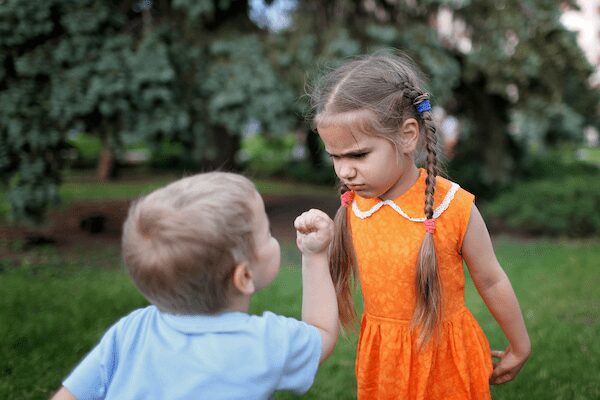
In reality, many preschoolers do engage in some of the behavior listed above. The challenge is to distinguish between typical preschool squabbles and actual bullying.
This is the time in life when children “try out” many types of behavior to learn how to interact with others. They work to understand the impact of their actions and their words.
Preschool children who are just learning to socialize may do things that are thoughtless, unkind, or even downright mean. In an effort to secure a friendship, Samantha may boss Rachel around and get her to do what Samantha tells her to do.
My most memorable story about this was a child who ordered another child to use a specific potty in the school bathroom. Even though it made her friend cry, she was adamant day after day. After discussion, she preferred the child use the potty next to her so they could sit together. “That is what friends do, Miss Cathie, they sit together,” she told me, nodding solemnly. This was not bullying but a misunderstood code of conduct in a friendship. The difference is that the negative consequences of these behaviors do not bring the child satisfaction or joy.
One of the main symptoms of bullying behavior is that it is repeated and has a deliberate intent to scare, harm, or upset another. In most preschool conflicts, the power is balanced.
Let’s look at a typical example. David and Paul (both three-year-old boys) are playing in the sandbox. They see a popular red dump truck. They both grab for it, and a conflict begins. “It’s mine! I had it first,” they both cry. One pulls the truck, and the other falls over crying. The child has his truck, and he walks away, leaving the crying child in the sandbox. This conflict will take some teacher interaction to resolve, but it is not bullying. Neither boy wanted to harm the other.
Learning to share, take turns, and care about others’ feelings is an important component of preschool social learning. When working with children to resolve squabbles, I often find they are surprised that their actions caused another child to be upset or cry. They are so egocentric at this age that they only want what they want and focus on getting it, often at the expense of others.
What can you do if you feel there is a bullying situation brewing in your child’s class?
The first step is to gather as much information as possible, then speak with your child’s teacher. While the adults in your child’s classroom are great observers and see much that happens at the school, they are not able to see everything. Therefore, they need your input on how things are affecting your child. Some children are shy, especially in their first year, and do not feel comfortable talking to the teacher. They only share those serious feelings with their parents at home. And a bully may be sneaky, and it may be hard for your child to make sense of the situation.
How do Montessori guides work with children on these skills?
We explain to children that “you can’t have your fun by making other people sad.” This is the basic anti-bullying mantra. When squabbles arise, Montessori works with both children to discuss, analyze, and resolve the conflict. They help each child to listen while the other tells their side of the story and identify the way the conflict made them feel. Then the children and the guide brainstorm for ways to resolve the problem. “What do you need to make you feel better?” is a question we often ask. We expect that the child who was hurt to initiate the conversation. “It is not Ok for anyone to hurt your body or your feelings.” We expect the child who did the hurting to “fix” the problem.
Problems are not left until they are resolved. The child who was hurt (or bullied) is helped to stand up for himself, and the child who was doing the hurting (or bullying) is taught to listen and make amends.
So in the Montessori Method, both types of children are taught anti-bullying strategies.
Guides in 3-6 classrooms spend significant time with these sorts of problems. And most children do this sort of self-advocacy independently by the end of their fourth year.
For further reading on this subject, I recommend: The Everything Parents’ Guide to Dealing with Bullies: From playground teasing to cyber bullying, all you need to ensure your child’s safety and happiness by Deborah Carpenter, and the children’s picture book, One by Kathryn Otoshi.
Cathie Perolman has been involved in Montessori education for over 40 years. Cathie has worked in the classroom as a 3-6 assistant; a classroom teacher; a level leader; a teacher trainer; and a college professor. She currently spends her time mentoring teachers, conducting workshops for teachers and administrators; and writing for her blog and for magazines. She also serves as a consultant for schools and as a school validator for the Montessori Schools of Maryland. Cathie is the creator of the Color Coded Sound Games and the Rainbow Reading System as well as other reading and cosmic printable materials to enhance classrooms. Find them at cathieperolman.com.