Related Posts

How to Tell Whether Your Child Is Really Progressing
Snapshot
Your child loves school, and the classroom feels calm and respectful. But is your child really learning what they need to learn, and is the education worth what your family is investing in it? These are some of the most reasonable questions a Montessori parent can ask. This article explains why happiness matters but isn’t enough, what progress looks like at different ages, how Montessori schools track academic growth, and what research says about Montessori outcomes. It also covers how to weigh tuition costs, why completing a full Montessori cycle matters, and what evidence you should expect your school to provide.
A Question Worth Asking
One question parents sometimes hesitate to ask their Montessori school is also one of the most reasonable: How do I know my child is really making progress?
Perhaps your child comes home happy every afternoon. They seem confident, adore their teachers, and talk enthusiastically about their friends. You appreciate the peaceful classroom atmosphere and the respectful way adults speak with children. But you also wonder what your child is actually learning. Are they developing the reading and math skills they need? Will they be ready for the next stage of their education? And if your family is making a substantial financial commitment to Montessori, how can you tell whether it’s worthwhile?
These are legitimate questions, and parents should never feel uncomfortable asking them. Montessori offers something distinctive, but its benefits shouldn’t be a mystery. You deserve to understand what your child is learning, how the school assesses their development, and whether it’s delivering the education it promised.
Happiness Matters, but It Isn’t Enough
Children should enjoy going to school. A child who feels safe, respected, and connected to the people around them is much better positioned to learn. And there is something deeply reassuring about watching a child walk into the classroom confidently, greet their friends, and become absorbed in meaningful work.
But happiness alone isn’t evidence of progress. Children can enjoy school without being appropriately challenged, and they can feel perfectly comfortable in an environment where important academic needs are going unaddressed. On the other hand, a child who is genuinely learning may sometimes feel frustrated, tired, or uncertain when facing something difficult. (If your child occasionally comes home grumbling that long division is “impossible,” that may actually be good news.)
So the question isn’t only whether your child is happy. It’s whether your child is growing. Are they developing new abilities? Are they becoming more knowledgeable, capable, independent, and confident? Are they learning to think, communicate, solve problems, and work with others? Those questions reveal the value of an education.
Progress Looks Different at Different Ages
One challenge in assessing Montessori education is that the most important signs of progress change as children grow.
Toddlers. Progress may mean learning to communicate needs, manage simple routines, coordinate movements, and do more for themselves. A child who once needed help washing their hands now manages the whole sequence alone. A child who used to melt down in frustration begins using words to express feelings. These are meaningful achievements, even though they don’t look like conventional academics.
Children’s House (ages three to six). Here we see increasingly sophisticated language, mathematical understanding, concentration, coordination, and social development. Children learn to recognize and write letters, connect sounds with symbols, explore quantities, and build the foundations of reading and arithmetic. They also become better at choosing purposeful work, completing it, and taking part responsibly in their classroom community.
Elementary. Children should be developing increasingly strong reading, writing, and math skills. They should be learning to research questions, organize information, communicate ideas, and apply what they know, while taking more responsibility for planning and completing their work.
Adolescence. Students should take ownership of their learning, engage with complex ideas, collaborate effectively, and show sound judgment.
At every age, progress involves both acquiring knowledge and developing as a person. A good Montessori school should clearly explain what appropriate progress looks like at each stage and how your child’s growth this year compares with where they were a year ago.
What About Reading and Mathematics?
Let’s address a common worry directly. Some parents worry that Montessori schools emphasize independence, creativity, and social development so much that academics become secondary. That should not be the case.
Montessori includes a substantial academic curriculum. Children are expected to build strong foundations in language, mathematics, science, geography, history, and more. The methods differ from those of conventional schools, but the responsibility to ensure children are learning is the same. And Montessori asks for more than correct answers. The goal is genuine understanding first, followed by fluency, so a good teacher should be able to tell you not only what your child can do, but how well they understand it.
In a well-run Montessori classroom, teachers keep records of the lessons they’ve presented, closely observe children’s work, and assess their growing understanding. They may use work samples, individual assessments, portfolios, and conferences to document progress. Some schools also use standardized assessments, particularly in the elementary years. Using an appropriate assessment to understand how a child is doing is nothing un-Montessori. What matters is how you use the information: to identify strengths, recognize difficulties, adjust teaching, and communicate clearly with families. Assessment should inform education, not become its purpose.
Respecting each child’s pace is central to Montessori, but it should never excuse complacency. A child who is consistently struggling with reading or mathematics needs attention, and you should expect the school to recognize it and explain what it is doing about it.

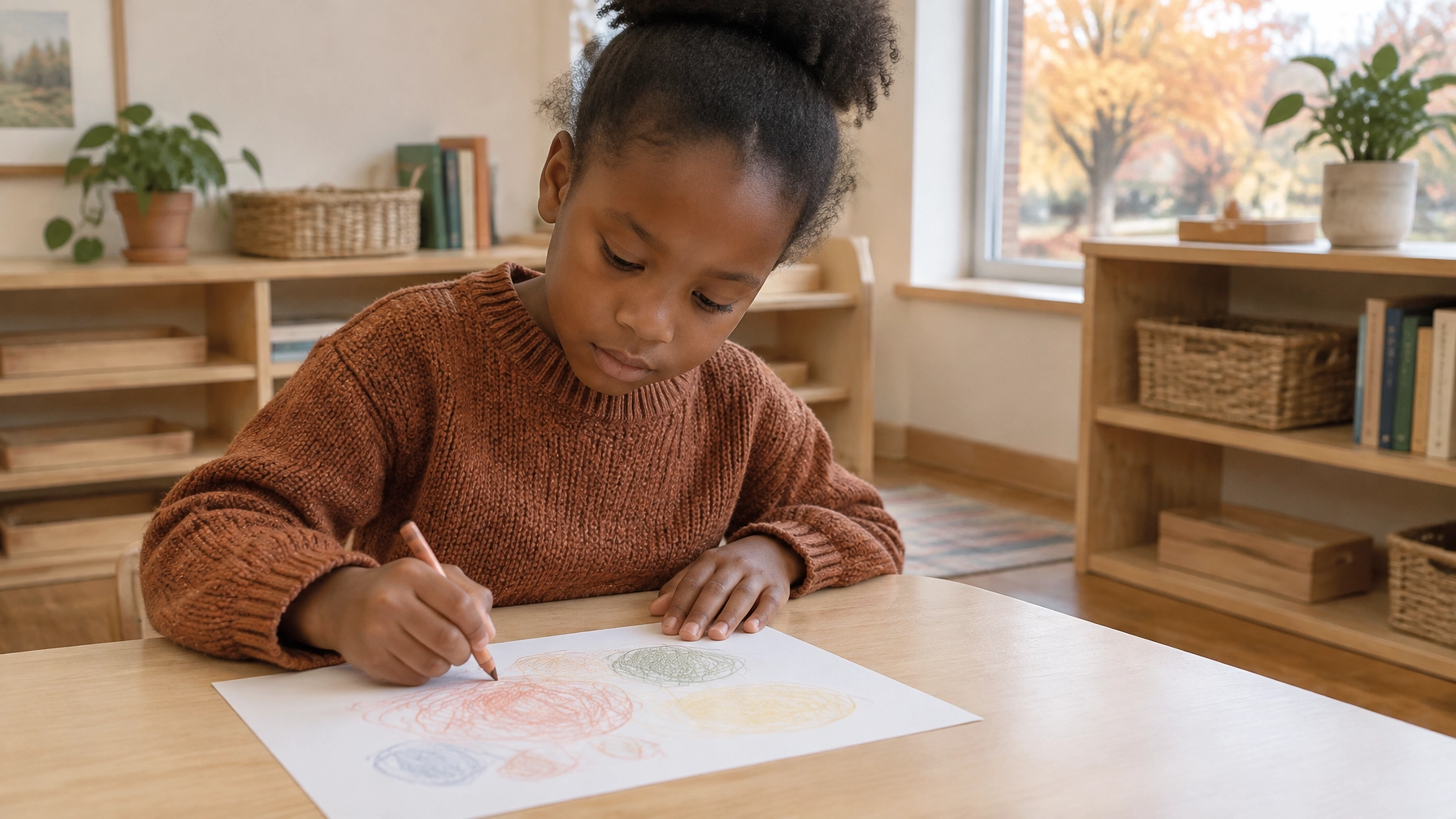
Sharing observations and work samples can make a child’s growth easier to understand.
The Progress You May Not See on a Report Card
Some of childhood’s most important developments are hard to capture in grades or test scores. Consider concentration. A child who once flitted from one activity to the next may gradually become able to work independently for long stretches, and that change ripples across every subject. Or consider confidence. A child who once avoided anything unfamiliar may begin approaching challenges with curiosity and determination. An older student learns to plan a project, organize materials, meet deadlines, and work well with classmates.
These capacities shape how children learn, how they relate to others, and eventually how they handle the responsibilities of adult life. They are part of what you’re investing in. But they shouldn’t excuse vague reporting. If a school tells you your child is developing independence, it should be able to give you specific examples of what your child can do now that they couldn’t do six months ago.
What Does the Research Tell Us?
Parents sometimes ask whether Montessori has been shown to produce better outcomes. The research is encouraging, though it deserves careful interpretation.
A 2023 systematic review published by the Campbell Collaboration examined 32 rigorous studies comparing Montessori with traditional education. On average, Montessori students outperformed their peers by about a quarter of a standard deviation on academic outcomes and about a third on nonacademic outcomes, such as executive function, creativity, and social skills. The effects were larger in the preschool and elementary years than in middle and high school.
These findings suggest that Montessori can offer meaningful benefits. But they don’t mean every Montessori school produces superior results or that every child will benefit in the same way. Schools vary in how faithfully they implement Montessori principles, how well prepared their teachers are, and the quality of their leadership. And research describes patterns across large groups of children. It can’t tell you how your child is progressing in your school. For that, you need careful observation, appropriate assessment, and honest communication.
Is the Investment Worth It?
For families paying private school tuition, this question has real financial consequences. Tuition may require genuine sacrifice, such as postponing purchases, cutting back on other spending, or making hard choices about family finances. It’s entirely reasonable to ask whether the education justifies those costs.
But it helps to think carefully about what you’re investing in. Academic preparation certainly matters, since children need the knowledge and skills to succeed in future schools. Most parents want more, too. They want their children to become thoughtful, capable, confident people with curiosity, good judgment, independence, and the ability to work well with others. They want their children to discover real interests and experience the satisfaction of learning. A strong Montessori education aims to support all of these.
So the question isn’t simply whether Montessori produces higher test scores. It’s whether your child’s school is helping your child develop in the ways your family values, and whether those benefits justify the cost compared with the other options available to you. No single answer fits every family. A school can be excellent and still be beyond what a family can reasonably afford, while another school may be affordable but not provide the education a particular child needs. Families deserve to make these decisions thoughtfully, with accurate information rather than guilt or pressure.
Why Completing the Cycle Matters
Another consideration deserves attention. Montessori programs are organized into multi-year developmental cycles. In Children’s House, children typically spend about three years together, usually from ages three through six, and the curriculum is designed around that progression.
In the first years, children develop foundational skills and become familiar with the materials. As they grow older, they build on those foundations for increasingly sophisticated work. In kindergarten, many children bring their earlier experiences in language and mathematics together in remarkable ways, and they become leaders and mentors in their classroom community. Families who leave before that year sometimes miss the very moment when everything starts to come together.
The same principle applies to elementary education, where the curriculum builds over six years and children benefit from the chance to deepen their understanding and take on more responsibility. Of course, families sometimes need to change schools for financial, personal, or practical reasons. But when weighing the value of Montessori, remember that the program is designed as a developmental progression, and its benefits often emerge most fully at the end of a cycle.

Older children can grow in confidence as they share responsibility with younger classmates.
Evidence You Should Expect From Your School
A school that asks families to make a significant investment should be able to show what that investment is producing. Here are some questions you should feel free to ask:
How do you document each child’s academic progress, and how often will we see it?
What does a typical student know and do by the end of each cycle?
Do you use any outside or standardized assessments, and how are the results used?
How do your graduates fare when they move on to their next schools?
What benefits will my child gain by completing the full cycle, and what might they miss by leaving early?
How do you ensure your classrooms are faithful, well-implemented Montessori programs through accreditation, teacher credentials, or other means?
These conversations shouldn’t feel adversarial. They are part of a healthy partnership between parents and educators. A strong school should welcome them, explain its approach clearly, and show how it benefits your child.
Looking Beyond the Next Report Card
When we think about progress, it’s natural to focus on what’s next. Will my child be ready for first grade? Will they thrive in middle school? Will they be prepared for high school or college? Those questions matter. But it’s worth looking a little further ahead, too.
What kind of learner is your child becoming? Do they have the confidence to approach unfamiliar challenges? Do they know how to ask questions, investigate ideas, and learn from mistakes? Are they becoming more responsible for themselves and more considerate of others? Can they work independently and collaborate when needed? These qualities will shape their lives long after they’ve forgotten the details of any particular assignment.
A good education should help children succeed in their next school. A great education should also help them learn throughout their lives. That, ultimately, is what makes an investment in education worthwhile.

Talking about the day can help families notice the work behind a child’s growth.
Parents shouldn’t have to choose between academic achievement and the development of the whole child. A strong Montessori education should deliver both, and schools should clearly show families how their children are progressing.