Related Posts


Helping Children Navigate Sibling Rivalry, Jealousy, and Everyday Family Conflicts
There are few sounds more familiar in a family home than children arguing.
“He took my stuff!”
“That’s not fair!”
“She always gets to go first!”
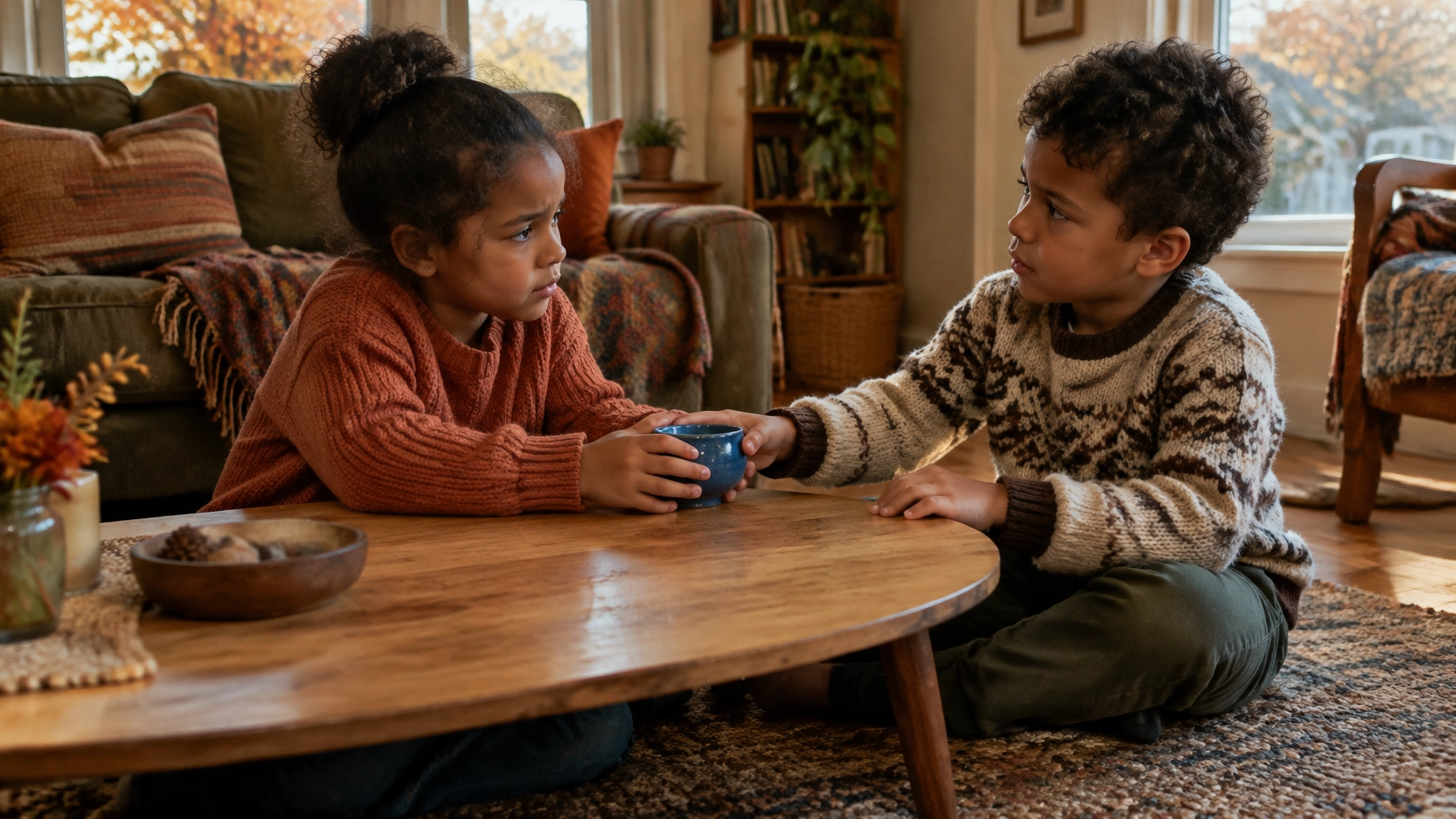
Sometimes the disagreement begins over something important. More often, it seems to involve something remarkably small: who gets the blue cup, who sits beside Mom, or who had a particular toy first.
Parents may find themselves wondering why children who love one another can be so unkind to each other.
And when the arguing seems endless, it’s natural to ask: What are we doing wrong?
Usually, nothing.
Sibling disagreements are a normal part of family life. Brothers and sisters share a home, parents, possessions, routines, and attention. They spend more time together than most people who haven’t chosen to live together would ever imagine.
They are also learning how relationships work.
That doesn’t mean we should ignore hurtful behavior or allow children to mistreat one another. But it does mean that we can approach sibling conflicts as opportunities to help children develop skills they will need throughout their lives.
Why Do Children Fight?
From an adult perspective, many sibling arguments seem completely unnecessary.
Why can’t they simply take turns? Why does one child always want whatever the other child is using? Why does a perfectly peaceful afternoon suddenly become a battle?
Part of the answer is that children are still developing the ability to manage strong feelings, understand another person’s perspective, and resolve disagreements.
Young children are especially likely to see situations from their own point of view.
A four-year-old who wants a toy may understand perfectly well that her brother is using it, but still find it extremely difficult to wait.
An older child may understand the importance of fairness yet become furious when a younger sibling receives attention or assistance.
Children are also sensitive to their place within the family.
They want to know that they matter, that they belong, and that their parents love them.
Sometimes sibling rivalry is less about the toy, the game, or the disputed privilege than it is about a child’s underlying question: Am I just as important as my brother or sister?
Fair Doesn’t Always Mean Equal
One of the most common complaints parents hear is, “That’s not fair!”
Children are keen observers of differences.
They notice when one sibling has a later bedtime, receives more help, or is allowed to do something they cannot.
Our first instinct may be to make everything equal.
But children don’t always need the same things.
A toddler may need help getting dressed while an eight-year-old can manage independently. An older child may be ready for privileges that would be inappropriate for a younger sibling.
One child may need additional support with reading, while another needs help managing frustration.
Treating children fairly means recognizing their individual needs, abilities, and circumstances.
We can explain this without becoming defensive.
“Your sister needs help with that right now. When you were younger, you needed help with some things, too.”
Or, “Your brother is old enough to stay up later. When you’re older, we’ll talk about changing your bedtime.”
Children may not immediately agree. That’s all right.
Our responsibility is not to eliminate every complaint about fairness. It is to make thoughtful decisions and help children understand them.
Resist the Temptation to Become the Judge

A calm adult listens to both children without assigning blame.
When children argue, parents often rush in to determine who started it.
We question witnesses, reconstruct events, and eventually announce a verdict.
Sometimes that is necessary, especially when someone has been hurt or a serious boundary has been crossed.
But when every disagreement becomes a courtroom drama, children may become increasingly dependent on adults to settle their disputes.
They may also become skilled at presenting their own case and blaming the other child.
Montessori education offers a different possibility.
In a Montessori classroom, children are gradually helped to express their needs, listen to others, and work toward solutions.
At home, we can do much the same thing.
Suppose two children are arguing over a game.
Instead of immediately deciding who is right, we might say, “I can see that you both want to use this. Let’s hear what happened.”
Give each child an opportunity to speak without interruption.
Then ask, “What could we do that would work for both of you?”
Younger children may need us to suggest possibilities. Older children can increasingly develop solutions themselves.
The goal isn’t simply to end the argument.
It’s to help children learn how to resolve the next disagreement with less adult assistance.
Know When to Step In
There is an important difference between allowing children to work through ordinary disagreements and permitting harmful behavior.
When a child is hitting, threatening, intimidating, or repeatedly humiliating a sibling, adults need to intervene.
We can be calm without being passive.
“I won’t let you hit your brother.”
“You’re very angry, but you may not hurt her.”
“We’re going to separate for a little while until everyone is safe.”
Physical safety comes first.
It is also important to recognize that not every sibling conflict involves two equally responsible participants. Sometimes one child has considerably more power because of age, size, temperament, or a persistent pattern of intimidation.
In those circumstances, simply telling children to work it out themselves may leave the more vulnerable child unprotected.
Parents need to observe carefully and respond accordingly.
Avoid Comparing Children
Even affectionate comparisons can create unnecessary competition.
“Your sister never had trouble getting ready.”
“Why can’t you keep your room as neat as your brother?”
“Your brother is the athletic one, and you’re the reader.”
We may intend these comments as harmless observations, but children can begin to see themselves as occupying fixed positions within the family.
One becomes the responsible child. Another becomes the difficult child. One is the clever one, another the artistic one.
Over time, these labels can influence how children understand themselves and one another.
Montessori education encourages us to see each child as a developing individual.
We can do the same at home.
Notice each child’s interests, efforts, and accomplishments without using a sibling as the standard of comparison.
Instead of saying, “Your brother learned to read much earlier,” we might say, “You’ve been working hard on reading, and I can see how much more confidently you’re approaching books.”
Each child deserves to feel appreciated for who they are.
Make Time for Each Child

Individual time can help each child feel secure while siblings share the same home.
Children don’t need parents to divide every minute of attention equally.
But they do need to feel that their relationship with each parent is secure.
Sometimes sibling rivalry becomes more intense when children feel they are competing for attention.
A few minutes of undivided attention can make a surprising difference.
Perhaps one child helps prepare dinner while the other parent spends time with a sibling.
Perhaps you take a walk together, read a book, or invite a child to accompany you on an errand.
The activity doesn’t have to be elaborate.
What matters is the experience of being together without competing for attention.
These moments are especially valuable when a new baby arrives or when one child has been receiving additional attention because of illness, learning difficulties, or another challenge.
Help Children Learn to Repair Relationships

Rebuilding together can be one way children begin to make things right.
One of the most important lessons children can learn is that relationships can recover after disagreements.
We all say things we regret.
We lose patience. We misunderstand one another. We sometimes behave badly toward people we love.
Children need help learning what to do afterward.
An apology can be meaningful, but forcing a child to say “I’m sorry” before they understand what happened may accomplish very little.
Instead, help children recognize the effect of their behavior.
“Your sister was upset when you knocked down her building. What could you do to help make things better?”
Perhaps the child can help rebuild it.
Perhaps they can return something they took.
Perhaps they need to acknowledge that their words were hurtful.
The important lesson is that when we hurt someone, we have a responsibility to try to repair the relationship.
Parents can model this, too.
When we lose our temper, we can acknowledge it.
“I was frustrated, and I spoke too sharply. I’m sorry.”
Children learn a great deal from watching adults take responsibility for their own behavior.
Brothers and Sisters Don’t Have to Be Best Friends
Parents sometimes have an idealized picture of sibling relationships.
We imagine brothers and sisters playing happily together, sharing everything, and remaining lifelong companions.
That may happen.
But siblings are individuals with different personalities, interests, and needs.
Some will become exceptionally close. Others may have affectionate but less intimate relationships.
Children also need opportunities to develop friendships and interests outside the family.
We should encourage kindness and mutual respect without insisting that siblings always play together or enjoy the same activities.
An older child may sometimes want to spend time without a younger sibling.
A younger child may need protection from being continually excluded.
Our task is to find a reasonable balance between individual freedom and family responsibility.
What Children Learn From Living Together
I sometimes think that family life is one of the most demanding forms of social education.
Children must learn to share space, respect boundaries, manage disappointment, negotiate differences, and consider the needs of others.
They discover that other people have feelings and preferences that may be quite different from their own.
They learn that they cannot always have their way.
And, with guidance, they begin to understand that love does not require constant agreement.
These lessons take time.
We should not expect young children to manage every conflict with the patience and wisdom of mature adults.
After all, adults still struggle with many of these same challenges.
What matters is the direction in which children are growing.
Are they becoming better able to express their feelings without hurting others?
Are they learning to listen?
Can they occasionally resolve a disagreement without asking an adult to intervene?
Are they developing greater consideration for one another?
These are meaningful signs of progress.
Our goal is not to raise brothers and sisters who never argue.
It is to help children learn that disagreements are part of life, that relationships deserve care, and that even after a difficult moment, we can find our way back to one another.
And perhaps, years from now, the siblings who once argued over the blue cup will remember something more important: that they grew up together, learned from one another, and belonged to the same family.