Related Posts

Give Children a Real Part in the Celebration
There is something wonderful about the excitement children feel as a special family celebration approaches.
Perhaps they are looking forward to Christmas, Hanukkah, Diwali, Lunar New Year, Eid, or a holiday that is particularly meaningful in their family’s culture or religious tradition.
Perhaps the family is preparing for a birthday, welcoming relatives, or gathering for a celebration that has been part of their lives for generations.
Whatever the occasion, children often sense that something special is coming.
We put up decorations, prepare favorite foods, tell stories, welcome people, and remember traditions.
Yet I sometimes wonder whether, in our efforts to create wonderful celebrations for our children, we unintentionally leave them out of much of the preparation.
We do the shopping. We plan the meals. We decorate the house. We wrap the presents, prepare the table, and organize the activities.
Meanwhile, the children wait for everything to happen.
And then, when the celebration finally arrives, we hope they will appreciate all the effort that went into making it special.
I think there’s a better way.
Instead of doing everything for our children, why not invite them to help create the celebration?
This is one of the simplest and most meaningful ways to bring Montessori principles into family life.
Children Want to Be Part of What Matters
One of the things Maria Montessori understood so well was that children have a deep desire to participate in the world around them.
They don’t simply want to be entertained.
They want to do things.
Young children are fascinated by the activities of everyday life. They want to wash vegetables, stir ingredients, arrange flowers, sweep the floor, and carry things from one place to another.
They want to imitate the people they love and become part of the family’s work.
As they grow older, that desire develops into a need for greater responsibility and meaningful participation.
Elementary children often enjoy planning projects, solving practical problems, and working together toward a shared goal.
Adolescents may want opportunities to make real decisions, contribute their talents, and take responsibility for something that matters.
Family celebrations offer wonderful opportunities for all of this.
And when children participate in preparing a celebration, something important changes.
The occasion is no longer simply something adults have arranged for their enjoyment.
It becomes something they helped create.
Begin With the Planning
One of the best ways to involve children is to begin before the holiday arrives.
Invite them into the planning.
What traditions are especially important to your family?
Which foods do you usually prepare?
Who will be joining you?
What needs to be done before everyone arrives?
For younger children, the conversation may be simple.
“We’re going to have a special family dinner on Saturday. Would you like to help choose the flowers for the table?”
An elementary-aged child might help develop a menu, create invitations, or make a list of supplies.
Older children and adolescents can take on more substantial responsibilities.
Perhaps they can help plan part of the meal, organize an activity for younger relatives, or coordinate arrangements for guests.
I wouldn’t turn this into a formal assignment.
The purpose is to invite children into something enjoyable and meaningful.
And we should remember that their ideas may be different from ours.
A child might suggest a new family tradition or a different way of celebrating.
Sometimes those ideas become the things everyone remembers most fondly.
Preparing Food Together
Food is central to many family celebrations.
Special dishes often connect us with our childhood, our cultural heritage, and the people who taught us to prepare them.
I have always thought that cooking with children is one of the most valuable experiences families can share.
It involves practical skills, coordination, mathematics, language, planning, and cooperation.
But it also creates opportunities for conversation and connection.
A toddler can wash vegetables, tear lettuce, or help carry safe ingredients to the table.
A preschool child can measure ingredients, stir mixtures, peel certain fruits, or arrange food on a serving plate.
Elementary children can follow recipes, measure quantities, prepare simple dishes, and help plan the sequence of tasks.
Older children and adolescents may be ready to take responsibility for an entire dish or meal, depending on their experience.
Of course, cooking involves real hazards. Hot surfaces, sharp tools, and unfamiliar equipment require appropriate instruction and supervision.
But children can learn to use real tools safely as their abilities develop.
One of the great pleasures of cooking together is that children begin to understand the work behind the finished meal.
They discover that preparing food requires time, patience, and care.
And when everyone sits down to eat, they can take genuine pride in having contributed.

Preparing food together makes room for conversation and contribution.
Let the Preparations Be Imperfect
I suspect one of the reasons adults sometimes hesitate to involve children is that we have a particular picture of how everything should look.
We want the decorations arranged beautifully.
We want the table set properly.
We want the cookies to look like the pictures in the recipe.
And children, especially young children, don’t always produce the results we imagined.
The decorations may be uneven.
The cookies may be oddly shaped.
The table settings may not match.
But I would encourage parents to ask themselves what really matters.
Is the goal to create a celebration that looks perfect?
Or is it to create an experience that brings the family together?
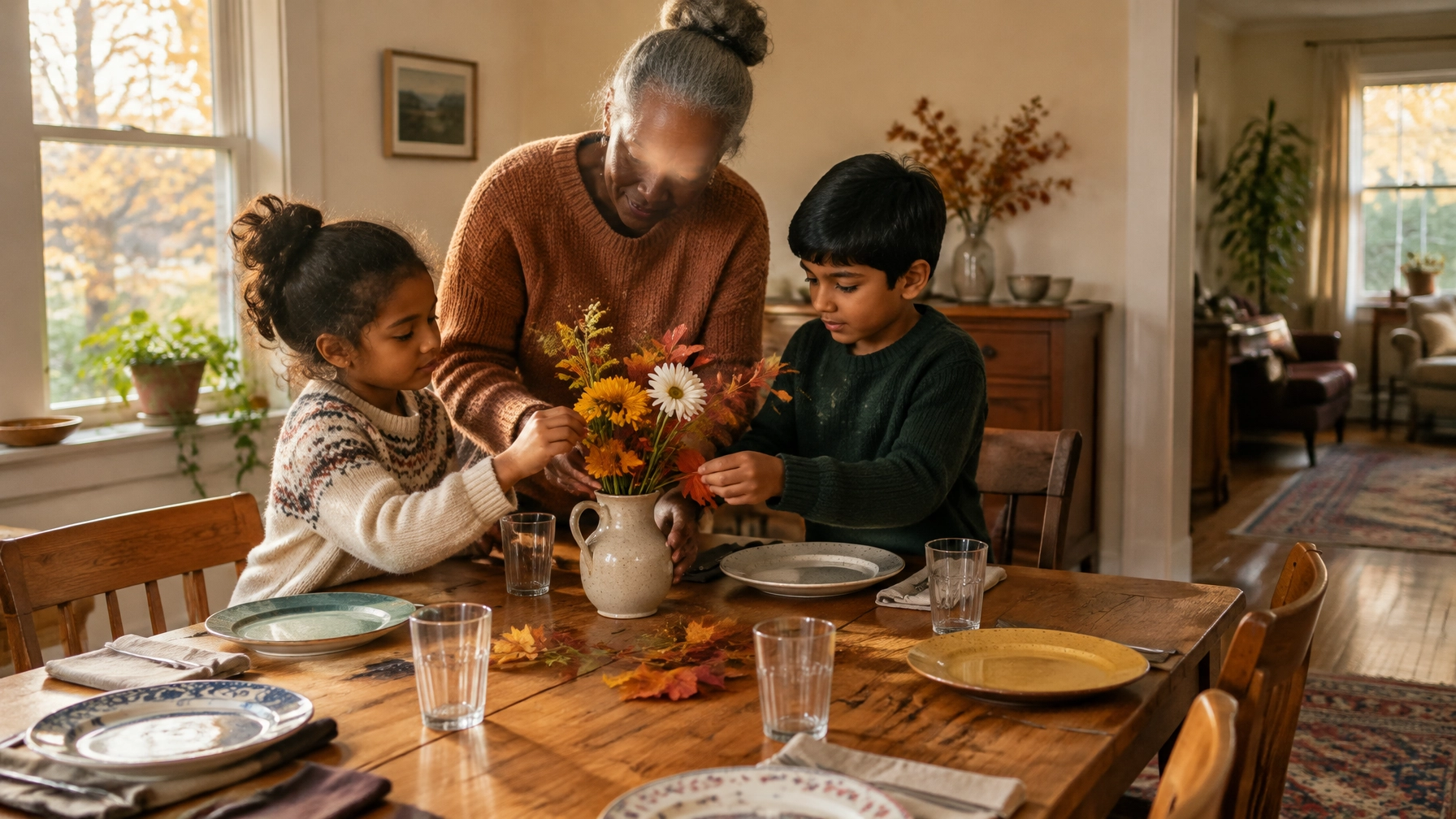
A child who carefully arranges flowers may not create the centerpiece an adult would have designed.
But the child’s contribution has meaning.
And when we welcome that contribution, we communicate that the child belongs.
We are saying, in effect, “Your work matters here.”
I think that’s worth far more than a perfectly arranged table.
Decorations That Tell a Story
Decorating can become another opportunity for meaningful participation.
Rather than simply purchasing everything ready-made, invite children to help create some of the things that make the occasion special.
Young children may enjoy arranging natural materials, making paper decorations, or placing familiar objects around the home.
Elementary children can create more elaborate decorations, design place cards, or help prepare a welcoming space for guests.
Older children may enjoy taking responsibility for a particular part of the celebration.
The most meaningful decorations are not necessarily the most elaborate.
Sometimes they are the ones that tell a story.
An ornament made by a child years ago.
A handmade decoration passed down through generations.
A special cloth or object associated with a family tradition.
A collection of photographs from previous celebrations.
These things connect children with their family’s history.
They help children understand that celebrations are not simply occasions for receiving presents or enjoying special food.
They are also ways of remembering who we are and the people to whom we belong.

Handmade decorations can connect children with family stories.
Make Room for Family Stories
I have always believed that children benefit enormously from hearing family stories.
Celebrations offer natural opportunities for these conversations.
Perhaps a grandparent remembers how the family celebrated when they were young.
Perhaps a parent describes a special meal prepared by someone who is no longer alive.
Perhaps a family tradition began in another country or was adapted when relatives moved to a new home.
Children are often fascinated by these stories.
They help connect the generations.
And they give children a sense that they are part of something larger than themselves.
I would encourage families to make time for these conversations rather than allowing every moment to be filled with organized activities.
Sometimes the most memorable part of a celebration is simply sitting together and listening.
Older children might enjoy interviewing grandparents or recording family recipes and stories.
These can become treasured family keepsakes.
And they preserve memories that might otherwise be lost.
Helping Children Welcome Guests
When relatives and friends visit, children can play a meaningful role in making them feel welcome.
A young child might help arrange a place for a guest’s coat or offer a small plate of food.
An elementary child might greet visitors, help younger children find something to do, or assist with serving.
An adolescent might help coordinate activities, prepare refreshments, or make sure an older relative is comfortable.
These are opportunities to practice hospitality.
Children learn that welcoming people involves noticing their needs and helping them feel included.
They also discover that they have something valuable to contribute to the experience of others.
I think this is particularly important when families include people of different ages.
Children can learn to enjoy the company of adults and older relatives rather than spending the entire celebration in a separate world.
They may discover that a grandparent has fascinating stories, that an uncle enjoys teaching them a skill, or that a younger cousin needs someone to help them feel comfortable.
These experiences strengthen family relationships.
Celebrations Can Include Giving
Many holidays include traditions of generosity, hospitality, or service.
These provide wonderful opportunities for children to think about the needs of others.
Perhaps your family prepares food for someone who is ill or unable to join the celebration.
Perhaps you invite a neighbor who might otherwise spend the day alone.
Perhaps your children help choose items for a community collection or participate in a local service project.
The important thing is to make the experience meaningful rather than turning generosity into another obligation.
Young children may not understand complex social problems, but they can understand kindness.
They can help prepare a card, select something to share, or participate in a simple act of service.
Older children can begin to understand the circumstances that make assistance necessary and consider how they might contribute.
Adolescents may be ready to take a more active role in organizing or participating in community efforts.
I would avoid presenting these activities as a way of making children feel guilty about their own good fortune.
Instead, help them recognize that celebrations can be occasions for strengthening connections and extending kindness beyond the immediate family.
Don’t Fill Every Moment
One of the challenges of holidays is that adults sometimes feel responsible for making every moment special.
We organize activities, outings, visits, meals, and entertainment.
The schedule becomes so full that everyone is exhausted.
Children may become overstimulated, irritable, or overwhelmed.
And parents may wonder why an occasion intended to bring happiness has become so stressful.
I think it’s worth remembering that children need unhurried time.
They need opportunities to play, rest, explore, and simply enjoy being with the people they love.
A holiday doesn’t have to be filled with constant excitement to be memorable.
Sometimes children are happiest when they have time to build something with a cousin, play a familiar game, or sit quietly with a grandparent.
I would encourage parents to leave room for these moments.
And if the family has several days together, consider allowing children to help decide how some of that time will be spent.
A walk in nature, a family game, an afternoon of baking, or a shared project may be more satisfying than another elaborate outing.
What About Family Games?
One of my favorite holiday traditions is the family game.
Games bring people together in ways that are difficult to replicate through passive entertainment.
They invite conversation, laughter, cooperation, and sometimes a little friendly competition.
For young children, simple matching games, picture games, and cooperative activities can be enjoyable.
Elementary children may appreciate increasingly complex board games, card games, and strategy games.
Adolescents often enjoy games that involve problem-solving, humor, negotiation, or teamwork.
The important thing is to choose activities that suit the ages and interests of the people involved.
Not every game needs to be competitive.
Cooperative games, in which players work together toward a shared goal, can be particularly enjoyable when children of different ages are participating.
And sometimes the simplest games become the most beloved family traditions.
I have known families who return to the same games year after year.
The pleasure comes not only from the game itself but from the familiar experience of being together.
When Children Become Overwhelmed
Even the happiest celebrations can be difficult for young children.
There may be unfamiliar people, changes in routine, late nights, exciting activities, and more noise than usual.
Some children manage these changes easily.
Others become tired, anxious, or overstimulated.
A child who seems uncooperative may simply have reached the limit of what they can comfortably manage.
I encourage parents to maintain reasonable expectations.
Young children may need quiet breaks.
They may need familiar foods, regular meals, and opportunities to rest.
They may not want to hug or kiss every relative, even when adults are delighted to see them.
We can teach courtesy and kindness while respecting children’s comfort with physical affection.
Older children may also need some time away from the activity.
An adolescent who retreats to read for a while isn’t necessarily rejecting the family.
Sometimes a little privacy makes it easier to return and participate comfortably.
A successful celebration doesn’t require everyone to be together every minute.
The Gift of Responsibility
As children grow, I encourage parents to give them increasingly meaningful responsibilities during family celebrations.
Not simply chores assigned because adults need help, although there’s nothing wrong with sharing necessary work.
I’m thinking of responsibilities that allow children to experience themselves as capable contributors.
A child who plans a family game night.
An elementary student who prepares a favorite dish.
An adolescent who organizes a gathering for relatives.
A group of siblings who work together to decorate the home.
These experiences develop planning, cooperation, problem-solving, and confidence.
But they also communicate trust.
When adults give children meaningful responsibilities, they are saying, “We believe you can do this, and we’re counting on you.”
That can be a powerful experience.
And the satisfaction children feel when their contribution is appreciated may become one of their strongest memories of the celebration.

Children belong in the shared work and pleasure of a family gathering.
The Traditions Children Will Carry Forward
I sometimes wonder what children will remember about the holidays and celebrations of their childhood.
Will they remember every present they received?
Probably not.
Will they remember whether the table decorations were perfectly arranged?
I doubt it.
But they may remember baking with a grandparent, preparing a special meal with a parent, playing games with cousins, or helping welcome guests into the family home.
They may remember the stories that were told and the laughter around the table.
They may remember being trusted with a responsibility that made them feel grown up.
And years later, when they have families of their own, they may find themselves repeating some of those same traditions.
Perhaps they will prepare the recipe they learned as a child.
Perhaps they will teach their own children how to make a familiar decoration.
Perhaps they will gather everyone around the table for the same family game.
This is how traditions are passed from one generation to another.
Not simply by watching adults create celebrations, but by participating in them.
Making the Celebration Our Own
I hope families will approach the coming season with a little less pressure to create something elaborate and a little more confidence in the value of ordinary experiences shared together.
We don’t need perfect decorations, expensive activities, or an exhausting schedule to create meaningful memories.
We need time, attention, and opportunities for everyone to contribute.
Invite your children into the preparations.
Give them real responsibilities appropriate to their ages and abilities.
Welcome their ideas.
Allow things to be a little imperfect.
And remember that the work of preparing for a celebration can be every bit as meaningful as the celebration itself.
When children help create the holidays, they discover that family traditions are not simply things we receive. They are things we build together, through our care, creativity, and willingness to contribute.
And those are gifts that can last for generations.