Related Posts



What the research says, and what parents can expect along the way
Snapshot
What does it really mean to be good at mathematics? Is it the ability to calculate quickly, or is it understanding how numbers work and knowing how to solve unfamiliar problems? Recent research from France, along with decades of research into Montessori education, suggests that the deep mathematical understanding children develop in Montessori classrooms may become increasingly valuable as they grow older. Some of the benefits may not become apparent until years later.
What Does It Mean to Be Good at Math?
Many of us grew up believing that being good at math meant getting the right answers quickly. We memorized multiplication tables, learned rules for solving problems, and took timed tests. Some of us became quite proficient. Others came away convinced that mathematics was simply something we were not good at.
But mathematics is much more than calculation. It is a way of thinking, recognizing patterns, understanding relationships, and making sense of the world.
Imagine two children who can correctly tell you that 12 multiplied by 15 equals 180. One has memorized a procedure that produces the correct answer. The other understands what multiplication means, can visualize the problem, and might discover several different ways to solve it.
Both children have arrived at the correct answer. However, the second child has developed an understanding that may help when faced with a problem that looks quite different from anything encountered before.
Ideally, we want children to develop both mathematical understanding and computational fluency. Montessori education begins by building a foundation upon which both can develop.
Holding Mathematics in Their Hands
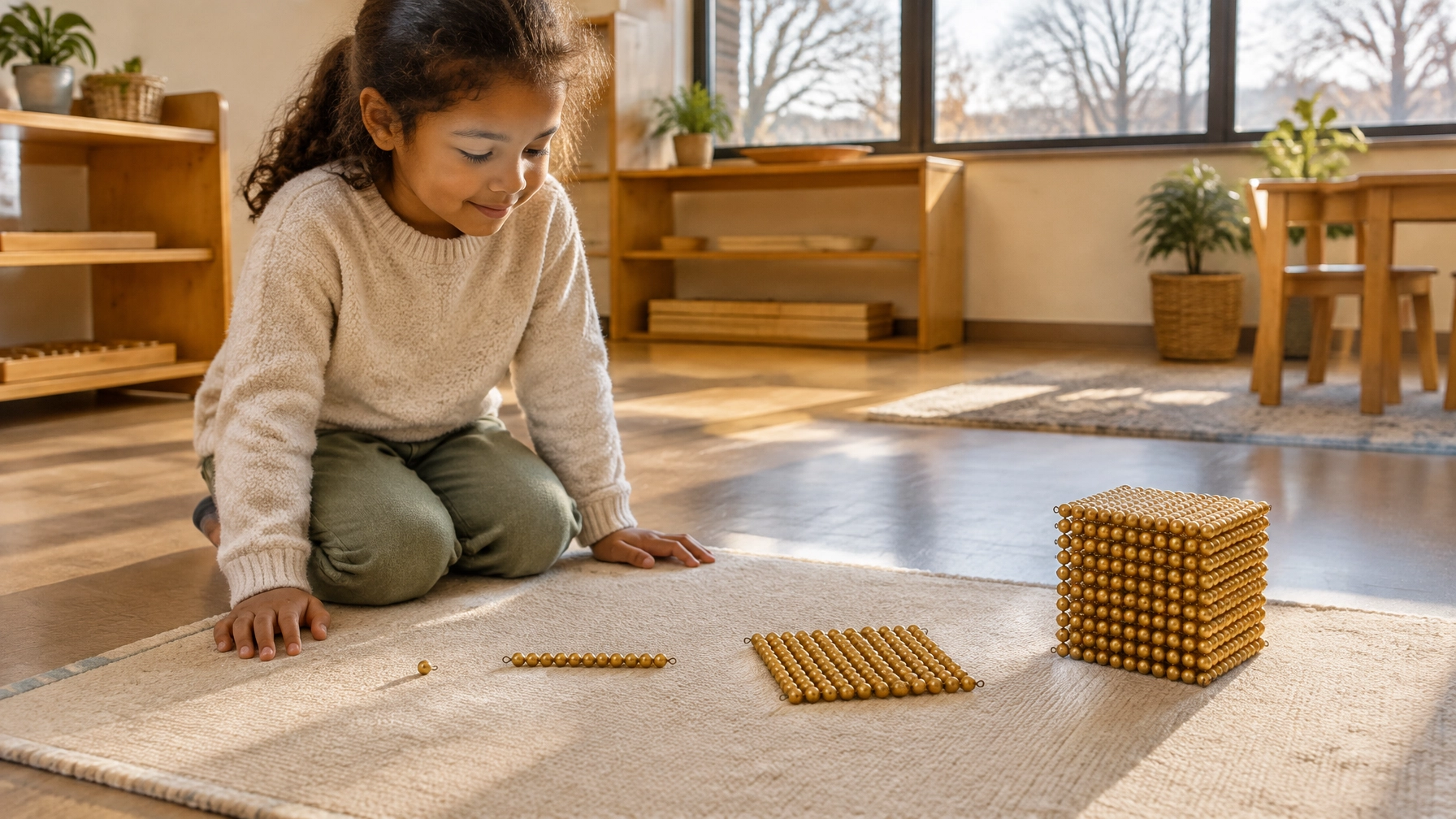
If you have spent time observing in a Montessori classroom, you have probably seen young children working with the golden beads. A single golden bead represents one unit. A bar of ten beads represents ten. A square made up of ten ten-bars represents one hundred, and a large cube made up of ten hundred-squares represents one thousand. In this way, the materials allow children to hold our number system in their hands.
A five-year-old does not simply have to accept an adult’s explanation that ten hundreds make a thousand. The child can see it, feel it, build it, and discover it through experience.
Using the golden beads, young children can explore addition, subtraction, multiplication, and division with surprisingly large numbers long before they are ready to do the same operations using only pencil and paper.
As children grow older, they work with increasingly abstract materials. Eventually, they discover that they no longer need the materials at all. The mathematical relationships they once explored physically have become part of the way they think.
This is one of the distinguishing characteristics of Montessori mathematics. We are not simply teaching children how to perform mathematical operations. We are helping them understand why those operations work.

Ten beads to a wire, ten units to a ten, and the child’s finger does the counting.
A Revealing Discovery in France
A study published in December 2025 in the scientific journal Scientific Reports offers a fascinating perspective on the long-term value of this approach.
Researchers in Lyon, France, studied children who had been randomly assigned to either Montessori-inspired or conventional public preschool classrooms in a disadvantaged community. At the end of kindergarten, the children in the Montessori program demonstrated stronger reading skills, but researchers found no significant advantage in mathematics.
Five years later, the researchers returned to assess the children again. By then, the children had spent several years attending conventional elementary schools, and the picture had changed. The earlier reading advantage was no longer apparent. However, the children who had attended the Montessori preschool now demonstrated stronger mathematical problem-solving abilities.
They were not faster at performing basic calculations. Their advantage appeared in their ability to reason through mathematical problems.
Researchers sometimes describe this as a sleeper effect: an educational experience may provide a foundation whose full value does not become apparent until much later. Think of planting a tree. For a considerable period, much of its growth takes place beneath the surface. The roots are developing, even though we may see relatively little change above the ground. Mathematical understanding may develop in much the same way.
The French study was relatively small and involved an adapted Montessori program in one community. We should not draw sweeping conclusions from it alone. Nevertheless, its findings are consistent with much of the broader research into Montessori mathematics.
What the Broader Research Suggests
Developmental psychologist Angeline Lillard of the University of Virginia has spent more than twenty years studying Montessori education, and her new book, The Montessori Difference: Considering the Evidence, reviews the research to date.
Her work, along with that of other researchers, suggests that Montessori education can offer meaningful academic benefits, although the results vary considerably depending on the quality of the program, the length of children’s Montessori experience, and the way their learning is assessed. A 2023 review of the most carefully designed studies found that, on average, Montessori students did better in math than their peers in conventional schools.
Research has also suggested that Montessori children’s understanding of place value and mathematical relationships can be particularly strong.
A study of former public Montessori students in Milwaukee found advantages in mathematics and science during high school, years after the students had left their Montessori elementary schools.
What makes these findings especially significant is that they suggest the value of a Montessori education may extend beyond what children can demonstrate on a particular test at a particular age.
When Early Test Scores Raise Questions
Parents sometimes become concerned when their children enter the elementary years and appear to be working at a different pace from children attending conventional schools.
Several American studies have found that Montessori students do not consistently outperform their peers on standardized mathematics tests during the early elementary years, and in some studies they score a little lower around 3rd grade. In a number of these studies, however, an advantage begins to emerge by about 4th or 5th grade.
There are several possible explanations.
Montessori classrooms follow a developmental curriculum rather than organizing every mathematical concept around a particular grade level. Children spend considerable time exploring the decimal system, place value, and the four mathematical operations (addition, subtraction, multiplication, and division) in much greater depth years before many students do in American schools. Standardized tests, however, generally assume that every child has encountered the same concepts at approximately the same time.
Montessori children may also have less experience with the format of standardized tests. And a test emphasizing rapid calculation may reveal relatively little about a child’s deeper mathematical understanding.
None of this means that parents should ignore concerns about their child’s progress. Children need to develop computational fluency, master mathematical facts, and steadily expand their mathematical knowledge. Some children will need additional instruction or specialized support.
A good Montessori teacher should be able to explain where your child is in the mathematics curriculum, what your child understands, and what the next steps will be.
The important thing is not to confuse a single test score with a complete picture of a child’s mathematical development.
Helping Your Child Develop a Mathematical Mind
One of the most valuable things parents can do is to help children discover how much mathematics is woven into everyday life.
When you double a recipe, you are working with fractions and multiplication. When you build a bookshelf, you are exploring measurement and geometry. When you compare prices at the grocery store, you are using mathematical reasoning.

Measuring ingredients together brings mathematics into family life.
Invite children into these experiences. Play card games and board games together. Estimate how long a journey will take, measure the garden, figure out how much paint you will need to cover a wall, and look for patterns in nature.
When your child explains how they solved a mathematical problem, resist the temptation to immediately show them a faster way. Listen to their reasoning, and ask them how they arrived at their answer. You may discover that your child understands mathematics in ways you never did.
Perhaps most importantly, avoid passing along your own anxieties about mathematics. Children who repeatedly hear adults say, “I was never good at math,” may begin to believe that mathematical ability is something people either possess or do not. In truth, we can all learn mathematics.

Measuring a garden bed makes mathematics part of an everyday project.
Looking Beyond the Next Test
Education is a long-term undertaking. The real measure of its success is not simply how well children perform on a test next spring, but what they can understand and do ten or twenty years from now.
The emerging research into Montessori mathematics gives us reason to appreciate the importance of building a strong foundation.
We want children who can calculate accurately and efficiently. But we also want children who can think mathematically, approach unfamiliar problems with confidence, and recognize that mathematics is a useful and fascinating way of understanding their world. Those are abilities that will serve them throughout their lives.
For Those Of Us Who Would Like to Read More
Basargekar, A., & Lillard, A. S. (2021). Math achievement outcomes associated with Montessori education. Early Child Development and Care, 191(7–8), 1207–1218.
Dohrmann, K. R., Nishida, T. K., Gartner, A., Lipsky, D. K., & Grimm, K. J. (2007). High school outcomes for students in a public Montessori program. Journal of Research in Childhood Education, 22(2), 205–217.
Le Diagon, S., Van der Henst, J.-B., & Prado, J. (2025). Early Montessori education shows delayed benefits for mathematical problem-solving in a 5-year longitudinal randomized controlled trial. Scientific Reports, 15, 43961.
Lillard, A. S. (2026). The Montessori Difference: Considering the Evidence. Oxford University Press.
Randolph, J. J., et al. (2023). Montessori education’s impact on academic and nonacademic outcomes: A systematic review. Campbell Systematic Reviews, 19(3), e1330.
Snyder, A. L., Tong, X., & Lillard, A. S. (2022). Standardized test proficiency in public Montessori schools. Journal of School Choice, 16(1), 105–135.