Related Posts

There’s a quiet shift happening in education right now.
A recent article in Education Week describes a growing movement to bring play back into kindergarten classrooms. After years of pushing academics earlier and earlier — more worksheets, more testing, more structured instruction — educators are beginning to ask an important question: have we gone too far?
The answer, increasingly, is yes.
And so we are seeing a return to play-based learning. Classrooms are reintroducing hands-on exploration, imaginative activity, and child-centered experience. Researchers point to evidence that children learn better — especially in areas such as problem-solving, language, and early math — when they are actively engaged rather than passively instructed.
All of this is encouraging. But from a Montessori perspective, it also feels familiar. Because Montessori education never left this ground in the first place.
What the “Return to Play” Gets Right
For years, many kindergarten classrooms have drifted toward what might best be described as watered-down first grade. Children have been expected to sit longer, complete more formal academic tasks, and move at a pace that reflects adult expectations rather than child development. The consequences have been predictable: rising stress and anxiety in young children, shorter attention spans, reduced intrinsic motivation, and a growing number of children labeled as struggling or behind.
The renewed focus on play is, in many ways, a corrective response. It recognizes that young children learn best when they are actively engaged, genuinely curious, and free to explore within a meaningful environment. This is not a new discovery. It is a rediscovery — and one that aligns closely with what Maria Montessori observed more than a century ago.
Where the Conversation Still Falls Short
At the same time, the current play-based movement often stops just short of something deeper. Many schools are now trying to balance two competing ideas: children need play and early academics. So they create a hybrid model — often called guided play — in which teachers design playful activities that are still tightly aligned with academic standards.
This is a step in the right direction. But it still reflects a fundamental assumption: that play and learning are separate things that need to be balanced against each other.
Montessori education begins from a different premise entirely. For young children, meaningful activity is learning. Not play versus work. Not play plus academics. But purposeful engagement that integrates movement, concentration, exploration, and discovery into a unified experience.
The Science Behind the Magic: Sensitive Periods
To understand why Montessori works the way it does, it helps to understand one of Maria Montessori’s most important insights: the concept of sensitive periods.
Montessori observed — and modern developmental neuroscience has since confirmed — that children do not develop in a smooth, even progression. Instead, they pass through distinct windows of time during which the developing brain is exquisitely receptive to particular kinds of learning. During these periods, a child is drawn to certain experiences with an intensity that can look almost compulsive. A toddler who insists on carrying objects from room to room, organizing them, and carrying them back is not being difficult. She is in the grip of a sensitive period for order and movement, and her brain is building neural architecture that will serve her for the rest of her life.
These sensitive periods are not permanent. They open, they peak, and they close. When a child’s environment provides the right experiences at the right moment, learning happens with a naturalness and joy that requires no coercion. When that window passes, the same learning is still possible — but it becomes effortful in ways it didn’t need to be.
The years from birth through age six represent the most concentrated cluster of sensitive periods in human development. During this time, children are in sensitive periods for language, movement, order, small objects, and fine detail, and the social world around them. The Montessori environment is designed from the ground up to meet children precisely where these sensitive periods place them — offering materials, experiences, and time that align with what the developing brain is most hungry to receive.
This is not a philosophical preference. It is a practical response to how children are actually built.
The Montessori Difference: Beyond Play
If you walk into a Montessori classroom for children ages three to six, you may not immediately see what most people would label as play. You will see children working.
A four-year-old carefully tracing sandpaper letters. A five-year-old building numbers with golden beads. A group of children is preparing a snack together. Another child is deeply absorbed in washing a table, repeating the process with quiet focus.
To an outside observer, this might not look like play. But to the child, it is something far more powerful. It is chosen. It is meaningful. It is deeply engaging. And most importantly, it builds the foundation for everything that follows.
Montessori understood that young children are not simply looking to be entertained. They are driven by an inner need to develop themselves — to refine movement, language, coordination, and understanding. What we sometimes call play is often the child’s way of doing exactly that.
The Power of the Extended Learning Cycle
One of the most overlooked differences between Montessori and conventional play-based programs is the daily schedule. In many kindergarten classrooms, even those embracing play, the day is broken into short segments: circle time, activity centers, transitions, and group lessons. Children are frequently interrupted just as they begin to concentrate.
Montessori classrooms are structured around an extended, uninterrupted work cycle — typically three hours in the morning. This allows children to choose their work, become fully absorbed, repeat activities, and move from simple to more complex challenges at their own pace. It is within this sustained period of concentration that real learning happens — not through constant novelty, but through deep engagement and repetition.
What is less often discussed is what this daily practice is building beneath the surface. Every morning that a child selects a work, carries it carefully to a mat, engages with it fully, and returns it to the shelf before choosing something new, that child is exercising the very capacities that researchers now identify as executive function: the ability to plan, to focus attention, to manage impulse, to follow through, and to shift flexibly from one task to another. These are not incidental outcomes. They are, in a very real sense, the whole point. A child who spends three years in this kind of environment does not simply learn things. She learns how to learn — and develops the self-regulation and inner discipline that will carry her through every level of education that follows.
Independence, Not Entertainment
Another important distinction lies in the role of the adult. In many play-based classrooms, the teacher remains the central organizer, setting up activities, directing engagement, and managing transitions. In Montessori, the teacher prepares the environment — but the child takes the lead.
The goal is not to keep children busy or entertained. It is to help them become independent, self-motivated, and able to sustain focus. This shift — from teacher-directed activity to child-directed learning — is subtle but profound. It changes not only what children learn, but how they come to see themselves as learners.
What a Five-Year-Old Knows and Loves
Perhaps the best way to appreciate the scope of what Montessori offers is to spend time with a child who has grown up in it. By age five — the year that corresponds in conventional schooling to kindergarten — a child who has been in a Montessori environment for two or three years is often a genuinely remarkable person, not because she has been pushed, but because her curiosity has been consistently met.
Language and literacy unfold in Montessori through a progression so carefully sequenced that children rarely experience reading as a struggle. The journey begins with spoken language, with rich conversation, storytelling, and vocabulary that is never artificially simplified. Children handle sandpaper letters, tracing each shape while hearing the sound it represents, building a sensory-motor memory that anchors phonics in the hand and the ear as well as the eye. Movable alphabets allow children to build words before their hand is strong enough to write them fluently. By five, many Montessori children are not simply decoding text — they are reading with comprehension and genuine pleasure, because they arrived at reading through their own effort rather than through instruction imposed from outside. Grammar is introduced not as a set of rules to memorize but through beautiful wooden symbols and hands-on activities that make the function of language visible and concrete. A child comes to understand what a noun is not because she was told, but because she physically sorted words into categories and felt the difference.
Mathematics in the Montessori environment is equally sensory and equally profound. Long before a five-year-old works with abstract numerals on paper, she has carried the weight of a thousand golden beads in her hands, has built and disassembled the decimal system physically, has laid out the sequence of numbers on a long number line that stretches across the floor. She understands quantity, place value, and the operations of addition, subtraction, multiplication, and early division not as procedures to execute but as relationships she has experienced in three dimensions. Geometry enters the picture through wooden insets, pattern work, and the exploration of shape and form that begins with the hands and expands into an intuitive spatial intelligence that will serve her in mathematics, art, architecture, and design for the rest of her life.
Geography and world culture open early and generously in Montessori. Puzzle maps of continents, countries, and landforms are among the most-loved materials in the classroom. Children trace the borders of nations with their fingers, learn the names of capitals, and encounter the diversity of human cultures through stories, artifacts, music, foods, and celebrations from around the world. By five, a Montessori child often has a genuinely global frame of reference — a sense that the world is large, varied, and endlessly interesting — rather than the narrow cultural lens that early childhood can inadvertently impose.
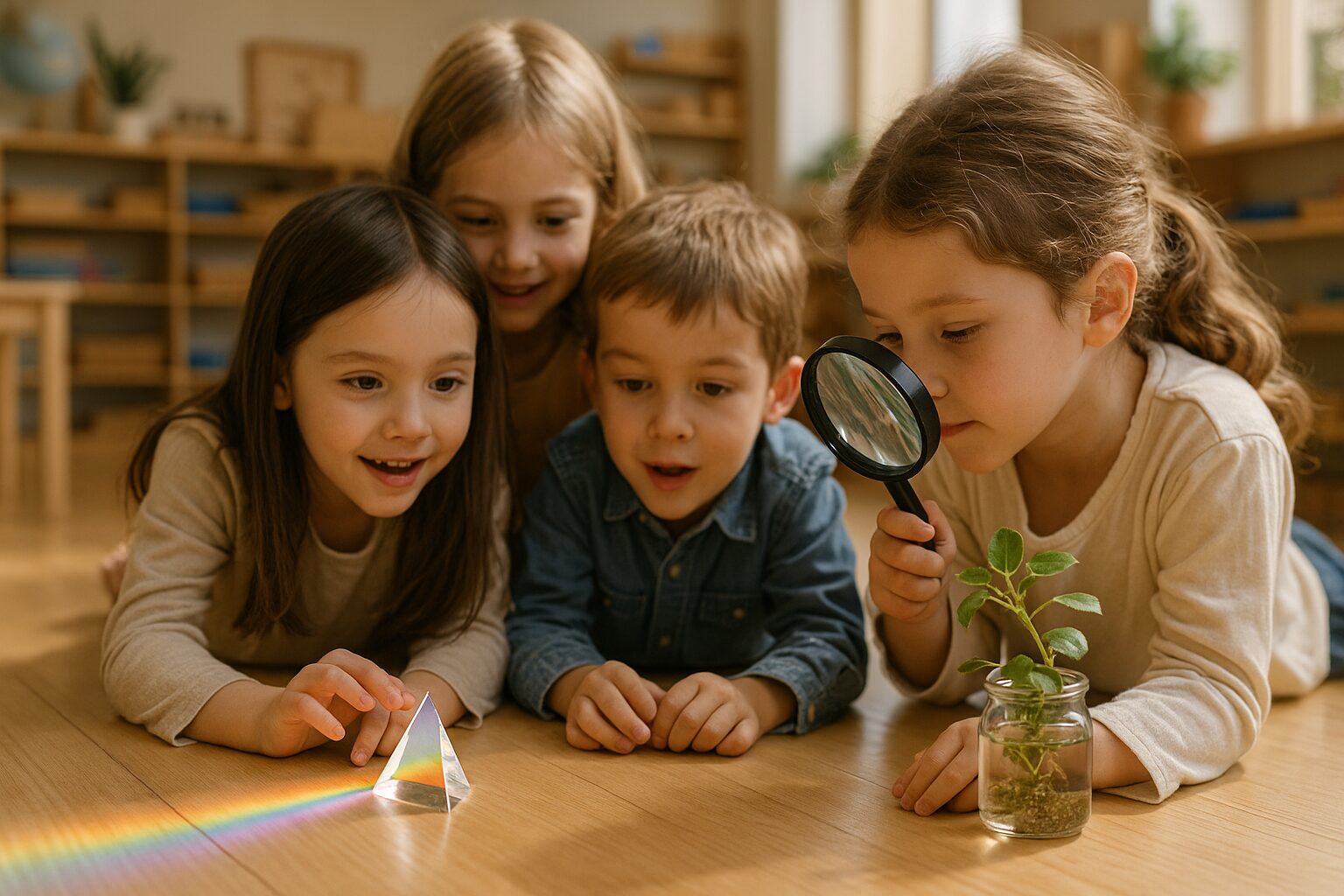
Science is woven through the environment from the very beginning. Children observe, classify, and name the natural world. They work with materials that introduce the properties of matter, the cycles of living things, the structure of the solar system, and the diversity of animal and plant life. The approach is not encyclopedic memorization but the cultivation of scientific habit: careful observation, patient comparison, and the willingness to ask why. A five-year-old who has grown up in this environment has already developed an instinct for inquiry that most adults spend years trying to recover.
Art and music are not enrichments layered onto the curriculum — they are part of its fabric. Children work with color, form, texture, and composition from their earliest years, developing an aesthetic sensibility alongside their cognitive and physical skills. Music is present daily, in singing, in rhythm work, and in exposure to the music of many traditions. The five-year-old Montessori child has not merely been exposed to art and music. She has participated in them repeatedly, building both competence and love.
What ties all of this together is something that no curriculum map can fully capture: confidence. A child who has spent her early years in an environment where her choices were respected, her pace was honored, and her curiosity was consistently rewarded arrives at age five with a deep and unshakeable sense that she is capable. She is not waiting to be taught. She is ready to learn.
Why This Matters Right Now
The renewed interest in play-based learning reflects a growing awareness that something hasn’t been working. Parents are noticing it. Teachers are feeling it. Children are living it. We see it in rising anxiety among young children, increased behavioral challenges, and a widespread difficulty with sustained attention and follow-through.
These are not failures of children. They are signals that the environment is out of alignment with how children actually develop. The move back toward play is an important step. But Montessori invites us to go further.
Rather than asking how we bring play back into kindergarten, a more powerful question might be: how do we design environments that truly match how children learn and grow?
Montessori offers one answer to that question — not as a trend, not as a reaction, but as a coherent, time-tested approach grounded in careful observation of children. Today, there are more than 25,000 Montessori schools around the world, serving children across cultures, languages, and communities. Families continue to choose Montessori not because it is new, but because it works.
A Thought for Parents
If you are hearing more about play-based learning, you are not alone. It is worth asking some thoughtful questions. What does “play-based” actually look like in practice? How much genuine choice and independence do children have? Are they able to concentrate deeply, or are they constantly moved from one activity to the next? And most importantly, is the environment designed around the needs of the child, or around adult expectations?
These questions can help you see beyond labels and understand what your child is truly experiencing each day.
Young children are not meant to be rushed, nor are they meant to be managed from one activity to the next. They are meant to explore, to concentrate, to discover, and to grow into themselves at their own pace. Montessori education has long understood this. And as the broader world of education begins to rediscover the value of play, it may also begin to rediscover something even deeper: that when we truly follow the child, learning takes care of itself.
If you’re wondering how these ideas apply to your own child, your child’s Montessori teacher is always the best place to begin the conversation.