Related Posts



Why children need quiet, unhurried time in a busy world
It's Saturday morning, and your child has barely finished breakfast. "What are we doing today?" You explain that there's no special plan; you're just staying home. Your child looks genuinely disappointed. "But what are we going to do?"
It's an interesting question. When did an ordinary day at home become something that needs an organized activity?
Many children today have schedules that would tire an adult. School, sports, music lessons, dance, tutoring, playdates, weekend outings, and family commitments fill the week, and when a quiet moment finally appears, a screen is usually waiting to fill it. We want our children to have wonderful opportunities, and many of these activities are genuinely valuable. But it's worth asking a simple question: does your child have enough time that belongs entirely to them?
Montessori education reminds us that development can't always be hurried or scheduled. Sometimes children need the freedom to do nothing in particular, and to discover what comes next.
Not Every Moment Needs a Purpose
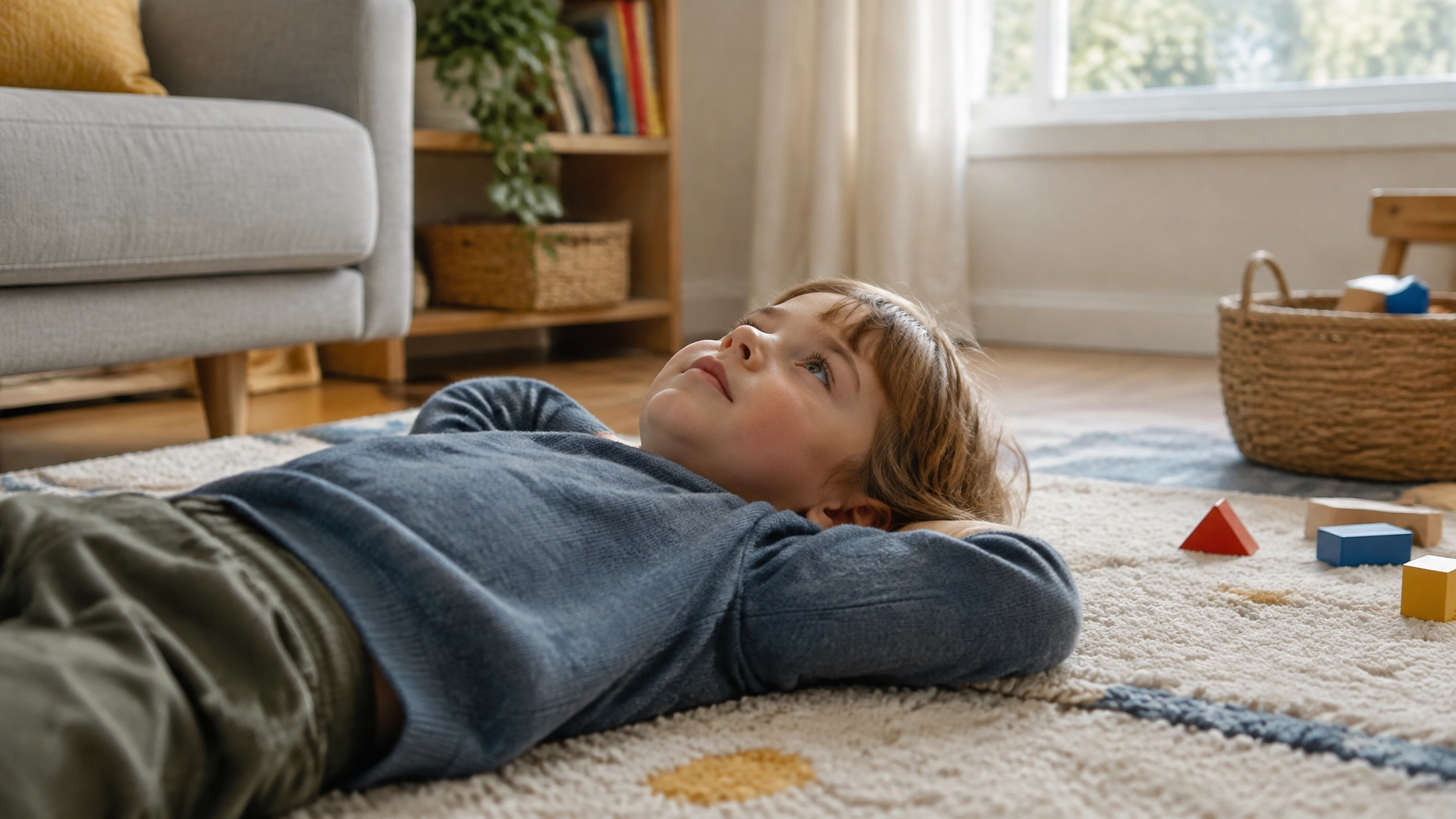
Adults often feel pressure to make children's time productive. If a child isn't reading, practicing, exercising, or taking part in something organized, we may worry that the time is being wasted. But development doesn't always look productive from the outside. A child lying on the floor staring at the ceiling may be thinking something through. A child wandering around the yard may be noticing things no adult would see. A child sitting quietly with a handful of stones may be in the early stages of inventing a game. Some of the most interesting activity begins only after a period of what looks like nothing at all.

Boredom Is Often the Doorway
"I'm bored!" Many parents hear these words as an emergency. We rush to suggest activities, offer entertainment, arrange a playdate, or hand over a device. But boredom isn't necessarily harmful. Often it is simply the uncomfortable pause between one activity and the next.
A child who is used to constant stimulation may need time to rediscover the ability to come up with ideas on their own, and at first that can be hard. The child may complain, wander from room to room, start a few things and abandon them. Then, quite suddenly, something catches their interest: a cardboard box, a forgotten book, a collection of leaves, an old construction set, or an idea for a story. The ability to create one's own activity grows only through experience, and that experience begins with some unfilled time.
Montessori teachers see a version of this in the classroom. Partway through the long morning work period, children sometimes become restless, chatty, and unsettled, as if they've run out of things to do. Montessori called this "false fatigue." Experienced teachers know not to step in and redirect everyone, because if left alone, children very often settle into their deepest and most satisfying work of the day right afterward. The restless moment is frequently the doorway to concentration.
Montessori Freedom and Self-Direction
Montessori education values purposeful activity, but purposeful doesn't mean that adults assign a purpose to every moment. In a Montessori classroom, children choose their work within a carefully prepared environment. They follow their interests, repeat activities as often as they need to, concentrate deeply, and make their own discoveries. Gradually they become more capable of directing their own learning.
The same principle can guide family life. Children benefit from a home with worthwhile possibilities within easy reach, such as:
- Books, both familiar favorites and a few new ones
- Art and writing materials
- Blocks or other construction materials
- Outdoor space, even a small yard or balcony
- Real household tasks they can help with, like baking, gardening, or sorting laundry
But alongside those possibilities, children need the freedom to decide for themselves what interests them.
Quiet Time Isn't a Punishment
For many families, quiet time has come to mean something children must endure: "Go to your room," "Sit still," "Stop bothering me." But quiet time can instead become a pleasant, valued part of the family's day.
After lunch on a weekend, for instance, everyone might spend a little while reading, drawing, resting, or working on something independently. A younger child looks at picture books, an older child builds, writes, or listens to music, and a parent reads too. Nobody has to produce anything. The goal is simply to create some breathing space in the day.

Children Need Time to Think
Imagine a child who has just spent the morning at a natural history museum, gazing up at dinosaur skeletons and studying fossils. If the afternoon is immediately filled with another activity, the experience has little room to settle. But if the child has free time afterward, something interesting may happen. They might draw a dinosaur, build a museum out of blocks, ask a string of questions, pull a book off the shelf, invent a game, or simply sit and think about what they saw.
Children need time to process their experiences. Learning doesn't end when an activity is over. Very often, it continues quietly afterward.

Overscheduling Can Crowd Out Independence
Organized activities can be wonderful. Sports build teamwork and physical skills, music develops discipline and artistic expression, and clubs and lessons introduce children to new interests. The American Academy of Pediatrics has also emphasized, however, that free, unstructured play is essential to children's healthy development.
When adults organize nearly every hour, children have fewer chances to decide how to use their own time. They grow used to someone else providing the plan, and when there isn't one, they can feel lost. The answer isn't to eliminate organized activities. It's to make sure there's still room for self-direction.
How Much Is Too Much?
There's no single number of activities that's right for every child. Some children thrive on a busy schedule, while others become overwhelmed. Rather than counting activities, look at the whole child and ask:
- Is my child sleeping well?
- Do they have time to play freely?
- Are they genuinely enjoying their activities?
- Do they spend time with friends without adults directing what happens?
- Is there room for ordinary family life?
- Are they often exhausted, irritable, or anxious about keeping up?
- Is there any time during the week when nobody is telling them what comes next?
The answers will usually tell you far more than the calendar does.
Let Children Discover Their Own Interests
One child spends an entire afternoon drawing. Another becomes fascinated by the insects under a rock. Another builds complicated structures, and another reads for hours. Interests like these don't always begin with an adult's lesson plan. Often they emerge simply because a child had time to explore. A parent who notices the interest can then offer better materials, books, or experiences to support it, but the direction comes from the child, and that sense of ownership is powerful.
Parents Need Unhurried Time, Too
Children notice how we live. If we're constantly rushing, checking our phones, and hurrying from one obligation to the next, children may absorb the idea that life must always be busy. A quiet afternoon together can teach something different. You might cook together, read, garden, take a walk, or simply sit outside. Conversation tends to happen naturally when nobody is racing to the next event, and these unhurried moments become especially valuable as children grow older and less inclined to share their thoughts on demand.

A Simple Experiment
Try this one afternoon this week:
- Don't schedule anything
- Put away personal screens, including your own, for a few hours
- Make sure a few worthwhile materials are within your child's reach
- Let the time unfold
Your child may complain at first, and that's fine. You can acknowledge the feeling without becoming the family entertainment director: "I know you wish we had something planned. You have some time to decide what you'd like to do." If your child truly needs help getting started, offer two or three possibilities, then step back and see what happens. You may be surprised.
Childhood Needs Breathing Room
Children need stimulation, challenge, relationships, and opportunities to discover the world. But they also need rest, quiet, reflection, and imagination. They need time to follow their own thoughts, time when nobody is evaluating them, time when they don't have to achieve anything, and time when they can simply be children.
An afternoon without a plan isn't necessarily an empty afternoon. It may be exactly the space a child needs to discover something important. Sometimes the best thing we can give children isn't another activity, but the freedom to find one for themselves.