Related Posts

Understanding the two sides of your child
You sit down for your child’s parent conference, and the teacher smiles. “Your daughter is doing beautifully. She’s independent, responsible, and wonderful with the younger children.” You listen with growing amazement. Independent? Responsible? Helpful? Surely the teacher must be describing someone else’s child.
At home, your daughter refuses to put on her shoes, leaves toys all over the house, argues about brushing her teeth, and occasionally dissolves into tears because you cut her sandwich the wrong way. How can this possibly be the same child?
It is, and both pictures are true. Children, like adults, behave differently in different environments, and sometimes the differences are surprisingly large. Understanding why can help parents and teachers work together, instead of wondering which version of the child is the real one.
Two Environments, Two Sets of Expectations
Think about your own life for a moment. At work, you are probably organized, patient, and careful about what you say. At home, you relax. You may be more emotional, and you may express frustrations you would never share with colleagues. None of this makes you a different person; it simply reflects different settings, relationships, and demands.
Children experience something very similar. School and home have different routines, different expectations, different relationships, and different emotional demands. A child who functions beautifully in one setting may struggle with things that seem simple in the other, and that doesn’t necessarily mean anything is wrong.
Why Montessori Classrooms Encourage Independence
A well-prepared Montessori classroom is carefully designed so that children can do things for themselves. In a typical classroom:
- Materials sit on low, open shelves where children can reach them
- Furniture, tools, and dishes are sized for children’s hands and bodies
- Every item has a consistent place, and children learn to return things where they belong
- Teachers demonstrate each procedure slowly and clearly before children try it
- The daily rhythm is predictable, with long periods to choose and complete work without interruption

A prepared environment makes it easier for children to choose and care for their work.
Under these conditions, children often develop remarkable independence. A four-year-old may prepare her own snack, wash the table afterward, choose her next activity, and put everything away without a single reminder.
Home is usually organized quite differently, for perfectly understandable reasons. Shoes are in a closet the child can’t reach. Breakfast is rushed. Adults do things for children because it’s faster. Toys are stored in deep bins where nothing has a particular place, and the routine may change from day to day. The child may be fully capable of doing something but have far fewer chances to practice it independently.
Home Is Where Children Let Go
There’s another important difference. Children tend to feel safest expressing strong emotions with the adults they are closest to. After a day of managing the social and behavioral expectations of school, they may simply have less patience left. A child who has been cooperative all morning may become irritable on the drive home, dissolve into tears over a small disappointment, or argue with every simple request.
Many parents know this as the after-school meltdown, and some writers call it “restraint collapse.” In a sense, it can be a compliment: your child feels secure enough with you to let go. But it shouldn’t be dismissed automatically. More often than not, it’s a signal that your child needs food, rest, movement, a few minutes of quiet connection, or simply a break from demands before the evening begins.
The Child Who Can Do Everything at School
Suppose the teacher tells you, “He puts on his own coat every day.” Yet at home, he stands beside you with his arms held out, saying, “Help me!” It’s tempting to answer, “Your teacher says you can do this yourself!” That may be true, but it probably isn’t the most helpful response.
Perhaps your child is tired, or the morning feels rushed. Perhaps being helped is one way he seeks closeness with you, especially if there’s a new baby or other change at home. Independence isn’t something children display perfectly in every situation. Sometimes they need encouragement, sometimes they need a little assistance, and sometimes they just want to feel cared for. The goal is to support growing independence without turning every ordinary task into a contest of wills.
What Parents Can Learn From School
If your child is independent at school, ask the teacher how the classroom supports that independence. Useful questions include:
- What routines does my child follow each day?
- How are materials arranged so children can reach them?
- How do you introduce a new skill?
- What do you say when a child asks for help with something they can already do?
The answers often point to small, practical changes at home, such as:
- A low hook for coats and a basket for shoes by the door
- A small pitcher and cup the child can use without help
- A consistent place for backpacks, books, and other belongings
- Low shelves with a few toys on trays or in baskets instead of one large bin
- An extra ten minutes in the morning and a predictable sequence for getting ready

Low hooks and a basket give a child a practical place to manage everyday belongings.
Changing the environment is often far more effective than reminding a child, again and again, what to do.
What Teachers Can Learn From Parents
The exchange should work in both directions. Teachers need to know what parents are seeing, because parents often notice things that aren’t visible in the classroom. Perhaps the child is having trouble sleeping. Perhaps there’s a new baby, a move, or an illness in the family. Perhaps the child is worried about friendships or schoolwork but hasn’t shown it at school.
A child who seems quiet and cooperative in class may be holding in considerable anxiety. A child who never complains to the teacher may come home every afternoon and say that something is wrong. Both perspectives matter. The goal isn’t to decide whether the parent or the teacher has the more accurate picture. It’s to understand the whole child.
When the Difference Deserves Closer Attention
Not every difference between home and school is simply a matter of comfort or routine. Adults should look more closely if a child:
- Regularly becomes extremely distressed after school
- Resists or refuses going to school
- Has ongoing trouble sleeping
- Shows a significant, lasting change in behavior or mood
In those situations, it helps to ask what might be contributing. Is the child having difficulty with peers? Feeling overwhelmed? Struggling with expectations that are too high, or too low? Feeling misunderstood? Are there developmental, emotional, or learning needs that call for additional support? Parents and teachers should explore these questions together, and seek guidance from a pediatrician or other professional when appropriate, rather than assuming the behavior will simply go away on its own.
Avoid Comparing the Two Versions
Children don’t benefit from hearing, “Why can’t you behave at home the way you do at school?” or “Your teacher says you’re wonderful, so why aren’t you wonderful for me?” Statements like these tend to leave children feeling misunderstood, and sometimes ashamed, without helping them do anything differently.
Instead, focus on the specific skill or situation in front of you. For example:
- “I know you can put your shoes on. Would you like to start, and I’ll help if you get stuck?”
- “You seem really tired. Let’s have a snack before we talk about your day.”
- “We need to leave in ten minutes. What do you need to do to get ready?”

A quiet snack can offer time for connection before the evening begins.
This approach combines respect for your child with clear, reasonable expectations.
A Partnership, Not a Competition
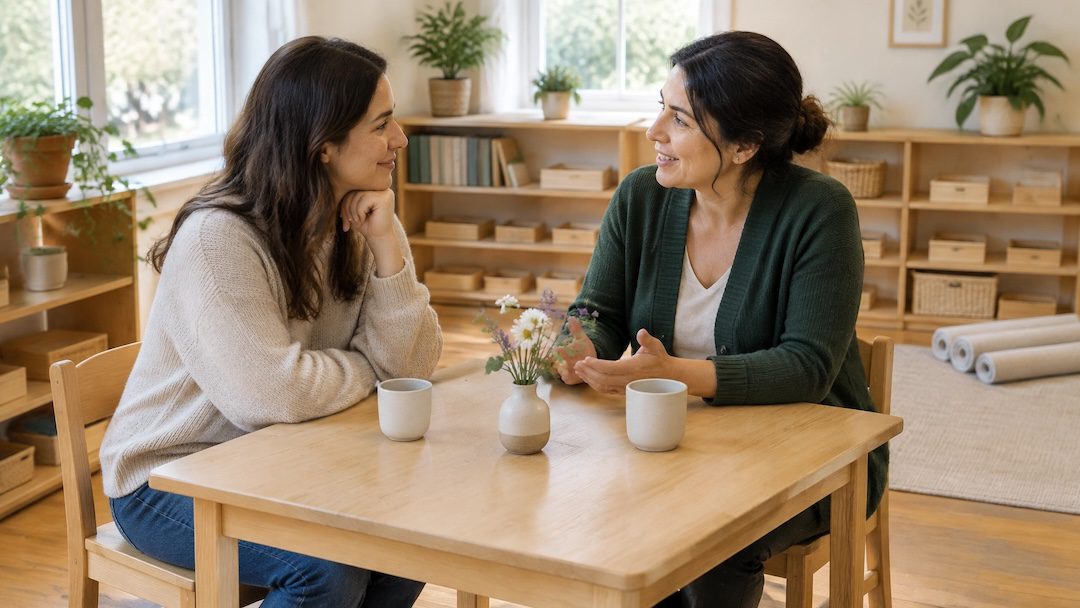
The most useful parent conferences are conversations in which two sets of caring adults compare what they know about the same child. The teacher sees your child within a community of peers, working with carefully prepared materials and following the rhythm of the classroom. You see your child within family relationships, daily responsibilities, celebrations, frustrations, and moments of vulnerability. Neither view is complete by itself. Together, they offer a far richer understanding, and that understanding leads to better decisions for the child.
One Child, Many Possibilities
Your child isn’t pretending to be independent at school, and isn’t necessarily pretending to need help at home. Both experiences can be genuine. Children are still developing, their abilities are still becoming consistent, and they respond to the people and environments around them. They sometimes need different kinds of support in different settings.
So the next time a teacher describes a child you barely recognize, don’t assume the teacher has made a mistake. Ask questions, share your own observations, look for patterns, and consider what each environment may be teaching you about your child. The goal isn’t to make children behave exactly the same everywhere. It’s to help them become increasingly capable, confident, and secure wherever they are.