Related Posts



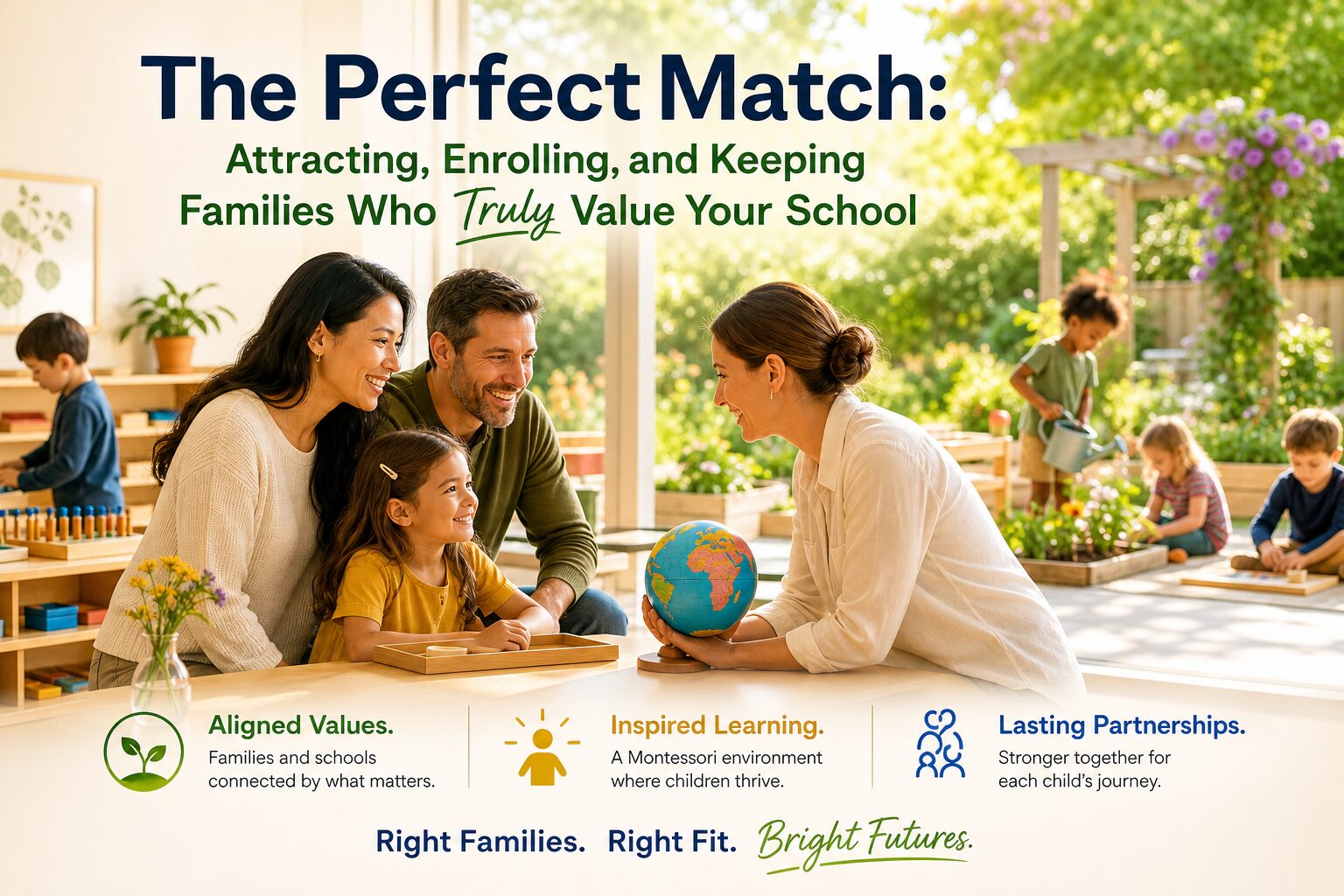
There is a practical reality every Montessori school leader understands: you need to fill your seats. Enrollment drives revenue, revenue sustains staff, and staff sustains the program. That is simply how schools survive.
But there is a second reality — equally important, and often far less clearly articulated. Not every family that can enroll will strengthen your school. The long-term health of your program, its culture, its consistency, and its ability to deliver an authentic Montessori experience depend on enrolling families who understand the work, support it, and remain part of the community over time.
This series is about how to do that intentionally — not through pressure or persuasion, but through clarity, alignment, and honest communication.
A Shift in How to Think About Enrollment
Most schools approach enrollment as a numbers problem. How many inquiries came in this month? How many tours did we schedule? How many applications are in the pipeline? Those metrics matter, and I am not suggesting you ignore them. But they do not address the deeper question: Are we attracting the right families, and are we helping them recognize that this is the right place?
When that alignment is missing, the consequences tend to show up later. Families who enrolled but remain quietly uncertain. Parents who question core Montessori practices — not out of bad faith, but because no one helped them truly understand what they were choosing. Students who leave at key transition points. A slow erosion of community cohesion that is hard to name but impossible to miss.
When schools consistently attract families who genuinely value Montessori, the picture looks very different. Retention improves. Parent partnership deepens. Teachers feel supported rather than challenged. The program becomes more stable, more confident, and ultimately more effective. Enrollment, understood this way, is not simply about filling seats. It is about building the conditions under which Montessori can actually succeed.
Why So Many Schools Struggle to Communicate Their Value
Montessori education is widely respected. Many parents are curious about it. Some actively seek it out. And yet, in school after school, the same pattern appears. Families express interest, visit the campus, like what they see — and then hesitate. This is rarely because Montessori lacks value. It is almost always because that value is not being communicated in a way parents can fully understand and trust.
Most schools fall into the same trap. They explain Montessori. They describe the philosophy, the materials, and the multi-age classroom structure. All of that matters — but it is not what parents are actually trying to decide. Parents are not asking, “What is Montessori?” They are asking much more personal questions: Will this work for my child? Will my child be successful here? Am I making the right decision? When those questions are not clearly answered, hesitation is the entirely natural result.
What Parents Are Really Looking For
Parents are not shopping for an educational method. They are trying to secure a future for their child. They want to raise children who are confident and capable, independent and self-directed, thoughtful and socially aware — children who will succeed not only in school but in life.
Montessori aligns remarkably well with those goals. But schools often communicate that alignment indirectly, or not at all. Instead of clearly connecting Montessori to the outcomes parents care about most, messaging tends to stay abstract. Child-centered. Whole-child development. Hands-on learning. These phrases are accurate, but they do not reduce uncertainty. They do not help a parent clearly see what will actually be different for their child if they choose your school.
The Role of Communication in Building Trust
At its core, enrollment is a trust decision. Parents are choosing to invest financially, commit emotionally, and align their family with your school’s philosophy. That level of commitment requires genuine confidence — and confidence comes from communication that consistently does three things.
It makes the outcome visible. Parents need to understand not just what children do in a Montessori classroom, but what they become. They need to see children concentrating deeply, taking ownership of their work, collaborating and leading — not as abstract ideals, but as observable realities they can recognize and believe.
It provides evidence. Parents look for proof, whether they realize it or not. They want to know how you assess children’s progress, what success looks like at different ages, and how students fare when they move beyond your program. Without clear answers to those questions, even a strong initial interest can turn into hesitation.
It reduces uncertainty. Every prospective parent carries unspoken concerns: Will my child fall behind? Is this too different from what I know? What happens next? Strong schools do not avoid those questions. They address them directly, calmly, and consistently — and in doing so, they build the kind of trust that leads to genuine commitment.
The Cost of Getting This Wrong
When communication is unclear or incomplete, schools often compensate in ways that create new problems down the road. They try to appeal to everyone. They soften or dilute Montessori principles. They overpromise outcomes or oversimplify what the program actually is. They rely on the warmth of a tour rather than the clarity of a message.
These approaches may produce short-term enrollment numbers. But they often lead to long-term misalignment — families who enrolled but do not fully support the program, increased friction between parents and teachers, higher attrition at transition points, and a weaker, less cohesive community. This is not simply a marketing problem. It is a program integrity problem.
A More Effective Approach
The goal is not to convince more families to enroll. It is to help the right families recognize that they belong. That requires a shift — from explanation to alignment. Instead of asking how we describe Montessori, ask what the hopes and concerns are of the families you most want to serve, where Montessori clearly meets those needs, and how you communicate that connection in language parents immediately understand.
When that alignment is clear, marketing becomes more effective, admissions conversations become more productive, and decisions happen more quickly and with greater confidence. You spend less energy persuading and more time welcoming families who were already looking for exactly what you offer.
What This Series Will Cover
In the coming articles, we will take this framework and apply it practically across every major part of your enrollment system. We will look at how to write ads that capture attention and attract the right families, how to design websites and landing pages that build confidence rather than confusion, how to structure school visits so parents truly understand what they are seeing, and how to follow up in ways that move families from interest to genuine commitment. We will also look at messaging that supports long-term retention — not just initial enrollment — and at how to use images, video, and storytelling to make Montessori visible and compelling to the families you most want to reach.
The goal is a practical playbook — one that schools can use to strengthen enrollment while preserving the integrity of everything that makes Montessori worth choosing.
Filling seats matters. But filling them with the right families matters far more, because over time, those families shape everything: the tone of your community, the level of trust in your classrooms, the stability of your enrollment, the strength of your Montessori practice. When your communication is clear, consistent, and aligned with what parents truly value, something important happens. The right families recognize themselves in your message — and they choose to stay.
In the next article, we will look closely at how to identify the fears, desires, and decision-making patterns of your ideal families, and how to use that understanding to shape every piece of your messaging.