Related Posts
by Tim Seldin
If you’ve spent your career in independent schools or early childhood education, you’ve likely encountered Montessori—perhaps as a competitor, a curiosity, or simply another name in the landscape of educational options. I want to take a few minutes to explain what we do and why it matters to anyone who cares deeply about how children learn and grow.
I’ve spent four decades working with Montessori schools around the world. What I’ve learned is that, while our methods differ, many of our goals align closely with what thoughtful educators in any setting aim to accomplish: helping children become confident, capable, and curious human beings.
A Different Starting Point: How We View Children
The foundation of Montessori education stems from Dr. Maria Montessori’s discovery that children of different ages have distinct learning styles. Rather than viewing education primarily as delivering content, we see it as preparing an environment that draws out each child’s natural curiosity, deepens their concentration, and sustains their joy in learning.
Dr. Steven Hughes, a pediatric neuroscientist, once described the difference this way: in traditional models, we push content and curriculum. In developmental models such as Montessori, we follow the learner and optimize brain development.
This doesn’t mean we abandon academics—far from it. Montessori students typically perform exceptionally well on standardized measures. But we believe that when you prepare a child’s mind and body for learning first, the academic content follows naturally and is retained more effectively.
If you’ve ever watched a child lose themselves in deep, focused work—the kind where time seems to disappear—you’ve seen what we’re cultivating. We aim to make that the norm rather than the exception.
The Prepared Environment: Freedom Within Structure
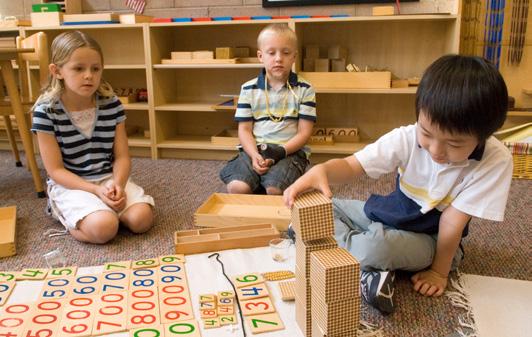
Walk into a Montessori classroom, and you’ll notice it looks different. Rather than desks in rows facing a teacher, you’ll see low shelves arranged around the perimeter, with materials displayed at child height. You’ll see children working on the floor, at tables, sometimes alone, sometimes in small groups. You might see a six-year-old helping a four-year-old, or a child who’s been working with the same material for forty-five minutes, completely absorbed.
This is what we call the “prepared environment.” Every material in the room has been carefully selected to focus on a specific concept or skill. Unlike toys with multiple features, our materials focus on one thing at a time, allowing children to master it through repetition and self-correction. The materials often indicate when children’ve made an error, reducing their reliance on adult judgment.
The teacher has introduced these materials to each child individually or in small groups. Once introduced, children are free to choose what they work on, for how long, and whether to work alone or with others. This isn’t chaos—it’s disciplined freedom. And it requires something many educators find difficult: trusting that children, given the right environment and materials, will choose work that challenges them.
Time to Go Deep: The Uninterrupted Work Cycle
One of our most distinctive practices is the three-hour uninterrupted work period. This likely sounds impractical to many educators accustomed to 45-minute blocks and subject-switching bells.
But here’s what we’ve found: when children know they have extended time, they settle into deeper work. They’re not watching the clock. They’re not mentally preparing for the next transition. A child can start with a simple activity, warm up, and then move to a more challenging task. Or they can stay with one material for an hour, really mastering it.
The teacher circulates, observing carefully, giving lessons to individuals or small groups, but most of the time belongs to the children themselves. This develops something we desperately need in our students: the capacity for sustained attention, self-direction, and deep work.
If you’re concerned about whether children can handle this much autonomy, I understand. Most of us didn’t experience it ourselves. But I’ve watched it work for thousands of children across cultures, socioeconomic levels, and learning profiles. It turns out children rise to the expectations we set and the trust we extend.
The Teacher as Guide: A Different Kind of Mastery
Montessori teachers undergo extensive specialized training—typically a full academic year beyond their bachelor’s degree. But what they learn is quite different from traditional teacher preparation.
Rather than lesson planning for whole-group instruction, they learn to observe individual children with scientific precision. Rather than lecturing, they learn to give concise, engaging presentations that spark interest and then step back. Their goal is not to be the center of attention but to make themselves gradually unnecessary.
We often say the Montessori teacher is “the guide on the side” rather than “the sage on the stage.” After introducing a concept or material, the teacher observes and reflects on the child’s understanding. What did they miss? What captures their interest? Based on these observations, the teacher decides when to re-present, when to introduce something new, and when to stay out of the way.
This doesn’t mean Montessori teachers are passive. It means they’ve developed a different kind of mastery—one that requires deep knowledge of child development, precise observation skills, and the wisdom to know when to intervene and when to trust.
And here’s something that might surprise you: we’re as interested in character development as academic achievement. We want avid scholars, yes, but we also want happy, emotionally healthy children who work well with others, show resilience, and develop genuine self-esteem grounded in real capability.
Why Multi-Age Classrooms Matter
If you’re accustomed to age-segregated grades, our multi-age classrooms might seem strange. We typically group children in three-year spans: 18 months to three years for toddlers, three to six for early childhood, six to nine for lower elementary, nine to twelve for upper elementary.
There are powerful reasons for this. Younger children learn by watching older ones. Older children solidify their own understanding by teaching younger ones. No child is permanently “the struggling one” or “the star”—everyone is both learner and teacher depending on the context. And critically, children aren’t competing with same-age peers for the teacher’s attention or comparing themselves to a narrow cohort.
But we also intentionally cultivate other kinds of diversity: different learning styles, different cultural and socioeconomic backgrounds, boys and girls together, typically developing children alongside those with learning differences.
Why? Because this mirrors the real world our students will enter. They won’t work in organizations sorted by age and ability. They’ll collaborate with people who think differently, learn differently, and come from different backgrounds. The Montessori classroom becomes a laboratory for learning how to work effectively across differences.
It’s worth noting that many successful innovators and entrepreneurs—Jeff Bezos, the founders of Google, and many others—credit their Montessori experience with teaching them to think independently, work collaboratively, and approach problems creatively. The skills developed in our diverse, mixed-age classrooms translate directly to adult success.
Three Core Values: Independence, Individuality, and Interdependence
Everything we do rests on three foundational values.
Independence. A young child once said to Dr. Montessori: “Help me to do it myself.” This captures our entire philosophy. We give children just enough support to become self-reliant—not so much that they remain dependent, but enough that they can master genuine skills.
From three-year-olds learning to pour their own water and button their own coats, to twelve-year-olds designing independent research projects, we’re constantly asking: how can this child do more for themselves? The goal isn’t independence for its own sake. It’s building the confidence and competence that comes from genuine capability.
Individuality. We’re not processing children through a standardized curriculum at a standardized pace. We’re helping each child discover and develop their unique capacities. Some children are drawn to mathematics, others to language or art or the natural sciences. Some learn quickly in bursts, others through patient, methodical repetition.
The Montessori approach allows us to honor these differences rather than fight them. Every child works at their own pace through a carefully sequenced curriculum, which means advanced learners aren’t held back and struggling learners aren’t left behind. This is differentiation built into the model, not something teachers have to engineer on top of everything else.
Interdependence. But we’re not just cultivating isolated individuals. We want children to understand that they’re part of something larger: their classroom community, the school, the natural world, society.
This is why we have children of different ages working together, why we emphasize care for the environment, why older children mentor younger ones, why we study our place in the cosmos and on the planet. We want students who are empowered and capable, yes—but who understand their responsibilities to others and the world they inhabit.
The Home-School Partnership: Parents as Partners
One final element that might interest you: we take parent partnership seriously in ways that go beyond typical parent communication.
We don’t see parents as peripheral to the educational process. They have insights about their children that we need in order to understand the whole child. And we have observations and strategies that can help parents at home. This is a genuinely collaborative relationship, not a hierarchical one where the school is the expert and parents are clients.
In practice, this means regular, substantive communication; parent education events where we help parents understand child development and Montessori philosophy; and a culture where teachers and parents trust each other enough to have honest, productive conversations about children’s growth and challenges.
Many independent schools aspire to this kind of partnership. We’ve built it into our model from the beginning.
What This Means for Education
I’m not suggesting Montessori is the only way to educate children well. Many independent schools and early childhood programs achieve remarkable outcomes through different approaches. But I do think we offer something worth considering—particularly as education faces mounting pressure to serve diverse learners, prepare students for an unpredictable future, and honor childhood rather than simply rush through it.
If you’ve been in education long enough, you’ve probably noticed that many current reform movements are “discovering” things Montessori has done for over a century: personalized learning, hands-on engagement, mixed-age groupings, emphasis on executive function and self-regulation, project-based learning, and developmental appropriateness.
We don’t claim to have all the answers. But we do have a comprehensive, time-tested model that addresses many of the challenges educators are grappling with today. And perhaps most importantly, we have evidence that it works—not just academically, but in developing the kind of humans we want to send into the world: curious, capable, compassionate, and confident.
If you’re building or leading a school, I suggest that you look closely at what we do. You might not adopt the whole model, but you might find elements worth adapting. And if you’re a parent or educator exploring options, I’d invite you to visit a well-implemented Montessori school—not to convince you it’s the only way, but to see what’s possible when we truly follow the child.
The question I encourage every school founder and leader to ask is this: What kind of human beings are we trying to cultivate, and does every decision we make support that vision?
For us, that question has been central for more than a hundred years. And it continues to guide everything we build.