Related Posts

Snapshot
Why do Montessori children learn the sounds of letters before their names? Why do they trace sandpaper letters, build words with a movable alphabet, and sometimes begin writing words before they can read them? Montessori’s approach to language follows a carefully considered developmental journey. It begins long before a child picks up a pencil and continues well beyond learning to read. Understanding that journey helps parents appreciate how children become confident readers, writers, and thinkers.
A parent visits a Montessori classroom and notices something unusual.
A four-year-old is sitting on a rug with a box of small wooden letters.
The child selects several letters and arranges them on the rug.
“Cat,” the child announces.
Then the child begins another word.
The letters aren’t perfectly aligned. The child isn’t writing with a pencil. And the teacher doesn’t seem concerned about spelling every word correctly.
What’s going on?
The child is learning to write.
But not in quite the way many adults remember learning.
Language Begins Long Before Reading
Think about how a child learns to speak.
Nobody hands a toddler a grammar textbook.
Children listen.
They watch.
They imitate.
They experiment with sounds.
They gradually discover that words have meaning and that words can be combined to express increasingly complicated thoughts.
By the time children are three, many have acquired an astonishing amount of language.
They can ask questions, tell stories, express feelings, and explain what they want.
Montessori education builds on this remarkable natural development.
Before children begin reading and writing, we help them develop rich spoken language.
We name things.
Tell stories.
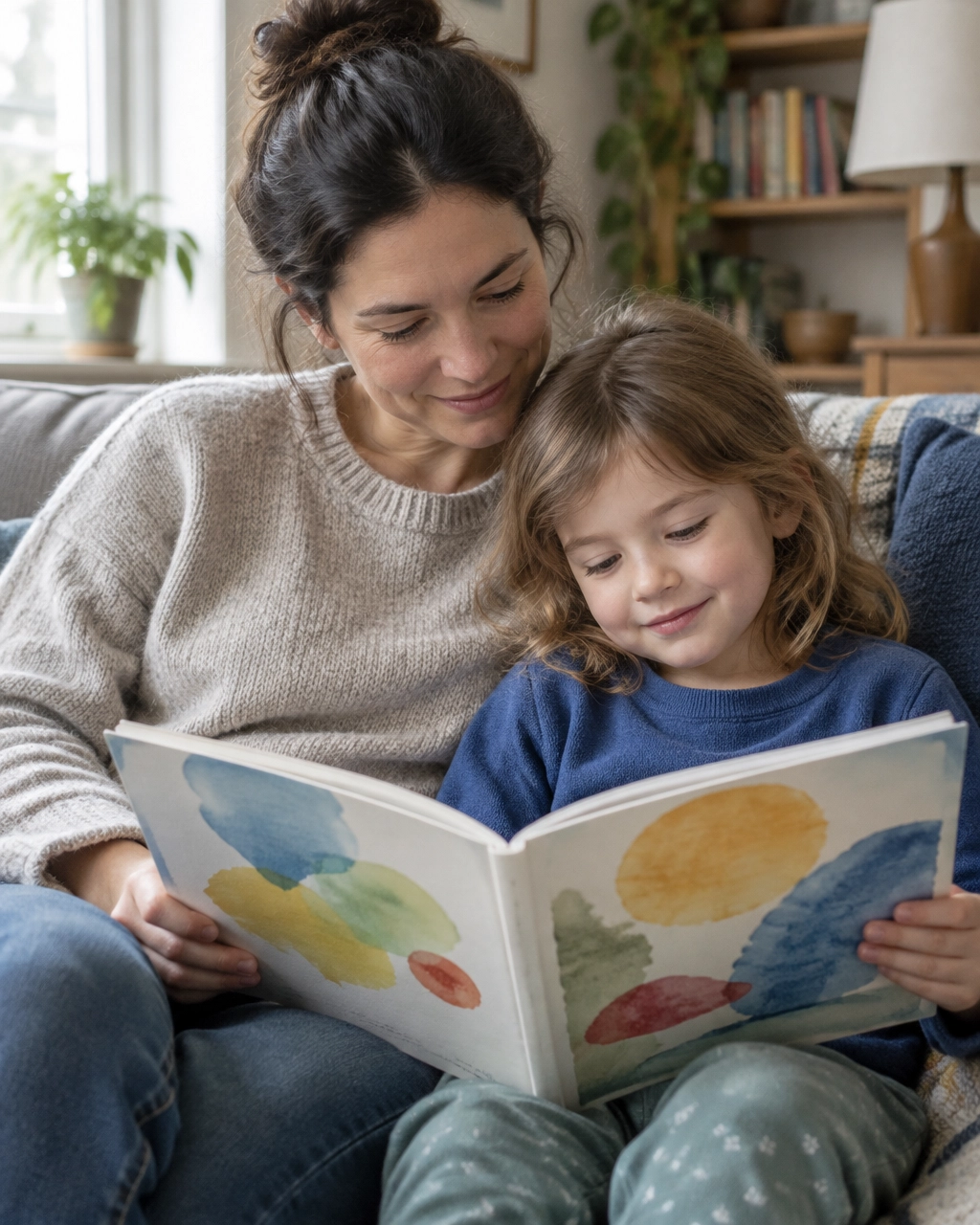
Read books aloud.
Sing.
Recite poems.
Talk about the world.
Listen carefully to what children have to say.
These experiences are not simply preparation for reading.
They are an essential part of intellectual development.

First, Children Learn to Hear the Sounds in Words
Before children can connect letters with sounds, they need to become aware that spoken words are made up of individual sounds.
Consider the word sun.
An adult hears a familiar word.
A young child gradually learns to hear the separate sounds: /s/, /u/, /n/.
This ability is called phonemic awareness.
Montessori teachers develop it through enjoyable language games.
“I spy something that begins with /m/.”
“Can you think of something that starts with /b/?”
“What sound do you hear at the end of cat?”
Notice that we’re talking about sounds, not letter names.
A child doesn’t need to know the name of the letter S to hear the /s/ sound at the beginning of sun.
This distinction becomes important when children begin learning written language.
Why Sandpaper Letters?
One of the best-known Montessori language materials is the set of sandpaper letters.
Each letter is made from a textured surface mounted on a smooth board.
The child traces the shape with two fingers while hearing and saying its sound.
For example, the teacher may trace the letter m while saying /m/.
The child sees the shape.
Feels the shape.
Hears the sound.
And eventually learns to connect them.
This is a multisensory experience.
Instead of simply memorizing what a letter looks like, the child develops a physical familiarity with its form.
Montessori teachers generally introduce the sounds associated with letters rather than beginning with their alphabet names.
Why?
Because when children begin sounding out words, they need to know what sounds the letters represent.
Knowing that the letter M is called “em” is useful.
But knowing that it represents /m/ is what helps a beginning reader recognize the word mat.
Children eventually learn letter names too. The emphasis on sounds is a deliberate starting point, not a rejection of the alphabet.

Writing Can Come Before Reading
This is one of the most surprising aspects of Montessori language education.
We often assume that children must learn to read before they can write.
But Montessori recognized that children may be ready to compose words before they have developed the fine-motor control needed for handwriting.
Imagine a child who can hear the sounds in dog.
The child knows the letters that represent /d/, /o/, and /g/.
But holding a pencil and forming those letters may still be difficult.
Should the child have to wait?
Montessori’s answer was no.
Enter the Movable Alphabet
The movable alphabet is a collection of individual letters that children can arrange to form words.
The child doesn’t have to write each letter by hand.
Instead, the child selects the letters needed to represent the sounds they hear.
At first, the child may build simple phonetic words.
Later come longer words, phrases, sentences, and stories.
The movable alphabet allows children to express ideas through written language before handwriting has become effortless.
And because children are composing rather than merely copying, they begin to experience written language as a means of communication.
A child may use invented phonetic spelling while developing this ability.
That doesn’t mean spelling doesn’t matter.
It means the child is working through a developmental process in which expressing ideas and learning conventional spelling gradually come together.
Meanwhile, the Hand Is Being Prepared
Montessori children also work with materials that develop the coordination needed for handwriting.
The Metal Insets, for example, invite children to trace geometric shapes, create designs, and fill areas with carefully controlled pencil strokes.
Practical Life activities develop coordination and control of movement.
Sandpaper letters introduce the movements associated with forming letters.
Eventually, children begin writing letters, words, and sentences by hand.
The goal is not simply neat handwriting.
It is helping children develop the physical ability to communicate their thoughts without the mechanics of writing becoming an overwhelming obstacle.
Then Comes Reading
Reading requires another important step.
The child must look at written symbols, connect them with sounds, blend those sounds, and recognize the resulting word.
Montessori classrooms offer carefully sequenced opportunities to develop this ability.
Children may begin by reading simple phonetic words and matching them with objects or pictures.
Later, they encounter more complex spelling patterns, phonograms, and words that cannot be decoded using only the simplest sound-letter relationships.
They gradually move from individual words to phrases, sentences, and books.
Reading doesn’t necessarily arrive as a single dramatic moment.
For some children, it develops slowly and steadily.
For others, several pieces seem to come together almost suddenly.
Teachers observe each child’s progress and provide appropriate lessons and practice.
Reading Is More Than Decoding Words
A child who can pronounce every word on a page isn’t necessarily understanding what the page means.
Real reading involves comprehension.
Children need vocabulary, background knowledge, curiosity, and the ability to make connections.
This is one reason Montessori education places such importance on language throughout the curriculum.
Children talk about geography, biology, history, mathematics, art, and the natural world.
They learn the names of plants, animals, landforms, and geometric shapes.
They listen to stories and discuss ideas.
All of this builds the knowledge that helps reading become meaningful.
What Happens in Elementary School?
The language curriculum doesn’t end when children become fluent readers.
In Montessori elementary classrooms, children increasingly use reading and writing to explore the world.
They research questions.
Write reports.
Compose stories and poems.
Study grammar.
Investigate word origins.
Prepare presentations.
Discuss books.
Learn to organize and communicate increasingly complex ideas.
Language becomes both a subject of study and a tool for learning everything else.
A child who once used the movable alphabet to build the word cat may eventually write a research paper about the evolution of mammals.
The developmental journey is extraordinary.

How Can Parents Help at Home?
The most important thing parents can do is create a language-rich family life.
Read aloud every day, even after children begin reading independently.
Talk with your children.
Tell stories.
Listen to theirs.
Play rhyming games.
Sing songs.
Visit the library.
Let children see you reading and writing for real purposes.
Invite them to help write shopping lists, birthday cards, recipes, and messages to relatives.
And resist the temptation to turn every enjoyable activity into a lesson.
A child who loves books, stories, conversation, and ideas already has a powerful foundation for literacy.
If you are concerned about your child’s progress, talk with the teacher. Montessori’s individualized approach should include careful observation, appropriate instruction, and timely support when a child experiences difficulty.
The Larger Goal
Montessori language education is not simply a different technique for teaching children to read.
It is an approach that begins with the child’s natural desire to communicate.
It respects the development of spoken language.
It connects sounds, symbols, movement, and meaning.
It allows children to compose words before handwriting is fully developed.
And it gradually opens the door to the vast world of written language.
Ultimately, we want more than children who can sound out words.
We want children who read because they are curious.
Who write because they have something to say.
Who listen carefully.
Who express themselves clearly.
And who discover that language gives them the power to explore ideas, understand other people, and share their own thoughts with the world.
Learning to read opens the door. Learning to love language invites children to walk through it.