Related Posts


If Montessori education is to remain strong in the century ahead, the single most critical factor will be the preparation of the adults who guide the children. Buildings may change. Technology will evolve. But everything depends on the quality of the human being in front of the child—the prepared adult who leads with calmness, compassion, and understanding.
Maria Montessori saw teacher preparation as both a scientific and a spiritual process. It is not only about knowing how to present lessons but about transforming how we see children and ourselves. The adult learner must cultivate patience, humility, and faith in the child’s potential—what Montessori called “the inner preparation.”
That remains at the heart of every authentic training program, no matter where or how it is delivered.
The Landscape of Montessori Teacher Education
Montessori teacher education today is extraordinarily diverse.
The Association Montessori Internationale (AMI), founded by Maria Montessori herself, continues to represent the most traditional approach, usually through full-time year-long programs or two-summer intensive courses followed by a practicum year.
The American Montessori Society (AMS) and the Montessori Accreditation Council for Teacher Education (MACTE) have also shaped the modern landscape, promoting high standards for curriculum, practicum supervision, and faculty preparation.
Alongside these, many respected organizations have broadened access to authentic Montessori education: MEPI (Montessori Educational Programs International), the IMC (International Montessori Council), IAPM (International Association of Progressive Montessorians), Pan American Montessori Society, MCI (Montessori Centre International in London), and MWEI (Montessori World Educational Institute), among others.
The Center for Guided Montessori Studies (CGMS)—an IMC-affiliated program—pioneered the blended, low-residency format now widely emulated. Together, these organizations represent a global movement that continues to evolve while remaining true to Montessori’s enduring principles.
The Traditional and University-Based Models
For decades, Montessori teacher training has been offered in deeply immersive, in-person programs lasting from nine months to two years. These full-time courses immerse the adult learner in Montessori philosophy, child development, and the practice of using materials. Observation and daily mentorship are constant.
Many of these programs are now university-affiliated, allowing students to earn both Montessori certification and academic credit toward a degree. Loyola University Maryland and Sarasota University—the first fully accredited Montessori university—are among the best-known in the United States. Several other universities accept MACTE-accredited coursework toward completion of a B.A., M.A., or M.Ed.
Other traditional programs, especially within AMI and AMS, follow a summer-intensive model: one or two full summers of coursework followed by a year-long supervised practicum. These programs enable working educators to train while remaining active in their schools.
The strength of all in-person formats is immersion. Adult learners live and breathe Montessori—observing classrooms, handling every material, and internalizing the calm rhythm and precision that give the method its grace.
The Practicum: Where Theory Becomes Wisdom
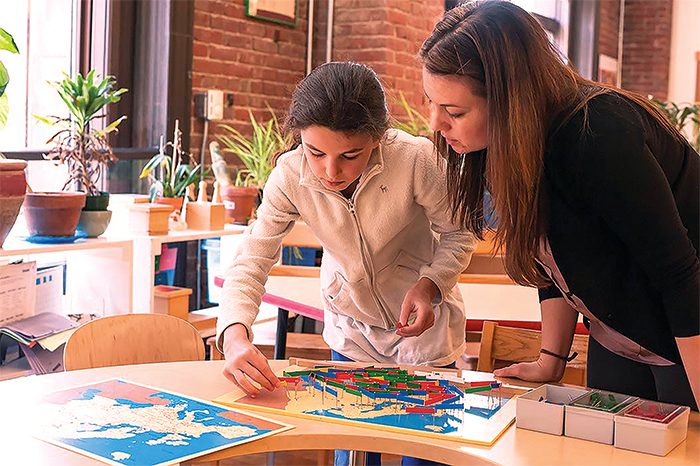
The practicum year is where Montessori training becomes real. Under the guidance of a certified, experienced Montessori mentor in a functioning classroom, the trainee learns how to balance freedom and order, maintain calm through chaos, and recognize the moment when intervention helps—or hinders—a child’s independence.
A supervised practicum provides modeling, coaching, and accountability. The mentor teacher sets the tone, guiding the intern through observation, reflection, and gradual assumption of leadership.
By contrast, a self-directed practicum—where a trainee leads a class independently with only occasional supervision—rarely provides enough support unless additional mentoring is built in by the school or the training center. Without steady observation and feedback, the subtleties of authentic Montessori practice can be easily lost.
Because the practicum is so essential, most schools that sponsor new teachers for training make sure that consistent support is provided. Many will underwrite tuition in exchange for a multi-year teaching commitment—often five years—ensuring both stability for the school and meaningful experience for the teacher.
Blended and Low-Residency Models
The advent of the blended-learning model, first championed by CGMS, has transformed Montessori teacher preparation. Combining streaming video lectures, filmed classroom observations, recorded lesson presentations, and live interactive seminars, this approach allows adult learners to study from anywhere while maintaining depth and rigor.
In-person residencies provide the tactile and relational side of learning—practicing with materials, role-playing lessons, and receiving individualized feedback. The practicum year completes the circle, with regular video conferences, observation reports, and visits from supervising faculty.
When CGMS introduced this approach, it was controversial. Many in the Montessori world doubted that online formats could replicate the transformational experience of traditional training. Yet, over time—and especially during the pandemic—nearly every training center found itself turning to hybrid or fully online instruction out of necessity.
What began as an experiment became a revelation: well-designed blended programs could be rigorous, relational, and remarkably effective.
Today, blended formats are offered not only by CGMS and IMC but also by AMS, MEPI, and other programs worldwide. The key is balance—preserving depth of practice, strong mentorship, and philosophical integrity while expanding access for adult learners who cannot leave their jobs or families for extended periods.
The Core Curriculum: Preparing the Whole Adult
Every authentic Montessori teacher education program, whether traditional or blended, includes a comprehensive course of study that mirrors the holistic nature of child development. Core areas include:
- Montessori Philosophy and Human Development — understanding the purpose of education as the self-construction of the person
- Observation and Documentation — learning to watch with neutrality, to record what one sees, and to interpret through a developmental lens
- Environmental Design — preparing physical and psychological spaces that foster independence, beauty, and peace
- Curriculum and Material Mastery — not only how to present lessons, but how they interconnect across the curriculum and across age levels
- Peace Education — nurturing empathy, conflict resolution, and moral awareness appropriate to the child’s stage of development
- Diversity, Equity, and Inclusion — building classrooms that honor difference and reflect the cultures and languages of the families they serve
- Supporting Diverse Learners — meeting the needs of neurodivergent children and those with physical or emotional challenges through individualized strategies
- Family Communication and Engagement — explaining Montessori principles clearly to parents and sharing each child’s social, emotional, and academic growth
- Collaboration and Teamwork — functioning as part of a teaching team and cultivating shared leadership
- Classroom Leadership and Management — maintaining structure and grace, fostering responsibility through calm authority rather than control
- Assessment and Record-Keeping — documenting progress through observation and narrative reports rather than grades or tests
- Professional Ethics and Self-Care — managing stress, maintaining balance, and sustaining one’s joy and purpose
These studies, coupled with practice and reflection, prepare adults not only to teach but to lead—to build communities of peace and purpose.
The Range of Programs and the Question of Depth
Montessori teacher preparation now spans a wide continuum of models and intensity. Programs such as AMI, AMS, IMC, MEPI, and MCI require extensive coursework, supervised practicums, and ongoing evaluation to ensure consistency and depth. Their graduates are generally well prepared to assume responsibility for a Montessori classroom immediately upon certification.
Alongside these are other study options, such as NAMC (North American Montessori Center), Pan American, and various regional or online programs that are not MACTE-accredited. These initiatives have played a meaningful role in introducing Montessori philosophy and methodology to a global audience, particularly in regions where accredited training centers are inaccessible.
However, while such programs can inspire and inform, they should not be mistaken for full professional preparation. Graduates often emerge with a solid conceptual grasp of Montessori ideas but without the intensive practicum experience, guided supervision, and mentorship required to internalize the method at a professional level.
Montessori teaching is not simply a curriculum—it is a craft learned through observation, modeling, and reflective practice under the guidance of a trained and experienced mentor.
This is why MACTE accreditation has become so important. MACTE’s standards ensure that programs balance rigorous theory, practical experience, and mentorship. Accreditation gives schools, parents, and trainees confidence that the diploma represents a comprehensive, high-quality preparation for leading a classroom.
At the same time, it’s worth recognizing that programs like NAMC and others have provided valuable access points—often helping aspiring educators discover Montessori and later pursue more in-depth, accredited training. In this sense, they can serve as entryways rather than endpoints.
Ultimately, what matters most is integrity, mentorship, and the commitment to true transformation. The deepest Montessori preparation—whether through AMI, AMS, MEPI, IMC, or another accredited organization—produces adults who do not simply know Montessori but become Montessori in their way of seeing and serving the child.
Technology, AI, and the Next Frontier
Technology will continue to influence teacher education in ways Maria Montessori could never have imagined. Artificial intelligence, when used wisely, can become a valuable assistant—never a replacement—to teachers and trainers.
AI-powered tools may help adult learners analyze classroom observations, recognize behavioral patterns, and strengthen objectivity. Virtual reality may soon allow trainees to “step inside” a simulated Montessori classroom, observe lessons at work, or practice presentations in an environment that responds to their timing and tone.
Within schools, AI could also lighten the load of paperwork that so often pulls teachers away from children. It can assist with tracking attendance and lesson records, documenting children’s work choices, and even generating progress summaries based on teacher observations—always under human review. It can help organize communications with parents, reminding teachers to share milestones or schedule conferences.
Properly used, AI should never replace human intuition or the daily art of observation. Instead, it can support teachers by freeing them from repetitive administrative tasks so they can spend more time doing what truly matters: watching, guiding, and connecting with children.
Used ethically, transparently, and with respect for privacy, such technologies can enhance Montessori education rather than threaten it—allowing teachers to focus on human relationships while still meeting the increasing demands of documentation and accountability.
The Human Dimension
Behind all the structures and acronyms lies a deeply human story. People choose to become Montessori educators out of love—love of children, of learning, of peace. Yet the journey is demanding. Training requires time, money, and emotional stamina, and compensation in early childhood education remains modest.
Recognizing these realities, many schools now sponsor their own teachers through training, covering tuition in exchange for a commitment to remain with the school for several years—often five. This partnership benefits both sides: the school gains continuity and depth, and the teacher gains mentorship, a sense of belonging, and a secure start to their Montessori career.
Ultimately, the work of the Montessori teacher is not learned solely from manuals. It is learned through guidance, reflection, and the quiet shaping of character over time.
Looking Ahead
The future of Montessori teacher preparation depends on holding two truths at once: that Montessori training must remain a journey of transformation—not just information—and that adults learn in many different ways.
Whether one studies at an AMI center in Amsterdam, an AMS-affiliated university program in Boston, a MEPI or IMC center in North Carolina, MCI in London, or through a blended online program like CGMS, the goal is the same: to prepare adults who can observe with humility, lead with kindness, and create classrooms where children grow in independence, confidence, and peace.
Technology may open new doors—but transformation still happens person to person, heart to heart, hand to hand.
If Montessori teacher education continues to honor that sacred relationship while embracing innovation, it will continue to form the kind of teachers the world most needs: grounded, compassionate human beings who believe in the limitless potential of every child—and who know how to help it unfold.