Related Posts

How Mixed-Age Montessori Classrooms Support Social and Moral Development
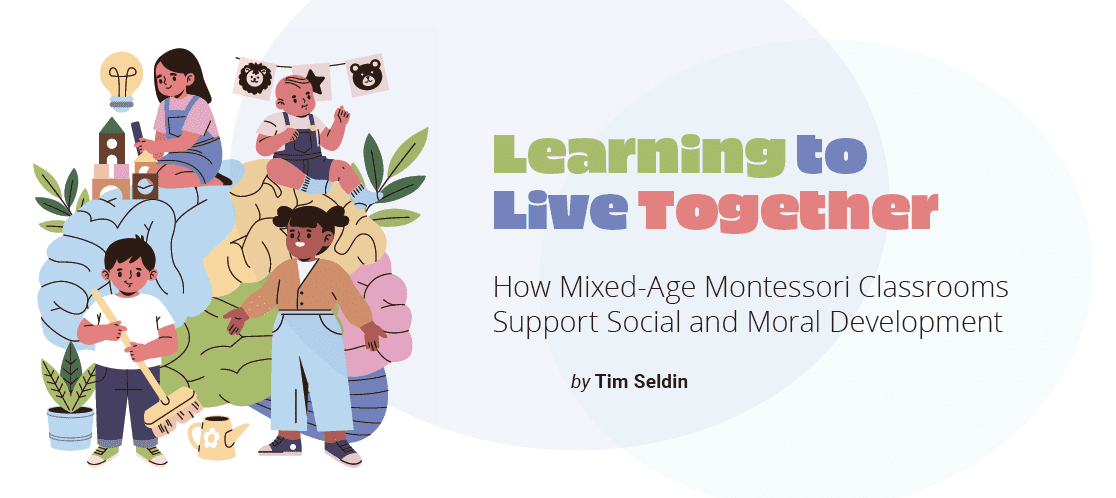
One of the first questions many parents ask about Montessori is whether mixed-age classrooms are used. Children ages three to six learn together, sharing the same space, materials, and daily rhythms. Parents naturally wonder: Will younger children be overwhelmed? Will older children be held back? How does this actually work socially?
These are reasonable questions, especially for those of us
who grew up in traditional, same-age classrooms. Montessori, however, is grounded in a different understanding of how children develop—not only academically but also socially and morally. The mixed-age classroom is not simply an instructional choice. It is a carefully designed social environment intended to help children learn to live with others.
A Classroom that Reflects Real Life
Outside of school, children are rarely grouped strictly by age. Families include siblings of different ages. Neighborhoods and communities are naturally mixed. Montessori classrooms intentionally mirror this reality.
Within a three-year age span, children experience themselves in different roles. One year, they are new and learning; later, they become confident helpers and leaders. No child is always the youngest or always the most capable.
This balance reduces unhealthy comparison and allows confidence and humility to grow side by side.
Leadership Grows Naturally
In a mixed-age Montessori classroom, leadership is not assigned by adults. It emerges from competence. Older children help younger ones because they can—and because they remember what it felt like to struggle.
You might see a five-year-old patiently showing a younger child how to roll a rug, or a four-year-old helping a threeyear-old complete a puzzle. These moments are not staged. They occur because children feel ownership of their environment and a sense of responsibility for one another.
This kind of leadership builds empathy. Younger children learn that asking for help is safe. Older children learn that knowledge carries responsibility. Both age groups come to see learning as something shared rather than competitive.
Conflict as a Learning Opportunity
When children of different ages share a space for several years, conflict is inevitable—and valuable. Montessori does not try to eliminate conflict.
Instead, guides help children work through it respectfully.
Montessori classrooms do not rely on reward charts, public praise, or artificial incentives to encourage good behavior. Instead, values are embedded in daily life.
A younger child may want a material that someone else is using. They learn to wait, ask, or choose something else. The older child learns to finish their work thoughtfully and return materials so others may use them. Over time, children learn that their choices affect the community.
These everyday moments are how moral reasoning develops. Children are not lectured about fairness or kindness. They experience what cooperation feels like—and what happens when it breaks down.
How Character Is Built
Montessori classrooms do not rely on reward charts, public praise, or artificial incentives to encourage good behavior. Instead, values are embedded in daily life.
Children wait because the community matters.
They care for materials because other children depend
on them.
They speak respectfully because relationships endure.
They help because they belong together.
Over time, external guidance becomes internal understanding. Children begin to act considerately, not to please adults but because it feels right.
What Parents Often See—and Miss
From the outside, Montessori classrooms usually appear calm and simple. Children work independently or in small groups without constant adult direction. What may not be immediately visible is the complex social learning taking place beneath the surface.
When an older child patiently teaches a younger one, they are learning responsibility and self-control. When younger children watch attentively, they are developing trust in their own future growth.
Parents sometimes worry that younger children will struggle or older children will be bored. More often, younger children feel inspired, and older children feel purposeful. Each child matters—not only for what they receive but also for what they contribute.
Partnering with Your Child’s Montessori Guide
If you are curious about how your own child is navigating the mixed-age environment, your Montessori guide is your best resource. Guides observe social development over extended periods and can provide insights that may not be apparent at home.
They see the shy child beginning to speak up, the impatient child learning to wait, the confident child learning gentleness.
In a mixed-age Montessori classroom, children are learning far more than academics. They are learning how to live with others—and how to act with integrity when no one is watching. That, ultimately, is education at its deepest level.