Related Posts


Three Tools That Finally Match What Montessori Does
I rarely advocate for specific products in print. I have been around long enough to be skeptical of anything that presents itself as the answer to a problem our schools have been navigating for decades. But occasionally I encounter tools so genuinely aligned with what Montessori education values — and so useful in combination — that staying quiet feels like a disservice.
This is one of those times.
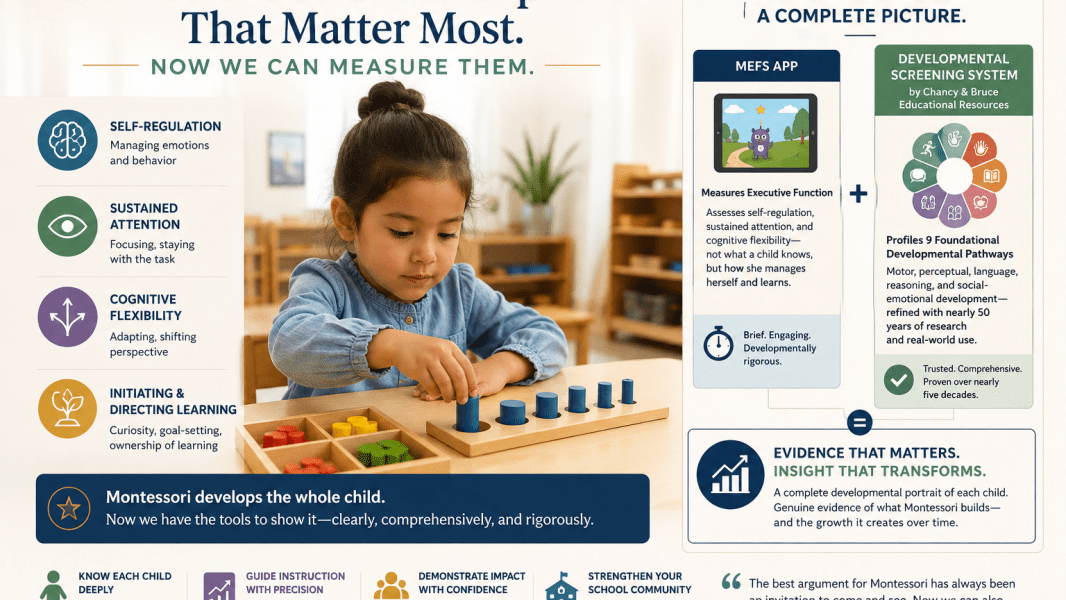
Over the past year, I have been looking closely at three assessment tools that I believe belong in far more Montessori schools than are currently using them.
The first is the MEFS App, a scientifically validated measure of executive function developed by researchers at the University of Minnesota.
The second is the developmental screening system from Chancey & Bruce Educational Resources, which I have written about separately and which I am increasingly convinced represents the best early childhood developmental assessment available to independent schools.
The third is the Developmental Environmental Rating Scale — the DERS — developed by the National Center for Montessori in the Public Sector, which assesses not the child but the classroom itself.
Used individually, each of these tools gives a school something valuable. Used together, they give a school something it has rarely had: a genuinely complete picture of how each child is developing, rigorous evidence of what the Montessori environment is actually producing, and a coherent framework for demonstrating all of it to the families and boards that need to understand it.
What We Know and What We Can Show
For as long as I have been in this work — and that is more than fifty years now — the strongest argument for Montessori education has been: come see for yourself. Visit our classrooms. Watch the children. You will understand.
That argument remains true. But it is no longer sufficient.
Public pre-K programs are expanding in state after state. Families are comparing options with a sophistication that was rare a generation ago. Boards and accrediting bodies want evidence of outcomes. And prospective parents — even those who are already drawn to Montessori — are asking harder questions than they used to. Philosophy matters to them, but so does proof.
The honest challenge is that Montessori builds things that conventional assessments do not measure well. Standardized tests tell us what a child already knows. They rarely tell us anything useful about how she manages herself, sustains effort, recovers from frustration, or brings flexible thinking to a problem she has not seen before. Those are the capacities that Montessori education develops with particular intentionality — and until recently, we had no reliable way to document that development systematically.
That is beginning to change.
Executive Function: The Heart of What We Build
Executive function is the umbrella term researchers use for the cognitive skills that govern how we manage ourselves and our thinking: working memory, cognitive flexibility, inhibitory control, and planning. These are not peripheral abilities. Study after study has confirmed that they are better predictors of long-term academic success than IQ — and that their influence extends well beyond school, shaping adult health, professional effectiveness, and the quality of relationships across a lifetime.
What strikes me every time I read this research is how precisely it describes what Montessori education is designed to develop. The three-hour uninterrupted work cycle is, among other things, a sustained daily exercise in working memory and inhibitory control. The freedom to choose work — real freedom, within a carefully prepared structure — builds cognitive flexibility and the capacity to initiate and sustain purposeful effort. The self-correcting materials shift the locus of evaluation from the teacher to the child, building internal monitoring and self-regulation. Maria Montessori did not use the language of neuroscience, but she was deliberately and systematically building executive function for decades before researchers gave it that name.
This means that a valid, reliable measure of executive function is not simply a useful research tool for Montessori schools. It is a direct measure of what we do and what we produce.
The MEFS App: Assessment That Fits Our Children
The MEFS — the Minnesota Executive Function Scale — was developed by Dr. Stephanie Carlson and Dr. Philip Zelazo, two of the leading researchers in executive function science. It is administered as a brief, game-like interaction on a tablet. Children as young as two can complete it without the experience feeling like a test, because for them, it genuinely does not. The assessment is appropriate across a wide age span, yields reliable and standardized results, and — importantly — measures executive function as something distinct from intelligence. It correlates strongly with other validated EF measures and shows low correlation with IQ. It is capturing something real and specific that most assessments entirely miss.
I know some Montessori educators will need a moment with this. We are cautious about standardized testing, and rightly so. We have seen what happens when the wrong tools are used to evaluate our children — when a child who has spent years developing concentration and self-direction is handed a timed worksheet and the result is presented as evidence of what she knows. The MEFS is not that. It is designed to observe developing cognitive capacities through an age-appropriate, engaging interaction. It is consistent with how we believe children should be assessed.
Used over time, MEFS data becomes a growth story. A school that tracks executive function from the toddler program through the primary years and into elementary can see not just where children are, but how they are developing — and whether the environments it is creating are doing what Montessori environments should do.
The DERS: Assessing the Environment, Not Just the Child
This brings me to the piece that makes the full framework coherent.
The MEFS tells us what is developing in the child. It does not, by itself, tell us why — or whether our classrooms are actually providing what Montessori classrooms should. That is what the Developmental Environmental Rating Scale addresses.
The DERS was developed by the National Center for Montessori in the Public Sector as a rigorous, Montessori-specific instrument for evaluating the quality of the prepared environment. Where generic classroom observation tools measure features that apply equally to any early childhood setting, the DERS is built around the specific conditions that define a well-functioning Montessori classroom: the integrity of the materials, the character and structure of the work cycle, the degree to which children exercise genuine self-direction, the quality of adult-child interactions, and the overall coherence of the prepared environment as a system.
The thesis underlying the DERS, and the reason I find it so compelling in combination with the MEFS, is direct and testable: classrooms that score high on the DERS should produce children who score high on the MEFS. A classroom that faithfully creates the conditions Montessori described — genuine freedom, a coherent prepared environment, sustained uninterrupted work, respectful adult presence — will be building executive function in the children who inhabit it. A classroom that has the right materials but lacks those conditions, or that interrupts the work cycle with transitions and teacher-directed activities, will be building something less than what Montessori intended. The DERS can tell you which situation you are in. The MEFS, tracked over time, can confirm it.
This matters practically for school leaders. A classroom observation tool tells you what to look for and gives you a framework for honest reflection and productive coaching. It identifies specifically where a classroom environment is strong and where it falls short — not in terms of generic quality metrics, but in terms of the Montessori-specific conditions that produce the outcomes we care about. And it creates accountability that is grounded in our own values rather than borrowed from a framework built for different purposes.
The National Center has developed a licensing program that allows schools to access both the DERS and the MEFS as an integrated annual subscription, which makes it practical for schools to use them systematically rather than as one-off exercises. The connection between the two tools is not incidental. It is the point: assess the environment, assess the children developing within it, and see whether the relationship between those two measures tells the story you hope it does.
Chancey & Bruce: The Developmental Foundation
Executive function matters enormously. It is not, however, the whole picture of a young child’s development.
A child may have strong self-regulation and genuine gaps in auditory memory. Another may be highly verbal but show fine motor development that is lagging behind what her work with Montessori materials will eventually demand. A third may have receptive language well ahead of his expressive language — a gap that an attentive teacher might sense without being able to name. Without a careful look at the full developmental landscape, we respond to what we can see and miss what lies beneath.
This is what Chancey & Bruce address.
I wrote at length about Chancey & Bruce recently, so I will not retrace that ground in full here. The short version: founded in the early 1980s, they have spent nearly fifty years developing and refining a developmental screening system that is now among the most thorough and trustworthy available to early childhood programs. Their one-on-one assessment — conducted by trained screeners and drawing on input from parents and teachers as well — profiles children across nine developmental pathways: fine motor, gross motor, visual discrimination, visual memory, auditory discrimination, auditory memory, receptive language, expressive language, comprehension, and social-emotional maturity.
If you have spent time in a Montessori classroom, these domains will feel like old friends. They are the neurological foundations — the architecture of learning rather than its surface products — that our environment is specifically designed to build. Chancey & Bruce is not measuring something foreign to us. They are looking carefully at the very capacities we spend years nurturing.
What the Three Together Can Tell You
Here is what I find most compelling about using these tools in combination.
The DERS establishes a foundation at the classroom level. It asks whether the environment a school has created is, in fact, a Montessori environment in any deep sense — one with the structural integrity and fidelity to principle that the research associates with strong developmental outcomes. It is the input measure. It gives school leaders an honest evaluation of the conditions they are providing before asking what those conditions are producing.
The MEFS then measures the most significant outcome — the development of executive function — in the children who have been living and working in that environment. If the DERS is asking whether we are doing what Montessori intended, the MEFS is asking whether it is working. The relationship between the two, tracked honestly over time, is one of the most meaningful things a Montessori school can know about itself.
The Chancey & Bruce screening widens the lens to ensure that no child falls through the gaps. It provides breadth — a careful developmental portrait of the whole child across all the foundational domains, with the nuance that comes from triangulating screener observation, teacher input, and parent perspective. A child who scores well on the MEFS but has unaddressed gaps in auditory processing may be working harder than she needs to in order to keep pace with the phonemic awareness work that comes naturally to her peers. A child whose executive function is growing beautifully may still need extra time and guidance in fine motor development before certain Montessori materials will be accessible to her in the ways they are intended to be. The Chancey & Bruce screening catches what the MEFS, by design, does not pursue.
Together, the three tools give a school what it has rarely had. The DERS tells you whether your environment is what you believe it to be. The MEFS tells you whether your children are developing the self-regulatory capacities that Montessori environments are specifically designed to build. Chancey & Bruce ensures that you see each child whole — not just the cognitive self-management capacities that aggregate data can reveal, but the full developmental picture that individualization requires.
For school leaders, the aggregate story matters as much as the individual one. A school that can show, over multiple cohorts, that high-fidelity Montessori environments — as measured by the DERS — produce children with measurably growing executive function — as measured by the MEFS — is doing something rare and significant. It is building an evidence base for what Montessori education actually does. That evidence answers questions that philosophy alone cannot answer, meets families where they are, and gives boards and accreditors the outcome data they are increasingly asking for.
This summer, we will be hosting a webcast that brings all three tools into direct conversation. We will look at how the DERS, the MEFS, and the Chancey & Bruce system can be used together as a coherent assessment strategy — how they relate to each other, what each one reveals that the others do not, and how school leaders can begin to build this kind of systematic evidence-gathering into the rhythms of their programs. I hope you will join us. Details on how to register will be forthcoming.
To Wrap Up
Montessori herself was a scientist. She measured things. She observed with precision. She was always in the service of understanding the child more deeply rather than confirming what she already believed. I do not think she would have been suspicious of tools like these. I think she would have been glad we finally have them.
The most important work still happens in the classroom. It always has, and no assessment changes that. But tools that look carefully at the very things we most care about — that see what we see through lenses we can trust — deserve a serious look from every Montessori school committed to knowing its children well and demonstrating that commitment to the world.
Copyright 2026 The Montessori Foundation