Related Posts



Snapshot
A Montessori parent conference is more than a progress report. It is a chance for the two groups of people who know your child best, parents and teachers, to compare notes, ask questions, notice patterns, and think together about what your child needs next. A little preparation can turn a pleasant twenty-minute conversation into something genuinely useful.
Sometime this fall, you may find yourself sitting across from your child’s Montessori teacher for your first parent conference of the school year. You may arrive with a long list of questions, or with absolutely no idea what to ask. Perhaps your child seems wonderfully happy, and you mainly want reassurance. Or perhaps something has been worrying you.
“My child says she doesn’t have any friends.”
“He says he doesn’t do anything all day.”
“Every morning she says she doesn’t want to go to school.”
“Why isn’t he reading yet?”
“She used to tell me everything. Now I get ‘I don’t know’ and ‘nothing.'”
This is exactly why conferences matter. You and your child’s teacher are both looking at the same child, but from very different vantage points. Put those two pictures together, and sometimes you see something neither of you could see alone.
If This Is Your First Conference
If your child is young, or this is your first experience with a Montessori school, you may feel a little nervous. Many parents do. It helps to know that the conference is not a test of your parenting, and it is not a verdict on your child. Teachers look forward to these conversations. They want to hear what you have noticed, and they want you to leave feeling informed and encouraged. You do not need any special knowledge to take part. You only need to know your child, and you already do.
Start With an Important Assumption
Your child’s teacher probably sees a somewhat different child than you do, and that is perfectly normal.
At home, children are with the people they know most intimately. They can fall apart after holding themselves together all day. They may be demanding, silly, argumentative, cuddly, exhausted, talkative, or completely unwilling to answer questions.
At school, the teacher sees your child as part of a community of other children, and notices things you rarely have a chance to observe. Who does your child choose to work beside? Does she tend to lead or follow? What does he do when something is difficult? Does she ask for help right away, or keep trying? Can he wait patiently while another child finishes using something he wants? What kinds of work draw her attention, and how long can she concentrate? What makes him laugh, and what frustrates him?
And you know things the teacher cannot see. Perhaps bedtime has suddenly become difficult, Grandmother has moved into the house, Dad is traveling more, or a beloved pet has died. Perhaps your child has become fascinated by dinosaurs, has started reading signs from the back seat of the car, or spends an hour every Saturday building elaborate structures in the backyard. All of this helps us understand the child.
Before the Conference, Stop and Think
A day or two before the conference, spend ten minutes thinking about your child. Not about grades or reports, but about your child. Ask yourself what seems different from a few months ago, what your child is excited about, what seems difficult right now, what you are wondering about, and whether anything has changed at home that might be affecting your child.
You don’t need a long list. Write down the two or three things you most want to understand. Otherwise, it’s easy to get back into the car after the conference and suddenly remember the question you meant to ask.
A Few Practical Details
Some conferences take place in person and some by video, so check which your school uses. If your child has two parents or guardians, it is often helpful for both to take part, in person or by video, so you both hear the same thing. If that isn’t possible, one of you can take notes for the other. Bring your written questions, and don’t be shy about taking notes during the conversation. Twenty minutes goes by quickly, and it is easy to forget details later.
Ask About the Whole Child
Naturally, parents want to know how their children are doing academically, so ask. But don’t stop there. One of the great strengths of Montessori education is its focus on the whole child’s development. Instead of asking only, “Is she where she should be in reading?” you might also ask what she is becoming really interested in, where the teacher sees the deepest concentration, what he chooses when nobody tells him what to do, who she spends time with, how he responds when work becomes difficult, whether she is becoming more independent, and whether there is anything about your child that has surprised the teacher.
That last question can lead to a fascinating conversation.
“My Child Says He Does Nothing All Day”
This one deserves special attention. You pick your child up and ask, “What did you do today?” The answer is “Nothing.” You try again: “You were there all day. What did you work on?” “I don’t remember.”
This can be maddening, but it is also very common. Young children don’t naturally organize their day into a story they can report at pickup time, especially when they are tired and hungry. So instead of assuming that nothing happened, ask the teacher what your child has been choosing. You might discover that the child who tells you nothing about school has spent three days absorbed in map work, has begun building words with the Movable Alphabet, has been showing a younger friend how to pour water without spilling, or has become captivated by adding large numbers with the Golden Beads. The conference gives you a window into a world you normally don’t get to see.
Ask to See the Work
If possible, ask to look at examples of your child’s work. Some schools use portfolios. Others keep samples of writing, artwork, mathematics, photographs, or records of lessons and activities.
Don’t look only for polished products. A page with errors can tell you a great deal, and so can a series of samples collected over several months. The question isn’t simply, “Is this good?” A more interesting question is, “What does this show us about where my child is now, and where she is headed?” Montessori development is often easier to understand when we look at growth over time rather than comparing one child with another.

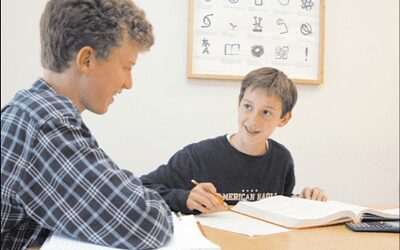
Looking at work samples together can make a child’s growth easier to understand.
Don’t Be Afraid to Ask What You Don’t Understand
Montessori has its own vocabulary, and it can sound like a foreign language at first. You may hear terms such as Work cycle, which is the long, uninterrupted stretch of the day, often about three hours, when children choose their work and concentrate on it. Practical Life refers to everyday activities such as pouring, sweeping, buttoning, and preparing snacks, which build independence, coordination, and concentration. Sensorial describes materials that help children explore and refine the senses, such as size, shape, color, sound, and texture. Normalization is Montessori’s word for the calm, focused, cooperative state children grow into, not a comparison to other children. Grace and Courtesy refers to lessons in everyday manners and respectful ways to treat others.
If the teacher uses a term you don’t understand, ask. You are not supposed to have completed Montessori teacher training in order to be a good Montessori parent. If your child keeps talking about the Stamp Game and you have no idea what that means, this is the perfect time to say, “Can you show me?” Understanding a little more about what happens in the classroom can change the conversations you have with your child at home.
What If the Teacher Raises a Concern?
This is sometimes the moment when a conference becomes uncomfortable. Perhaps the teacher says your child has difficulty concentrating, frequently interrupts other children, avoids certain kinds of work, or is struggling socially.
Your first instinct may be to explain. “But she never does that at home.” “He told me another child started it.” “She already knows how to do that.” Resist the urge to solve the issue right away, and get curious instead. You might ask how often the teacher is seeing this, when it usually happens, whether there is a pattern, what the teacher has tried, what seems to help, and whether this is a significant concern or something you should simply watch.
A specific description of behavior is far more useful than a label. “He has trouble with self-control” doesn’t tell us nearly as much as “During group conversations, he often calls out because he is excited to answer before another child has finished speaking.” Now we have something we can understand and work with.
It also helps to remember that a teacher’s observation is a snapshot of a child at a particular point in a long process of growth. It is not a prediction, and it is not a judgment of your child or your parenting.
And Tell the Teacher What You See
The conversation should work in both directions. Suppose the teacher says your child seems unusually tired in the mornings. You may know immediately why: she has started waking up at five. Or perhaps the teacher reports that your child seems worried about making mistakes, and you have noticed the same thing at soccer practice. Sometimes a pattern becomes visible only when home and school compare observations.
Should Your Child Be Part of the Conference?
Sometimes, yes. It depends on your child’s age and your school’s approach. In many Montessori elementary and adolescent programs, children take an active role, showing a portfolio, explaining a project, demonstrating a material, or talking about their own goals. Even a younger child can sometimes proudly show Mom or Dad a favorite piece of work. There is something powerful about moving from adults talking about a child to adults talking with the child.
But children don’t need to hear every part of an adult conversation, and some topics are better discussed privately. A thoughtful conference makes room for both. If you aren’t sure how your school handles this, simply ask when you schedule the conference.

Children can sometimes take an active role by showing a parent favorite work.
Try Not to Turn the Conference Into a Competition
It is natural to wonder, “Is my child ahead? Is she behind? Is everyone else reading? What math are the other six-year-olds doing?” Sometimes comparisons are useful, because teachers need to recognize when a child may need extra support. But Montessori asks us to look at something more meaningful than a child’s rank. You might ask whether your child is progressing, whether she is engaged, whether important skills are developing, whether concentration is growing, whether he is taking on greater challenges, whether there are areas he tends to avoid, and whether he is becoming more capable of working independently.
Development doesn’t happen in a perfectly straight line. A child can seem to plateau for weeks and then suddenly make an enormous leap. The conference helps us look at the trajectory rather than obsessing over a single point on the line.
Ask the Question Parents Often Forget
Before the conference ends, ask, “Is there anything we can do at home that would be helpful?” The answer may surprise you. It probably won’t be flash cards. It might be to let your child dress herself, read together every night, get to bed earlier, give him more responsibility around the house, spend more time outdoors, practice arriving at school on time, let her solve more of her own problems, or talk together at dinner and visit the library often.
Or the advice may be simply, “She’s doing beautifully. Don’t turn home into school. Let her be six.” That can be excellent advice, too.
And Share What Your Child Loves
Another side to the partnership is easy to overlook. Tell the teacher what fascinates your child. If your seven-year-old has become obsessed with bridges, astronomy, ancient Egypt, horses, insects, machines, or cooking, mention it. A good Montessori teacher may be able to use that interest as a doorway into something much larger. Children learn especially well when their own curiosity is already pulling them forward.
The Conference Shouldn’t Be the Only Conversation
Ideally, nothing truly serious should come as a complete surprise at a scheduled parent conference. Parents and teachers shouldn’t wait several months to discuss an important concern, and if something is worrying you, you don’t need to wait for the scheduled date to ask to talk.
Think of the conference as a checkpoint, a chance to step back from daily drop-offs, emails, permission slips, and hurried hallway conversations and look at the larger picture. How is this child doing? What are we seeing? What has changed? What is emerging? What might need our attention? And where might this child be headed next?
After the Conference
A few simple steps help the conversation continue to do its work. Write down, while it’s fresh, the two or three most important things you heard and anything you agreed to try. If you agreed on something to do at home, give it a few weeks before deciding whether it’s working. Share the highlights with your child positively, focusing on what the teacher noticed and appreciated. Send a short thank-you note or email, and let the teacher know what you’d like to follow up on. If you agreed on a check-in, put a date on the calendar so it doesn’t slip.

Reviewing work samples together helps parents and teachers notice growth over time.
Two Views of the Same Child
Perhaps the most useful way to think about a parent conference is this. The teacher knows your child as a member of a learning community. You know your child as a member of your family. Neither picture is complete by itself. When parents and teachers genuinely listen to one another, those two pictures begin to come together.
For twenty or thirty minutes, everyone can focus on something that can easily get lost in the rush of everyday life: Who is this child becoming, and how can we help?