Related Posts



Snapshot
How does a child get from counting three crackers at snack time to working with multiplication, fractions, geometry, and eventually algebra? In Montessori, mathematics is a carefully constructed journey. Children begin with quantities they can see and touch. Gradually they connect those quantities with written numbers, discover how our decimal system works, carry out arithmetic with concrete materials, notice patterns, and move step by step toward abstract thinking. Because they learn with real, three-dimensional objects rather than pictures on a page or screen, Montessori children often grasp ideas such as place value years before conventional schools introduce these concepts. The materials change as children grow, but the guiding idea stays the same: understanding comes before memorizing a procedure.
Ask a three-year-old how old she is, and three small fingers will probably pop up proudly. Offer a choice between one cookie and two, and almost every child knows instantly which is more.
Young children are surrounded by quantity every day. “How many strawberries would you like?” “Can you bring me two napkins?” “You have one shoe on. Where’s the other one?” “Do we have enough plates for everybody?” Long before they can read a written numeral, children are forming a deep intuition that numbers describe something real.
Montessori mathematics builds on that natural beginning.
Before Mathematics Comes Mathematical Thinking
Maria Montessori spoke of the child’s “mathematical mind,” and much of the Montessori classroom nurtures it well before formal number lessons begin.
Consider the Sensorial materials: the Pink Tower, the Brown Stair, the Red Rods, and the Knobbed Cylinders. As children work with them, they are constantly comparing. Which is longer? Which is thicker? Which is larger? What comes next? They arrange objects in order, notice small differences, sort and classify, and discover patterns and relationships.
None of this looks much like a math lesson. Yet these are exactly the habits of mind that mathematics depends on. When the child is ready, Montessori begins to make number itself concrete.
Number Has Length
 The red and blue rods
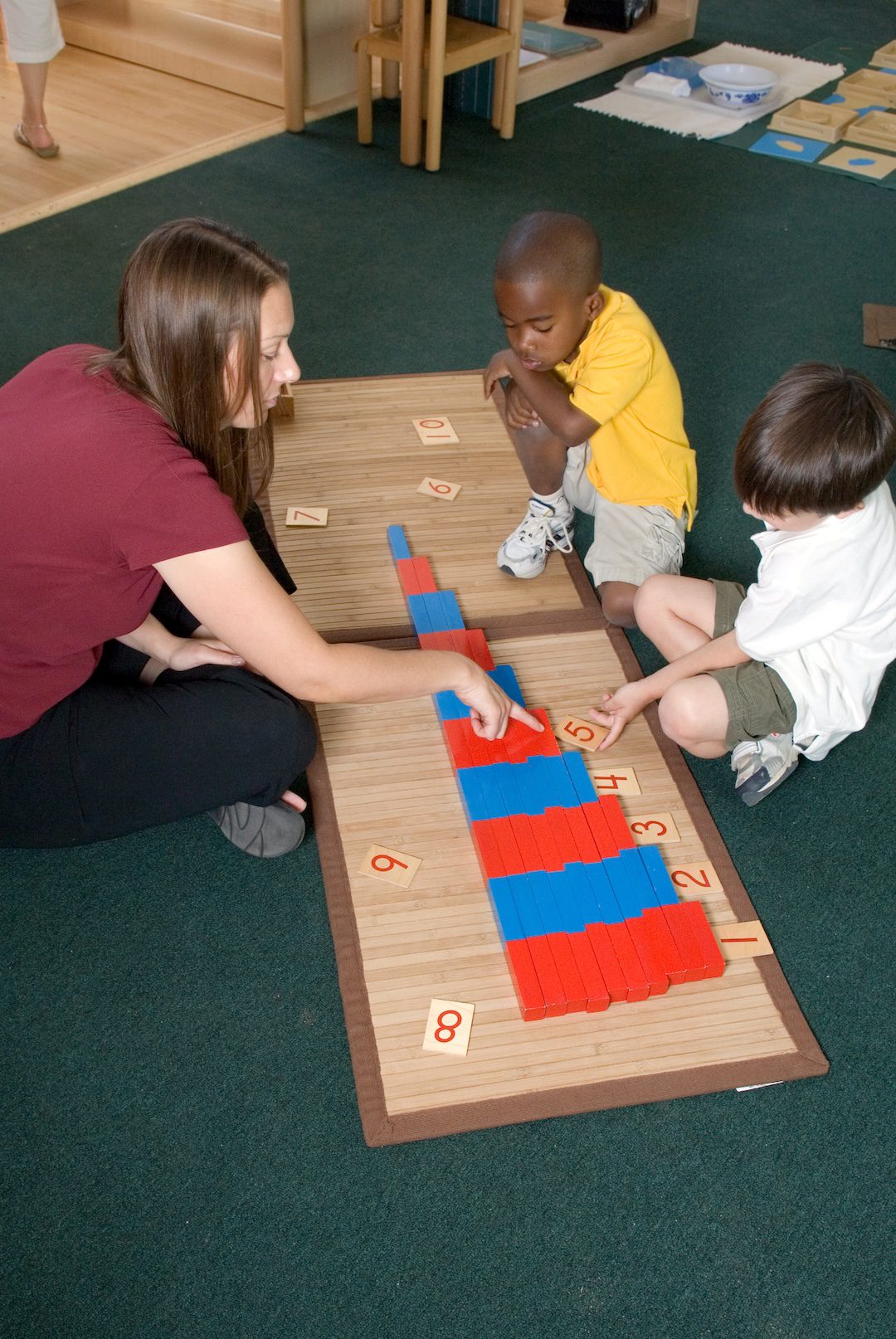
One of the child’s first formal introductions to quantity is the Number Rods, sometimes called the Red and Blue Rods.
Children who have worked with the Red Rods will recognize them right away. They are the same ten lengths, from 10 centimeters up to 1 meter. The Red Rods are solid red, but each Number Rod is divided into alternating red and blue sections, each ten centimeters long. The shortest rod has one section, the next has two, and so on up to ten.
Now the child doesn’t simply hear that five is more than two. She can see that five is longer. She can carry it across the room, lay it beside the three or the four, and compare. Number has become something physical.
A Number Also Has a Name and a Symbol
At about the same time, children meet the written numerals through the Sandpaper Numerals. The child traces each numeral with two fingers while hearing its name. The hand, eye, ear, and mind all work together. Later, children trace numerals in a tray of sand and then begin writing them. Graph paper with large squares makes those first attempts easier.
Gradually, the child connects three different ideas: this is a quantity, its name is “five,” and this symbol, 5, stands for it. That link between quantity, spoken word, and written symbol is one of the foundations of everything that follows.
The Mystery of Zero
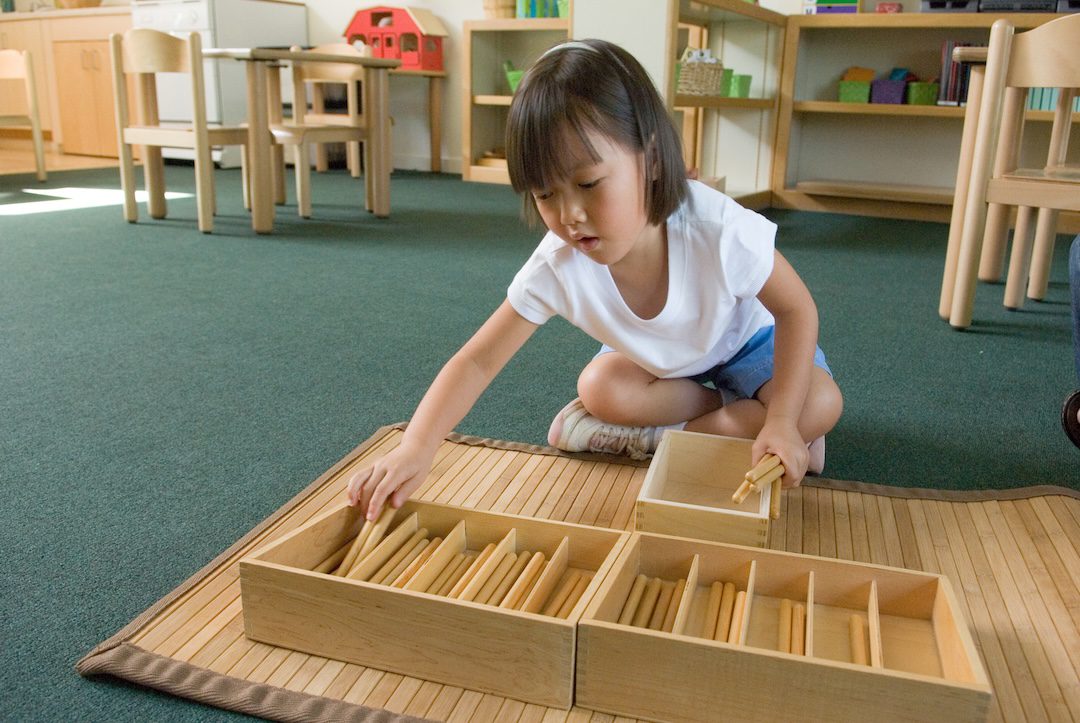
The Spindle Boxes offer another experience with number. They contain compartments labeled 0 through 9, and the child counts the matching number of wooden spindles into each one. One spindle goes into the 1, two into the 2, three into the 3, and so on.
But what goes into the zero? Nothing at all. That empty compartment makes zero wonderfully clear. Zero isn’t just another numeral; it means none.
There’s a quiet bit of design here, too. The box holds exactly forty-five spindles, the total needed to fill every compartment. If the child finishes with spindles left over, or runs out too soon, she knows to count again. The material itself tells her, without an adult having to correct her.
Odd and Even Begin to Make Sense
 cards and counters odd and even
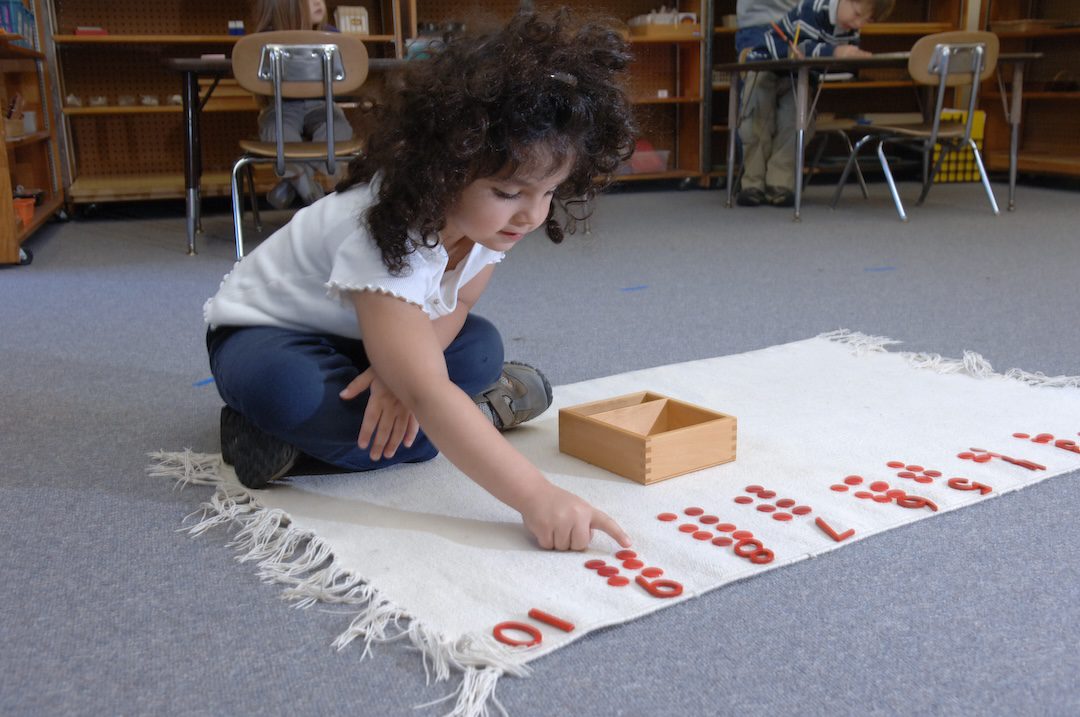
With the Cards and Counters, the child lays out the numerals 1 through 10 in a row and places small counters beneath each one, arranging them in pairs. Two makes a pair. Three makes a pair, with one left over. Four makes two complete pairs.
As the quantities grow, a pattern appears. With the even numbers, every counter has a partner. With the odd numbers, one is always left on its own. The child can actually see the difference between odd and even. An idea that could have been taught as a definition becomes something she discovers for herself.
What Comes After Ten?
Early mathematics has many more steps than one article can cover, but a few are worth mentioning.
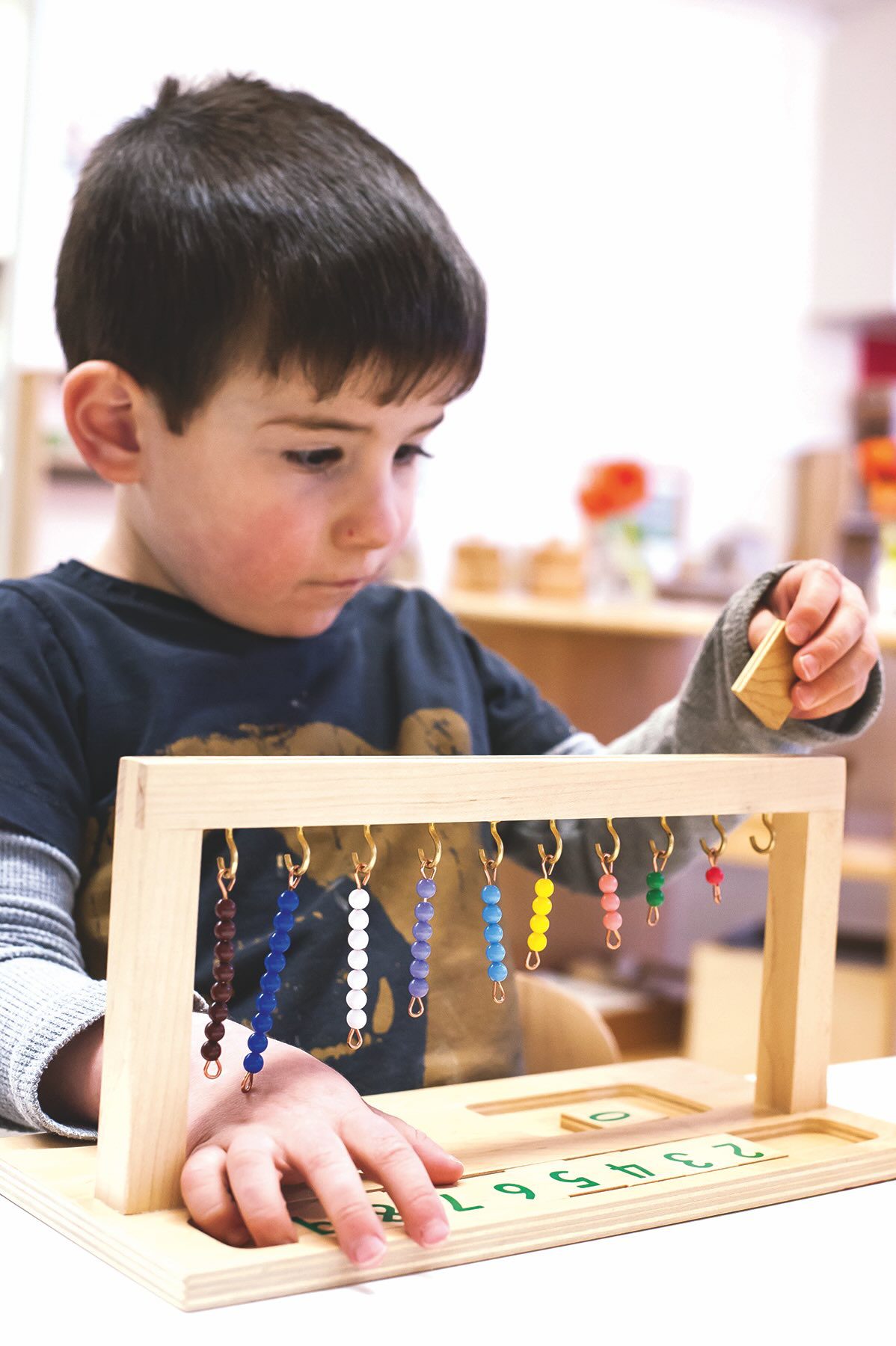
Children work with the Short Bead Stair, a set of colored bead bars representing the quantities one through nine. With the Teen Boards and bead materials, they build numbers beyond ten and see that eleven is one ten and one unit, twelve is one ten and two units, and so on. The Tens Boards then help them build twenty, thirty, forty, and all the numbers in between.
Something important is happening. The child isn’t simply learning to recite “eleven, twelve, thirteen, fourteen.” She is discovering how our number system is built. Alongside this work comes one of the most memorable experiences in Montessori mathematics.
One, Ten, One Hundred, One Thousand
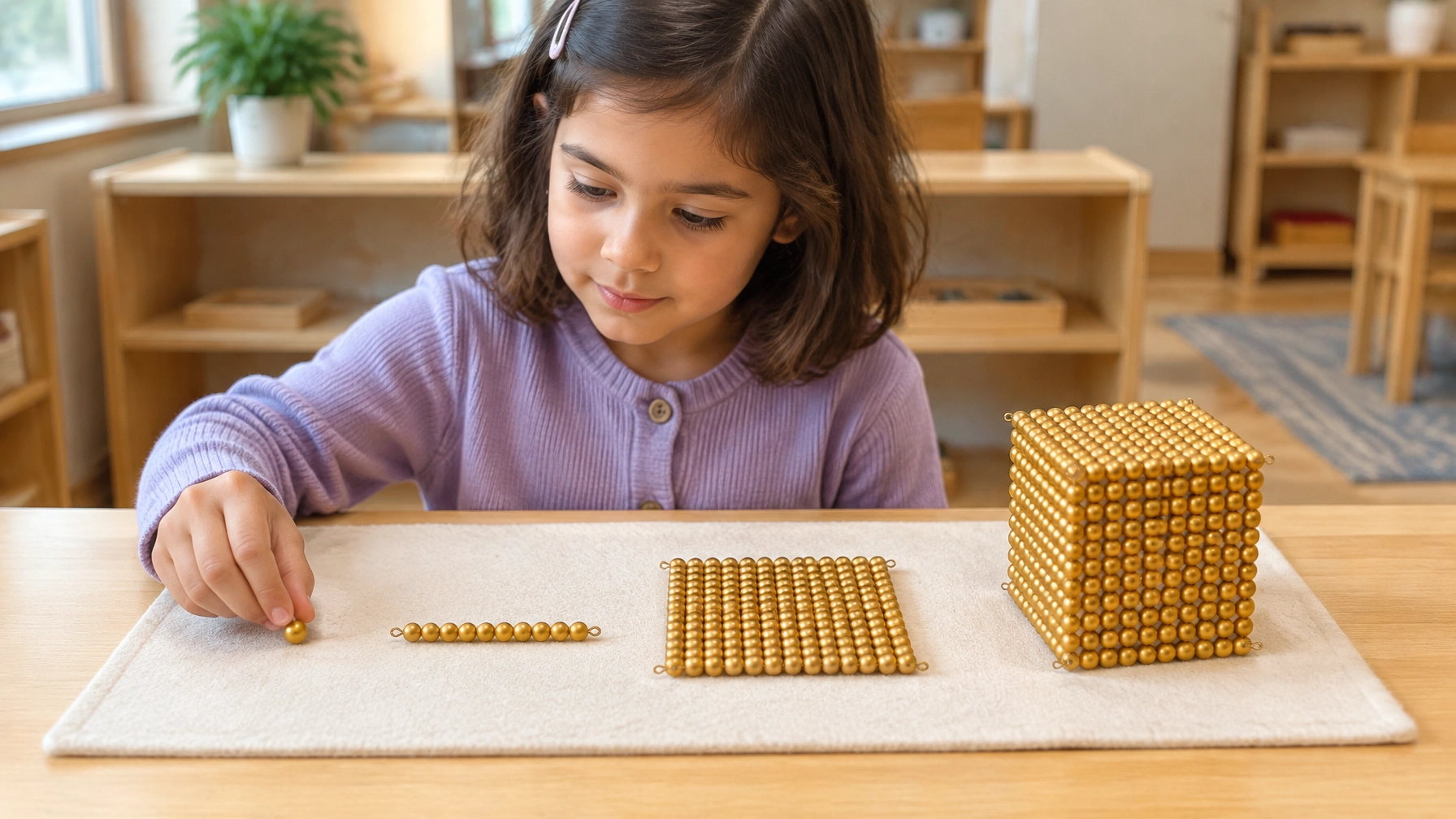
The Golden Bead Material introduces the decimal system on a grand scale. A single golden bead represents one unit. Ten beads strung together make a bar of ten. Ten bars form a square of one hundred, and ten hundred-squares stacked together form a cube of one thousand.
The difference in size is dramatic. A unit fits between two fingers, while a young child carries the thousand cube carefully in both hands. To a four- or five-year-old, the written symbols 1, 10, 100, and 1,000 can seem fairly arbitrary. The Golden Beads make their relationship unmistakable: ten units make a ten, ten tens make a hundred, and ten hundreds make a thousand.

The Golden Bead Material gives the child a concrete experience of the relationship among one unit, one ten, one hundred, and one thousand.
Going to the Bank
The classroom keeps a supply of Golden Bead Material traditionally called “the bank.” The child takes a tray, and the game begins.
“Would you bring me three units?” Off she goes, returning with three single beads. “Now bring me four tens.” Back to the bank. Later the teacher might ask, “How many hundreds would you like in your number?” “Three!” “And how many thousands?” “Two!”
Notice what hasn’t happened yet. We haven’t begun by handing the child a card that reads 2,347 and asking her to build it. First, we want her to understand the quantities themselves: two thousands, three hundreds, four tens, seven units. She has carried them, counted them, compared them, and put them together. The number is real before it becomes abstract.
Then We Find the Number Cards
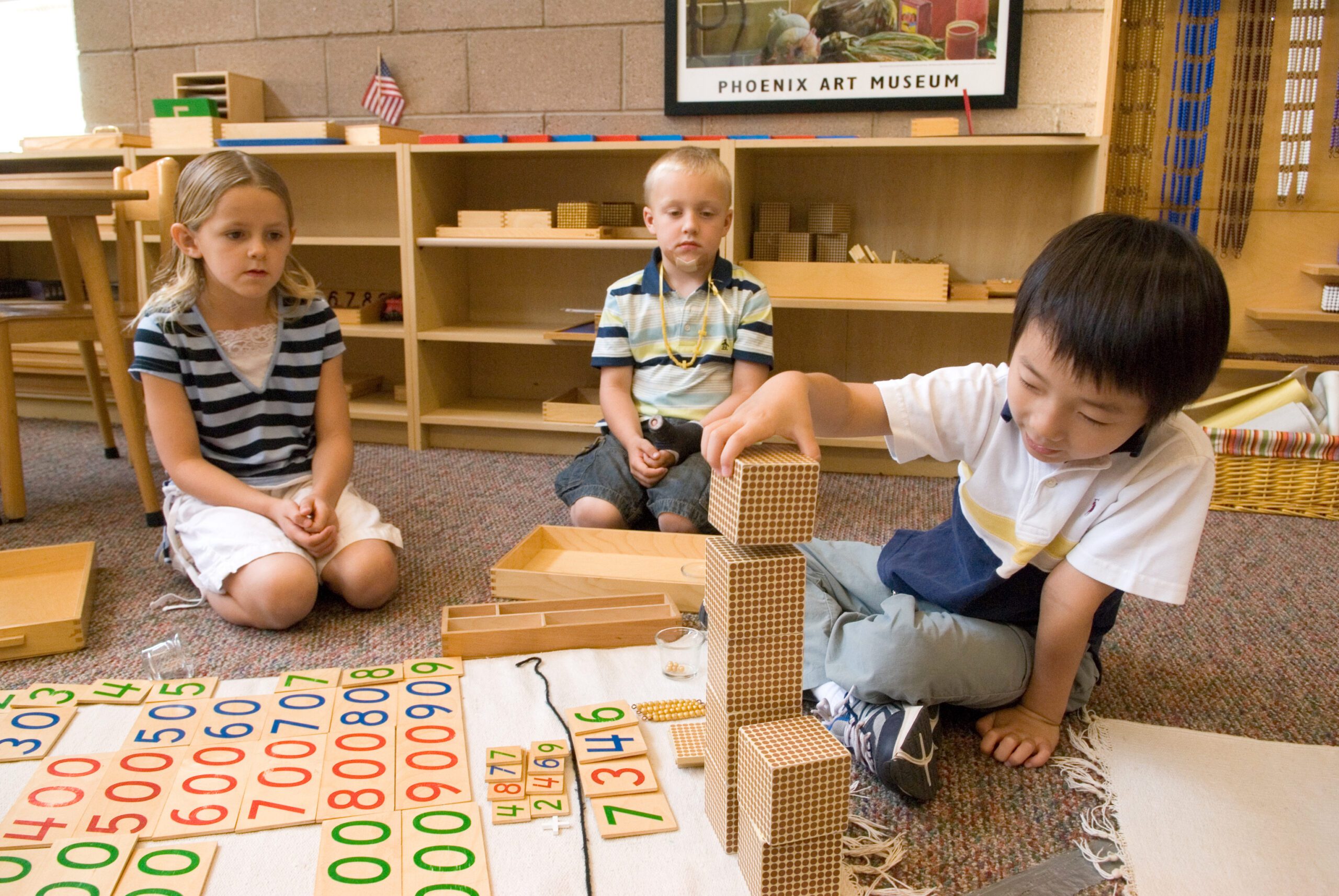
Children also learn a set of numeral cards for units, tens, hundreds, and thousands, each category in its own color. They learn these separately at first, often laying them out carefully in long rows.
Eventually the two experiences come together. Suppose the child has brought back two thousands, three hundreds, four tens, and seven units. She finds the matching cards, 2,000, 300, 40, and 7, and then stacks them on top of one another, lined up on the right. Together they form 2,347.
Something rather wonderful has happened. The child has built the same number in two languages: first as a quantity, then as a symbol. Place value isn’t just a rule the teacher explained. She can see what it means.

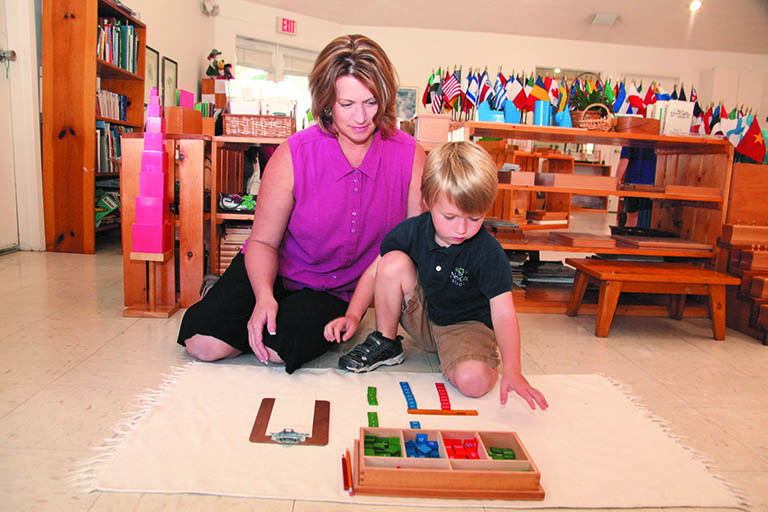
In a small individual lesson, the child explores the quantities directly while the teacher observes and guides.
Real Objects, Not Pictures of Objects
It’s worth pausing here to notice two things that set Montessori mathematics apart.
The first is timing. Many Montessori children work comfortably with thousands and exchange in addition and subtraction by age four or five. Conventional schools often don’t introduce these ideas until second or third grade. This isn’t because Montessori is trying to push children ahead. It happens because concrete materials make these ideas understandable at an age when, presented only as written symbols, they would be out of reach. Every child moves at her own pace, and that is exactly as it should be.
The second is how children learn. In many classrooms today, mathematics arrives on a whiteboard, a tablet screen, or a workbook page with pictures of blocks or beads. A picture of a thousand cube is still just a flat image. It can’t show the child how heavy a thousand is compared with a single unit, or how ten hundred-squares stack perfectly into a cube.
When a child carries a thousand cube in both hands, counts out ten bars to make a hundred, or trades a handful of units for a ten, she learns through her muscles and senses as well as her eyes. She can turn the material over, take it apart, and put it back together. Maria Montessori observed a century ago that young children understand most deeply what they can touch and manipulate, and today a growing body of research on how young children learn supports her insight.
This is also why parents of young Montessori children may not see many math worksheets coming home. The most important mathematical work is happening on the classroom floor and tables, with materials in the child’s hands. Paper comes later, when it can record an understanding the child already has.
A screen can show a child mathematics. Montessori materials let her hold it.
Now We Can Add, Subtract, Multiply, and Divide
Once children understand how numbers are built, they can begin doing arithmetic with the Golden Beads.
Addition starts simply, with quantities chosen so that no exchanging is needed. Then the problems become more interesting. Suppose two quantities are combined, and there are now more than ten units. Ten units go to the bank and are exchanged for one ten. In the same way, ten tens become a hundred and ten hundreds become a thousand. Years later, when adults talk about “carrying” or “regrouping” in written arithmetic, the Montessori child already knows what is really happening: ten of one kind become one of the next.
Subtraction lets children experience the reverse. If there aren’t enough units to take away six, the child brings a ten to the bank and exchanges it for ten units. Something that can look mysterious on paper makes sense because she has actually done it.
Multiplication is introduced as taking the same quantity several times. Often several children each build the same number and then put their quantities together. Division is explored as sharing a large quantity equally among several people. Before these operations become procedures written on paper, they describe actions the child truly understands.
Slowly, the Materials Change
Children don’t carry Golden Beads around forever, nor should they. As understanding grows, Montessori introduces materials that are gradually more abstract.
The Stamp Game, for example, represents units, tens, hundreds, and thousands with small tiles marked 1, 10, 100, and 1,000, rather than with actual quantities of beads. Later come the bead frames and, eventually, written calculation. At the same time, children work toward quick, confident recall of their addition, subtraction, multiplication, and division facts.
Montessori doesn’t reject memorization. It simply puts understanding first. The goal is a child who can calculate accurately and efficiently without needing materials.
Discovering the Patterns Hidden in Numbers
The Bead Cabinet opens up another fascinating part of mathematics. It holds colored bead chains for the numbers one through ten.
Take the chains made of golden ten-bars. With the shorter one, the hundred chain, the child counts 10, 20, 30, all the way to 100, marking each step with a small numbered arrow. Then she folds the chain up and finds that it forms a perfect hundred-square. The thousand chain stretches impressively across the classroom floor, and the child counts along it by tens: 10, 20, 30… 100, 110, 120… until she finally reaches 1,000. Folded up, it becomes ten hundred-squares, and when she stacks them, they match the thousand cube exactly.
Children don’t count only by tens. The chains for the other numbers let them count by twos (2, 4, 6, 8), by threes (3, 6, 9), by fours, by fives, and so on. Adults call this skip counting, but the child is discovering something far more significant. These are multiples. Patterns are emerging from numbers, and those patterns will matter enormously later on.
Fractions Become Something You Can Hold
Fractions follow the same principle. The symbol ¾ is abstract. But give a child a circle divided into four equal pieces and let her take one away, and she can see that three of the four pieces remain. Now three-fourths means something.

A fraction circle allows the child to see a whole divided into equal parts and to explore what remains when one piece is removed.
With these fraction materials, children compare one-half with one-third and discover that two-fourths and one-half are the same amount. Later, they go on to add, subtract, multiply, and divide fractions.
Once again, the hands prepare the mind.
Geometry Grows Up With the Child, Too
The same progression happens with geometry. Young Montessori children handle triangles, circles, rectangles, other polygons, and geometric solids. They learn their names, compare their shapes, and notice their characteristics.
In the elementary years, children return to geometry at a much deeper level. They investigate lines and angles, triangles and quadrilaterals, equivalence, congruence, similarity, area, and volume. They measure, construct, take figures apart, and rearrange them, discovering relationships they eventually learn to express as formulas. What began as sensory exploration has become mathematical reasoning.

In the elementary years, geometry becomes a way to investigate relationships, construction, equivalence, area, and volume.
And Eventually, Algebra
By the elementary years, children grow increasingly curious about the relationships behind their calculations. Why does this work? Will it always work? What pattern do I see? Can I predict what happens next? Can I show the same idea a different way? Questions like these lead naturally toward algebra.
This is where the long Montessori journey becomes especially interesting. Materials children knew when they were very young can return years later with entirely new meaning. A three-year-old may happily take apart and rebuild the Binomial Cube as a colorful wooden puzzle. Years later, she may discover that the same cube represents an algebraic formula.
That story deserves its own article.
Supporting Mathematics at Home
Parents often ask how they can support this work at home. The good news is that it doesn’t require special materials, flashcards, or drills. Everyday family life is already full of mathematics.
Invite your child to set the table and figure out how many forks, cups, and napkins everyone will need. Cook together. Measuring cups and spoons naturally introduce halves and quarters. Match socks from the laundry basket into pairs, and notice whether one is left over. It’s a wonderful way to talk about odd and even.
Count steps on the stairs, apples in the bag, or cars in a parking row. Look for shapes on a walk: round wheels, triangular roofs, rectangular windows. Play simple board games that involve dice and counting spaces.
One gentle caution: try not to teach shortcuts such as “carry the one” or “borrow from the next column” before your child has learned them in class. These tricks can produce correct answers without understanding, and they can get in the way of what the child is discovering with the materials. If you’re curious about what your child is doing, ask her to show you, or arrange a classroom observation. Most children love the chance to demonstrate their work.
From the Hand to the Mind
A three-year-old comparing the lengths of rods isn’t thinking about algebra, and she shouldn’t be. She is doing the work that is right for her now. Over time, though, something remarkable develops.
The child who carried a Number Rod learns that a quantity can be represented by a numeral. The child who counted spindles into a box discovers zero. The child who arranged counters discovers odd and even. The child who carried Golden Beads from the bank discovers the decimal system, and the child who traded ten units for a ten discovers why our arithmetic works. The child who counted bead chains discovers multiples and patterns.
Gradually, the materials become less necessary. The mathematics moves inside. What the hands once held, the mind now understands.
This is one of the central ideas of Montessori education. We don’t rush children toward abstraction. We give them experiences that allow abstraction to emerge when they are ready.
The goal isn’t a child who is good at using Montessori materials. It’s a child who can think mathematically: who understands numbers, recognizes relationships, asks good questions, sees patterns, and has the confidence to tackle a problem she has never seen before.
That journey can begin with something as simple as three small fingers held proudly in the air.