Related Posts



Snapshot
Gardening doesn’t have to end when the weather turns cold. A sunny windowsill, a few pots, and some seeds can give children months of meaningful work. An indoor garden offers something screens and toys cannot: a living thing that changes slowly and needs real care. Children can plant, water, measure, observe, draw, cook, and sometimes even eat what they grow. Best of all, the project can grow along with the child.
When we think of gardening with children, we tend to picture spring: warm soil, seed packets, watering cans, and tomato plants getting taller by the day. Then fall arrives. The garden slows down, the days get shorter, and family life moves indoors.
But gardening doesn’t have to stop. In fact, fall and winter can be wonderful times to give a child their own small indoor garden. You don’t need a greenhouse, you don’t need to know much about gardening, and you certainly don’t need to turn this into a science curriculum. Start with a pot, some soil, something interesting to grow, and a child. Then see what happens.
Why Growing Something Is So Appealing to Children
A seed doesn’t do anything spectacular when you plant it, and that is part of its value. You put it into the soil, you water it, and then nothing happens, at least nothing you can see. The child has to wait. Tomorrow there may still be nothing, and the next day, either. Then one morning, a tiny green shoot pushes up through the soil.
Young children are fascinated by transformations like this because they are real. No adult has created an animation to make the seed sprout, and the child isn’t pressing a button to make something happen. Nature is moving at its own pace, and the child’s job is to notice.
This Is Very Montessori
Gardening fits naturally into Montessori family life because it involves real work with a real purpose. The plant actually needs water. The dead leaf actually needs to be removed. The pot actually needs more soil. The herbs can actually be used in dinner.
This is different from giving children an activity designed merely to keep them occupied. Children often recognize the difference. They like knowing that what they are doing matters. Caring for a living thing also teaches something Maria Montessori valued deeply: responsibility toward the natural world.
Start Small
Don’t begin by creating an indoor farm. One or two plants are enough.

One or two plants are enough to begin together.
Beans are a good place to start. The seeds are large enough for small fingers to handle; they sprout reliably, and the early growth is easy to watch.
Herbs such as basil, chives, parsley, and mint let children eventually smell, taste, harvest, and cook with something they have cared for. For quick success, buy small starter plants from a garden center or grocery store. Parsley and mint can be very slow to sprout from seed, though mint and basil will often grow roots from a cutting placed in a glass of water.
Kitchen scraps are another easy place to start. Green onions will regrow from their roots in water, and the base of a head of romaine lettuce will sprout a small new cluster of leaves. Don’t expect a full harvest, but the transformation is fun to watch.
Bulbs work beautifully too. Paperwhite narcissus can be grown in a shallow dish of pebbles and water, and children can watch the roots and shoots develop day by day. They need no chilling and often bloom within a few weeks.
The particular plant matters less than having something the child can genuinely care for.
Seeing Roots Grow
Here is a simple project that works wonderfully for young children. Place a damp paper towel inside a clear zip-top bag, tuck in a bean seed, and tape the bag to a sunny window. Within a week or so, the child can watch the root emerge and grow downward, then the shoot grow upward, with no digging required. Once the bean has sprouted, you can move it into a pot of soil.

The child can observe roots and shoots without digging.
A Few Practical Basics
Indoor gardening in fall and winter has one big challenge: light. The days are short, and the sun is low. A few simple choices make a big difference.
Choose the sunniest window you have, ideally one that faces south. Herbs especially need bright light. If your windows are dim, an inexpensive timer-based grow light can help. Turning the pots every few days keeps plants from leaning toward the glass.
Choose pots with drainage holes and set them on a saucer or tray. A pot with no drainage is the quickest route to an overwatered, unhappy plant.
Use packaged potting mix rather than yard soil, which can compact in a pot and bring in pests.
On safety: bulbs such as paperwhites, amaryllis, and daffodils are poisonous if eaten, so they are best for children who no longer put things in their mouths. Chives, onions, and some other plants can harm cats and dogs, so check before placing them where pets can reach. Wash hands after handling soil.
Give the Child Real Tools
This is where Montessori thinking can make a surprisingly large difference. Imagine that you have created a lovely indoor garden for your four-year-old. The plants are on the windowsill. The watering can is under the kitchen sink behind the cleaning supplies. The soil is in the garage. The towel needed to wipe up spilled water is somewhere in the laundry room.
Who actually owns this garden? The adult does.
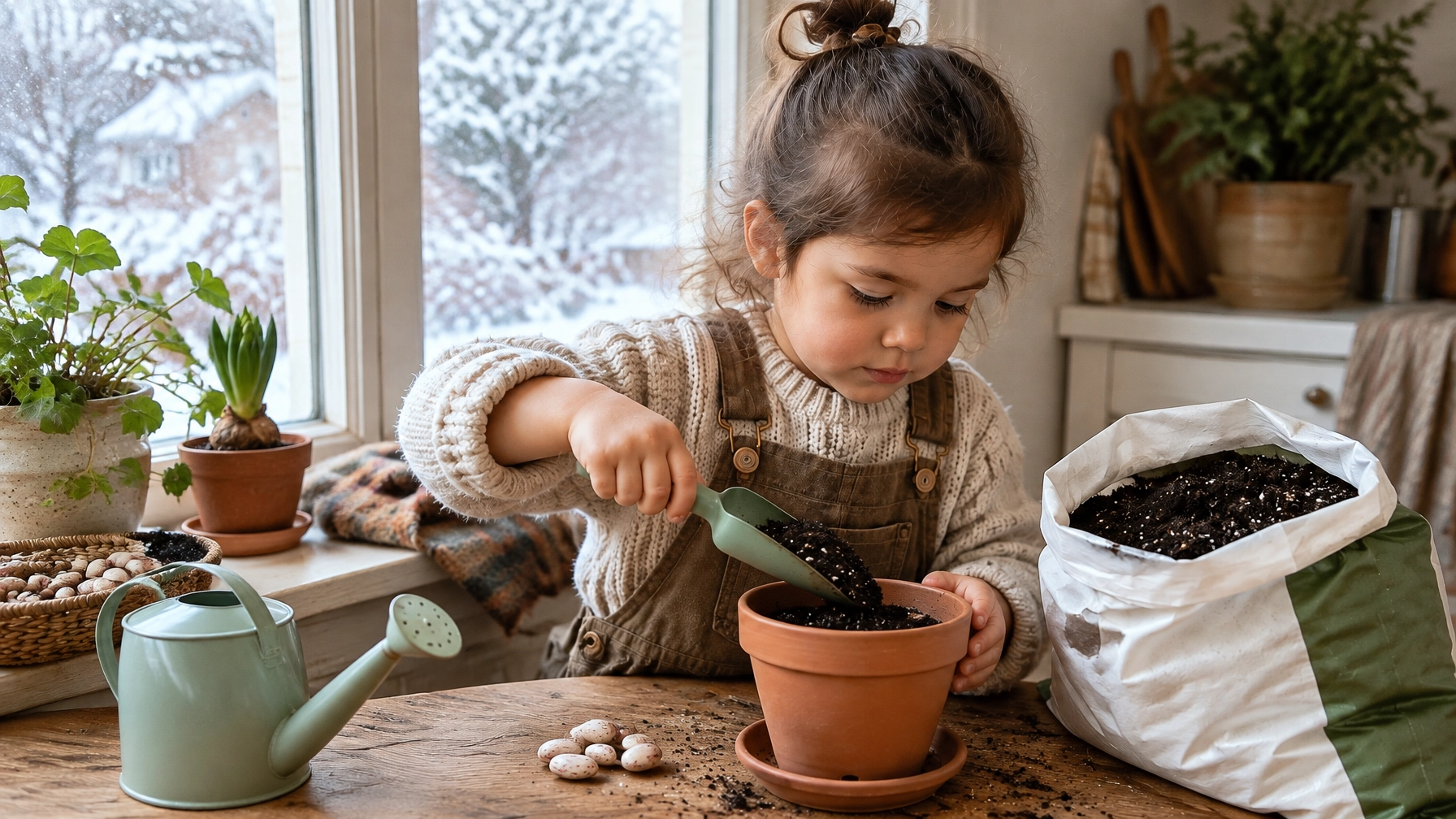
Instead, think about what the child needs to care for the plants independently. A small watering can the child can fill and carry. A little sponge or cloth nearby for spills. A small basket holding child-sized tools, such as a trowel and a spray bottle for misting. A designated place for everything, so each item can be found and put back.

An orderly place for every tool supports independence.
Now the child doesn’t have to ask an adult every time something needs to be done. That changes the activity from “helping Mom or Dad with the plants” to “these are plants I know how to care for.”
Be Careful About the Watering Can
There is one lesson most indoor gardeners eventually learn. Children really like watering plants, and sometimes they like it considerably more than the plants do.
A tiny watering can helps. So does showing the child how to check whether the soil actually needs water. Gently push a finger into the soil, up to the first knuckle. Is it damp or dry? Does this plant need water every day? Probably not. This turns watering from a repetitive chore into an act of observation. The question becomes not “Do I get to water it?” but “What does this plant need today?That is a very different kind of thinking.

Watering begins with noticing what the plant needs.
Let Children Make Some Mistakes
Perhaps your child gives the plant too much water. Perhaps a seed doesn’t sprout. Perhaps the plant gets tall and spindly because it doesn’t get enough light, or everyone forgets about it for three days. Not every gardening mistake requires an adult rescue.
A wilted plant can provoke a wonderful question: “What do you think happened?” Sometimes the child will know. Sometimes you can investigate together. Real life provides feedback, and that is one reason gardening is such a good activity for children.
Gardening Changes as Children Grow
One of the nicest things about this activity is that a two-year-old, a six-year-old, and a ten-year-old can all participate, but not in the same way.
A toddler can carry a small watering can, touch the soil, wash a leaf, smell an herb, and help scoop soil into a pot. A four- or five-year-old can plant seeds, water carefully, remove dead leaves, and watch for new growth. A six- or seven-year-old might make plant labels, count the days until a seed sprouts, measure growth, or draw what is happening. An older elementary child can begin asking much more complicated questions. Does a plant grow faster in one window than another? What happens if seeds receive different amounts of light? Why do roots grow downward and shoots upward? What exactly is happening inside a seed? Why do some plants thrive indoors while others don’t?
One little pot can lead surprisingly far.
Keep a Plant Journal
For children who enjoy drawing or writing, try putting a small notebook near the garden. Don’t turn it into an assignment. Just make it available.

A plant journal gives observation a place to grow.
A young child might draw the plant. An older child might write something like “October 12: planted 4 bean seeds,” and a week or so later, “October 20: first sprout appeared. 3 cm tall.” The child might measure the plant every few days. Perhaps three of the four seeds sprout, and then comes the question, “Why didn’t the fourth?””
Now we have mathematics, writing, observation, drawing, and science growing out of something the child actually cares about. That is very different from filling in a worksheet about plants.
Grow Something You Can Eat
There is something particularly satisfying about eating something you’ve grown. A child can snip chives and add them to potatoes. Basil can go into a sauce, mint can flavor water, and a few lettuce leaves can become part of lunch.

Harvesting herbs connects care with a real family meal.
You don’t need to produce enough food to feed the family. The point is the connection: I planted this, I cared for it, it grew, and now we’re eating it. For a young child, that is a fairly profound experience.
Try Growing Something From the Kitchen
You don’t necessarily have to start with a packet of seeds. Look around your kitchen and wonder together. What happens if you put the bottom of a green onion in water? Can you sprout an avocado pit? It’s a long wait, often several weeks, so this one teaches patience. What happens to a sweet potato set partly in a jar of water? Can you plant pepper seeds? Many grocery-store seeds won’t sprout, which makes the result even more interesting. Will every seed from the foods we eat actually grow?
Now the kitchen itself becomes a place for investigation. Some experiments will work beautifully, and some won’t, and that is fine. The question “What do you think will happen?may be more valuable than knowing the answer ahead of time.
Don’t Take Over
This is probably the hardest part. The row isn’t straight. There is soil on the floor. The plant labels aren’t particularly attractive. The child is taking forever. You could do it much faster.
Of course you could. You’re an adult. But speed isn’t the point. If we continually step in to straighten, correct, clean up, and improve children’s work, they eventually learn an unintended lesson: the adult can do this better than I can.
Instead, show the child how to do something carefully, then give them time. If soil spills, show them how to sweep it up. If water spills, keep a cloth nearby. The cleanup is part of the work.
Notice More Than You Explain
Adults have an interesting habit around children: we explain things, constantly. Sometimes we can allow the child to discover something first.
Instead of immediately saying, “Look! Your seed sprouted because it absorbed water and the root is growing downward,” say, “Something changed.”Then wait. Your child may lean closer. “There are roots!” “Where?” “Right there!” Now the child owns the discovery. There will be plenty of time for vocabulary and explanations later. Observation can come first.
Bring Some Nature Inside
An indoor garden will never replace being outdoors. Children need mud, trees, insects, wind, rain, rocks, leaves, sunshine, and the enormous complexity of the natural world. But when winter makes outdoor gardening difficult, a few living plants can bring a little piece of nature into the home.
They also give children something increasingly rare: something that cannot be hurried. A plant doesn’t care that we’re busy, and it doesn’t grow faster because we’d like to see the flower today. It asks us to observe, care, wait, and return tomorrow. For children growing up in a world where so much happens instantly, that may be one of gardening’s greatest gifts.
Getting Started This Weekend
Choose one or two plants, such as beans and a small basil or chive plant. Find the sunniest spot your child can reach. Gather a few pots with drainage, a bag of potting mix, a small watering can, and a cloth. Set up a small basket and a notebook nearby. Plant together, show your child how to check the soil, and then step back. Plant something together this fall. Put it somewhere your child can reach. Give them the tools to care for it. And then try not to make too much of it. Just watch what grows.