Related Posts
Snapshot
A good home art area does not need to be elaborate. It needs to be inviting, orderly, accessible, and stocked with materials children can use more independently. The goal is not to produce perfect projects. It is to give children a place to draw, paint, cut, glue, build, and experiment with their own ideas.
Children like to make things. They draw, cut, tape things together, paint, and build strange constructions from cardboard. They collect scraps that adults may mistake for trash. And if they have access to good materials and a place where they are allowed to work, they often return to this kind of activity again and again.
That is why a small art area at home can be so valuable. It isn't a craft closet that an adult has to unlock, and it isn't a table covered with so many supplies that no one knows where to begin. It is simply a thoughtfully prepared place where a child can create.
Start With a Place, Not With Supplies
Parents often begin by buying materials, which is understandable. But first ask a simpler question: where will the child actually work? It might be one end of the kitchen table, a small desk, a low table near a window, a corner of the family room, or a shelf beside a child-sized work surface.
The area does not need to be large. It does need to feel like a place where making things is expected and welcome. For a young child, the surface and shelves should be easy to reach. If every pencil, piece of paper, and paintbrush is stored above the child's head, the area doesn't really feel like theirs.
Fewer Materials Are Often Better
It is easy to overwhelm children with too many choices. A giant bin filled with markers, crayons, glue sticks, pom-poms, stickers, pipe cleaners, glitter, stamps, foam shapes, beads, and twenty kinds of paper may seem generous. It may also be chaotic. Montessori tends to favor fewer, well-chosen materials, presented clearly.
For a child of about three or older, you might begin with plain drawing paper, a few good crayons or colored pencils, pencils, child-sized scissors, glue, a small selection of collage paper, and modeling clay or playdough.
That is enough to begin. Later, you can rotate materials. Watercolors can come out for a while, then chalk, then collage, then clay. A material often becomes more interesting when it is not buried among fifty others.
For a toddler, the list is shorter still: a few chunky crayons and large sheets of paper, with simple painting added once you are ready to supervise it.
Make the Materials Visible
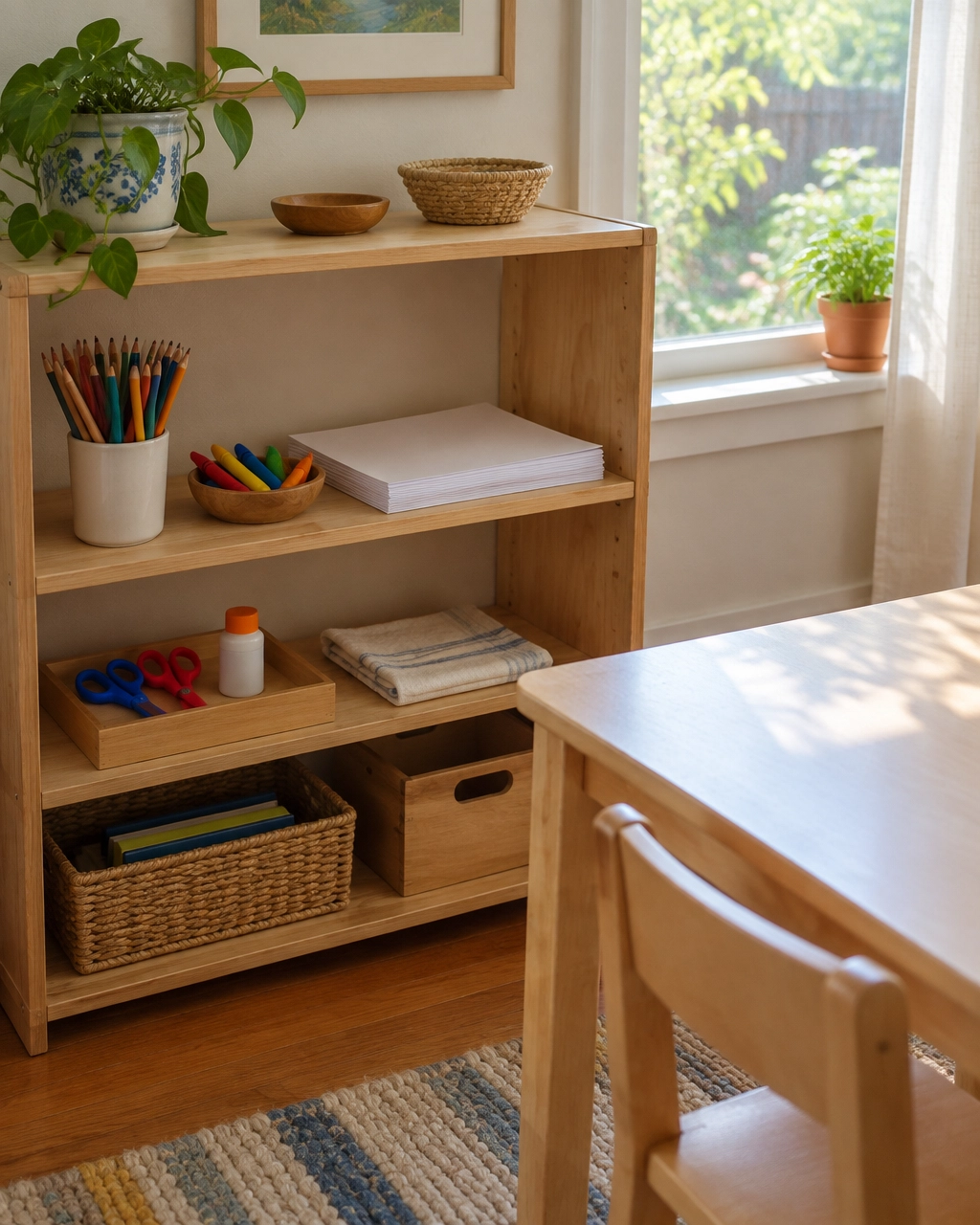
Children are much more likely to use materials they can see. Think of a cup of pencils, a small tray with scissors and glue, paper stacked neatly, and a basket holding a few collage materials. This is different from putting everything into one large plastic tub. The child should be able to look at the area and understand what is available.
That sense of order matters, and it also makes cleanup possible. If every object has a place, the child can learn to return it there.

The child’s work begins with accessible materials and time to concentrate.
Safe Materials, Safe Spaces
A few simple precautions keep the art area enjoyable for everyone.
Look for materials labeled non-toxic. In the United States, an AP seal from the Art and Creative Materials Institute is a helpful sign.
For children under three, and for any child who still puts things in her mouth, avoid small items such as beads, pom-poms, buttons, and googly eyes. They are choking hazards.
Stay close when toddlers use paint, glue, or clay, and when any child is learning to use scissors.
Most children are not ready for scissors until around age three. Choose a pair that actually cuts, with rounded tips, and get left-handed scissors if your child is left-handed.
Skip glitter for young children. It gets everywhere and is hard to clean up.
Art Is Not the Same as a Craft Project
There is nothing wrong with making a holiday decoration from time to time. But there is an important difference between art and an adult-designed craft. A craft often begins with an expected result: “Here is the turkey. Make yours look like this. Glue the eyes here. Put the feathers there.” The child may enjoy it, but the adult has already done much of the thinking.
Art is different. The child begins with materials and an idea, or perhaps no idea at all. She experiments, makes choices, changes direction, and discovers what the material can do. The result may not look like anything recognizable, and that is fine. The point is not to make something that looks impressive to an adult. The point is to create.
Show How to Use the Materials
Freedom works best when children know how to use the materials well, and a little demonstration helps. You might show a young child how to carry scissors safely, use just enough glue, rinse a paintbrush, wipe up a spill, and put finished work in its place.
Then step back. You do not have to explain everything. Children usually need a short lesson in how to use a tool, not instructions about what to make with it. That distinction is important.
What About the Mess?
This is where many art areas fail. Adults want children to create, but they do not want paint on the rug. Both concerns are reasonable. The solution is not to avoid messy materials forever. It is to prepare for them. Use a washable mat or an old tablecloth. Keep a cloth or sponge nearby. Have an apron or old shirt available. Put out only a small amount of paint or glue at a time. Show the child how to clean up.
For a very young child, this may require plenty of help, and that is fine. The goal is increasing independence, not instant independence.
The Area Should Grow With the Child
A two-year-old does not need the same art area as a ten-year-old. As children grow, the area can change.
A toddler may begin with thick crayons, large sheets of paper, and perhaps simple painting. A four- or five-year-old may be ready for colored pencils, scissors, glue, collage, watercolor, and clay. An elementary-aged child may want sketchbooks, better drawing pencils, rulers, compasses, fabric, wire, more advanced paints, or materials for building models. Older children may begin working on projects that last for days or weeks, so they may need a safe place to leave work in progress.
The important thing is to keep adjusting the environment as the child's abilities grow. An art area should not remain frozen at the level it was when the child was three.
Let Children Learn to Care for Good Materials
There is a temptation to give children cheap supplies because “they're just going to ruin them.” But poor materials are often more frustrating: a pencil that barely makes a mark, scissors that do not cut, paintbrushes with stiff bristles, or watery paint that produces weak color.
Children can learn to care for good materials. They do not need expensive professional art supplies, but tools that work well send an important message: your work matters.
A Basket for Recycled Materials
Many children are happiest with materials that cost nothing. A basket or box for recycled treasures can become one of the most used parts of the art area. Good things to collect include cardboard tubes and small boxes, clean egg cartons and food containers, fabric and ribbon scraps, used wrapping paper and old greeting cards, and corks, bottle caps, and fallen leaves, though watch for small parts with younger children.
Masking tape and child-safe glue turn these odds and ends into robots, houses, boats, and inventions. Wash and dry everything first, and when the basket is full, it is full. That keeps the collection from taking over the house.

Recycled materials invite children to build, combine, and invent.
Don't Correct the Drawing
Suppose your child draws a person with enormous arms and no neck. Or paints the sky purple. Or draws a house with six chimneys. You know people don't look like that, and your child probably knows it too. Resist the urge to correct.
Young children's drawings are not architectural plans. They express what the child notices, imagines, remembers, or experiments with. If the child asks, “Do you like it?” you do not need to become an art critic. You might say, “You used a lot of blue.” Or, “You worked on that for a long time.” Or, “Tell me about this part.” That keeps the focus on the child's thinking rather than adult approval.
Be Careful With Praise, Too
It is natural to say, “Beautiful!” or “That's amazing!” or “You're such a good artist!” There is nothing terrible about any of those comments. But if every piece of work gets the same enthusiastic praise, children may begin creating for the reaction instead of for the pleasure of creating.
Sometimes simple interest is more powerful. You might try asking, “What were you thinking about when you made this?” Or, “How did you make that texture?” Or, “I noticed you mixed two colors.” These comments invite conversation without judging the work.
Have a Place for Finished Work
Children make a lot of things, which creates another practical problem: what do you do with all of it? You do not have to save everything forever, but it helps to have a system. A drying rack for wet paintings. A shelf for work in progress. A folder or box for drawings. A bulletin board or string with clips for a few favorite pieces.
Perhaps once a month, the child can help choose what to keep and what to let go. Older children can photograph larger projects before taking them apart. This shows respect for the work without turning the house into permanent storage for every scrap of paper.
Include Beauty
Children notice their surroundings. A home art area doesn't need to look like a classroom, but it can still be attractive. Consider a small vase with a flower, a beautiful postcard, a painting print, a shell, an interesting piece of fabric, or a few natural objects. These things do not need to become “lessons.” They make the environment more interesting and beautiful. Children deserve beauty too.
Sometimes Create Beside Them
You do not always have to lead the activity. Sit nearby and draw, paint something, work with clay, or write in a sketchbook. Children learn a great deal from seeing adults absorbed in meaningful work. You do not need to produce anything impressive. In fact, it may be useful for your child to see that adults also experiment, make mistakes, and start over. Creating can be part of family life rather than something adults arrange for children.
Brothers and Sisters
If you have more than one child, the art area may need to work for different ages at once. Younger children can use the lower shelves with safe materials, while small-part materials and sharper tools go higher up for older children. Younger children often enjoy working beside an older sibling, and older children may enjoy showing a younger one how to use a material. Each child also needs a place to keep work in progress that the other will not disturb.
Let the Child Own the Space
This may be the most important part. If the art area belongs to the child, then the child should gradually learn to manage it. Over time, a child can take on jobs like sharpening pencils, replacing paper, washing brushes, putting caps back on markers, sweeping scraps from the floor, wiping the table, and telling you when the glue is running low.
This is where art connects naturally with Practical Life. Creating something is one part of the work, and caring for the environment is another.

Cleaning up is part of the work, not an interruption.
You Don't Need to Redesign the Whole House
Sometimes parents encounter Montessori ideas and feel they need to redesign every room. You don't. Start small: a shelf, a table, or a basket of supplies. Think about what your child can reach, what your child can manage, and what will allow greater independence. Then observe. Is the area being used? Are there too many materials? Is something missing? Has the child outgrown it?
A prepared environment is not something we create once and declare finished. It changes as the child changes.
Getting Started This Weekend
Choose one low spot, such as a table corner or the bottom of a shelf. Gather a small set of materials: paper, a few crayons or pencils, and perhaps scissors and glue if your child is ready. Arrange them in a cup, a tray, or a basket where your child can see them. Add a cloth or sponge for spills. Show your child how to use each item, and then step back and watch.
The Real Goal
A home art area is not about producing little artists. It is about giving children another language for thinking. A child can make something that did not exist before. She can try an idea, change it, solve a problem, combine materials, make a mistake, and begin again. She can work for twenty minutes or become completely absorbed for an hour. And when the area is well prepared, much of this can happen without an adult directing every step.
That may be the space's greatest value. It isn't the pictures that end up on the refrigerator or the crafts that come home in a folder. It is the quiet confidence of a child who can walk over to a shelf, gather what she needs, and begin: “I have an idea.”