Related Posts



Bringing Montessori Into the Everyday Life of Your Family
Snapshot
Bringing Montessori into your home does not require special furniture, expensive educational materials, or a perfectly organized playroom. Some of the most meaningful Montessori experiences take place during ordinary family life. By encouraging independence, involving children in meaningful activities, establishing reasonable boundaries, and treating one another with respect, families can create homes that support children’s development naturally and without unnecessary pressure.
Let Your Home Be a Home
Somewhere along the way, Montessori at home became associated with beautiful wooden toys, carefully arranged shelves, neutral colors, and remarkably tidy children’s bedrooms.
There is nothing wrong with an attractive, thoughtfully organized home. But these things are not the essence of Montessori.
A Montessori-inspired home can be a small apartment, a farmhouse, a crowded multigenerational household, or a home filled with colorful toys, family photographs, books, and the comfortable clutter of everyday life.
What matters most is not how your home looks. It is how your child experiences living there.
Does your child feel loved? Does she feel capable? Does he have opportunities to participate in family life? Are children treated as people whose ideas, feelings, and contributions matter?
These questions matter far more than whether you have purchased the right kind of shelf.
Help Me Become More Independent
Imagine a typical morning in a busy household.
A parent is trying to get breakfast ready, find missing shoes, prepare lunches, and make sure everyone gets out of the door on time.
It is often easier to do things for children than to wait while they do them for themselves.
Yet, when we repeatedly do things that children are capable of doing, we unintentionally communicate something about their competence.
Montessori encourages us to look for opportunities to help children become increasingly independent.
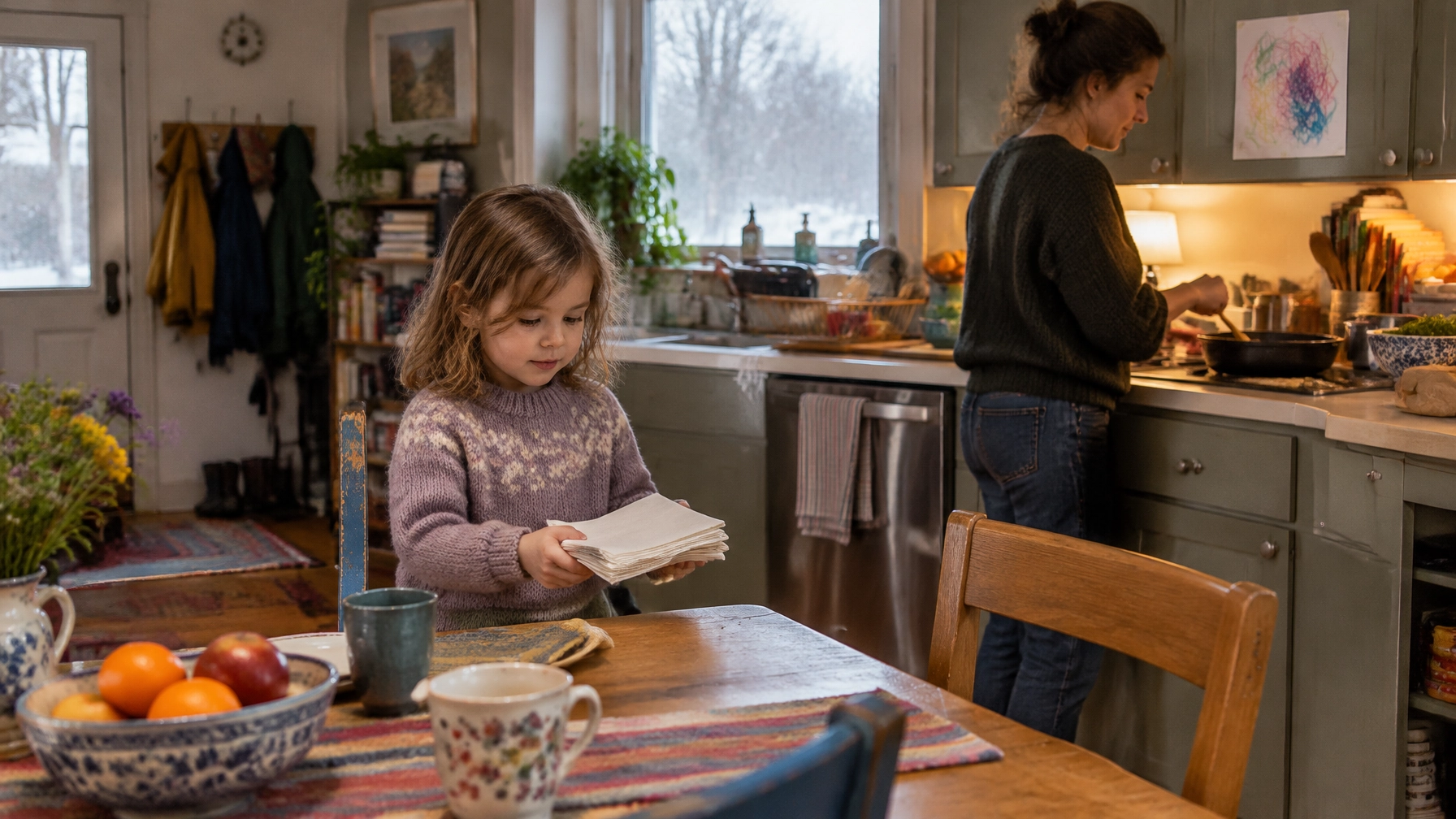
A toddler may carry a napkin to the table. A preschool child may dress independently, wash fruit, or put dirty clothes in a laundry basket. An elementary-aged child may organize a school bag, prepare a simple meal, or take responsibility for feeding a pet.
An adolescent can learn to manage a budget, plan meals, make appointments, contribute to household decisions, and gradually take on many responsibilities of adult life.
Independence develops through experience. Children need opportunities to practice, make mistakes, and discover that they are capable.
Some mornings, you will need to help because the family is running late. That is perfectly reasonable.
What matters is the general direction in which you are moving.
Make It Easier for Children to Succeed
One of Montessori’s most practical ideas is that we can reduce unnecessary dependence by thoughtfully arranging the environment.
Rather than repeatedly asking children to put away their belongings, consider whether they have an accessible place to put them.
A hook at a child’s height may make hanging up a coat possible. A small basket near the door may solve the problem of missing shoes. A stable step stool, used safely, may allow a child to wash hands or help prepare food.
A few accessible cups and dishes can enable a young child to participate more independently at mealtimes.
These changes need not be expensive. Often, the best solutions involve rearranging what you already own.
The objective is not to create a miniature version of the adult world. It is to remove unnecessary obstacles while maintaining appropriate supervision and safety.

An everyday kitchen can offer opportunities to participate.
Invite Children Into Real Family Life
Young children often want to do the things they see adults doing.
They want to stir the soup, wash the vegetables, fold the towels, water the plants, sweep the floor, and help care for animals.
These activities may seem ordinary to us, but they are wonderfully meaningful to children.
Preparing a meal together involves language, measurement, sequencing, coordination, planning, cooperation, and patience.
Gardening introduces children to biology, weather, seasons, and responsibility.
Shopping together can become an opportunity to discuss money, nutrition, geography, and decision-making.
We do not need to turn these experiences into formal lessons. The learning emerges naturally through conversation and participation.
There is also something emotionally important about being needed.
Children who make genuine contributions to family life begin to understand that they are not simply recipients of other people’s care. They are members of a community who can care for others.

Family work can be shared across generations.
Respect Does Not Mean Permissiveness
Montessori parenting is sometimes misunderstood as allowing children to decide everything for themselves.
Children are not miniature adults. They need adults who provide protection, emotional security, reasonable expectations, and consistent boundaries.
A child may choose between two appropriate outfits, but adults decide whether clothing suitable for cold weather is necessary.
A child may decide which book to read at bedtime, but the family establishes a reasonable bedtime routine.
A child is entitled to feel angry or disappointed, but those feelings do not justify hurting another person.
Respectful parenting means recognizing children’s emotions and perspectives while providing the guidance they still need.
You can be both kind and firm.
Protect Time for Childhood
Children’s lives can become remarkably busy. School, extracurricular activities, appointments, screens, and organized entertainment may leave little time for spontaneous play or quiet reflection.
One of the most valuable things parents can provide is some unhurried time.
Children need opportunities to build elaborate constructions, invent games, explore outdoors, become absorbed in a book, daydream, and pursue interests without constantly being directed toward the next activity.
Families also benefit from rituals that create a sense of continuity: shared meals, bedtime stories, weekend walks, family game nights, and conversations about the day’s events.
These experiences help children develop a sense of belonging and security.

An unhurried moment together.
What Parents Can Let Go Of
Parents whose children attend Montessori schools sometimes wonder whether they should purchase classroom materials and continue lessons at home.
Generally, there is no need.
Montessori materials are part of a carefully developed curriculum. Their presentation and sequence are among the responsibilities of a trained educator.
If your child’s teacher suggests a particular activity or practice at home, that may be helpful. Otherwise, your home can provide a different and equally valuable range of experiences.
You do not have to reproduce the school day. You do not need to constantly correct your child’s academic work, turn every family outing into a lesson, or buy every toy advertised as Montessori-inspired.
Read together. Talk together. Explore together. Play together.
Allow your child to experience the pleasure of discovering something without being evaluated.
Home and School Are Partners
The Montessori classroom and the family home serve complementary purposes.
School provides opportunities to participate in a broader community, develop friendships, explore a structured curriculum, and work with trained educators.
Home provides intimate relationships, family traditions, emotional security, and experiences that connect children with the realities of everyday life.
When home and school share an underlying respect for children’s development, each strengthens the work of the other.
They do not need to be identical.
A Way of Living Together
Ultimately, Montessori at home is less about educational materials and more about the culture of family life.
It involves listening carefully, letting children do things for themselves, taking their ideas seriously, setting reasonable expectations, and sharing responsibility for the household’s well-being.
It also involves laughter, affection, stories, adventures, and sometimes a willingness to leave the dishes until morning.
Children do not need perfect parents or perfect homes.
They need loving adults who believe in their potential and who gradually help them discover their own capabilities.
That is Montessori at its most fundamental level. And every family can begin practicing it today.