Related Posts



Understanding the hidden reasons families leave Montessori schools, and what we can do before they make that decision
Snapshot
One of the most important lessons in school leadership is that parent satisfaction and parent commitment are not the same thing. Families can love their children’s teachers, appreciate Montessori, recommend the school to friends, and still decide not to return next year.
Too often, schools treat reenrollment as an administrative process rather than an ongoing relationship with each family. By the time reenrollment agreements go out, many parents have already begun to make decisions about their children’s educational futures.
Building a strong and sustainable school requires more than attracting new families. It requires helping the families who are already part of our community develop a deeper understanding of their children’s education, a growing sense of belonging, and a compelling vision of what lies ahead.
Retention is not something we do in February. It is something we do every day.
Imagine receiving an email from the parents of a five-year-old who has attended your Montessori school for three years.
Their daughter is thriving. Her teacher describes her as curious, confident, independent, and increasingly drawn to challenging work. Her parents have always been friendly and supportive. They have volunteered at school events and recommended the school to neighbors.
Then comes the email. They have decided to enroll their daughter in another school next year. They thank you for everything you have done and tell you how much they have loved their years at your school. They may even tell you that it was a difficult decision.
You are surprised, perhaps even a little hurt, and you wonder what went wrong.
But from their point of view, nothing necessarily went wrong. They may simply have come to believe that it was time for their daughter to move on.
This distinction is enormously important. We tend to think that families leave schools because they are unhappy. Certainly, some do. But others leave because they never developed a clear understanding of why they should stay.
Satisfaction is not the same as commitment
When we ask parents whether they are happy with our school, most will answer in terms of their child’s present experience. Their child enjoys coming to school. They like the teacher. They feel welcome. They are pleased with their child’s progress.
These are encouraging signs, but they tell us relatively little about how the family pictures the next three, six, or nine years of their child’s education.
A parent can be completely satisfied with the Montessori early childhood experience while assuming that their child will attend a conventional elementary school. Another family may love the elementary program but believe that middle school should offer something more traditional. Still others may be unsure whether they can continue to afford tuition, whether their child will be academically competitive, or whether a relatively small community will offer enough social opportunities.
None of these concerns necessarily reflects dissatisfaction with the school.
What we need to understand is that parents are continually making decisions about their children’s futures. Their commitment to our school is not established once, when they sign an enrollment agreement. It evolves as their children grow, their circumstances change, and their understanding of education develops.
Our relationship with families needs to evolve as well.
Parents are making decisions even when we are not talking with them
Those of us who have spent much of our professional lives in Montessori education tend to see the developmental journey as a coherent whole. We understand the connection between the independence of the three-year-old, the intellectual curiosity of the seven-year-old, and the growing social awareness and sense of purpose of the adolescent.
Parents rarely begin with that same perspective. Most come to us because they are looking for an excellent educational experience for the child they have today. They are not necessarily thinking about the child their three-year-old will become at nine or twelve.
As their children grow, new questions emerge.
Will my child be ready for first grade?
Is my child learning enough mathematics?
Will my child be able to adjust to another school someday?
Are there enough friends in the class?
What about sports, technology, academic competition, or preparation for college?
These are reasonable questions, and we should welcome them. Unfortunately, if we are not actively talking with parents about these issues, they will naturally turn to other sources for advice.
Grandparents offer opinions. Friends describe their experiences at other schools. Neighbors talk about gifted programs, athletic opportunities, and academic achievements. Social media introduces parents to competing ideas about what makes an excellent education.
Gradually, an alternative vision of their child’s future begins to take shape. By the time a family schedules a tour at another school, they may have been considering a change for months. The first conversation we have with them about leaving may be the last conversation in a much longer decision-making process.
Thanksgiving and the conversations around the dinner table
The holiday season is a particularly interesting time in the life of an independent school.
Families gather with relatives they may not have seen for months. Someone asks a child how school is going. Grandparents ask parents about their plans for kindergarten or first grade. A cousin talks about the wonderful public school in their neighborhood.
Someone inevitably asks, “How long are you going to keep her in Montessori?”
Notice the assumption built into that question. Montessori is seen as something temporary, a lovely way to begin childhood before moving on to a more conventional education.
Other questions may be more challenging.
“She’s still playing with beads?”
“When will he start getting real grades?”
“Don’t you think she needs to learn how to deal with competition?”
“Why are you paying all that money when you have perfectly good public schools?”
Parents who have not developed a deep understanding of Montessori may struggle to respond. They may know that their child is happy, but they may not be able to explain what makes the education exceptional.
This is one of the reasons parent education is so important. It is not simply about helping parents understand what happens in a Montessori classroom. It is about helping them develop a thoughtful educational philosophy of their own. When parents understand why they have chosen Montessori, they are better equipped to weigh the advice and opinions of others.
The trouble with natural exit points
Every school has points at which families are especially likely to reconsider their enrollment.
For Montessori schools, one of the most significant is the year before kindergarten. Another is the move from kindergarten into elementary. Schools with upper elementary and adolescent programs often face similar challenges at each later transition.
In many communities, the prevailing culture tells parents that kindergarten is the beginning of real school. Montessori educators understand that the kindergarten year is actually the culmination of a remarkable three-year developmental experience.
But how well do our parents understand that?
We may explain the three-year cycle during the admissions process. We may mention it at orientation. We may include a paragraph about it in our parent handbook. But two years later, when a family is deciding whether to pay tuition for kindergarten or take a publicly funded alternative, how much of that information do they remember?
More important, have they actually seen what happens during that third year? Have they watched six-year-olds working with mathematical concepts, reading, writing, doing research, solving problems, and taking on leadership in their classroom? Have they had a chance to imagine their own child becoming one of those capable older children?
The same principle applies to the transitions into elementary and middle school. Too often, we expect parents to make a substantial financial and educational commitment to a program they have barely experienced.
We cannot assume that families will stay in Montessori simply because the next classroom is down the hall. Each new developmental stage is a new admissions decision.
Helping parents fall in love with the next classroom
One of the most effective retention strategies is to give parents opportunities to experience the education their children have not yet received.
Consider the family of a four-year-old. Their understanding of Montessori is shaped largely by their child’s current experience. What would happen if we invited them to spend a morning observing older children?
What if they could see a six-year-old helping a younger classmate, an elementary child researching the origins of civilization, or a group of adolescents developing and running a small business?
What if they could talk with the teachers who might guide their children in the years ahead?
What if they could hear from other parents who once faced the same decisions and now have the benefit of several more years of experience?
Schools often put considerable energy into open houses for prospective families. Perhaps we should put comparable energy into creating meaningful experiences for our current families.
We want parents to look ahead with anticipation rather than uncertainty. A mother whose child is four should already be excited about what she will see at five and six. The parents of a six-year-old should be developing an appreciation of the intellectual adventures that await their child in elementary. The next classroom should be an opportunity that families understand and look forward to.

An observation morning can help parents picture the next stage of their child’s education.
Are we talking about Montessori, or are we talking about their child?
Montessori educators are often very comfortable explaining Montessori philosophy. We can talk about sensitive periods, the prepared environment, the three-period lesson, normalization, cosmic education, and the development of executive function.
These concepts are important. But parents are most interested in understanding their own children.
A parent may be fascinated by an explanation of the Montessori mathematics curriculum, but the conversation becomes far more meaningful when we show how their daughter has developed the persistence to work through a challenging problem.
We can explain the importance of independence, but it becomes personal when we describe how their son, who once needed constant reassurance, now confidently chooses his own work and helps others.
Rather than simply telling parents what Montessori is, we need to help them recognize what Montessori is doing for their children.
Great parent conferences should do more than review progress through the curriculum. They should help parents understand who their child is becoming, and help them anticipate what may unfold over the next several years. The educational experience becomes much more valuable when parents can see it as part of their child’s personal journey.
The value of an education is not always visible
Independent Montessori schools ask families to make a significant financial commitment. For many, tuition is a real sacrifice. Parents may put off buying a new car, take fewer vacations, work extra hours, or make other changes in their family’s way of life to afford the education.
We should never take that commitment for granted. As tuition increases and children grow older, parents may ask themselves from time to time whether the investment still makes sense.
This is especially challenging because some of the most important benefits of a Montessori education are not easily measured or immediately visible.
How do we communicate the value of a child’s growing ability to concentrate?
How do we help parents recognize intellectual curiosity, initiative, resilience, empathy, sound judgment, and the ability to work with others?
How do we demonstrate academic growth while also helping parents appreciate the broader development of their children?
It is not enough to tell families that Montessori develops a lifelong love of learning. We need to help them see the evidence. Several things can contribute to a more complete understanding of the educational experience:
Documentation of children’s work
Thoughtfully written progress reports
Classroom observations
Individual conferences
Portfolios
Student-led presentations
Conversations with graduates
At the same time, we must be prepared to discuss academic achievement directly. Parents deserve clear and credible information about their children’s progress in reading, writing, mathematics, science, and other areas of the curriculum.
Montessori should not be presented as a choice between academic excellence and healthy human development. We aspire to both, and we have a responsibility to show how our programs support them.
When the school never becomes their community
There is another side of retention that deserves considerably more attention: the family’s sense of belonging.
Some parents develop deep relationships with other families, teachers, and school leaders. Others remain relatively anonymous, even after several years. They drop their children off in the morning and pick them up in the afternoon. They read the occasional school email, attend a conference, and pay their tuition. They may have tremendous respect for their child’s teacher, but the school has never truly become their community.
This is not necessarily because they are uninterested. Modern family life can be demanding. Parents may work long hours, have competing responsibilities, or simply feel uncomfortable entering a group where everyone else seems to know one another.
We need to be intentional about helping families find their place. A family-friendly school creates many different ways for parents to take part. Some will volunteer. Some will attend parenting workshops. Others will enjoy informal gatherings, family activities, community service projects, or chances to share their interests and expertise with children.
We should also recognize that belonging cannot be measured simply by attendance at school events. A parent who rarely comes to an evening program may still feel deeply connected to the school through meaningful personal relationships.
The objective is not to keep parents busy. It is to help them feel known, welcomed, respected, and valued. When families develop a real sense of belonging, school becomes something more than a service they purchase.
Parent education should be a continuing conversation
Many schools struggle to attract parents to traditional parent education evenings. Those who attend are often the very parents who are already deeply committed to Montessori. Meanwhile, the families we most hope to reach may be absent.
Perhaps we need to rethink what we mean by parent education. Rather than relying mainly on occasional lectures about Montessori philosophy, we might develop a continuing conversation with families about children, parenting, learning, and human development.
A conversation about children’s friendships can open a window into the social life of a multiage classroom.
A workshop on helping children develop resilience can lead naturally into a discussion of freedom, responsibility, and learning through experience.
Regular newsletters, brief videos, carefully chosen articles, classroom stories, informal parent conversations, and practical family workshops can gradually build understanding over time.
The central question is not how many parent education programs our school offers. It is how much our parents are actually learning, and whether that learning is helping them understand and appreciate their children’s education.
The early warning signs
Sometimes families give us signs that their commitment to the school may be changing.
A previously engaged parent becomes more distant.
Questions about academic achievement become more frequent.
A family begins asking about standardized testing, transfer records, or how children adjust to traditional schools.
A parent who once talked enthusiastically about the elementary program stops mentioning it.
Other families raise concerns about tuition, friendships, classroom composition, teacher communication, or the long-term direction of the school.
None of these signs necessarily means that a family is preparing to leave. We should be careful not to read normal questions or changing patterns of participation as evidence of disloyalty. But they may be an invitation to a conversation.
The worst response is often to become defensive. When a parent asks whether their child is keeping up academically, our first instinct should not be to explain why conventional measures of achievement are inadequate. We should begin by understanding what prompted the question. There may be a specific concern that we can address. There may be information we have failed to communicate. There may even be a real issue in our program that deserves attention.
Listening is one of the most powerful tools in school leadership. Parents who feel comfortable bringing their concerns to us give us a chance to respond. Parents who believe their concerns will be dismissed may simply stop asking.

Listening openly gives families room to share questions and concerns.
The conversation we should be having with every family
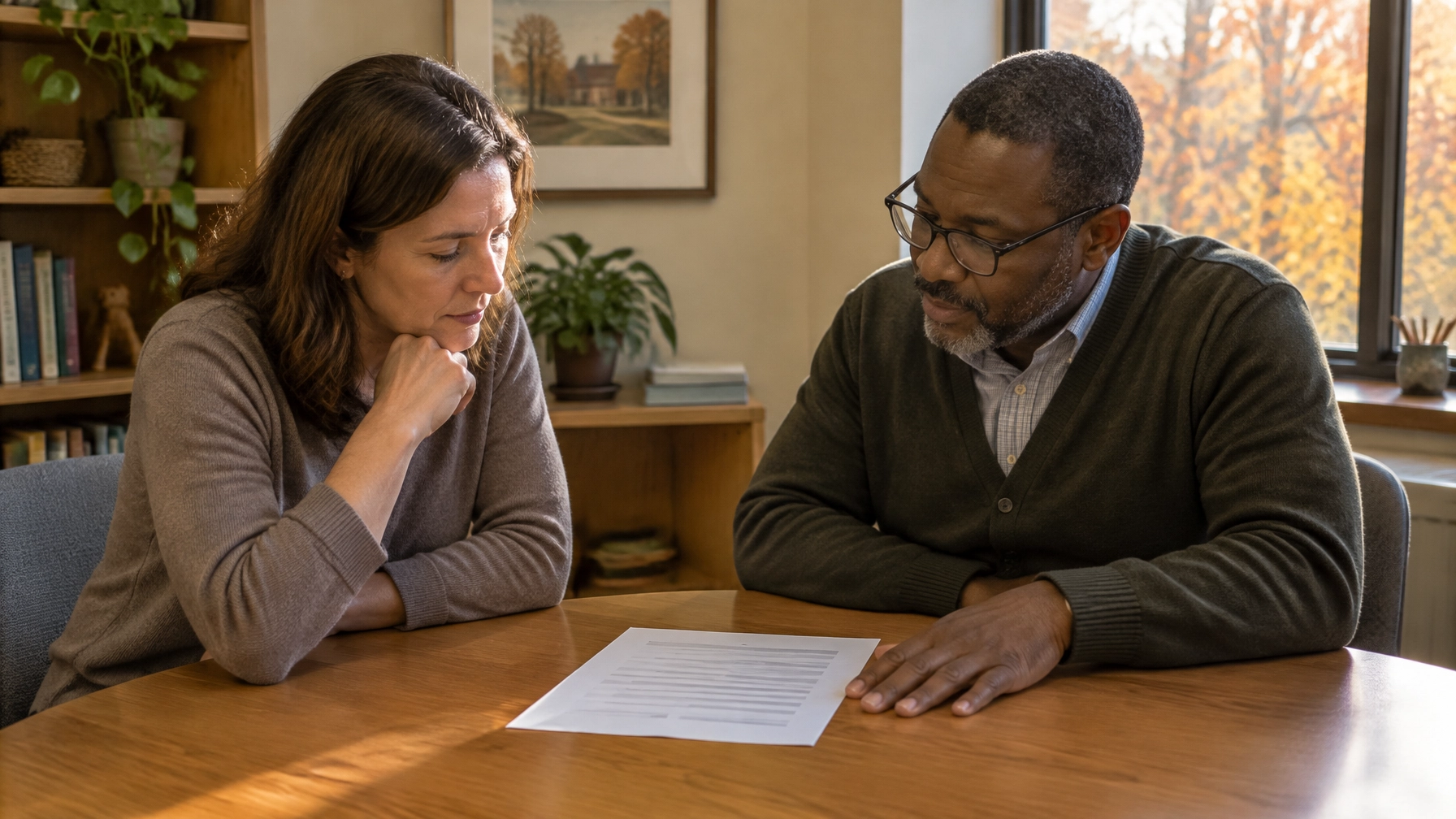
What would happen if every family in our schools had a chance, at least once a year, to sit down with someone who knows them and have a thoughtful conversation about their child’s educational future?
This would not be an ordinary parent-teacher conference. It would not be a sales presentation or an attempt to secure an early commitment to reenroll. It would be an opportunity to understand the family’s hopes, questions, concerns, and changing circumstances.
We might ask:
What have you been especially pleased to see in your child’s development this year?
What are your hopes for your child over the next several years?
Are there parts of your child’s education that you would like to understand better?
Are there things you wish our school did differently?
How do you see your child’s educational journey unfolding?
Are there questions or concerns that might influence your decision to continue at our school?
What could we do to better support your family?
The value of these conversations lies not simply in the questions but in our willingness to listen to the answers.
We may learn that a family is struggling financially. Another may be worried about the small number of children in a particular age group. Another may have reservations about a teacher or the academic strength of a program. Still another may be completely unaware that our school offers a program beyond their child’s current classroom.
These conversations can also reveal opportunities for school improvement that we might otherwise miss. The goal is to understand families as individuals rather than treating them as a single group.
Sometimes the parents are telling us something we need to hear
It would be a mistake to suggest that every retention problem can be solved through better communication or parent education. Sometimes parents leave because our schools have not delivered the educational experience we promised.
Perhaps teacher turnover has been excessive.
Perhaps the elementary program is underdeveloped.
Perhaps parents have legitimate concerns about academic progress, classroom management, communication, bullying, or school leadership.
Perhaps the building and grounds no longer reflect the quality of education we claim to offer.
In these circumstances, a more sophisticated marketing campaign is not the answer. We need to address the underlying problems.
School leaders should be willing to examine patterns in family departures without automatically blaming them on a lack of understanding of Montessori. If families repeatedly leave a particular classroom, level, or program, we need to investigate. If parents consistently raise the same concerns, we should consider whether those concerns point to a weakness in the school.
A school that is serious about retention must also be serious about improvement. The most effective marketing strategy will always begin with the quality of the experience we provide.
We should not wait until reenrollment season
In many schools, reenrollment begins sometime between January and March. Unfortunately, this is often when schools first start to focus on retention.
They send letters celebrating the school year. They announce next year’s tuition. They remind families about enrollment deadlines and explain that spaces may be offered to new applicants. Some offer incentives for early reenrollment.
These are perfectly reasonable administrative practices, but they should be the culmination of a year-long process, not its beginning.
By November, school leaders and admissions staff should already have a reasonably clear understanding of how each family is experiencing the school. They should know which families are approaching important developmental transitions, which have raised concerns, and which may benefit from additional support. They should be creating opportunities for parents to become familiar with next year’s program.
Between Thanksgiving and the winter holidays, schools have an important opportunity to strengthen relationships and begin conversations that might otherwise come too late. A personal phone call, an invitation to observe another classroom, or a conversation over a cup of coffee can accomplish far more than another promotional email.
Make retention a shared responsibility
In many independent schools, responsibility for enrollment falls mainly on the admissions director or the head of school. However, the people who have the greatest influence on whether families stay are often the teachers.
Teachers see children every day. They understand their strengths, their challenges, their friendships, and their remarkable moments of growth. They are in a position to help parents appreciate what is happening in their children’s lives.
Even a brief message describing something wonderful a child accomplished that morning can deepen a parent’s appreciation of the school. Imagine the effect of regularly receiving small, authentic glimpses into your child’s development. Not generic photographs of classroom activity, and not promotional messages, but thoughtful observations that show that someone truly knows and cares about your child.
Every family should feel that there is at least one adult in the school who knows their child exceptionally well and with whom they can speak openly.
Admissions staff, school leaders, business officers, office staff, and teachers all contribute to the family’s experience. Retention is the whole school’s responsibility.
Finding the perfect match also means being willing to let go
Of course, no school should expect to keep every family. Families relocate. Financial circumstances change. Children may need services that a particular school cannot provide. Some parents will discover that their educational priorities are different from those of the school. And there are circumstances in which another educational setting may truly be better for a child.
We should approach these situations with generosity and professionalism. Our objective is not to persuade every family to stay at any cost. It is to help every family make a thoughtful, well-informed decision in the best interests of their children.
When a family does leave, we should try to understand their experience, learn what we can from it, and end the relationship with dignity. Former families can remain friends, supporters, and enthusiastic ambassadors for a school that treated them well. Some may even return.
The way we say goodbye tells families a great deal about who we are.
A Practical Guide for School Leaders: The Family Retention Review
An exercise to undertake with your leadership and admissions team before reenrollment season
Set aside time to review your school’s enrollment, classroom by classroom and family by family. This should be a confidential, constructive conversation among the appropriate members of your leadership team. Its purpose is to identify opportunities to support families, not to label parents or speculate about their loyalty.
Step 1. Understand your retention history
Consider the following questions.
What percentage of eligible children returned in each of the last three years?
At which ages and developmental transitions do we lose the most families?
Are there significant differences in retention among classrooms or programs?
What reasons have departing families given us?
What patterns might we be overlooking?
Distinguish between expected departures, such as graduation from the school’s highest level, and departures that might have been prevented.
A useful starting point is to calculate your retention rate: divide the number of eligible students who returned by the number of students who were eligible to return, and multiply by 100. Use the same definition consistently from year to year.
Step 2. Review your relationships with current families
Consider creating a confidential working document with an entry for each family, covering the following.
Family and child: name, classroom, and age or grade.
Next year’s program: where the child would ordinarily continue.
Family experience: what we actually know about their experience.
Future plans: what the parents have told us.
Questions or concerns: financial, academic, social, or other issues.
Transition needs: how familiar they are with the next classroom or program.
Next action: a conversation, an observation, a meeting, or other support.
Responsibility: who will personally follow up.
Follow-up date: when the action should take place.
Be especially attentive to families whose future plans are unknown. A lack of information should never be confused with a lack of concern.
Step 3. Examine the parent experience with a self-assessment
As a leadership team, rate each statement below as consistently true, partially true, or needs attention.
- Every family has a meaningful personal relationship with someone at our school.
- Parents receive regular, individualized information about their children’s development.
- Families understand the educational purpose of the complete three-year Montessori cycle.
- Parents have opportunities to experience the next developmental level.
- We communicate academic progress clearly and credibly.
- Parents feel comfortable sharing concerns with us.
- We have an ongoing, accessible parent education program.
- New families receive intentional support during their first year.
- We understand the main reasons families have left our school.
- Teachers understand their role in parent relationships and retention.
- We begin conversations about educational transitions well before reenrollment.
- We have a personal follow-up plan for families who have raised concerns.
Any statement your team rates as needing attention is a good place to begin.
Step 4. Develop a retention calendar
Rather than treating retention as a seasonal campaign, consider establishing an annual cycle of family engagement.
August and September: welcoming families, onboarding, and building relationships.
October: early check-ins and communication about how children are settling in.
November: the family relationship review and individual conversations.
December: strengthening community and introducing future educational opportunities.
January: classroom observations, transition workshops, and conversations about next year’s programs.
February and March: reenrollment, individual follow-up, and financial assistance discussions where appropriate.
April and May: preparing children and parents for their next developmental stage.
June and July: maintaining relationships, reviewing retention results, and improving school practices.
Adapt this calendar to your school’s enrollment cycle and the needs of your community.
Step 5. Commit to five things before reenrollment
Review every family’s experience and expected plans for next year.
Personally connect with families who have raised concerns or whose plans are uncertain.
Invite families approaching a transition to experience the next classroom.
Create several meaningful opportunities for parents to understand their children’s educational progress.
Identify and begin addressing problems in the school that may be contributing to family departures.
A final thought: The families we already have
School leaders can become understandably preoccupied with attracting new families. We worry about our website, advertising, inquiry numbers, tours, applications, and enrollment projections. We devote considerable resources to communicating the value of Montessori to people who have never experienced it.
Yet some of our most important prospective families are already enrolled in our schools. They have entrusted us with their children. They have made a financial commitment. They have experienced our classrooms, gotten to know our teachers, and begun to discover what Montessori can mean in their lives.
We should never stop getting to know them. We should never stop earning their trust. And we should never assume that because they chose us several years ago, they will automatically choose us again.
The strongest schools are not simply places where children receive an excellent education. They are communities in which families understand what is happening, appreciate where their children are going, and feel that they have found partners for one of the most important journeys of their lives.
When we create that kind of relationship, reenrollment becomes something quite different. It becomes the natural continuation of a journey that neither the school nor the family is eager to end.