Related Posts


Cursive, Print, and the Montessori Tradition
Snapshot
Maria Montessori traditionally introduced children to cursive handwriting, and many Montessori schools continue this practice today. Others begin with print and introduce cursive later. Both approaches can support children’s literacy development when implemented thoughtfully. Although cursive offers potential benefits and deserves a meaningful place in children’s education, research does not show it is universally the best starting point. More important Montessori principles include preparing the hand, connecting sounds and symbols, meaningful writing, developmental readiness, and gradually achieving fluent written expression.
A Surprisingly Passionate Debate
Ask a group of Montessori educators whether children should first learn to write in cursive or print, and you may find yourself in the middle of a lively debate.
Some consider cursive an essential element of traditional Montessori practice. Others argue that print is more familiar to contemporary children and more practical in today’s world.
Parents may find these disagreements confusing. They may wonder why their child’s Montessori school teaches handwriting differently from another Montessori school or from the conventional schools they attended.
To understand this discussion, it helps to look at Montessori’s original approach to writing and the developmental purposes behind it.
Why Montessori Introduced Cursive
In the early twentieth century, when Maria Montessori established her first Children’s House in Rome, cursive was a customary form of handwritten communication.
It was natural for her to introduce children to the writing style commonly used by the adults around them.
However, her approach also served pedagogical purposes.
Montessori recognized the connection between physical movement and intellectual development. She understood that children could become familiar with written language through carefully prepared sensory experiences.
Cursive emphasizes connected, flowing movements. Depending on the style taught, it may reduce how often children need to lift their pencils within a word. It can also help make the boundaries between words visually apparent.
Montessori educators sometimes find that the distinctive movement patterns of cursive help children differentiate letters that they might otherwise confuse.
These are plausible educational advantages, although they should not be interpreted as guarantees for every learner.
Montessori’s Remarkable Preparation for Writing
Perhaps Montessori’s most significant contribution to handwriting instruction was recognizing that children could prepare for writing long before they were asked to write letters on paper.
The Montessori classroom provides numerous experiences that indirectly and directly support the development of written language.
Practical Life
Activities such as pouring, transferring small objects, fastening clothing, polishing, food preparation, and using simple tools help children develop hand-eye coordination, precision, controlled movement, and concentration.
These abilities contribute to later writing.
Children are not practicing handwriting directly, but they are developing the physical and mental capacities handwriting requires.

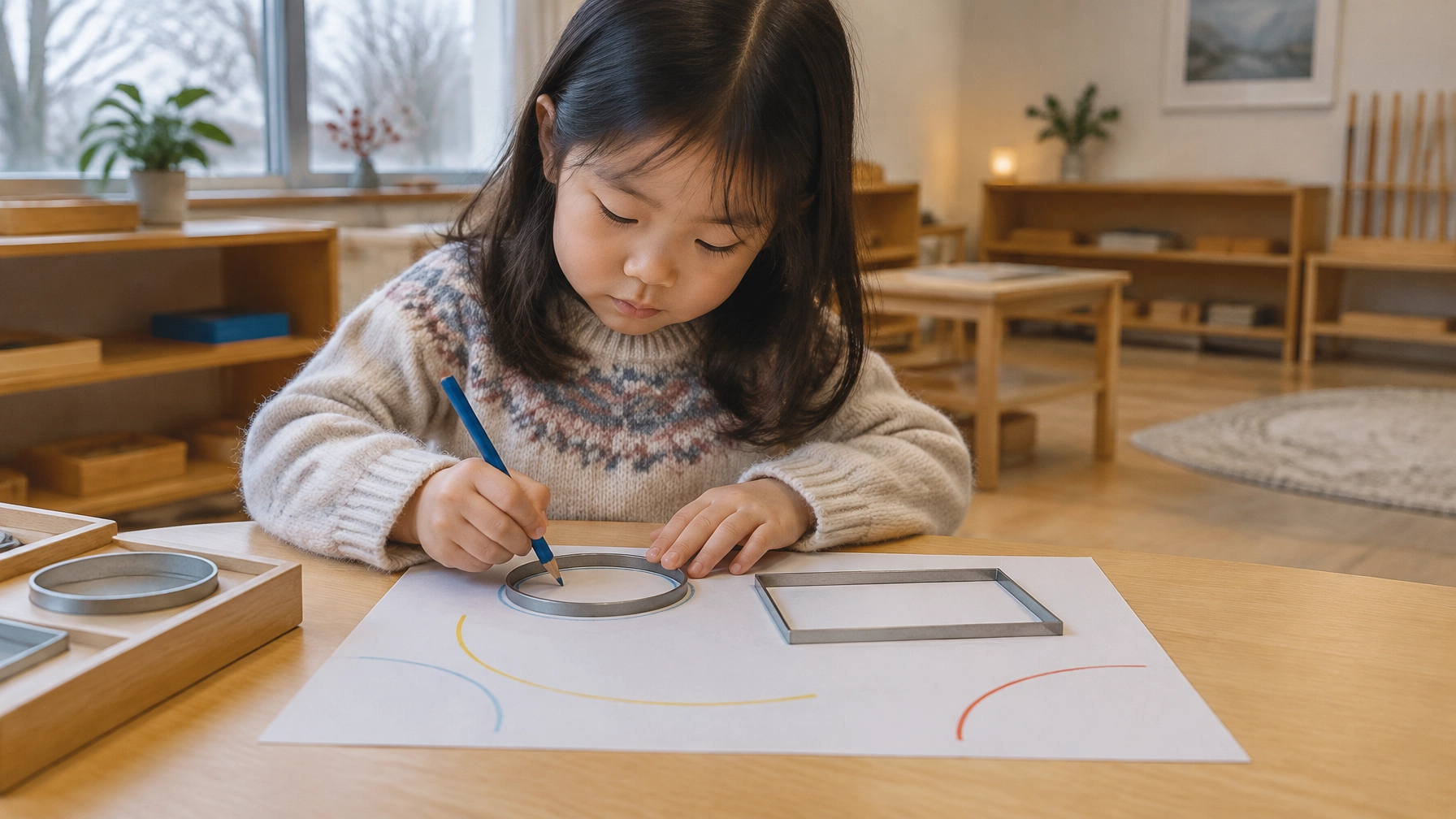
Tracing geometric forms gives children opportunities to refine pencil control.
The Metal Insets
The Metal Insets let children trace geometric forms and create designs with colored pencils.
Through repeated experiences, children refine their pencil control, learn to regulate pressure, develop increasingly precise movements, and gain experience working within defined spaces.
The activities are often enjoyable in their own right, which encourages children to practice voluntarily.
 Teacher And Pupils Working With Letters In Montessori School
The Sandpaper Letters
The Sandpaper Letters bring together sound, sight, touch, and movement.
A child hears the sound associated with a letter while tracing its form. This creates a multisensory experience that connects spoken language with written symbols and the movements involved in forming them.
Sandpaper Letters can be prepared in cursive or print. In either case, careful presentation and consistent letter formation are important.

Tracing a tactile form brings movement and touch into writing preparation.
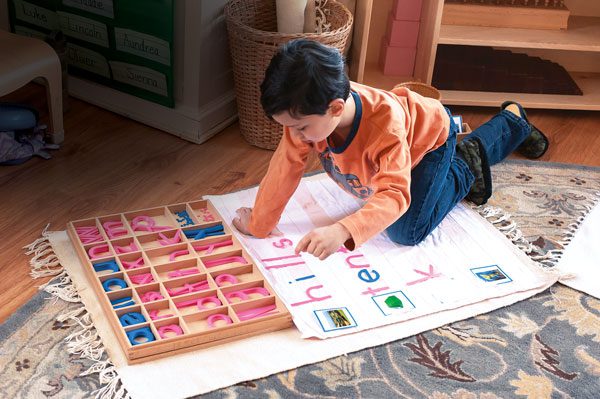
The Movable Alphabet
The Movable Alphabet is one of Montessori’s most ingenious educational materials.
Children can select letters and arrange them into words without forming them with a pencil.
This lets them express their ideas even when their handwriting skills are still developing.
A child may compose a word, a sentence, or eventually a short story using the Movable Alphabet before being able to write the same text fluently by hand.
Montessori recognized that the intellectual process of composing written language and the physical process of handwriting do not necessarily develop at the same rate.
Separating them allows children to make progress in one area without being unnecessarily limited by the other.

Individual wooden shapes give a child a way to explore composition before fluent handwriting.
The Case for Introducing Cursive First
There are several reasons Montessori educators may prefer a cursive-first approach.
Cursive preserves an important Montessori tradition. It provides experience with continuous, coordinated movements and gives children an opportunity to develop a form of handwriting that may become efficient and personally expressive.
Learning cursive in early childhood also takes advantage of children’s interest in sensory experiences, movement, and exploring written symbols.
Many Montessori educators report that children introduced to cursive handwriting also learn to recognize printed letters readily, particularly because print is so widespread in books and everyday surroundings.
Cursive can additionally give children access to handwritten letters, journals, historical documents, and family records that might otherwise become difficult for them to read.
For these reasons, I would encourage Montessori schools to think carefully before eliminating cursive from their programs.
The Case for Introducing Print First
There are also legitimate reasons why some Montessori educators begin with print.
Children encounter printed letters almost everywhere: in books, signs, packaging, keyboards, and digital environments.
For some children, learning to form letters that closely resemble those they frequently encounter may be helpful.
Some manuscript styles use relatively simple individual strokes. Depending on the child’s motor development and learning profile, this may make certain letters easier to master initially.
Local curriculum requirements and the expectations of other schools may also influence a school’s decision, particularly where children are likely to transition between educational systems.
These considerations deserve thoughtful attention rather than automatic dismissal.
However, children do not necessarily need to learn to write letters in the same script in which they first learn to read them. Reading and handwriting are related but distinct skills.
What Does the Research Actually Tell Us?
Contemporary research supports the importance of handwriting instruction in developing written expression.
Research reviews suggest that systematic handwriting instruction can improve legibility and, in appropriate circumstances, writing fluency and broader aspects of written composition.
The question of whether to introduce cursive or manuscript first is less settled.
Different studies have examined children of different ages, instructional approaches, languages, writing styles, and developmental profiles. Their findings do not establish one universally superior sequence.
Some studies suggest advantages associated with cursive instruction. Others suggest benefits of maintaining a consistent manuscript format until children develop sufficient fluency.
We should also be cautious about popular claims that cursive handwriting uniquely develops the brain, prevents dyslexia, or automatically produces superior academic achievement.
The fact that an activity engages particular brain networks does not, by itself, establish that it produces better educational outcomes than another activity.
The research more confidently supports the value of helping children become competent, increasingly fluent writers through purposeful instruction and practice.
Considering Individual Learning Differences
Not every child experiences handwriting in the same way.
Some children find connected movements relatively comfortable. Others find joining letters challenging.
Children with fine-motor difficulties, developmental coordination differences, dysgraphia, visual impairments, or other learning needs may benefit from differentiated instruction, additional time, adaptive tools, or specialist guidance.
A Montessori educator’s responsibility is to observe the individual child and respond thoughtfully.
When handwriting becomes a significant barrier to expressing ideas, alternative ways of recording those ideas may be appropriate while the child continues to receive handwriting support.
We should not allow difficulty forming letters to deprive children of the pleasure of composing stories, recording discoveries, and communicating their thoughts.
Developing a Coherent School Approach
Schools should avoid making handwriting decisions based entirely on individual teachers’ preferences.
A thoughtful approach considers the child’s experience across several years.
If one classroom introduces cursive and another insists on print, children may encounter unnecessary confusion. Similarly, introducing several handwriting styles in rapid succession may interfere with the development of automatic letter formation.
School leaders and educators should agree upon a coherent progression that considers:
The developmental rationale for the initial handwriting style.
The consistency of letter forms and formation movements across materials.
Appropriate preparation for handwriting.
Opportunities for meaningful writing and regular practice.
Children’s exposure to different forms of written language.
The introduction of a second handwriting style when children are ready.
Adaptations for children with individual learning needs.
Relevant accreditation, curriculum, and educational requirements.
In multilingual schools, these decisions may be particularly complex. Not all languages use the Roman alphabet, and different writing systems present different developmental and instructional considerations.
Montessori principles should be applied in ways that respect each language’s characteristics.
What Are We Ultimately Trying to Accomplish?
There is something deeply satisfying about watching a child discover written language.
A child realizes that the sounds of spoken words can be represented by symbols. Those symbols can be arranged to communicate ideas. Something imagined can be recorded on paper and shared with another person.
This is an extraordinary intellectual achievement.
Beautiful handwriting is worth cultivating, but it is not the ultimate purpose of learning to write.
We want children to become comfortable expressing themselves. We want them to write letters, tell stories, explain discoveries, record observations, formulate arguments, and communicate what matters to them.
My preference would be for children learning languages that use the Roman alphabet to encounter both print and cursive during their education. I believe cursive deserves a meaningful place in Montessori schools, and I see good reasons for introducing it early.
At the same time, I would never judge a Montessori school’s authenticity on its decision about which handwriting style comes first.
The deeper question is whether the school understands and preserves Montessori’s remarkable developmental approach to written language.
When children become capable, confident writers who discover the joy of expressing their ideas, we have accomplished something far more important than winning an argument about handwriting.