Related Posts



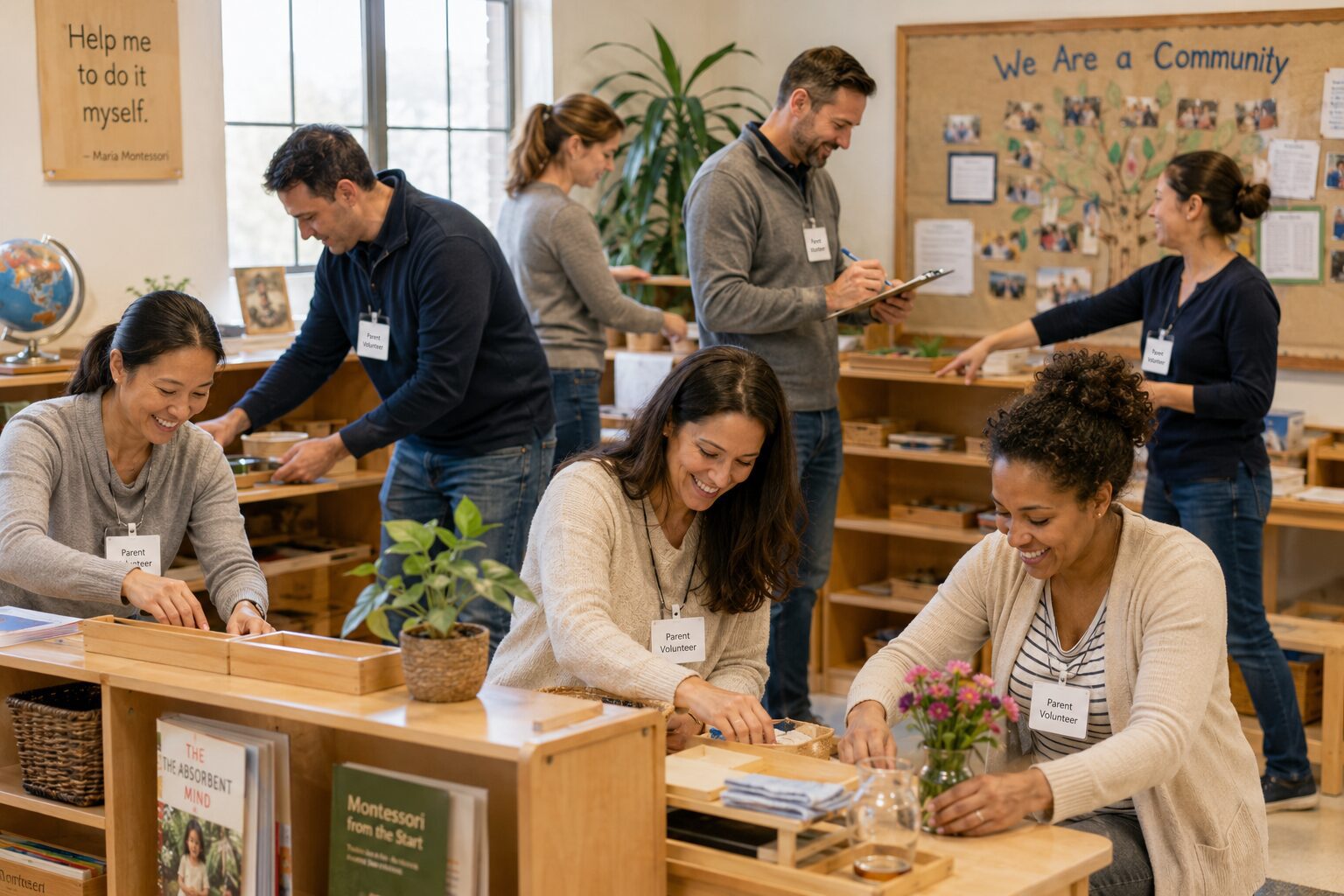
There’s a very specific trap that happens every Fall: you raise your hand to help with one small thing — folding a stack of practical life materials, maybe, or bringing in snack one Friday — and by October you’re somehow running the harvest festival, coordinating snack schedules for three classrooms, and fielding emails at 9 pm about napkins. Nobody meant for this to happen. It just expands, the way volunteer commitments often do.
Here’s the thing worth remembering before you say yes to anything: parent involvement in a Montessori community isn’t a favor you’re doing the school. It’s a genuine three-way benefit when it’s done sustainably — and understanding all three sides of that actually makes it easier to know what to say yes to.
For your child: Kids notice when their parents show up in their world, even briefly. A classroom visit, a shared skill, a familiar face at a school event — these moments tell a child, in a very concrete way, that the two most important parts of their life (home and school) are connected, not separate. It also models something core to the Montessori approach itself: contributing to a community isn’t optional or occasional; it’s just what people who belong to a place do.
For you: Involvement — the right amount of it — is one of the fastest ways to actually get to know the other families and teachers in your child’s daily world, instead of existing as a name on a class roster who only appears at drop-off and pickup. It turns “some school your kid goes to” into an actual community you’re part of, which tends to make the whole experience more meaningful and a lot less isolating.
For the school: Montessori schools, especially smaller or newer ones, often depend on real parent volunteers not as an afterthought, but as part of how the model works. Materials need maintenance events need hands, and classrooms benefit from outside skills and perspectives that teachers don’t have time to seek out on their own. A healthy volunteer base isn’t a nice extra. It’s often structurally necessary.
All of that is true — and none of it means you should say yes to everything. In fact, the version of you that’s stretched across five committees and burnt out by Thanksgiving isn’t actually delivering any of those three benefits well. A resentful volunteer isn’t modeling community for their kid. They’re modeling martyrdom.
Sustainable ways to show up:
- Pick one thing per semester, not five. A committee, a classroom visit day, a single event — not all of them. One consistent commitment beats five half-hearted ones, both for your own sanity and for the school’s ability to actually count on you.
- Ask what the school actually needs before volunteering for what sounds fun. The harvest festival is glamorous. The real gap might be someone who can quietly restock the practical life shelves every other week, or a parent who’s willing to do library reshelving during pickup chaos. Fun and needed aren’t always the same thing — ask before assuming.
- Offer a specific skill instead of general availability. “I’m a nurse and happy to do a short health lesson” is a much easier yes for a school to plug in than “let me know if you need anything,” which usually just gets filed away and forgotten, or worse, remembered at the worst possible moment.
- It’s okay to say “not this semester” without having to justify it. You don’t owe anyone a lengthy explanation for your bandwidth. A burned-out volunteer helps no one, especially not you, and definitely not the classroom, depending on a version of you that has anything left to give.
- Set a boundary on communication, not just time. If snack coordination has turned into a nightly text thread, it’s fair to ask that it move to a weekly email or a shared sign-up sheet instead. Protecting your evenings is part of protecting your ability to keep showing up
Being a present, engaged Montessori parent doesn’t mean being the only parent who shows up, or the one who shows up for everything. It means showing up consistently for the thing you actually chose — which, not coincidentally, is also the version of involvement your kid, you, and the school all actually benefit from.