Related Posts


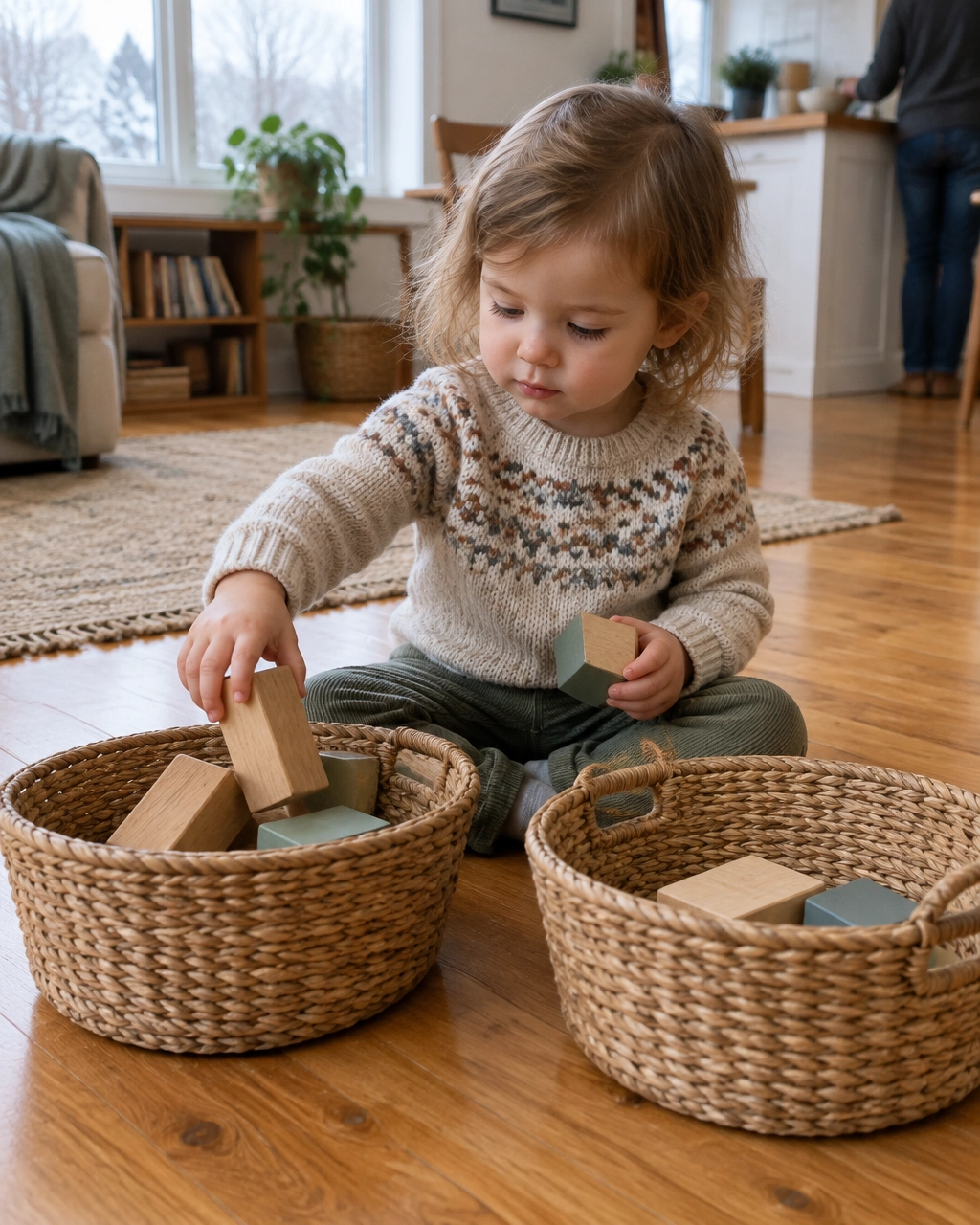
With a few simple materials within reach, a toddler can repeat an activity at their own pace.
Snapshot
Children don't need adults to entertain them every minute. With a little preparation, even toddlers can find satisfying things to do on their own. The key is offering a few activities that match the child's abilities, keeping materials within reach, and protecting enough uninterrupted time for the child to become absorbed. This article offers practical ideas for children from toddlerhood through age six, plus a simple way to set up a small activity shelf at home.
"What Can I Do?"
It's a familiar holiday scene. You're cooking dinner, wrapping presents, or trying to finish something that can't wait, and your child appears at your elbow. "What can I do?" You suggest the toys. "I don't want to." You suggest drawing. "That's boring." A few minutes later, the question is back.
The natural response is to look for more: more activities, more toys, something more exciting. Often the better answer is the opposite. Children tend to become more independent when we offer fewer choices, prepare them thoughtfully, and give them time to explore.
Why Independent Activity Matters
Watch a child who is truly absorbed. A toddler threads wooden rings onto a post, again and again. A four-year-old builds an elaborate tower of blocks. A six-year-old spends forty minutes drawing an imaginary city. No one is entertaining them or telling them what to do next. They have chosen something that interests them and are following it through.
Dr. Montessori observed that young children often seem to be asking, "Help me to do it myself." Moments of self-directed concentration are where that wish is fulfilled. They build focus, persistence, coordination, imagination, and confidence, and the capacity grows with practice.
Independent activity doesn't mean leaving young children unsupervised. It means letting them direct their own activity while an adult remains appropriately close by.
For Toddlers: Simple Activities With a Clear Purpose
Toddlers love repetition. A child may spend fifteen minutes putting objects into a container and taking them out again. To an adult it looks pointless; to the child it is fascinating. They are learning how objects fit together, how their hands work, and what happens when an action is repeated.
Good choices include transferring large objects from one basket to another, nesting cups and stacking rings, simple wooden knob puzzles, large building blocks, sturdy board books, and wiping a small table with a damp sponge.

Caring for a plant lets a young child take part in real family life in a meaningful way.
Toddlers also want to take part in real family life. They can carry napkins to the table, put unbreakable dishes on a low shelf, give a plant a small drink of water, or help wipe up a spill. The task doesn't need to be complicated. It needs to be something the child can succeed at, with just enough help.
Choose materials without choking hazards, and supervise water, food preparation, and anything else according to your child's abilities.
For Three- and Four-Year-Olds: Real Work and Creative Play
Children of three and four are often drawn to activities with a clear beginning, middle, and end. Consider washing vegetables or fruit for a snack, arranging flowers in a small vase, polishing a small mirror or a piece of wooden furniture, matching socks or folding napkins, puzzles, modeling clay, drawing, and painting, and simple lacing or sewing cards.
A tray makes an activity especially inviting. Picture a tray holding a sponge, a small bowl of water, and a drying cloth. The child carries it to a table, washes a few small objects, dries them, and puts everything back. This isn't pretend. The child is doing real work, and they know it.

The child carries the tray and completes each part of the activity independently.
This is also the age of rich imaginary worlds. A basket of wooden animals, blocks, scraps of fabric, and a few simple figures often inspires far more inventive play than a toy that talks, flashes, and performs on its own.
For Five- and Six-Year-Olds: Bigger Ideas and Longer Projects
By five or six, many children are ready for projects that take planning and several steps: following a simple illustrated recipe, building a bridge, marble run, or city with blocks, making a puppet theater and putting on a show, creating greeting cards or small handmade books, caring for a small indoor garden, and woodworking, sewing, or other handcrafts with appropriate tools and supervision.

An open-ended building project lets a child plan, experiment, and keep working at their own pace.
Some children are drawn to maps, numbers, writing, or collections; others to building and figuring out how things work. Observe what captures your child's interest. A child who builds for hours may appreciate better construction materials. A child who loves to draw may treasure a good sketchbook and a quality set of colored pencils. You don't need to invent a new activity every day. Often you only need to make it easier for your child to pursue an interest they already have.
Try a Small Activity Shelf
One of the simplest Montessori ideas to bring home is a low shelf holding a few carefully chosen activities. You don't need special furniture; an ordinary low bookcase works well.
To set one up, choose four to six activities your child can manage with reasonable independence. Place each in its own basket, tray, or container so its purpose is clear. Keep every activity complete, since a puzzle with missing pieces or a box of dried-out markers is not an invitation. And show your child how to take an activity to a table or rug, use it, and return it to its place when finished.

A small, orderly shelf keeps a few complete activities within a child’s reach.
This is a very different experience from digging through an overflowing toy box, and children often respond to the order and calm right away.
Rotate Rather Than Add
Parents sometimes worry that a child will be bored with only a few choices. In fact, too many toys can make it harder to choose anything at all. Keep some materials out and store the rest. After a week or two, notice what your child actually uses. Replace an activity that no longer holds interest, or introduce something a bit more challenging.
Let your child's interest set the schedule, not the calendar. If your child is deeply involved with a set of blocks, leave them out. Repetition and sustained interest are often signs that important learning is under way.
Resist the Urge to Rescue
Your child is struggling to fit a puzzle piece, and your first instinct is to help. Pause and watch. Is your child frustrated beyond what they can manage, or are they thinking it through? Often the greatest gift we can offer is a few more minutes to work it out. When the piece finally slides into place, the satisfaction belongs entirely to the child.
Independence Takes Preparation
Children don't become independent because we tell them to go play by themselves. They need accessible materials, chances to practice, realistic expectations, and an environment designed for their success. A toddler may play alone for only a few minutes; an older child may stay absorbed for much longer. Temperament, experience, and the activity itself all play a part.
And independent play is never a substitute for connection. Children still need our affection, conversation, shared work, and time together. The goal is balance.
This holiday season, before buying another toy or planning another outing, look around your home and ask whether your child can reach the materials they need, whether there is a clear, comfortable place to work, whether there are a few activities that are genuinely interesting to your child, and whether your child has enough unhurried time to use them.
Sometimes the most valuable gift we can give a child is not another thing. It is the chance to say, with real pride, "I did it myself."