Related Posts
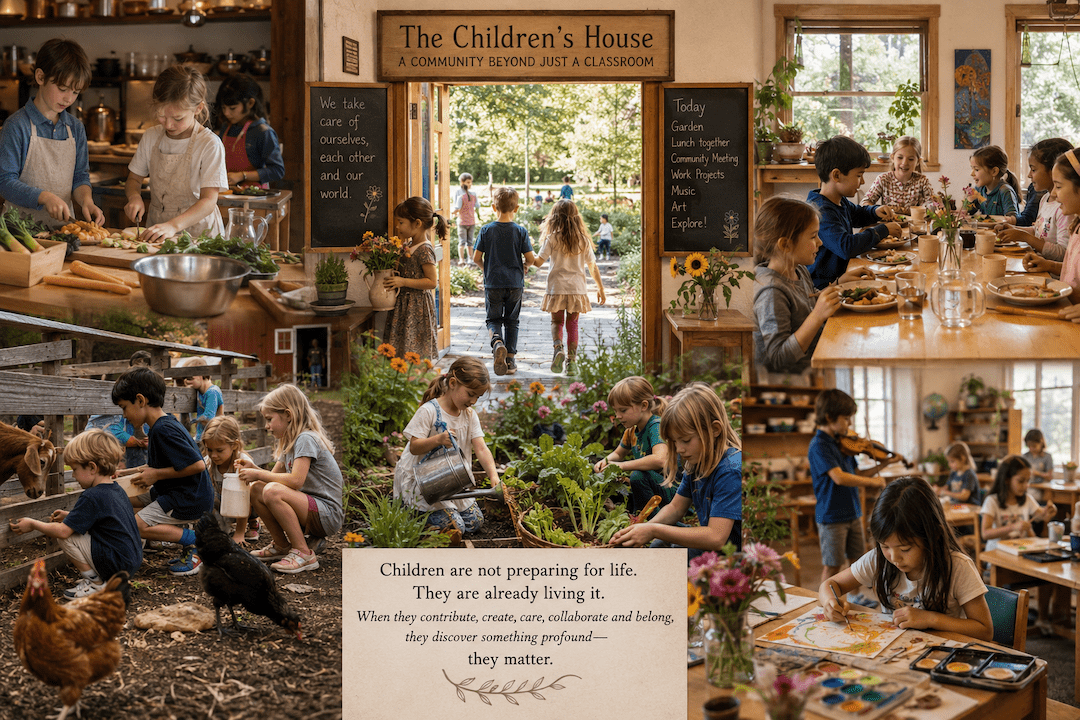
I recently read a thoughtful essay by my friend and colleague, Tammy Oesting, titled “What Have We Lost?” In it, Tammy reflects on stories from the early Montessori movement and asks whether, somewhere along the way, we may have unintentionally left behind some of the most human aspects of Montessori education.
As I read her piece, I thought of my own childhood.
I grew up at the Barrie School, outside Washington, D.C., founded by my mother in 1932. When I think about my years there, I certainly remember classrooms and wonderful teachers. I remember learning to read. I remember mathematics, history, and science.
But those are not the memories that come rushing back first.
What I remember are the smells coming from the kitchen on cold winter mornings.
I remember stopping by before class to grab a piece of toast and some fruit. I remember Edith, the cook, standing over enormous pots preparing lunch for what seemed like half the world. As I grew older, I spent countless hours helping her. We peeled potatoes, washed vegetables, stirred soup, baked bread, and prepared meals for hundreds of children and adults.
At the time, I never thought of it as school.
It was simply life.
The same was true throughout the campus. There were horses to feed, chickens to care for, gardens to tend, sidewalks to sweep, visitors to greet, younger children to help, and endless jobs that needed doing. The school depended on all of us.
What strikes me now is that no one seemed particularly concerned with whether these activities were educational. Of course they were educational. But that wasn’t the point. They mattered because they were real. The horses needed feeding whether we felt like it or not. The gardens needed watering. Lunch had to be prepared. The community genuinely depended upon our contribution.
And perhaps that is what Tammy’s article brought back for me.
Children need opportunities to discover that they matter. Not because adults tell them they matter. Not because they receive awards, grades, or praise. They discover it because their actions make a difference in the lives of others.
To understand why this is so central to Montessori’s vision, it helps to remember who Maria Montessori actually was.
We tend to think of her as an educator. And she was. But she was first and foremost a physician and psychiatrist, a scientist who came to education through medicine and through her work with children whom the world had largely given up on. She was a contemporary of Sigmund Freud, developed her own framework for understanding mental life, and spent years working with children labeled as mentally defective — children she came to believe were not damaged, but simply unstimulated, unseen, and denied any real agency over their own lives. When she gave those children meaningful work, real choices, and genuine dignity, they flourished in ways that astonished the medical establishment.
That experience was the seed of everything that followed.
It is no accident that the figures most drawn to Montessori’s ideas in the early decades of the twentieth century were not only educators but psychologists and psychoanalysts — among them Anna Freud, Alfred Adler, Jean Piaget, and Erik Erikson. They recognized in her work something they were pursuing from a different direction: that the deepest human needs are not primarily academic. They are the needs for agency, for belonging, for the experience of genuine competence, for the freedom to discover who one is. Anna Freud understood this with particular clarity. She recognized that Montessori had been the first to see that a child’s engagement could only grow freely when it was not prescribed and controlled by adults — that the joy of succeeding at work one has chosen for oneself is a more powerful force than any external reward or requirement.
What Montessori built, in other words, was not primarily a system of instruction.
It was a framework for mental and emotional health.
She believed — and the evidence of her schools confirmed — that children who are trusted with real choices, given meaningful responsibilities, allowed to follow their own curiosity, and welcomed as genuine members of a community develop something that no curriculum can teach directly. They develop a stable sense of self. They grow into people who know they are capable, who trust their own judgment, and who understand that their presence in the world is not merely tolerated but genuinely needed.
Maria Montessori called her schools Casa dei Bambini. We translate that phrase as Children’s House, and in doing so, I think we lose something essential.
Dorothy Canfield Fisher noticed this problem as early as 1912, in her book A Montessori Mother, one of the first accounts written by an American who had actually visited Montessori’s schools in Rome. Fisher wrote that the phrase Casa dei Bambini was being translated everywhere by English-speaking people as The Children’s House, whereas its real meaning, both linguistic and spiritual, was The Children’s Home — or, as she put it, the Children’s Community. She insisted on this rendering because she felt it offered a far more accurate and complete insight into the character of what Montessori had actually created.
Fisher was right, and over a century later her observation still matters.
A house is a building. A home is something altogether different.
A home is a place where life happens. People prepare meals together. They celebrate and solve problems together. They care for one another, share responsibilities, and learn how to live together. When Montessori used the word casa, she was not describing a curriculum or a classroom arrangement. She was describing a community — a place where children genuinely belonged and where their presence and contribution actually mattered.
This is the dimension of Montessori education I believe we most urgently need to reclaim. Not as a philosophical nicety, but as a matter of children’s wellbeing.
We are living through a period of genuine crisis in the mental health of young people. Anxiety, disconnection, and a pervasive sense of purposelessness are increasingly common, even among children in early adolescence. The research on what protects children from these outcomes points consistently in one direction: children who have a sense of agency, who experience genuine belonging, who believe their actions matter, and who have had the opportunity to discover who they are through real work and real relationships are far more resilient than children who have been managed, praised, evaluated, and entertained but never truly needed.
Montessori understood this a hundred and twenty years ago.
Over the years, I sometimes wonder whether we have become so focused on the mechanics of Montessori education that we occasionally overlook its deeper purpose. We carefully protect the work cycle. We maintain beautiful materials. We document lessons and track progress. All of those things matter.
But children also need time to talk. Time to imagine. Time to create. Time to wander outdoors. Time to become absorbed in projects that no adult planned. Time to build friendships. Time to experience the ordinary rhythms of community life.
One of the passages in Tammy’s essay describes the midday meals remembered by Margot Waltuch. Children and adults sat together for long stretches of time, eating, talking, laughing, sharing stories. I found myself wondering how many schools today would view such a meal as an essential part of the curriculum. Yet when I think back to my own childhood, I realize that many of life’s most important lessons were learned around a table. Meals teach patience, conversation, listening, and courtesy. They teach children to become genuinely interested in other people. Meals build community.
The same can be said of gardening, caring for animals, preparing food, maintaining the environment, planning events, or resolving conflicts. These activities may not fit neatly into curriculum guides. Yet they teach children how to live.
As children grow older, these opportunities become even more important. Elementary children should help plan their own expeditions and outings. They should participate in solving the practical problems that arise within their community. They should learn how to navigate disagreements, repair damaged relationships, and make decisions together. Adolescents, especially, need meaningful work in the real world — opportunities to venture into the larger community, interview people, volunteer, organize projects, and discover that their efforts have value beyond the classroom walls.
Children are not merely preparing for life. They are already living it.
The same principle applies to the arts. I sometimes worry that we unintentionally place creativity into neat little boxes. Art from 10:00 to 10:45. Music on Thursdays. Drama during special events. Yet children are naturally creative beings who should have opportunities to paint when inspiration strikes, write stories that wander in unexpected directions, put on plays with minimal adult intervention, and create things that are entirely their own. Some of the most meaningful performances I have ever witnessed were not carefully choreographed by adults. They emerged from the imaginations of children working together. The process was often chaotic. It was also profoundly educational. When children negotiate roles, solve problems, build sets, and figure things out together, they are developing capacities that will serve them throughout their lives.
Children also belong outside. Not occasionally. Not simply for recess. Outside should be woven throughout the day. Children need mud on their boots, gardens, weather, birds, insects, streams, and open sky. They need to know the names of the trees around them. Most of all, they need to develop a relationship with the natural world. A child who falls in love with nature will spend a lifetime caring for it.
As I reflect on Tammy’s question, I find myself wondering whether we sometimes focus too heavily on documenting academic progress while overlooking the larger story of childhood. Parents certainly need to know what their children are learning. But perhaps they also deserve to know who their children are becoming. Imagine receiving not simply a list of lessons completed but a portrait of a year in the life of a child — photographs from expeditions, stories they have written, gardens they have planted, alongside the child’s own voice reflecting on what challenged them, what they are proud of, and what they hope to accomplish next. Those are the questions that help children become reflective human beings.
Tammy’s question does not ultimately lead us backward, toward nostalgia for 1907. It leads us toward a renewed appreciation for something that was always central to Montessori’s vision — something Dorothy Canfield Fisher understood clearly more than a hundred years ago, even as American educators were already beginning to translate it too narrowly.
Montessori education was never intended to be merely a method of instruction. The woman who created it was a psychiatrist before she was a teacher. She understood that what children need most is not a better curriculum. They need to know they are capable. They need to discover who they are. They need to belong to something larger than themselves and to feel, in a way that no amount of praise can manufacture, that their presence in the world makes a genuine difference.
That is what a casa is.
Not a building with beautiful materials on the shelves.
A community. A home. A place where children learn not only how to read, write, calculate, and reason, but also how to contribute, create, care, collaborate, and belong.
When children experience that kind of community, they leave school carrying something far more valuable than academic knowledge alone.
They leave with the understanding that they matter — and that they have something meaningful to contribute to the world around them.