
Related Posts



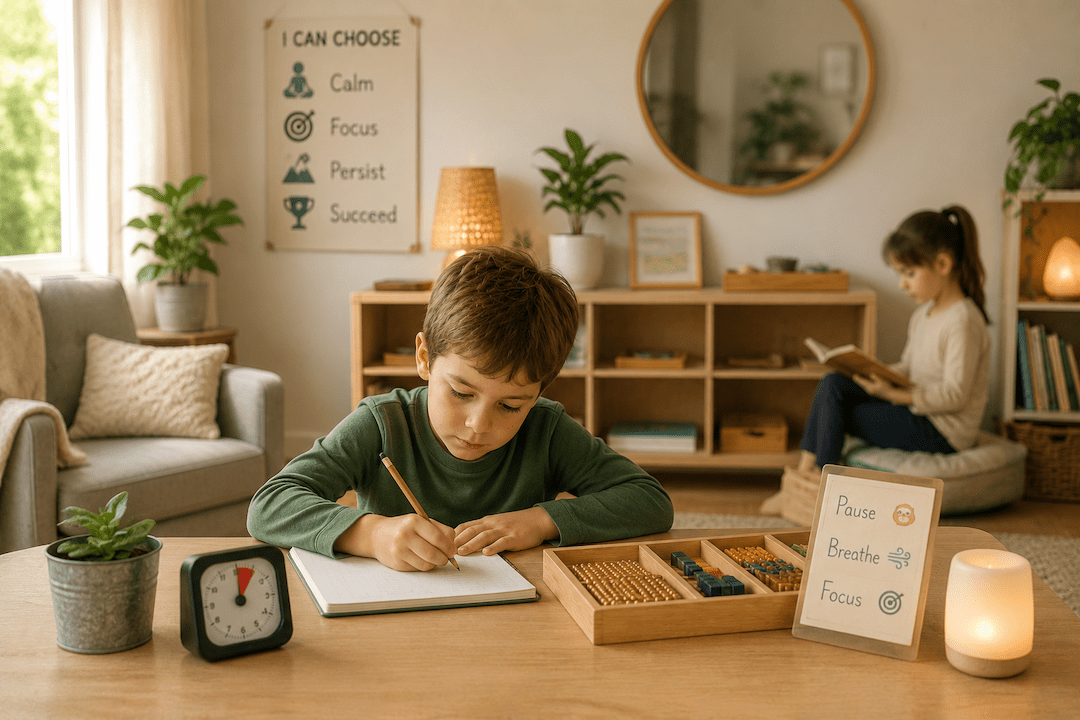
Many parents notice this behavior even when a child is doing something small. Perhaps they’re building with blocks. Maybe a story is being read aloud. Or they might be drawing or painting a picture on their own. For a couple of minutes or possibly longer, the room is silent. Then someone calls out from down the hall. One of their siblings walks past. A parent checks their cell phone. A toy near them suddenly plays music. The child stops whatever they’re engaged in and looks up. At some point, they’ll get back to what they were doing, but the minute has passed. There isn’t anything dramatically wrong; however, that thin thread of focus has been snapped. In too many families and schools today, this is happening multiple times a day.
Not only are there more distractions than ever before, but we’ve never had a culture like ours where children are exposed to so many stimuli; there is little time to focus. Children are moving between activities at an incredibly rapid pace and don’t have nearly enough time to fully immerse themselves in any single activity.
Children’s ability to concentrate has been viewed as something inherent (children either are able to focus or they aren’t). We tell parents that their child “has trouble paying attention” or “just won’t sit still,” which makes it seem as if the ability to stay focused is simply a product of genetics. However, the field of developmental psychology shows us a far more optimistic view of concentration. Just like children learn new words every day, children develop their capacity for focus as well. But instead of forcing the process along, researchers believe that children develop their ability to focus when provided with an environment that supports deep engagement with their surroundings.
Developing Their Ability to Concentrate
Dr. Adele Diamond is a developmental psychologist whose work focuses on Executive Function. This includes all the skills that allow children to follow directions, refrain from acting impulsively, switch between ideas, and remain focused long enough to finish a job. Her research demonstrates that concentration is much more complex than simply sitting quietly. A child who stays with a puzzle even when one piece doesn’t fit is employing several executive functions at the same time: working memory, self-regulation, problem solving, and persistence.
According to researchers at the Harvard Center on the Developing Child, these abilities act as the “air traffic control” of the developing brain because they help children keep track of many pieces of information, manage competing demands, and regulate their own behavior.
Montessori philosophy is especially relevant here. Maria Montessori realized that concentration is not only something that occurs in the classroom but also a foundation of healthy development. She saw that when children were fully immersed in meaningful tasks (or work), things began to change within them. They were less anxious, more independent, and better organized. And sometimes, remarkably happy afterward. In The Absorbent Mind, she writes that “the child who concentrates is infinitely happy.”
At first glance, this quote appears simplistic until you’ve seen a young child lose track of time entirely while washing a table, constructing a tower, writing letters, or performing repetitive movements simply because they provide satisfaction. To Montessori, concentrating wasn’t compliance. Concentration indicated to her that a child had made meaningful connections with their world.
Constant Distractions Become the Backdrop
Distractions are not always obvious. They happen in subtle ways that eventually take children away from what they are doing. This can take the form of constant change of activities, adults who ask a lot of questions while children are occupied with something, noise, or a seemingly infinite number of options to choose from.
On their own, these distractions may not seem very important, but together they make it difficult for children to remain engaged in a single meaningful activity long enough to concentrate. This is one of the reasons why prepared environments play a central role in the Montessori approach to teaching.
While most people think about the concept as referring to beautifully organized classrooms, the reality is much deeper and more meaningful. The prepared environment in a Montessori setting is designed to support children’s concentration. Special care is taken when selecting materials, ensuring that a specific sequenced collection is available and that the child is allowed to use them freely.
Rather than constantly encouraging children to move on to something new, a prepared environment quietly communicates to kids to stay with an activity, repeat it, and continue exploring it for as long as it remains meaningful.
Modern research echoes what Montessori educators have observed for generations. Researchers Cynthia DiCarlo of LSU (Louisiana State University) and Carrie Ota of WSU (Weber State University) demonstrated that the way adults provide choices and support directly affects children’s ability to sustain their attention.
Younger children will often maintain a higher level of attention when provided only a few relevant choices; however, the older preschooler will continue to grow toward increasing levels of independence. It is common for parents to underestimate the degree to which too many choices can overwhelm a child. For instance, a room full of bins, shelves, toys that flash lights, art supplies, etc., although may seem like a wonderful space to an adult due to all its potential, can be perceived as quite chaotic from a child’s perspective. A child rapidly transitions from one activity to another not because they lack curiosity, but because the environment continues to ask them to make another decision. Reducing visual distractions in a space allows children to find a place where they can choose and then commit themselves to that task through focused engagement.
How Real World Experiences Develop Meaningful Concentration
Educational neuroscientist Dr. Tzipi Horowitz-Kraus has studied how children’s brains respond to reading, screens, and storytelling experiences. In discussions published by Children and Screens, she describes attention as involving both quick alerting systems and slower executive systems that support memory, self-control, and deeper thinking. Her work highlights an important distinction between passive stimulation and active engagement. A child may appear captivated by fast-moving images, yet that does not necessarily mean the brain networks responsible for language, imagination, and sustained attention are being strengthened in the same way. For example, shared reading illustrates this well. When a parent points out illustrations, asks “What do you think will happen next?” or relates a character’s experience back to their kid’s own experiences. A child is essentially predicting, remembering, imagining and integrating different pieces of information. This principle applies similarly to hands-on experiences such as building, pouring water, washing dishes, sorting objects, painting, gardening, kneading dough, and working with materials. Each of these experiences requires a child to observe closely, adjust their actions based upon that observation, and continue to attend to the task at hand because the environment itself will provide immediate feedback.
Similarly, environmental psychologist Dr. Frances Kuo studied the effects of nature on children’s ability to pay attention. Dr. Kuo’s research indicates that exposure to green spaces may help children who struggle to sustain their attention develop their ability to direct it. Green spaces present multiple sensory experiences with minimal demands for children to constantly react. Leaves rustle, birds sing, bugs fly around, clouds slowly move across the sky.
Engaging in physical movement is equally important. As stated earlier many adults view concentration as sitting still; however, most young children exhibit some of their most intense periods of concentration while their bodies are physically involved in an activity. Montessori principles recognize this. Practical life activities are not merely large versions of everyday household chores for children. Activities including pouring liquids into containers, cleaning surfaces with soap and water, rubbing wood polish onto furniture, and cooking meals require coordination, sequence of steps, observation and precise control of movement. These common daily activities are able to strengthen concentration in children as they inherently reward children for demonstrating patience, care and repetition in completing their assigned tasks.
Protecting Attention in Everyday Family Life
Perhaps one of the biggest challenges families face today is not poor parenting; it is finding the time to allow children to truly engage with something they value. Contemporary family life moves rapidly. Mornings are busy getting everyone ready for school or daycare. Afternoon hours are spent attending school events, extracurricular activities, running errands, doing homework, and caring for younger siblings. Given the pace of modern family life, it can become easy to distract your child again and again rather than allowing them time to reflect upon something that interests them. Protecting the quiet moments in your family routine when your child can practice sustained attention starts with acknowledging that your child doesn’t need a perfect environment. What your child needs is consistent time to explore something that holds their interest.
Once, I worked with a family who felt that their young daughter was unable to play independently. She would frequently get up to ask for assistance, transition rapidly from one activity to another, and become agitated if she was not assisted. I took a closer look at the array of materials she had available. The room contained approximately 40 toys and activities, each placed in a large bin. The only thing wrong was that there were far too many things vying for her attention.
Working with the family, we removed nearly all of these items, leaving only a few select activities and a small table where she could go back and forth with her work during the day. Initially, she appeared somewhat perplexed. Then, relatively quickly, she went back to the same puzzle again and again, spent increasingly long periods of time drawing, and developed elaborate homes to house a handful of small stuffed animals. The amount of attention that existed within her did not change. What changed was the degree of competition the surrounding environment provided for it.
These kinds of experiences illustrate one of Montessori’s quieter observations. Children will often demonstrate extraordinary concentration when adults refrain from consistently directing their attention. We desire to encourage, praise, assist with challenges, and provide entertainment for our children. However, each unnecessary interruption forces children to move their attention away from what they discovered themselves. There are times when providing support means simply observing. If a parent observes a child’s efforts without intervening, concentration will grow by itself.
Guidance still matters. Children need encouragement, reassurance, and opportunities to develop knowledge while supported by caring adults. A parent who says, “I see you’re having difficulty getting this piece to fit,” and waits quietly provides the child with the opportunity to figure it out on their own. A parent who immediately assists the child in completing the puzzle removes the child’s concentration in favor of their own. While individual actions such as these may appear minor, when repeated hundreds of times, they have a significant impact on how children perceive challenge, perseverance, and their abilities to resolve problems on their own.
Creating Space for Attention to Flourish
The American Academy of Pediatrics has encouraged families to think less about counting minutes of media use and more about what digital experiences may be replacing. This way of thinking goes further than just looking at screens. Families should be considering whether children still have ample opportunity for engaging in conversations, movement, reading, exploring the outdoors, creative play, and being calm enough to have quiet moments that allow the mind to settle. Even parents find it challenging to maintain their focus under continuous exposure to stimuli. Given the immaturity of children’s self-regulatory skills, they tend to benefit even more from structured schedules that contain time for recovery after episodes of stimulation.
Montessori classrooms understand this concept by allowing children uninterrupted work cycles that gradually settle them into a state of concentration. Instead of expecting children to produce right away, they realize that children need time to observe, choose an option, tentatively initiate an activity, and return to the same activity before becoming deeply involved. Parents can offer similar alternatives at home by providing their children with a basket of carefully chosen books, a small table for drawing, or a shelf with a limited selection of activity options. One way parents can support their child’s concentration is by identifying what truly captures their child’s attention. Whether through pattern-making, movement, listening to a story, experiencing nature, building, listening to music, or performing practical tasks, when children are genuinely interested in something, they typically show the potential for continued involvement. As children experience the quiet satisfaction of maintaining a deep interest in meaningful pursuits, they will begin to demonstrate the ability to apply this concentration across various areas of learning and everyday life.
Additionally, there is a greater purpose behind safeguarding attention. By helping children learn to concentrate, they are teaching them to pay close attention, persevere through obstacles, make informed decisions, and derive pleasure from meaningful exertion. In today’s world, where children are repeatedly asked to look elsewhere, concentrating on a single, worthy pursuit becomes a form of independence. Reclaiming attention does not mean rejecting contemporary society entirely. It merely implies understanding that, regardless of whether children engage in modern forms of technology or traditional methods of communication, they still need the following: meaningful work; movement; stories; nature; periods of silence; and caring adults who appreciate the journey as much as the destination. Perhaps this is one of Maria Montessori’s most enduring gifts: the reminder that concentration is not something we force on children. It is something we patiently protect until it has the opportunity to flourish.
About the Author
Elena Maren is with Alphabet Trains, a company that produces research-backed educational materials to help children become curious, confident learners for life. Drawing on her knowledge of educational psychology and her experience in Montessori communities abroad, Elena shares her expertise on child development, attention, creativity, and prepared environments for successful growth, both at home and in schools.