
Related Posts


Let’s start with an uncomfortable truth: that extra seven minutes you spent finding a matching shoe this morning didn’t just cost you seven minutes. It cost the classroom something too.
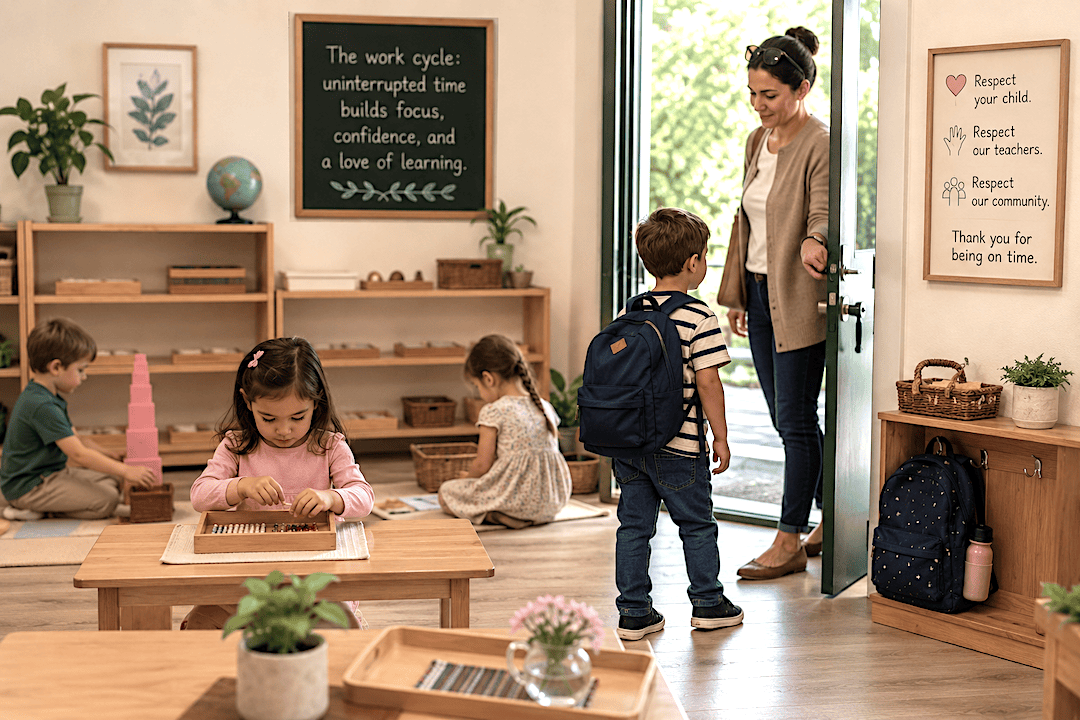
Montessori mornings are built around something called the “work cycle” — an uninterrupted stretch of time where children choose activities, settle into deep concentration, and build the kind of focus that doesn’t happen if the door keeps opening. Every late arrival is a small disruption to that rhythm — not just for your child, but for an entire room of children who were mid-thought when the door creaked open, and all eyes turned toward it.
Now put yourself in your child’s shoes, literally, walking in ten minutes after everyone else. The other kids are already settled into their work. The rug is full. Coats are already hung. Your child has to walk past a room of already-busy classmates, find a spot, and mentally catch up — all while feeling, on some level, like they missed something. For a young child, that’s not a minor inconvenience. That’s a small daily dose of “I’m behind before I even start,” and kids absorb that feeling more than we give them credit for.
Afternoon pickup has its own version of this. A child who’s consistently picked up last — after the room has cleared out, after the goodbye songs are over, after their friends are gone — can start to internalize that, too. Even if you’re only five or ten minutes behind the pack, young children don’t have a great sense of “just a few minutes.” They know “everyone left and I was still here.”
There’s also the very real, very unglamorous cost to teachers: a late pickup often means a staff member is now off their own schedule, sometimes past contracted hours, keeping an eye on one child while trying to close down a classroom. Multiply that by a few families doing it regularly, and you’ve got a burned-out staff — the same staff you’re relying on to be patient and present for your child every single day.
On the dawdling issue — because let’s be honest, this is the real obstacle for a lot of families:
If your child is the one adding 15 minutes to your morning by refusing to put on socks, staging a full sit-in over breakfast choices, or negotiating the terms of shoe-wearing like a tiny union rep — you’re not alone, and it’s not really a discipline problem. It’s usually a pacing problem. Young children move through routines on their own internal clock, and rushing them tends to backfire, leading to more resistance, not less.
What actually helps:
- Build in a real buffer — not 5 minutes, but a genuine 15–20 minutes of “dawdle room” so their pace isn’t a crisis for your pace
- Give choices within the routine instead of commands: “Do you want to put your shoes on before or after your jacket?” — same outcome, more cooperation
- Use a visual routine chart for younger kids who don’t yet have a strong sense of time — pictures of each step in order can move things along better than verbal reminders ever will
- Get as much ready the night before as humanly possible, so the morning is about executing, not deciding
Punctuality isn’t about rigid rule-following for its own sake. It’s a quiet form of respect — for your child’s sense of belonging in the room, for the teacher’s ability to run a calm classroom, and for the other families whose mornings also depend on a predictable start.