Related Posts



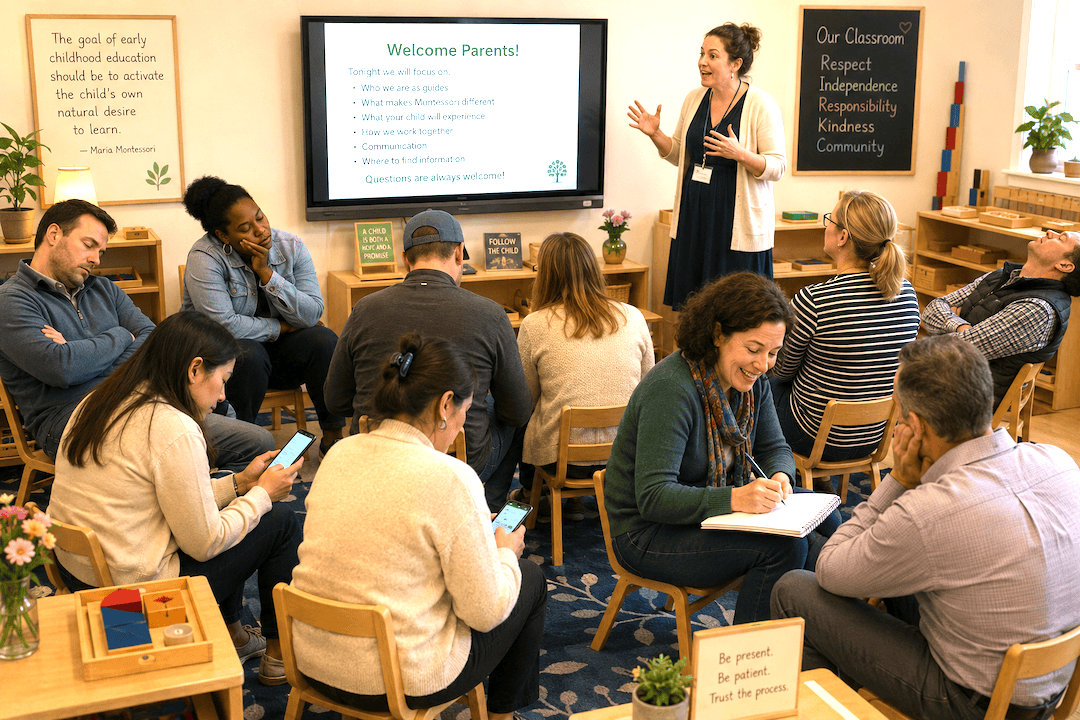
For many Montessori guides, the first parent meeting of the school year is one of the least enjoyable evenings. After spending weeks preparing the environment, getting to know the children, and helping everyone settle into a new routine, you now face another task: standing in front of a room full of parents to explain school policies, procedures, schedules, health requirements, communication systems, arrival and dismissal routines, birthdays, snacks, clothing, illness policies, conferences, volunteers, and dozens of other practical details.
You know it’s important. Parents need the information, and the school needs everyone to understand how things work. But after years of doing these meetings, it is worth asking a simple question: how well do they actually work?
Why We Hold These Meetings
The traditional parent orientation exists for good reasons. Schools need to communicate expectations clearly. Parents deserve to know how the classroom operates. Many questions can be answered before they become problems, families can meet one another and begin building a community, and, perhaps most importantly, the guide has the opportunity to establish trust.
None of these goals are wrong. The problem is that we often try to accomplish all of them in one evening.
Information Overload
Think about the parents sitting in front of you. Many are exhausted. Some have rushed from work. Others have younger children at home, and several are already overwhelmed by the beginning of the school year. Then we hand them twenty pages of policies while talking for ninety minutes. By the time we reach “please remember to label sweaters,” their brains have stopped processing information.
Educational psychology has taught us for decades that people cannot absorb that much new information at once. Parents leave feeling they attended a useful meeting, yet a week later, many cannot remember half of what was discussed. That’s not because they weren’t paying attention. It’s because they are human.
We Often Talk About the Wrong Things
Many parent meetings spend far more time discussing logistics than Montessori. Parents hear about parking, attendance, lunches, birthdays, clothing, permission slips, communication apps, emergency contacts, medication forms, and arrival procedures. All of those things matter, but they are not why families chose Montessori.
Most parents are quietly wondering something much deeper. Will my child be happy? Will my child make friends? How will you help when they struggle? Why don’t you use grades? Why is everyone doing different work? What should I expect over the coming months, and how can I support this at home? Unfortunately, we sometimes spend only fifteen minutes discussing the very questions parents care about most.
Why So Many Parents Don’t Become Engaged
One complaint heard in many schools is that only a small percentage of parents become actively involved. We often assume they simply aren’t interested. Usually, that isn’t true. Most parents care deeply; what they lack is confidence. They don’t know how they can contribute, and they aren’t sure whether they are welcome. Some assume volunteering is only for parents with flexible work schedules. Others fear they’ll do something wrong. Many simply never receive a personal invitation.
Engagement rarely grows because someone heard a presentation. It grows through relationships. People become involved because someone learns their name, welcomes them warmly, asks for their help, and makes them feel that they belong.
What Should the First Meeting Accomplish?
Instead of trying to tell parents everything, perhaps the first meeting should focus on just a few essential goals. Parents should leave understanding who you are as a guide, what makes Montessori different, and what their child will experience this year. They should understand how the school and family can work together, how communication will happen, and where to find practical information later. And above all, they should know that their questions are always welcome. Everything else can be provided in writing or shared over time.
Build Relationships Before Giving Information
Parents are much more likely to listen when they feel connected. Welcome them personally as they arrive. Introduce yourself and help parents meet one another. Share a story from the classroom, show photographs, display materials, and invite parents to handle some of the materials their children use every day. Let them experience Montessori rather than simply hearing about it. People remember experiences far longer than lectures.
Don’t Explain Every Policy
Parents do not need every detail on the first night. Provide a well-organized handbook. Create short videos explaining arrival routines or communication procedures, and send reminders when they actually become relevant. Instead of explaining holiday procedures in August, explain them shortly before the holidays. Instead of describing conference scheduling months in advance, communicate that information when conferences approach. Just-in-time communication is almost always more effective than just-in-case communication.
Make the Evening Interactive
Adults learn the same way children do. They learn by participating. Rather than speaking for an hour, invite discussion. Ask parents what they hope their child gains this year, what questions brought them to Montessori, and what concerns they have. These conversations help parents feel heard while giving you valuable insight into the families you serve.
Tell the Stories Only You Can Tell
Parents rarely remember policy number 7.3. They remember stories. Tell the story of the child who struggled to separate from a parent but eventually ran joyfully into the classroom each morning. Tell the story of the child who spent weeks pouring water before suddenly becoming fascinated with reading. Explain why repetition matters, and describe the quiet concentration that develops over time. Help parents begin seeing their children through Montessori eyes. Those stories become the framework through which parents interpret everything else that happens during the year.
Explain What Parents Will Probably Feel
This may be one of the most valuable parts of the evening. Tell parents that there will be moments when they wonder whether Montessori is working. There will be days when their child says they “played all day,” and weeks when progress seems invisible. There may be times when they compare their child to neighbors in more traditional schools. Assure them that these feelings are normal, and invite them to ask questions before worrying. A parent who understands the journey is far less likely to panic during the inevitable bumps along the way.
Think Beyond One Meeting
Perhaps the biggest mistake is believing that one orientation can accomplish everything. Parent education works best as an ongoing conversation: a short classroom newsletter, monthly parent coffees, brief videos, observation opportunities, evening workshops, individual conversations, classroom blogs, small discussion groups. Each builds understanding one piece at a time. Over the course of the year, parents become increasingly knowledgeable and confident, which is far more effective than trying to teach everything in a single evening.
The Meeting Is Only the Beginning
The first parent meeting should not be viewed as the finish line for parent education. It is the beginning of a relationship. Parents should leave feeling informed, certainly, but even more importantly, they should leave feeling welcomed. They should know that their questions are valued, feel excited about the year ahead, and trust that they have chosen adults who understand both children and parents.
If they leave with that confidence, the meeting has been a success — even if they forget what day library books are due. Because policies can always be looked up. Relationships are what make Montessori partnerships flourish.