Related Posts



Every year, teachers ask the same question. How long is this supposed to take? Many people feel normalization is an impossible dream in today’s world. There are too many digital distractions. Poor parenting skills. Rising levels of neurodiverse children. Nobody says this is easy, but I suggest we simply follow time-tested strategies to help our children settle in. Will it be perfect? Probably not, but the process is within our reach and need not take most of the school year.
Most of a classroom’s normalization can happen within the first two to four weeks of school, not the first few months. What follows for the rest of the year is refinement, not construction. The foundation gets laid remarkably fast when the adult is deliberate about it.
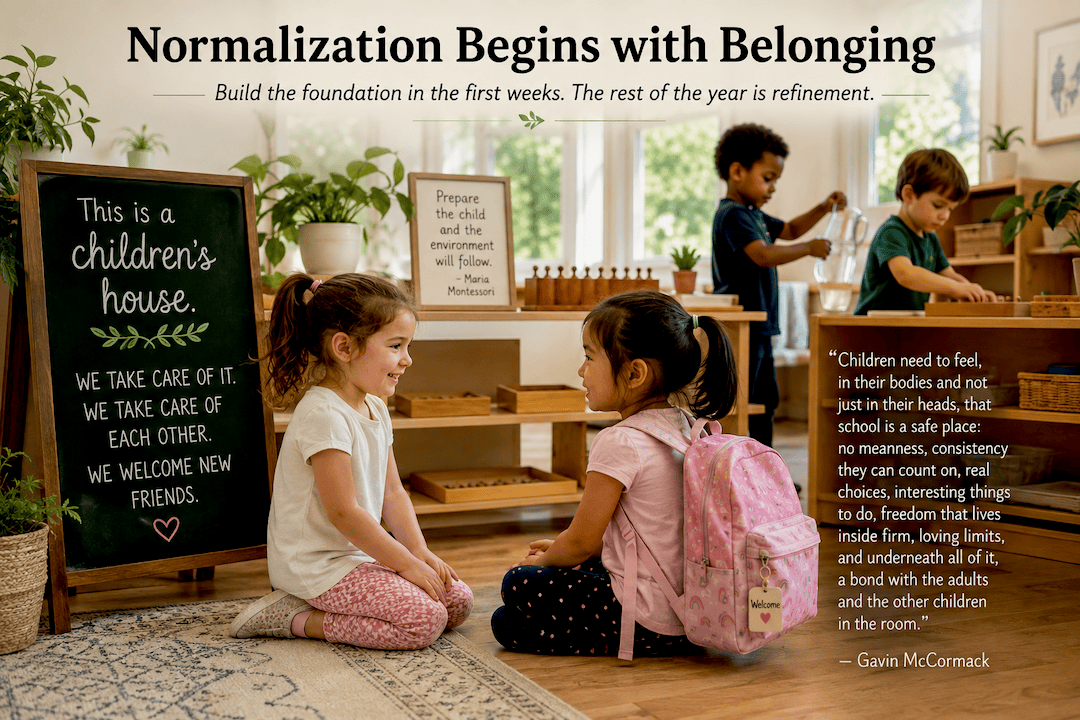
But there is a foundation beneath the foundation, and it is easy to overlook in the rush to teach routines. Before a child can absorb procedure, concentrate, or handle materials with care, they need to feel safe. My friend Gavin McCormack puts this as plainly as anyone I know. Children need to feel, in their bodies and not just in their heads, that school is a safe place: no meanness, consistency they can count on, real choices, interesting things to do, freedom that lives inside firm, loving limits, and underneath all of it, a bond with the adults and the other children in the room.
Normalization is not really a sequence of procedures bolted onto a classroom. It is what happens naturally once a child feels safe, known, and connected enough to stop watching the exits and start engaging with the work in front of them. Everything below is built with that in mind.
Bring the Returning Children Back a Full Week Early
The work begins before a single new child walks in, and it deserves more than an afternoon.
If at all possible, bring your returning children back a full week before the official start of school for new students. This single decision sets the tone for the year more than almost anything else in this article, so it is worth protecting on the calendar, even if it takes some persuading with your administration.
Use that week to explicitly remind returning children of the room’s culture. Maria Montessori called the environment a Casa dei Bambini, a children’s house. Say that to them directly, in those words, on the very first morning back. This is a children’s house. We are the children who live in it. That means we are responsible for taking care of it and of each other, including the new friends who will be joining us next week.
Then let them act on it, all week long, not in a single rushed session. Have them wash the shelves, arrange the plants, fill the pitchers, restock every tray, and make sure every material is complete and beautiful, exactly as the room will look when everyone arrives. Let them re-familiarize themselves with materials they have not touched all summer, refresh their own skills, and rebuild their own concentration before they are asked to model it for anyone else. Children who spend a full week restoring the room to its full richness are not just cleaning. They are rehearsing ownership, and they will be the ones showing new children how each of those materials is used in the coming weeks.
Spend part of that week explicitly preparing them for their role. Talk with them directly about what it feels like to be new somewhere, and ask them to remember it. Practice, almost like a rehearsal, how to greet a new child at the door, how to show a routine without taking over, how to invite someone to sit at your table. If you already have enrollment information, assign buddy pairings before new children even arrive, so that on opening morning a returning child can walk up to a specific new child by name and say, I am so glad you are here. Let me show you where to put your things.
This week is also your best opportunity to rebuild the returning children’s own sense of community with each other and with you, before the complexity of new relationships is layered on top. Take walks together. Eat lunch together. Let them reconnect after a summer apart. A group of returning children who feel securely bonded to each other and to you by the time new children arrive will extend that same security outward far more naturally than a group that is still finding its own footing.
If your whole class is new, as it is in many primary classrooms with a full turnover of three-, four-, and five-year-olds, your first two weeks look different. I address that separately below.
Week One of New Students: Full Shelves and Older Children as Hosts
Put the whole environment out. A rich, fully prepared classroom is part of what makes Montessori work, and returning children need it every bit as much as new ones. Reducing it down to a fraction of the materials solves a problem you do not actually have, because you already have something far more powerful than a stripped-down room: children who spent last week refreshing their own skills and who are ready to show others.
By the time new children arrive, your returning class already knows they are the hosts this year. You spent the week before reminding them of it. Now give that role real structure on opening morning. Each new child should have an assigned buddy from the returning group waiting for them, someone whose job is to walk in with them, show them where things go, and sit near them at snack. Rotate who greets visitors at the door. Ask a different returning child each day to give the very short group lesson on one routine, with you standing beside them. A five-year-old teaching a four-year-old how to roll a mat carries an authority that your instruction, however patient, cannot match, and it does something for the older child too. Nothing builds a child’s sense of belonging in a community faster than being needed by that community.
Your job this week is to work the room constantly, giving individual lessons to new children on the fundamentals: how to choose work, how to carry it, how to return it, and how to ask for help, while your returning children model, welcome, and quietly absorb some of the load. This is not radical simplicity. It is radical delegation. The richness of the environment stays intact because you have a team of small, capable people helping you run it, people who spent the previous week specifically preparing for this job.
Learn every new child’s name cold this week, and use it constantly and warmly. Greet each child by name at the door every single morning, get down to their eye level, and mean it. A child who is greeted by name and welcomed personally every morning learns within days that this adult sees them, and that lesson does more for behavior than any rule you will post on the wall.
Keep your first whole group gatherings under five minutes. One song, one very short story, then release children to work. The group meeting is usually the part of the morning that unravels fastest with new children, so protect it by keeping it short rather than trying to make it more engaging.
Week Two: Extending the Work Cycle, and Naming Kindness Out Loud
By the second week, most new children are beginning to move around the full environment with some confidence, largely because they have had a week of real peer mentorship rather than a stripped-down room to grow into. Now you extend the uninterrupted work period itself.
Resist consolidating the group the moment everyone has arrived. Let arrival be staggered and quiet. A child who arrives and immediately settles into work while classmates are still saying goodbye to parents is exactly the kind of morning you want, and it only happens if you protect that flow rather than interrupting it with a full group circle at nine o’clock sharp.
Keep the buddy pairings alive this week, but start loosening them. A returning child who spent all of last week glued to one new friend should now be encouraged to circulate and share the same small lesson with a second or third child. Remind your returning children, again in the language of the children’s house, that taking care of each other is not a job that belonged to just opening week. It is what everyone in this room does all year, for every classmate, not only the newest ones.
Now is also the moment to be explicit, out loud, about what safety in this classroom means. Not as a lecture, but as a standing, repeated message. In this house, we do not laugh at each other’s mistakes. In this house, everyone gets a turn. In this house, if someone is sad, we notice. If you see unkindness begin, even something as small as two children excluding a third from a game, intervene immediately and calmly, every time, without exception. Children are constantly testing, mostly unconsciously, whether the rule against meanness actually holds. The moment they learn it holds every time, for everyone, something in the room relaxes. Your returning children, who already trust you, will often be the first to hold each other accountable to this standard once they see you hold it consistently.
Begin introducing Grace and Courtesy lessons daily, but keep each one tiny and immediately usable. How to walk around, not through, another child’s rug. How to wait for a turn without interrupting. How to offer help without taking over the material. Teach it, then watch for the real moment later that same morning when a child needs it, and quietly coach them through using what you just showed them. That immediate connection between lesson and lived moment is what makes the lesson stick.
Week Three: Widening the Circle of Choice
By now, most new children have a working sense of the room, thanks in large part to a full environment and a community of peers who showed them how it works, rather than a room that slowly revealed itself to them alone.
Turn your attention this week to genuine interest, not just procedure. Watch which children light up around water, which ones gravitate toward numbers, and which ones want to be outside constantly. A classroom that consistently offers work children find fascinating is a classroom where you rarely need to manage behavior, because engaged children are not looking for something else to do. Real choice, offered within a rich, fully prepared environment, is what makes children feel genuine ownership over their own days. That sense of agency is not a reward for good behavior. It is one of the conditions that produces good behavior in the first place.
Lean into real work and real responsibility for the whole community. Watering plants, caring for a classroom pet, delivering a message to another classroom, setting up snacks for classmates, repairing a material that has come apart. Return often to the language you started with a week before school even began. This is our house. Taking care of it is our job, all of us, together. Children this age are hungry to contribute to a real community, and this kind of purposeful work absorbs energy that might otherwise surface as wandering or minor disruption. It also does something quieter and just as important. Contributing to the group is one of the fastest ways a child can come to feel like they belong.
If you have children who seem to need more physical release than the classroom offers, build in deliberate heavy work this week. Carrying stacks of chairs, hauling a watering can, raking part of the garden, moving a crate of blocks from one shelf to another. Do not wait for a management problem to suggest this. Build it into the rhythm proactively for the children who need it.
Week Four and Beyond: Consistency, Not Novelty
By the fourth week, most of your class should be showing real signs of settling. Longer stretches of concentration. Quieter transitions. Children solve small problems, like sharing a popular material, with less adult intervention, sometimes because an older classmate steps in before you even notice the problem.
What changes from here is not your strategy but your consistency. The routines you taught in week one need to be held to the same standard in week twelve. The same is true of the emotional climate. A limit you enforced gently but firmly in September still needs to be enforced gently but firmly in February. Children do not experience firm limits as a lack of freedom when the limits are consistent and delivered with warmth. They experience inconsistency as a lack of safety. If a child begins sliding back into carelessly returning material to the shelf, that is not evidence that normalization failed. It is evidence that the routine needs a fresh, individual re-teaching, exactly as gently and specifically as it was taught the first time, and your returning children are often your best resource for that re-teaching, not just you. The same holds true if a child begins testing the kindness rule again. Re-teach it just as calmly as you did the first week, every time it is needed, for as long as it is needed.
Keep returning to the ownership language all year, not only in September. This is our house. We take care of each other. Said often enough, in real moments rather than as a slogan, it becomes simply how the class understands itself.
When Every Child Is New
If your classroom, as in many primary environments, starts the year with no returning children at all, extend the timeline modestly, perhaps by an extra week or two. You do not have peer hosts to lean on yet, so you are personally demonstrating every routine to each child individually, and you are carrying nearly the full weight of building bonds, both between yourself and each child and among the children themselves.
The environment should still be fully prepared, but plan for much more individual and small-group teaching time in the first weeks, since you are the only host in the room. Introduce the language of the children’s house from day one anyway. Even a class of new three-, four-, and five-year-olds can begin to understand, with enough repetition and enough lived example, that this room belongs to them and that caring for it and for one another is their shared job, not just a rule handed down by the teacher. By the second or third week, watch for your first natural helpers to emerge, the children who, without being asked, start showing a friend how something works, and begin deliberately building on that instinct exactly as you would with a returning class.
What Realistically Takes Longer
I want to be honest about the limits here. Full, mature normalization, the kind where a classroom hums quietly for an entire three-hour work cycle with minimal adult direction, usually takes a full term, sometimes longer for a particularly young or particularly large group. What you can realistically expect within three to four weeks is the scaffolding: children who know the routines, who can choose and return work independently, who are accustomed to a calm and consistent adult, who feel that this room is a safe and kind place, and who are beginning to experience real concentration in short stretches.
That scaffolding is not the finished building. But it is the part that, if skipped or rushed, causes problems all year. Teachers who invest deliberately in these first weeks, who bring returning children back early enough to genuinely prepare them, and who trust those children as real partners in building the culture rather than working around them, consistently tell me the rest of the year feels different, calmer, and more productive than years when they tried to do it all themselves and hoped community would simply accumulate over time.
It will not accumulate on its own. But built this deliberately, starting a full week before the doors open to new families, with the children themselves as co-owners of the house from the very first day, it arrives far sooner than most new teachers believe possible.