Related Posts
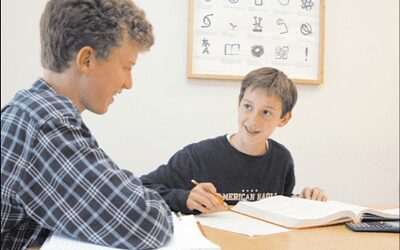
A few years ago, I watched a young child carry a small tray across a Montessori classroom with the solemn concentration of someone transporting an extremely valuable scientific specimen. On the tray were a glass of water, a sponge, and a little bowl. The child moved slowly, carefully, and with complete purpose.
Then came the inevitable moment. The glass tipped.
There was a pause. No adult rushed in. No one announced a five-alarm educational emergency. The child looked at the water, fetched a cloth, wiped the table, and began again. The second attempt was successful. More important, the child had learned something larger than how to carry a glass. He had learned that difficulty was not a verdict on his ability. It was information.
This is one of the quiet ways Montessori changes children’s lives.
The Montessori philosophy does not begin by asking, “How can we make children behave long enough to complete the lesson?” It begins with a more important question — What kind of human being is this child becoming?
We want children who can think for themselves, work with others, recover from mistakes, care about the world, and continue learning long after a teacher is no longer standing nearby. We want children who possess knowledge, certainly, but also initiative, judgment, compassion, and the courage to use what they know.
These outcomes are not decorative extras. They are the fundamental work of education.
A genuine love of learning
Many children begin life as enthusiastic investigators. They want to know why the moon follows the car, where worms go when it rains, and whether a radish seed will grow faster if someone sings to it. The questions arrive freely. No one has to offer a sticker for asking why.
Our challenge is to protect that natural curiosity as children move through school.
In Montessori, the prepared environment is designed to invite purposeful activity. Materials are accessible. The room is orderly without feeling sterile. Lessons are offered at the right moment, and children have opportunities to repeat, refine, and extend their work. The environment quietly communicates a powerful message — “You are capable of doing meaningful things here.”
Children are given freedom within limits. They can choose among appropriate activities, but they also learn to respect the classroom, complete work with care, return materials, and consider the needs of others. This is not permissiveness. It is a carefully structured form of independence.
The uninterrupted work cycle is especially important. Children need time to move beyond the first burst of enthusiasm, through the mild frustration that often follows, and into deeper concentration. If we interrupt every fifteen minutes for a new direction, a reminder, a reward, or a cheerful adult question, we may accidentally teach children that learning should always be entertaining and externally managed.
Sometimes the child needs us to stop talking.
That can be difficult for adults. We are wonderfully talented at interrupting children who are concentrating in order to ask whether they are concentrating. Montessori guides learn to observe instead. They watch for readiness, interest, fatigue, confusion, and the moment when a child is prepared for a new challenge.
The result is a different relationship with learning. A child does not simply complete an assignment because an adult expects it. The child discovers that work can be satisfying in itself — especially when it is meaningful, appropriately challenging, and connected to real understanding.
The protected joy of discovery
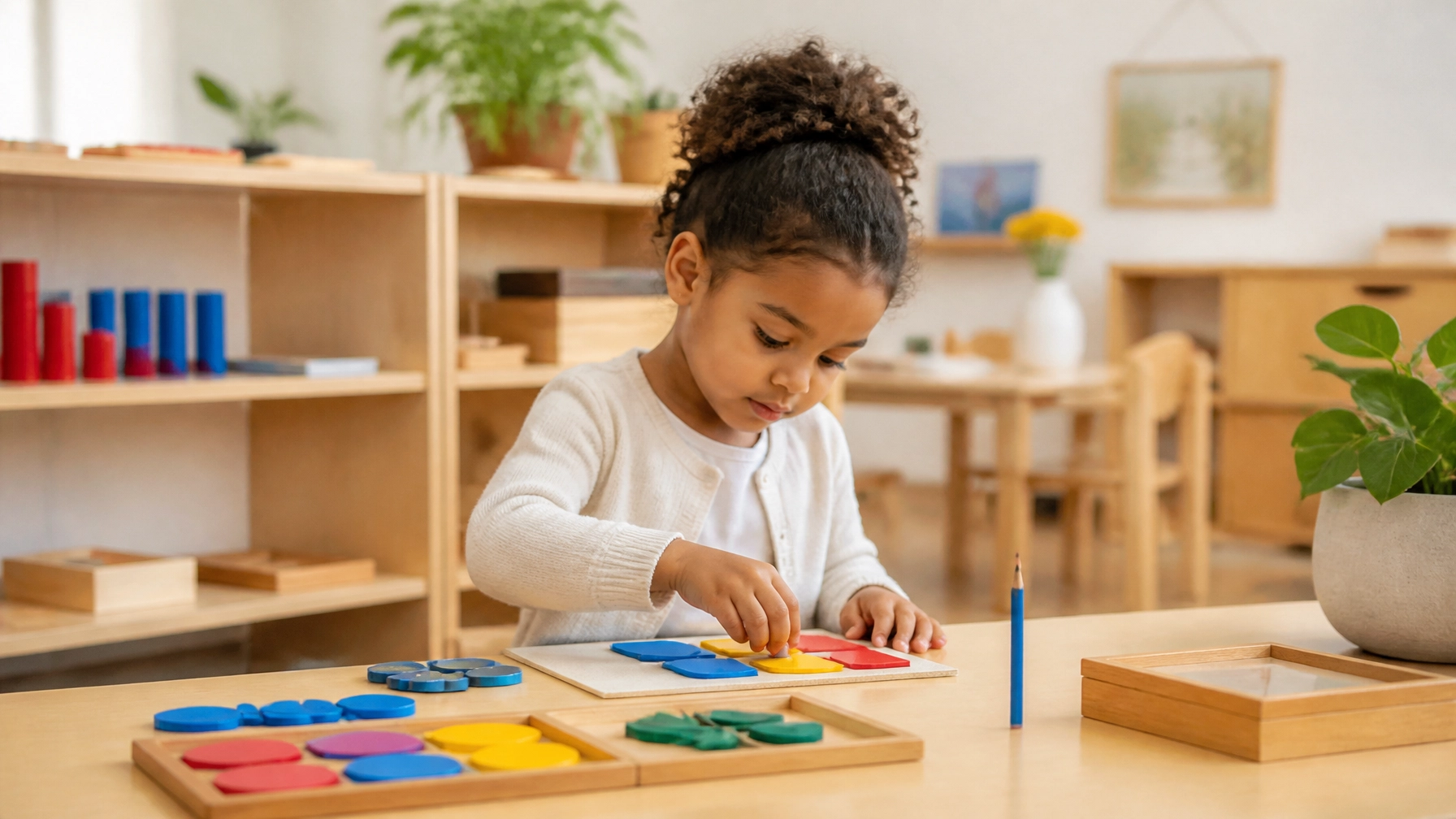
A Montessori child may spend a surprising amount of time repeating an activity that an adult considers simple. Pouring water. Building a tower. Matching sounds. Tracing a shape. Sorting objects. Writing the same word several times.
We may look at this and think, “Yes, but when will the real learning begin?”
The answer is that the real learning has already begun.
Repetition builds confidence, coordination, memory, and precision. It also allows children to experience the pleasure of mastery. The child notices, “I could not do this before. Now I can.” That discovery creates an internal source of motivation far more durable than praise alone.

Ingenuity and innovative thinking
Children do not become innovative merely because we tell them to “think outside the box.” In fact, children are often quite happy to think outside the box, inside the box, under the box, and possibly from the roof of the box.
Ingenuity grows when children encounter real problems and have the time, tools, and confidence to work through them.
Montessori materials give children concrete experiences that lead toward abstract understanding, but Montessori learning does not end with using materials exactly as demonstrated. Children also apply ideas in new situations. They build, classify, measure, compare, calculate, write, investigate, and make connections across areas of knowledge.
A child who has learned about balance may construct a bridge. A child who has studied plant life may notice that one classroom plant is struggling and begin investigating light, water, and soil. A child who has practiced decimal quantities may use that knowledge while planning a small shop or dividing materials among classmates.
This is where innovation becomes practical. It is not innovation as a slogan on a bulletin board. It is the habit of asking, “What is happening here, and what might we try next?”
The Montessori approach also changes the meaning of mistakes. When a material includes a built-in control of error, children can notice discrepancies without waiting for an adult to circle the problem in red. When a tower falls, a design does not work, or a calculation produces an impossible answer, the child has an opportunity to adjust.
Mistakes become part of the thinking process.
We do not want children to believe that intelligent people are those who never make errors. We want them to understand that intelligent people observe carefully, revise their plans, seek help when needed, and try again with better information.
That is the foundation of scientific thinking, entrepreneurship, artistic creation, and responsible citizenship.
Executive function — the invisible architecture of independence
Executive function includes the mental skills that help us plan, focus attention, remember instructions, manage impulses, shift strategies, and complete tasks. Adults use these abilities constantly, often without noticing. Children are still building them.
Montessori classrooms give children daily practice.
A child chooses work, gathers the necessary materials, carries them to a workspace, remembers the sequence, sustains attention, notices errors, and restores the environment when finished. This may sound modest. It is not. The child is practicing planning, working memory, motor control, self-monitoring, and follow-through in one ordinary activity.
Over time, these experiences accumulate.
The three-hour work cycle is another important support. Children develop sustained attention when they are permitted to work without constant interruption. They learn to remain with a task when it becomes less immediately exciting. They learn that concentration is not something adults pour into them like a beverage. It is a capacity they can strengthen.
Freedom within limits also supports self-regulation. A child has meaningful choices, but not unlimited choices. The boundaries are clear — we use materials safely, we respect others, and we restore what we use. Within those boundaries, children make decisions and experience the consequences of those decisions.
This is a much richer preparation for life than simply being told what to do at every moment.
Of course, children do not develop executive function in a perfectly straight line. A child may plan a complex building project beautifully and then forget where the shoes went. Another may remember every detail of a dinosaur but need considerable support to remember a lunchbox.
That is normal. Montessori does not expect children to behave like miniature adults. It gives them repeated, concrete opportunities to grow toward independence.

Emotional well-being and the dignity of real accomplishment
Children flourish when they experience both belonging and competence. They need to feel, “I matter here,” and also, “I can do meaningful things.”
The Montessori environment addresses both needs.
Respect for the child is not simply a pleasant tone of voice. It appears in the way adults prepare the environment, introduce activities, listen to children, protect concentration, and offer help without taking over. It appears when we give a child enough time to put on a coat rather than completing the task automatically because we are in a hurry.
We have all experienced the parental arithmetic of the morning — five minutes to leave, one child wearing one sock, and a mysterious object that absolutely must accompany us. In those moments, efficiency is tempting. Yet when adults routinely do for children what children can reasonably do for themselves, we may save three minutes while losing an opportunity for development.
Montessori asks us to notice the difference between necessary assistance and unnecessary rescue.
A calm, orderly environment also reduces the number of avoidable conflicts. When materials have a place, expectations are consistent, and adults do not rely on constant public correction, children can devote more energy to learning. They are less likely to feel that every moment is a test they might fail in front of an audience.
Grace and courtesy lessons give children language for social and emotional situations — how to interrupt appropriately, how to offer help, how to carry a chair, how to greet someone, how to express a need, and how to repair a hurt.
These lessons do not eliminate conflict. Nothing eliminates conflict, unless we are willing to remove all human beings from the building. They do, however, help children navigate conflict with greater awareness.
Most importantly, Montessori gives children the dignity of real accomplishment. A child who prepares a snack, cares for a plant, cleans a spill, completes a difficult puzzle, or helps restore a classroom experiences competence in a form that is visible and genuine.
Self-esteem built on real experience is sturdier than self-esteem built on continuous applause.
Social skills — learning to live in a community
Montessori classrooms are communities, not collections of individual children working in parallel while waiting for the next adult instruction.
The mixed-age structure is central to this community. Younger children observe older children and gradually absorb the routines, language, and expectations of the environment. Older children revisit foundational skills, deepen their understanding by explaining ideas, and discover that their abilities can benefit someone else.
This arrangement creates many natural opportunities for social development.
Children learn to wait. They learn to negotiate access to materials. They learn that another person may have a different idea. They learn to collaborate on a project even when no one gets precisely what he or she first imagined.
These are not minor manners. They are the beginnings of citizenship.
In a Montessori classroom, a child may need to say, “I am still using that work,” rather than grabbing it. Another child may need to ask, “Can I join you?” A pair may need to decide how to divide responsibilities. When the work does not go smoothly, the children may need an adult’s support — but the goal is not for the adult to solve every social problem. The goal is to help children develop the capacity to solve more of them themselves.
The adult might ask, “What happened?” “What were you hoping to do?” or “What could help both of you continue?”
This approach respects the seriousness of children’s social lives. A disagreement over a paintbrush may look small to us, but it is a real opportunity to practice perspective-taking, communication, flexibility, and repair.

Leadership that begins with service
We often describe leadership as confidence, public speaking, or the ability to stand at the front of a line. These qualities can be useful, although being the line leader is not quite the same as leading a community through a complicated decision about compost.
Montessori offers a deeper understanding of leadership.
Children lead when they take responsibility for the environment. They lead when they welcome a new classmate, demonstrate a work, help younger children find materials, or notice that the group needs something and act thoughtfully. They lead when they listen, organize, persist, and accept accountability.
The mixed-age classroom makes this visible every day. An older child may show a younger child how to roll a mat or care for a classroom plant. The older child is not performing leadership for a certificate. The child is experiencing the satisfaction and responsibility of being useful.
This matters because leadership based only on status can become competitive. Leadership based on service builds connection.
Montessori also encourages children to develop independent judgment. They are not trained merely to wait for permission before thinking. Within clear limits, they learn to make choices, evaluate results, and contribute ideas. They become comfortable with the possibility that their first plan may need revision.
That combination — initiative with responsibility — is precisely what families, communities, and workplaces need.

Why these outcomes matter beyond the classroom
The value of Montessori is not that children can identify a pink tower or carry a tray without dropping it. The value is that the habits developed through these experiences transfer into life.
A child who has learned to concentrate may approach a complicated book with patience. A child who has practiced organizing materials may plan a long-term project. A child who has experienced mistakes as information may be less frightened by an unfamiliar challenge.
A child who has learned grace and courtesy may enter a new community with respect. A child who has helped younger classmates may understand that knowledge becomes more meaningful when it is shared. A child who has been treated with dignity may be more likely to extend dignity to others.
Research on Montessori education continues to develop, and we should approach all educational research with care. Outcomes depend on many factors, including the quality and fidelity of implementation, teacher preparation, family circumstances, school leadership, and the individual needs of each child. Montessori is not a magic label, and placing a few wooden materials in a classroom does not create a Montessori education.
The prepared environment must be thoughtfully designed. Adults must understand child development. Guides must know when to intervene and when to step back. The school must protect concentration while maintaining clear expectations. Families and schools must work together.
When these elements are present, Montessori offers a coherent answer to a problem that schools everywhere face — how to educate children for a future that cannot be fully predicted.
A vision for every school
Why should Montessori be the way schools ought to be everywhere?
Not because every school must look identical. Not because one method can answer every local question or eliminate every educational challenge. Rather, Montessori embodies principles that every child deserves to experience.
Every child deserves meaningful work, not merely busywork.
Every child deserves the chance to concentrate without constant interruption. Every child deserves an environment that communicates trust, clear boundaries, and belonging. Every child deserves teachers who understand development and who can distinguish between helping and taking over.
Every child deserves opportunities to solve real problems, make thoughtful choices, work with people of different ages and abilities, and experience the dignity of contributing to a community.
These are not luxuries for a fortunate few. They are the foundation of human development.

At home, we can begin in small ways. We can prepare a child-accessible space, offer limited choices, invite participation in cooking and household care, protect periods of concentration, and replace some unnecessary correction with observation. We can ask less often, “How can I make this easier?” and more often, “What support will help my child become capable?”
At school, we can create environments where academic excellence and emotional well-being reinforce one another rather than compete. We can teach children not only what to know, but how to learn, how to relate, how to recover, and how to contribute.
This is the heart of the Montessori philosophy.
Montessori changes children’s lives because it changes what adults expect children to be capable of becoming. We see the child not as an empty vessel to fill, a problem to manage, or a score to improve, but as a developing human being with an active inner life and a powerful drive toward independence.
Our task is to prepare the conditions.
Then we watch carefully. We offer guidance. We protect the work. We set limits with respect. We make room for effort, mistakes, discovery, friendship, and service.
And, to our delight, we often see what Dr. Montessori saw — children who become increasingly purposeful, joyful, inventive, steady, compassionate, and ready to take their place in the world.
That is why Montessori basics are never merely basic. They point toward a larger vision of education — one in which schools help children become not only successful students, but capable human beings.