Related Posts

Pickup is a small daily drama.
There is the child who walks out carrying one shoe, a mysterious leaf, and the emotional weight of the entire afternoon. There is the parent who has answered 47 emails, navigated traffic, and is now hoping for a cheerful reunion. Then there is the simple question: “How was your day?”
Sometimes the answer is “Fine.” Sometimes it is a full-body collapse beside the cubbies.
For parents new to Montessori, these moments can raise important questions. What happened at school? Should we step in? Should we ask the guide for a complete report while other families wait behind us? And what does Montessori discipline look like when a child is tired, frustrated, or having a hard time?
Our answer begins with one deceptively simple practice—observe before we rescue.
The goal is not to prevent every struggle. The goal is to help children move through struggle with dignity, support, and growing independence.
1. Your child may need connection before conversation
Many children do not leave school ready to deliver a polished oral report about their day. They have been concentrating, making choices, navigating friendships, managing transitions, and absorbing an astonishing amount of information. By pickup, their internal battery may be flashing a small, determined 2 percent.
So when your child refuses to answer, hides behind your legs, or announces that school was “terrible” because someone looked at their work, we can begin with connection rather than interrogation. Sometimes the report is not verbal at all. Sometimes it is one shoe, a mysterious leaf, and the face of someone who has clearly seen too much.
Try:
- “I am so glad to see you.”
- “You look like you need a quiet moment.”
- “Would you like a hug, or would you like me to walk beside you?”
- “We do not have to talk about school yet.”
This does not mean we ignore concerning behavior. It means we choose the right moment to address it. A child who is hungry, tired, or overwhelmed is rarely at their best for a thoughtful discussion about conflict resolution.
At pickup, watch first. Is your child seeking closeness? Avoiding noise? Moving slowly? Talking rapidly? These details give us useful information without requiring the child to explain everything immediately.
A calm reunion can be the beginning of the conversation.

2. A hard day is information—not a verdict
When a guide tells us that our child had a difficult day, it can be tempting to imagine a courtroom drama. We may instantly wonder who was responsible, whether our child is falling behind, or whether the other child has been secretly appointed Minister of All Things Unkind.
Usually, a hard day is much more ordinary and much more useful than that.
Perhaps your child struggled to enter the classroom. Perhaps they interrupted another child’s concentration, became frustrated when a work did not go as expected, or needed repeated reminders about walking safely indoors. Perhaps pickup has now become the stage for a full cracker protest, complete with outraged body language and a grievance no one can quite decode. These moments are not evidence that a child is “bad,” nor are they proof that Montessori is not working.
They are observations.
In a Montessori environment, guides use observation to understand patterns and decide what support may help. Is the child tired? Is the material too challenging, or not challenging enough? Is there a recurring social difficulty? Does the child need a clearer presentation, a different work choice, or more practice with grace and courtesy?
We can bring the same curiosity home.
Instead of saying, “Why were you so naughty today?” we might say, “I heard that waiting was difficult today. I wonder what would help tomorrow.” That language keeps the focus on growth and responsibility rather than shame.
For a deeper look at the philosophy behind this approach, see the Montessori Foundation’s guide to Montessori discipline—developing inner discipline through freedom and structure.
3. Please do not solve every small problem at the cubbies
We understand the impulse. Your child cannot get a sleeve over one arm, the zipper has become a personal enemy, and you are standing there thinking, “I can fix this in four seconds.”
You can.
The more important question is whether you should.
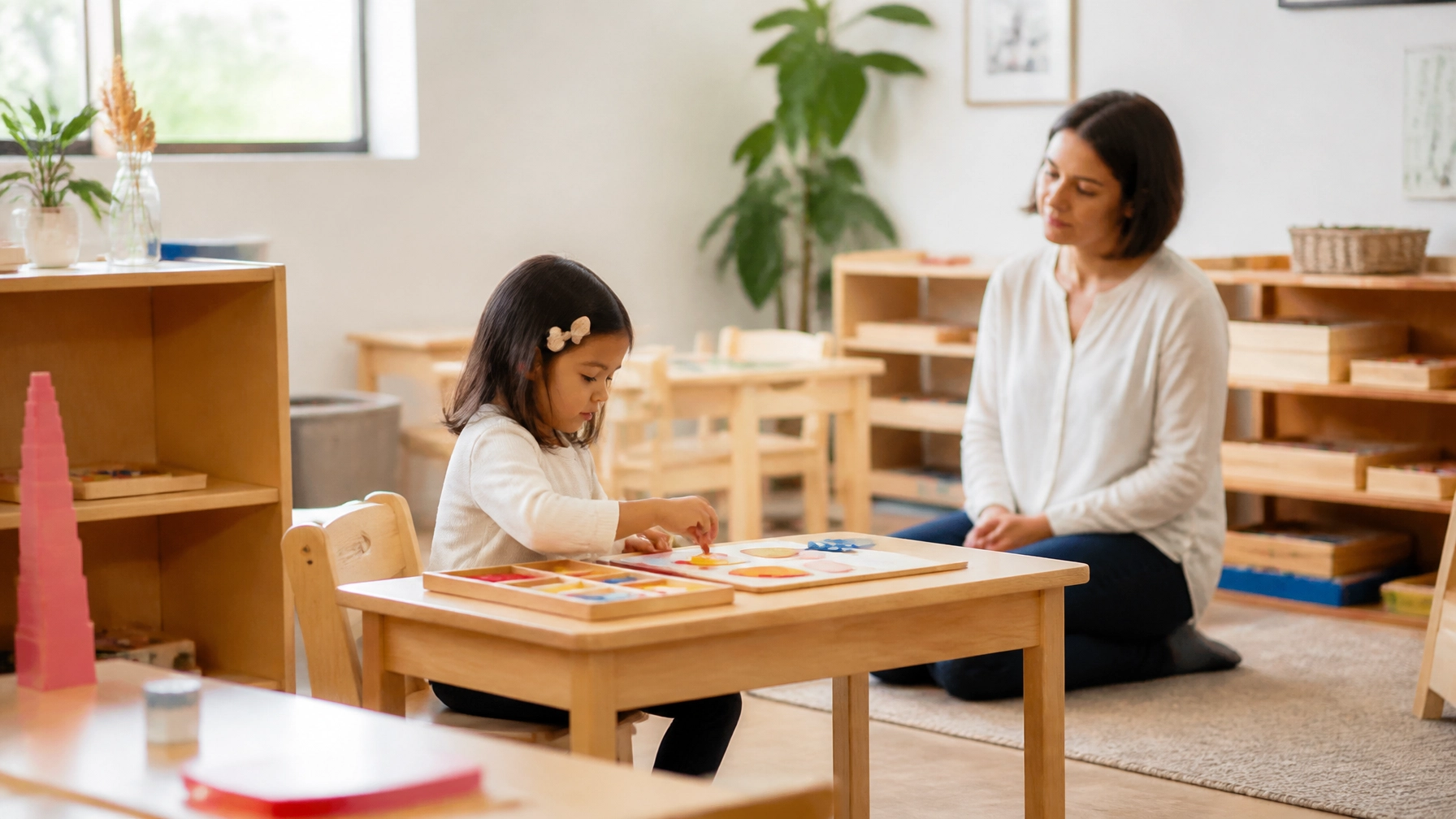
Montessori classrooms are prepared so children can do meaningful tasks for themselves. Low shelves, child-sized furniture, accessible materials, and orderly routines all communicate a powerful message—you belong here, and you are capable of participating.
The same principle can guide pickup. If your child can carry their bag, put on their coat, return a lunch container, or place a folder in the appropriate spot, we can give them time to try. We might offer a small amount of help without taking over completely. Yes, even when they are deeply committed to carrying only one shoe and a leaf that apparently must come home for scientific reasons.
Try:
- “Would you like to try first, or would you like one suggestion?”
- “The zipper is stuck. What could we try?”
- “I will wait while you finish.”
- “You can ask me for help if you need it.”
There is a difference between neglecting a child and allowing a child to practice. We remain available, attentive, and ready to help when help is genuinely needed. We simply do not turn every moment of effort into an emergency response.
The coat may eventually go on. The sleeve may be inside out. Life will continue.

4. Step in for safety and respect—then step back when the teaching is underway
“Observe” does not mean “stand nearby while someone gets hurt.”
Adults must intervene when there is danger, aggression, or a clear violation of another person’s dignity. We can stop hitting, prevent a child from running into traffic, or interrupt behavior that may harm someone. Montessori discipline includes freedom, but freedom exists within clear limits that protect people, materials, and the community.
The key is how we step in.
We can use a calm voice and direct language:
- “I will not let you hit.”
- “I am moving the bag so it does not hit anyone.”
- “The sidewalk is for walking. I will hold your hand.”
- “You are angry. You may say, ‘I am not finished,’ but you may not grab.”
Then we can avoid adding a second problem to the first. A child who has just lost control does not need a public lecture, a humiliating label, or a detailed forecast of every privilege they may lose before college.
They need a limit. They need our steady presence. They need an opportunity to repair and try again.
If a child throws a lunchbox, we can help retrieve it. If they speak harshly, we can invite a respectful rephrasing. If they refuse to leave, we can acknowledge the feeling while holding the boundary: “You wanted more time. It is time to go, and I will help you.”
This is neither permissiveness nor punishment. It is guidance.
The Montessori Foundation’s resource on positive discipline offers additional support for setting limits while preserving connection and responsibility.
5. The calm you want at home begins with your own nervous system
This may be the most difficult point, particularly after a long workday, a slow commute, and a child who has chosen pickup as the ideal location for a dramatic protest about crackers. To be fair, some pickup performances are so committed they deserve lighting and a stage manager.
Before we regulate our children, we often need to regulate ourselves.
Guides work deliberately to observe, pause, and respond rather than react. We can practice the same sequence:
- Take one breath before speaking.
- Notice what is actually happening.
- Name the feeling or need without excusing unsafe behavior.
- State the limit simply.
- Offer the next reasonable step.
For example: “You are very tired, and getting into the car feels hard. I will not let you kick the seat. You may climb in yourself, or I will help you.”
At home, we can create a gentle landing place after school. A predictable snack, a few minutes of outdoor movement, quiet reading, or time with a practical-life activity can help a child reconnect with their body and regain equilibrium. We do not need to recreate the entire classroom in our living room. A calm corner and a consistent rhythm can go a long way.

What should we tell the guide? Share observations, not labels
The home-school partnership becomes much stronger when we exchange useful information.
Instead of saying, “She is being bullied,” we might say, “She told me that another child took her work twice this week, and she cried in the car.” Instead of saying, “He cannot handle frustration,” we might say, “At home, he has been becoming upset when plans change. Have you noticed anything similar?”
Specific observations help guides look for patterns. Labels can unintentionally close the conversation.
Pickup is often not the best time for a long discussion, especially when the guide is supervising several children and families are moving through the doorway. We can briefly share essential information and request a meeting when there is enough time for privacy and thoughtful conversation.
Parents can also schedule a classroom observation when the school offers one. The Montessori Foundation’s parent’s guide to observing in a Montessori classroom explains how quiet observation can help us understand the prepared environment, the guide’s role, children’s concentration, and the subtle ways independence develops.
For ongoing parent guidance and family-school partnership resources, visit the Montessori Family Alliance.
A final thought for back-to-school night
Our children do not need us to remove every frustration from their path. They need us to notice, stay close, set limits, and trust the developmental work already taking place.
At pickup tomorrow, try an experiment. Pause for ten seconds before opening the car door or asking about the day. Look carefully. What is your child communicating through their posture, pace, and expression?
Can you guess what they may need?
Perhaps it is a snack. Perhaps it is help. Perhaps it is independence. Perhaps it is simply the reassuring knowledge that, after a full day of growing, learning, and practicing community life, we are there.
And yes (Sometimes they need the cracker first.)