Related Posts
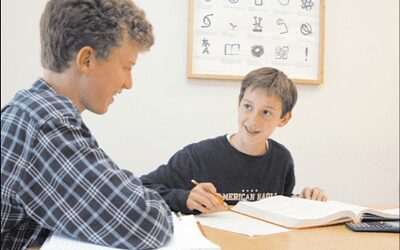
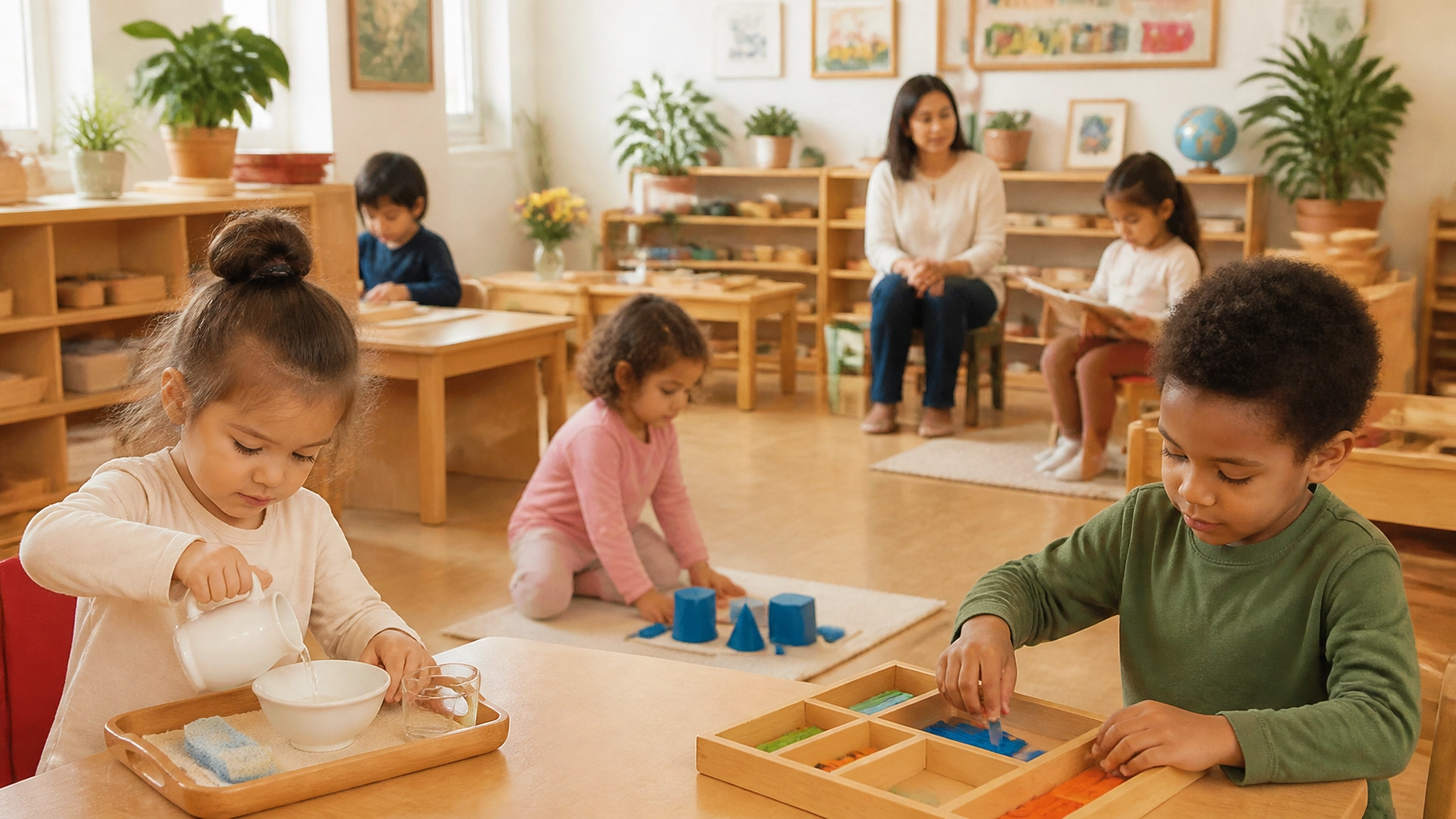
At back-to-school night, parents often look around a Montessori classroom and notice something unusual. A three-year-old is carefully carrying a tray. A five-year-old is reading to a younger classmate. A child who appears old enough to be “in charge” is quietly washing a table with the calm seriousness of someone running a small, very clean nation.
Then someone asks the question we hear every year:
“Why are all these different ages together?”
It is a fair question. Most of us grew up with classrooms organized by birth year, so a mixed-age group can look, at first glance, like someone forgot to check the enrollment spreadsheet, sneezed on the class roster, and decided to see what happened. In Montessori, however, the age span is not an administrative accident, a scheduling mishap, or a bold experiment in educational chaos. It is one of the central Montessori basics—the deliberate design of a classroom community in which children spend time as beginners, experienced learners, and leaders.
The usual arrangement covers a three-year span—approximately ages 3–6 in Primary, 6–9 and 9–12 in Elementary, and comparable developmental groupings as children grow older. Exact ages and structures vary by school, but the principle remains consistent.
Your child will be the youngest. Then the middle child. Then, to everyone’s amazement, the oldest.
That progression is the point.
The three-year cycle—learning through continuity
In a Montessori classroom, children generally remain with the same guide and community for three years. Rather than starting over with a new teacher, new classmates, and new expectations each fall, children gradually grow into the environment. That matters more than many of us first realize.
This continuity gives the guide time to know the child deeply—not just whether the child can read a particular book or solve a particular problem, but how the child approaches challenge, friendship, concentration, independence, and mistakes. It also gives the child something equally important—time. Real time. Not the hurried kind of time adults prefer when we are standing by the door thinking, “Could we please master shoe-tying before winter?”
The first year is not a year to “catch up” as quickly as possible. It is a year of orientation. Children learn where materials belong, how to choose work, how to carry a tray, how to greet a friend, how to wait, and how to restore the environment when an activity is complete. In other words, they are learning the culture of the classroom, which is no small thing.
The second year often brings greater confidence. The child knows the daily rhythm and can devote more energy to refining academic and practical skills. Children at this stage may still look to the oldest students for examples, while beginning to help those who are new. They are no longer wondering where the puzzle maps live. They belong.
The third year is the capstone. Children have mastered many classroom routines and are ready to use their knowledge on behalf of the community. They may demonstrate a material, comfort a younger child, help organize a group activity, or solve a practical problem without waiting for an adult to take over.
No graduation cap is required. A small pitcher of water and a well-placed work rug may be enough. Frankly, in Montessori, successfully rolling a rug and returning it neatly can carry more dignity than some corporate management seminars.

What younger children learn from older ones
Young children are extraordinary observers. They notice far more than adults sometimes realize—especially when we assume they are merely “playing” nearby. Dr. Montessori understood this well. Observation, imitation, repetition, and purposeful activity are not side stories in development. They are the story.
A new three-year-old may watch an older child prepare snack, use scissors safely, or return a material to the shelf. The younger child is absorbing the sequence, the movements, and the social expectations. Later, that child may attempt the same activity with remarkable concentration. What looks casual to us is often very serious inner construction.
This is one reason the prepared environment matters. Montessori classrooms are arranged so children can see meaningful work happening around them and access materials suited to their development. The environment quietly says, “You belong here, and you are capable of participating.” It does not shout, flash, or bribe. It simply works—which, as any parent knows, is refreshingly rare.
Older children provide living examples of possibility. A younger child who sees a five-year-old reading may not understand every word, but the child begins to understand that reading is something people do in this community. A child who watches an older classmate pour water without spilling may think, “I will do that someday.”
That kind of motivation is different from an adult saying, “You should be able to do this.” It is less pressure and more invitation. It is aspiration without performance anxiety.
Children also learn social grace from one another. They observe how classmates ask for a turn, resolve a disagreement, carry a chair, speak to a guide, or respond when work becomes difficult. We still need adults to protect the environment and guide behavior, of course. But children often understand a peer’s explanation in a way that feels immediate and accessible.
Ask any parent who has tried to explain a household rule that a sibling later summarized in seven words. Children have a gift for editorial efficiency. We deliver a thoughtful paragraph; another child says, “Put it back where it goes,” and somehow that is the version that lands.
Why older children do not lose out
Some parents understandably worry that older children may be held back by the presence of younger classmates. Will they receive challenging work? Will they spend the entire year helping? Will their academic growth slow down?
In a well-prepared Montessori environment, the answer is no.
Older children are not assigned the role of unpaid assistant. They continue to receive lessons and work that challenge them intellectually, creatively, and socially. Their guide observes their readiness and introduces increasingly complex materials, questions, and projects. The oldest child in the room is not there to become a tiny substitute teacher with no lunch break.
Helping a younger child is one part of the experience—not the whole experience. More importantly, explaining a process can deepen the older child’s own understanding. When a child describes how to build a decimal quantity, classify a plant, or care for a classroom animal, the child must organize ideas, choose language, notice another person’s perspective, and remain patient.
That is rigorous work.
It also develops what Dr. Montessori called the social life of the classroom. Children learn that knowledge is not merely something we collect for ourselves. It is something we can use to contribute. Academic growth and social development are not competing priorities here. In authentic Montessori, they strengthen one another.

Leadership is more than being the line leader
When we hear the word leadership, we may picture a child standing at the front of a room, giving instructions in a voice that can be heard from the parking lot. Montessori leadership is usually quieter. Less “tiny executive with a clipboard,” more “steady human being who notices what the community needs.”
It may look like an older child noticing that a new classmate cannot find the bathroom. It may look like someone bringing a cloth after a spill, inviting a younger child to join a group, or explaining how to roll a mat without taking over the work.
The goal is not to create miniature supervisors. The goal is to help children become responsible members of a community.
This matters for discipline, too. Montessori discipline is not based on fear, rewards, or adult control alone. We guide children toward self-discipline by giving them meaningful freedom within clear limits and real opportunities to practice responsibility. The mixed-age classroom supports that development every day.
A child who has been helped learns how to help. A child who has been welcomed learns how to welcome. A child who has been trusted with real responsibility gradually develops the confidence to handle it.
This is valorization in action—the process of recognizing and strengthening the child’s growing sense of capability and human worth.
Leadership also includes knowing when not to intervene. An older child may learn that helping does not mean grabbing another child’s work or correcting every small mistake. Sometimes the most respectful response is to offer a suggestion, wait, or ask a guide for support.
Those are sophisticated social skills. Adults are still working on them. Quiet leadership is still leadership, and in many cases it is the more difficult kind.
What parents may notice at home
The three-year cycle does not end when your child leaves the classroom. Its effects often travel home in surprising ways.
Your child may begin insisting on carrying their own backpack, preparing a snack, folding clothing, or showing a younger sibling how to complete a task. The process may take longer. There may be more crumbs. The newly independent child may also offer unsolicited demonstrations at highly inconvenient moments. You may be halfway out the door while someone explains, with deep sincerity, the correct way to peel a banana.
We can support this development by making room for purposeful participation:
- Invite your child to help prepare part of a meal.
- Keep a few household items where the child can reach them safely.
- Ask, “What do you think would help?” before rushing to solve a problem.
- Let your child observe a task before expecting independent success.
- Distinguish between a child needing help and a child needing more time.
- Encourage older siblings to model and invite rather than command.
At school, the guide carefully observes when to step in and when to step back. We can practice the same balance at home. Independence is not abandonment, and support is not doing everything for a child. Sometimes our main job is to breathe, hand over the small pitcher, and accept that meaningful learning can be slightly damp.
A few questions parents often ask
“Will my child be ignored because the class includes younger children?”
No. Montessori guides observe each child closely and present lessons according to individual readiness. The mixed-age structure allows children to work at different levels rather than requiring everyone of the same age to move through identical material at the same pace. In other words, the classroom is not one lesson delivered assembly-line style. It is a living community with individual academic paths.
“What if my child enters in the second or third year?”
Children who join mid-cycle can thrive. They may need help learning the classroom routines and finding their place in the community, just as any new member of a group does. A strong Montessori environment welcomes new children while preserving continuity for those already established. Joining later is not ideal in every circumstance, but it is far from hopeless. Children are remarkably capable when the environment is clear and the adults are consistent.
“Does my child have to stay for all three years?”
Families sometimes face moves, changes in circumstance, or other necessary transitions. Completing the cycle can offer a particularly satisfying arc of growth, but children benefit from Montessori at every stage. We encourage parents to discuss their individual situation with the school rather than treating the cycle as a rigid rule. Montessori is developmental, not superstitious. We value the full cycle, but we also live in the real world.
“Is this structure only for preschool?”
No. Mixed-age groupings continue through Montessori Elementary and beyond, although age spans and program structures may vary. The underlying purpose remains—to create communities where children learn from one another and gradually assume greater responsibility.

How we can partner with the classroom
At the beginning of the school year, it can be tempting to focus only on immediate evidence. What did my child learn today? How many letters were practiced? Is my child ahead?
Those questions have their place. But Montessori asks us to widen the lens.
Is your child becoming more independent? More capable of concentrating? More willing to try again? More considerate of others? More comfortable asking for help? More able to contribute to family life?
These changes may not arrive with a worksheet attached. They are nevertheless essential parts of education. Sometimes the deepest growth is not especially flashy. It does not wave at us from the pickup line.
At home, we can speak positively about the classroom community and avoid turning older children into permanent role models or younger children into perpetual babies. Each child deserves the dignity of growing at an individual pace. We can also ask the guide specific questions about our child’s participation—not only academic progress, but friendships, work habits, confidence, and emerging interests.
The Montessori Family Alliance offers families additional guidance for understanding Montessori principles and strengthening the bridge between home and school. The Montessori Foundation’s overview of the basic elements of the Montessori approach is another helpful place to begin.

The mixed-age classroom asks us to trust a longer story.
In the first year, your child may be the one watching. In the second, your child may be finding confidence. In the third, your child may be the one quietly showing someone else how things are done.
That is not a detour from learning. It is learning—academic, practical, emotional, and social.
So when your child is the youngest, we can remember that the child is not behind. The child is beginning.
When your child is in the middle, we can notice the growing competence that may be easy to overlook.
And when your child becomes the oldest, we can celebrate more than advanced lessons or polished skills. We can celebrate a child who has learned to belong, contribute, and lead with care.
That is one of the most meaningful Montessori basics of all. And yes, it may look a little unusual if we are expecting neat rows of same-age children moving in lockstep. But children are not spreadsheets. They are human beings building themselves in community. In Montessori, that is not a side benefit. It is the whole point.