Related Posts


People often ask us a deceptively simple question: what makes a school truly Montessori?
It sounds like a question with an easy answer. In practice, it is one of the most important questions a parent or educator can ask: and one that the educational marketplace rarely encourages them to pursue very far. Today, Montessori has become one of the most widely recognized names in education. You will find it attached to schools, childcare programs, toys, furniture, and even apps.
The name itself, however, guarantees nothing. Because the name "Montessori" was never trademarked, any school can call itself Montessori while offering only fragments of the philosophy. Another school may quietly embody Montessori philosophy with extraordinary integrity while rarely talking about labels at all. This matters enormously for parents trying to make good decisions for their children. It matters even more when you consider what children lose when they encounter something that resembles the approach only on the surface.
A Living Tradition More Than a Century Old
Before we explore what makes Montessori work, we should pause to appreciate its unusual history. Dr. Maria Montessori opened her first Casa dei Bambini: Children's House: in Rome in 1907. Within a generation, the approach had spread to multiple continents. Today, more than 24,000 Montessori schools operate in nearly every country in the world.
No educational approach that did not work: and work reliably: could have achieved this. Fashions in education come and go. Methods that attract enthusiasm in one decade are often abandoned in the next. Montessori has endured for more than a century not because of marketing, but because, when implemented faithfully, it consistently produces children who are curious, capable, and self-directed.
Montessori Is Not a Method; It Is a System
We often hear Montessori described as a "teaching method," as though it were simply a different technique for delivering a traditional curriculum. That description is misleading.
Montessori functions more like an ecosystem. Several essential elements must work together: a carefully prepared physical environment, specially designed learning materials, mixed-age communities, extended blocks of uninterrupted work time, and a precisely defined role for the adult. When these elements are present, something remarkable happens.
Most educational reforms are just modifications to a conventional structure: additions to a system that remains fundamentally organized around teacher direction and age-graded classrooms. They improve parts of the conventional model without replacing its underlying architecture.
Montessori replaces the architecture.
This is why partial implementation so often disappoints. A Montessori material in a conventional classroom is not Montessori. It is just a Montessori object in a non-Montessori system. The system is what does the work.
The Prepared Environment: Order, Beauty, and Respect
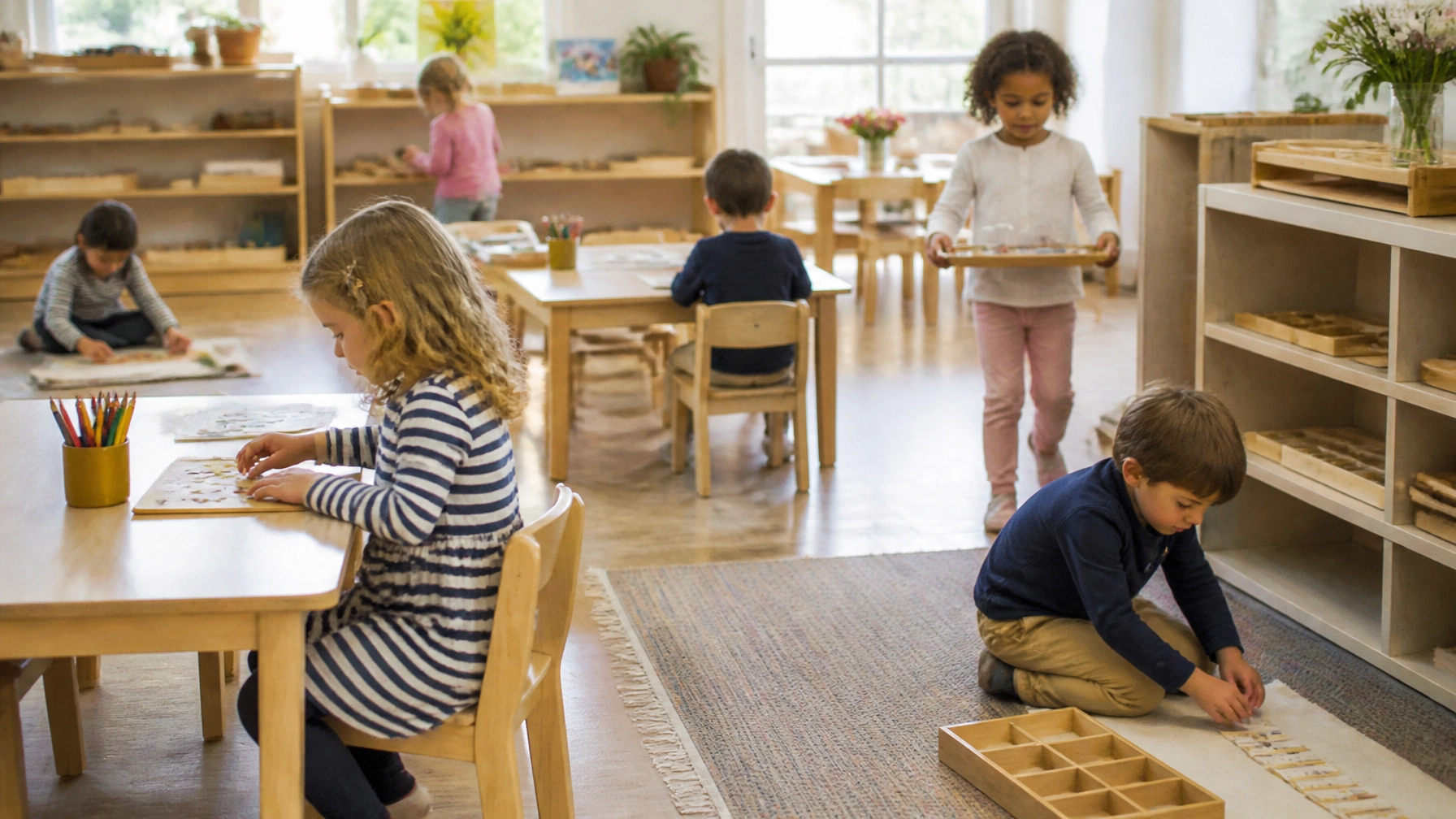
The first visible hallmark of authentic Montessori is the environment itself. A genuine classroom is not arranged for adult convenience; it is designed so that children can function independently.
Everything in the room serves a purpose. Furniture is child-sized and light. Materials are organized logically across open shelves, inviting children to choose their work freely. Children know where to find what they need and how to return it. In this way, the environment becomes a silent teacher. A well-prepared classroom communicates order, beauty, and respect. Children who learn in spaces prepared with genuine care tend to treat those spaces: and the people in them: with corresponding care.

Mastering the Montessori Materials
The materials used in our classrooms are perhaps the approach's most recognizable feature, and among its most frequently misunderstood. To an outside observer, they appear to be simply attractive wooden objects. In reality, they are precisely designed tools that isolate specific concepts.
Each material has a clear developmental purpose and a specific place in a carefully considered sequence.
- The Pink Tower refines visual discrimination of dimension.
- The Golden Beads allow young children to hold the decimal system in their hands.
- The Sandpaper Letters build a multi-sensory foundation for reading.
But the materials only work as intended when they are presented by a trained adult who understands their place in the sequence. The materials are not the curriculum by themselves. The relationship between the guide, the child, and the material is the curriculum. If you are looking for more specifics on these tools, our montessori basics guide can help you understand the materials list in more depth.

The Role of the Montessori Guide: Observation Over Instruction
Perhaps the most profound difference in Montessori lies in the role of the adult. In most traditional classrooms, the teacher is the center of activity. Instruction is directed from the front. This sends a consistent message: knowledge comes from the outside, and learning is something "done" to you.
In Montessori, the adult is a Guide. They prepare the environment, observe children with sustained attention, and introduce materials at the moment each child is developmentally ready. The guide is not passive; the role requires extraordinary attentiveness. But observation, not instruction, is the guide’s primary tool. When adults step back appropriately, children step forward.
Mixed-Age Communities and the Uninterrupted Work Cycle
One of the features that most distinguishes Montessori is the deliberate grouping of children across age levels (usually three-year spans).
Younger children learn by observing older peers. Older children consolidate their understanding by teaching what they know. This creates a stable social culture that renews itself naturally. Children learn to lead and to follow, to help and to receive help. It rewards collaboration rather than competition.
Furthermore, authentic programs depend on the Uninterrupted Work Cycle. This usually lasts approximately three hours. During this time, children choose their work and move freely. This extended cycle allows concentration to deepen. In a Montessori classroom, a child might spend an hour on a single math problem or return over several days to a writing project. That quality of sustained engagement is one of the most enduring gifts we can give a child.

Freedom Within Limits
Montessori freedom is not the absence of structure. It exists within carefully defined limits. Children are free to choose their work and move through the environment, but those freedoms are balanced by responsibilities. Materials belong to the community and must be treated with care. The concentration of others must be protected.
When this balance is maintained, discipline becomes internal. Children behave with consideration not because they fear consequences, but because they value their community.
A Philosophy of Life: The Partnership Model
What distinguishes Montessori most deeply is the vision of the human being that underlies it. Dr. Montessori believed that children are not empty vessels to be filled. They are active agents in their own development, driven by an innate drive toward growth.
This mirrors what Riane Eisler calls the Partnership Model: a way of organizing relationships based on respect for the capacities of each person and shared responsibility. The guide does not control the child; they create the conditions for the child's own development. For many families, this isn't just an educational preference: it’s a deeply held value about how human beings should relate to one another.
How Montessori Compares to Other Approaches
When finding an authentic montessori school, you might encounter other "alternative" models.
- Reggio Emilia shares our respect for the child but is organized around collaborative projects rather than a structured sequence of materials.
- Waldorf emphasizes storytelling and artistic work, but the role of the adult is much closer to a conventional teacher.
- Project-Based Learning uses authentic questions but often stays within the traditional age-graded, teacher-directed structure.
Montessori is distinctive in combining deep respect for the child’s agency with a rigorously designed, systematic educational system that is practically replicable across cultures.
Where Schools "Drift" and What to Look For
Unfortunately, even well-intentioned schools can "drift" away from authentic practice. This happens gradually: a work cycle is shortened to fit in a gym class, or a teacher without Montessori training is hired because of a staffing shortage. Each change seems minor, but eventually, the system breaks. The classroom might still look like Montessori, but it no longer functions like it.
If you are a school leader struggling with this drift, montessori consulting can provide the clarity needed to return to your core mission.
When you visit a school, here is what we suggest you look for:
- Watch the children: Are they choosing work independently? Are they absorbed?
- Watch the guide: Is she moving through the room quietly, offering individual lessons? Or is she leading a large group from the front?
- Notice the room: Is it orderly? Are the materials complete and well-maintained?
- Listen to the leadership: Do they talk about the developmental purpose of the materials, or just use general buzzwords?
Final Thoughts
Authentic Montessori education does not simply prepare children for the next grade level. It cultivates a lifelong relationship with learning and community. It embodies a vision of human beings as inherently capable and social.
That vision is not merely an educational philosophy: it is a statement about what human life can be. It is worth seeking out, worth asking hard questions about, and worth protecting once you have found it.

To learn more about implementing these principles in your school or home, explore our resources at The Montessori Foundation.