Related Posts


The Developing Brain and the Montessori Classroom
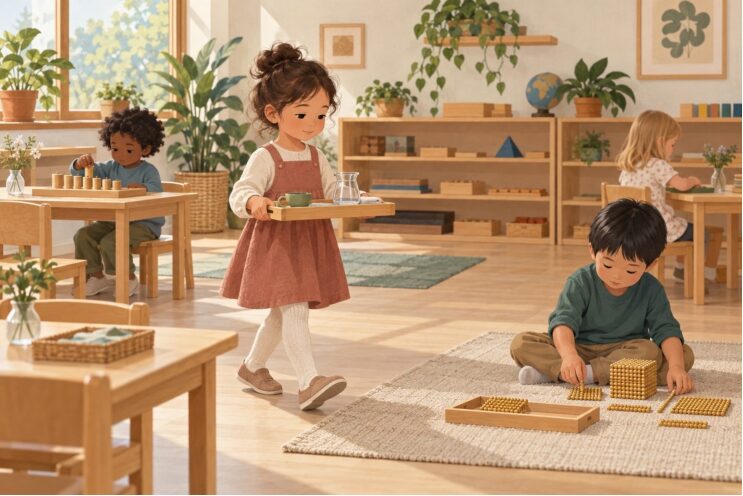
Walk into a well-functioning Montessori Children’s House during the morning work cycle, and something remarkable is happening. A four-year-old carefully carries a tray across the room, weaving around other children. She settles at a table, arranges her materials, and begins to work. When she makes a mistake, she pauses, considers what happened, and tries again. Nearby, a five-year-old working with the Golden Beads remembers the steps of a mathematical operation, organizes his materials, and checks his answer. Across the room, a three-year-old who wants the Pink Tower sees that someone else is using it, hesitates, and goes to watch instead of grabbing it. Two older children negotiate how to share a material they both want.
To a casual observer, these are ordinary moments. To a developmental neuroscientist, they draw on some of the most important and complex abilities the human brain develops: executive function. Understanding them can help us see, with new clarity, what Montessori early childhood education has always been trying to accomplish.
A Scientist the Montessori Community Knows Well
 Few researchers have illuminated executive function more than Dr. Adele Diamond, Canada Research Chair Professor of Developmental Cognitive Neuroscience at the University of British Columbia. A founder of developmental cognitive neuroscience, she is among the world’s leading authorities on how executive functions develop in children. She is also well known throughout the Montessori community, and Montessori educators, school leaders, and teacher educators around the world widely follow her research and writing.
For Montessori educators, Dr. Diamond’s work offers something precious: a scientific vocabulary for what we observe every day in our early childhood classrooms, and a set of principles that can help us do that work better.
The Brain’s Long Journey Toward Self-Regulation
Dr. Diamond’s research on executive function began with the very youngest children. Her early studies of infants, using a classic task in which a baby must search for a toy hidden first in one place and then in another, showed that these abilities begin to emerge in the first year of life, as the prefrontal cortex comes online.
In her influential 2002 chapter, “Normal Development of Prefrontal Cortex from Birth to Young Adulthood,” she traces how this part of the brain matures and how that maturation relates to children’s growing ability to direct their own thoughts and behavior. The prefrontal cortex, located at the front of the brain, plays a central role in deliberate action rather than simple reaction. It helps us remember our intentions, resist distractions, change course when something isn’t working, and weigh alternatives before acting.
Dr. Diamond emphasizes that the prefrontal cortex has an exceptionally long developmental path, beginning in infancy and continuing through childhood and adolescence into young adulthood. These abilities don’t switch on on a particular birthday. They emerge gradually, through maturation, experience, and relationships, which is why the environments we create for young children matter so much.
A schematic view of the prefrontal cortex, the region just behind the forehead, which keeps maturing from infancy into young adulthood. Illustration created for this draft.
Three Core Abilities
Dr. Diamond describes three core executive functions.
Working memory allows us to hold information in mind while we use it. A child who remembers that she needs to collect a tray, unroll a mat, arrange objects in sequence, and return everything when she is finished is holding a plan in mind and organizing her actions around it.
Inhibitory control lets us resist an immediate impulse to pursue a different goal. The three-year-old who waits for the Pink Tower rather than taking it is exercising a young and fragile version of this ability.
Cognitive flexibility lets us shift our thinking as circumstances change. A child who discovers that her first approach to a puzzle doesn’t work, and tries another, is practicing it.
From these core abilities grow the higher-order skills of reasoning, problem-solving, and planning. They matter enormously for young children’s futures. Research reviewed by Dr. Diamond and others suggests that executive functions are often a stronger predictor of school readiness than IQ.
Why the Years from Three to Six Matter So Much
The preschool years are a period of substantial growth in executive function. They overlap the years children spend in the Montessori Children’s House.
In one well-known task from her lab, children are shown pictures of the sun and the moon and asked to say the opposite of what they see: “night” for the sun and “day” for the moon. It sounds simple to an adult, but for many three- and four-year-olds it is surprisingly hard. The difficulty is not remembering the rule; it is holding back the strong urge to name what the picture actually shows. By six or seven, most children find it much easier.
The day-night task: say “night” for the sun and “day” for the moon. Illustration created for this draft.
In another task, developed by Philip Zelazo and his colleagues, children sort cards by color and are then asked to sort the same cards by shape. Many three-year-olds can repeat the new rule correctly and still go on sorting by color. They know what they are supposed to do but cannot yet make their behavior match.
In the card-sorting task, the same cards can be sorted by color or by shape; young children can recite the new rule yet keep sorting by the old one. Illustration created for this draft.
This distinction is enormously important for early childhood teachers. Knowing a rule and being developmentally able to follow it consistently are not the same thing. A child who can explain why we walk indoors may still run when excited. A child who knows that materials go back on the shelf may forget when something more interesting catches her eye. A child who has practiced resolving a disagreement peacefully may still grab or push when frustrated.
These behaviors do not automatically signal defiance or poor teaching. Often they reflect the ordinary limits of a developing executive system. Our responsibility is to tell the difference between unwillingness and developmental difficulty, and to help children build the capacities they need.
Dr. Diamond’s research also shows how much the situation matters. In variations of the day-night task, young children did noticeably better when the pictures were replaced with abstract designs that didn’t trigger such a strong habitual response. In a related study from her lab, they also did better when the adult briefly delayed their answer, giving them a moment to think. In other words, a young child’s success often depends on whether the demands of the moment fit what her developing brain can manage.
What Dr. Diamond’s Research Says Works
Looking across many programs that improve children’s executive functions, Dr. Diamond has identified several common threads. Every one of them speaks directly to Montessori early childhood practice.
- Executive functions improve through repeated practice, with the challenge increasing step by step as children become more capable.
- Children whose executive functions are weakest benefit the most, which means good early programs can help narrow gaps rather than widen them.
- Focusing narrowly on executive functions is less effective than also attending to children’s emotional, social, and physical development.
- Stress, loneliness, lack of sleep, and lack of physical activity all undermine executive functions, while joy, a sense of belonging, and activities children genuinely love support them.
- Movement matters. Activities that combine physical skill with concentration and self-control show particularly promising effects.
Anyone who has trained as a Montessori guide will recognize these principles. Maria Montessori arrived at them through careful observation more than a century ago.
Executive Function in the Montessori Early Childhood Classroom
The prepared environment is far more than a collection of beautiful materials. Seen through the lens of Dr. Diamond’s research, it is a carefully organized setting in which young children practice self-direction all day long. Consider some familiar elements of our practice.
The Uninterrupted Work Cycle
A long, protected morning work period gives children the chance to choose an activity, set a goal, sustain attention, carry a sequence through to completion, and return to work after a distraction. The point is not simply that children stay busy, but that they gradually learn to organize their own activity without constant adult direction. When we interrupt unnecessarily or schedule every moment around adult plans, we take away exactly the practice young children need.
Practical Life
Practical Life is often misunderstood by parents who expect preschool to focus mainly on reading and math. Why spend time washing tables, polishing brass, arranging flowers, or preparing snack?
Imagine a three-year-old washing a table. She must remember a sequence of many steps, gather the materials, coordinate her movements, stay focused, notice what remains undone, and finally restore everything to its place. She may spill and need to adjust. She may get distracted and have to bring her attention back. She may need to resist the urge to abandon the job halfway through. In a single activity, she draws on working memory, inhibitory control, and flexible problem-solving, and the exercises grow longer and more complex as she becomes more capable. This is precisely the kind of repeated, progressively challenging practice Dr. Diamond’s research describes.
That is why we should resist rushing children out of Practical Life as soon as they show interest in academic materials. Its developmental value reaches far beyond a clean table.
Washing a table offers opportunities to use memory, attention, self-control, and flexible problem-solving. Illustration created for this draft.
Movement and Control of Movement
Walking on the line while carrying a glass of water or a bell that must not ring, carrying a chair silently, rolling a rug carefully: these activities offer young children occasions to bring their bodies under the direction of their will. They call for physical skill, focused attention, and self-restraint, the combination Dr. Diamond’s research has highlighted as promising.
The Silence Game
Few activities ask more of a young child’s inhibitory control than the Silence Game. Children must hold their bodies still, resist every urge to move or speak, and listen for a whispered name. When it goes well, the room is filled with a sense of shared accomplishment. Children experience, often for the first time, that they can master their own impulses.
Grace and Courtesy
In Grace and Courtesy lessons, children rehearse how to greet a visitor, interrupt politely, ask for help, or say “no thank you,” before they need these skills in the heat of the moment. Rehearsal matters, because a three-year-old cannot easily invent a calm response while feeling frustrated or excited. Having practiced the words and actions ahead of time, she has something to draw on when her developing brain is under pressure.
One of Each Material
Because most classrooms have only one of each material, children regularly face the experience of wanting something someone else is using. Waiting, choosing something else, or asking to watch are small daily exercises in inhibitory control, supported by clear expectations and a warm adult nearby.
Waiting, watching, and choosing something else are small daily exercises in inhibitory control. Illustration created for this draft.
The Control of Error
Many Sensorial and early academic materials let children discover and correct their own mistakes. A child who finds that a cylinder doesn’t fit or that a sequence doesn’t come out right must stop and rethink. She needs to resist the impulse to force a solution, keep her goal in mind, and try another approach. If we correct every error immediately, we take over the very thinking we hope children will learn to do.
Mixed Ages
In a three-year span, younger children watch older ones exercise patience, persistence, and self-control, while older children practice those same abilities as they help and teach. The third-year child who gently shows a younger friend how to roll a rug is not only being kind; he is planning, explaining, and regulating his own behavior in the service of someone else.
Older children plan, explain, and regulate themselves while helping younger friends. Illustration created for this draft.
Choice Within Limits
Freedom in the Children’s House is not the absence of expectations. Children may choose their work, but they must use materials with care. They may move freely, but they must respect the work of others. Balancing what they want with what the situation calls for is demanding work for a young child, and it is how judgment develops.
Toddlers and the Earliest Beginnings
Because executive functions begin developing in infancy, our toddler programs matter too. Toddlers can already practice simple versions of these skills: waiting briefly for a turn, following a two-step routine at the snack table, putting a basket back on the shelf, or bringing a strong impulse under control with the help of a calm adult. Predictable routines, a well-ordered environment, and patient adults who allow toddlers to do things for themselves lay the groundwork for everything that follows.
The Prepared Adult
The adult is an essential part of the prepared environment. Our tone of voice, pacing, expectations, interventions, and emotional responses shape the conditions in which children learn. Dr. Diamond’s emphasis on stress and emotional well-being is especially important here. Young children cannot exercise self-control well when they feel anxious, rushed, or disconnected. A calm, warm, unhurried classroom is not a luxury; it is a condition for executive function to grow.
A teacher who constantly interrupts, corrects, or rescues may unintentionally remove opportunities for independent problem-solving. A teacher who offers too little guidance may leave children overwhelmed by demands they are not yet ready to manage. Finding the balance requires careful observation. Before stepping in, it helps to ask:
- Is this child unable to remember the sequence, or simply unfamiliar with it?
- Does the child understand the expectation but struggle to hold back an impulse?
- Is the activity too complicated, too easy, or not engaging enough?
- Would a brief demonstration, a visual reminder, or simpler steps help?
- Is the child tired, hungry, stressed, or upset in a way that is making self-control harder?
- Would waiting a moment longer allow the child to solve the problem independently?
Questions like these shift our attention from controlling behavior to understanding development.
Implications for School Leaders
School leaders shape the conditions in which early childhood teachers work and young children learn. If we truly value executive function, those priorities should be visible in how we run our schools.
- Protect a long, uninterrupted morning work cycle, and guard it against the steady creep of pull-outs, specials, and announcements.
- Keep Practical Life, Grace and Courtesy, and movement activities at the heart of the early childhood program, rather than treating them as preliminaries to academics.
- Help teachers understand executive function well enough to distinguish ordinary developmental limits from persistent concerns that call for further assessment or support.
- Remember that children who struggle most with self-regulation may benefit most from a strong Montessori environment. Before concluding that a child is “not a good fit,” ask whether the environment, the routines, or the adult support could be adjusted.
- Judge classroom quality by more than quietness and compliance. Look for purposeful engagement, sustained attention, children managing their own work, and a calm, joyful atmosphere.
- Make the case for the third year. The years from three to six are a period of rapid growth in self-regulation, and the kindergarten year is when much of that growth comes together. When families consider leaving after the second year, they should understand what their child would miss.
- Explain all of this clearly to parents. Learning to concentrate, wait, persevere, and manage frustration is not secondary to early reading and math. It is the foundation that makes independent learning possible.
A Necessary Word of Caution
Even with a scientist as respected as Dr. Diamond to guide us, we should be careful not to claim more than the research shows. Research on Montessori itself is still limited, and outcomes depend heavily on how faithfully Montessori is implemented. The research does not prove that any particular activity strengthens a specific part of the brain, and the classroom applications in this article are my own reflections on her findings rather than practices she has tested.
Nor do all children develop at the same pace. Differences among young children are substantial, and some need more explicit support, accommodations, or specialized help. The value of Dr. Diamond’s work is not that it proves everything Montessori believed, but that it gives us a clear, credible framework for understanding why our early childhood practices matter, and a challenge to implement them well.
The Deeper Purpose of Montessori Early Childhood Education
When we watch a three-year-old wait for the Pink Tower, a four-year-old carry a tray across a busy room, or a five-year-old patiently help a younger friend, we are witnessing something that deserves our attention. These children are not simply completing tasks. They are practicing the complex work of directing their thoughts and behavior toward a purpose.
That capacity develops over many years, and the early childhood years are among the most important of them. It cannot be rushed into existence through demands for obedience, and it cannot fully develop if adults continually make decisions children are capable of making themselves. Maria Montessori understood this through observation. Adele Diamond has helped us understand it through science.
Our work in the Children’s House is not merely to prepare young children for first grade. It is to create an environment in which they learn to direct their attention, organize their actions, manage their impulses, solve problems, and take their place in a community. That is preparation for life.
References
- Diamond, A. (2002). Normal development of prefrontal cortex from birth to young adulthood: Cognitive functions, anatomy, and biochemistry. In D. T. Stuss and R. T. Knight (Eds.), Principles of Frontal Lobe Function (pp. 466–503). Oxford University Press.
- Diamond, A. (2012). Activities and programs that improve children’s executive functions. Current Directions in Psychological Science, 21(5), 335–341.
- Diamond, A. (2013). Executive functions. Annual Review of Psychology, 64, 135–168.
- Diamond, A., Kirkham, N. Z., and Amso, D. (2002). Conditions under which young children can hold two rules in mind and inhibit a prepotent response. Developmental Psychology, 38, 352–362.
- Diamond, A., and Lee, K. (2011). Interventions shown to aid executive function development in children 4 to 12 years old. Science, 333(6045), 959–964.
- Gerstadt, C., Hong, Y., and Diamond, A. (1994). The relationship between cognition and action: Performance of children 3½–7 years old on a Stroop-like day-night test. Cognition, 53, 129–153.
- Zelazo, P. D. (2006). The Dimensional Change Card Sort (DCCS): A method of assessing executive function in children. Nature Protocols, 1(1), 297–301.
Editorial note: The Montessori classroom examples and recommendations are the author’s educational applications of the research, not interventions evaluated in the studies cited. The illustrations are representative artwork created for this draft, not photographs of real classrooms.
Revised and research-checked 29 Oct 2026. Citations verified against the published sources.