Related Posts

Snapshot
Montessori elementary education is far more than a continuation of preschool. Around age six, children’s questions grow bigger: how the universe began, why civilizations rose, how living things depend on one another, what makes the world work. The Montessori elementary program answers with an integrated curriculum that weaves together science, history, geography, mathematics, language, and the arts. Along the way, children learn to investigate, collaborate, think critically, and take growing responsibility for their own work.
“Where did the Earth come from?”
“Who invented numbers?”
“Why do people speak different languages?”
“Could dinosaurs have lived where our house is now?”
“Why do countries fight wars?”
Somewhere around age six, children’s questions begin to change. Younger children are fascinated by the world they can see and touch. Elementary-age children want to understand the world they cannot directly experience. They want explanations. They want to know why. They begin thinking about events that happened long before they were born, places they have never visited, and possibilities they can only imagine.
Maria Montessori recognized this shift, and she designed an elementary approach built to meet it.
From the Concrete World to the Power of Imagination
Young children learn mainly through direct experience. They touch materials, move objects, compare quantities, and practice the real activities of daily life.
Elementary children still benefit from hands-on materials, but they can now use imagination and reasoning to travel far beyond what is in front of them. They can picture:
The formation of the solar system
The migrations of ancient peoples
The structure of an atom
Daily life in distant civilizations
Montessori elementary education puts this new capacity to work, introducing children to the vast story of the universe and humanity’s place within it.
The Great Lessons
One of the most distinctive features of Montessori elementary education is the set of five Great Lessons: dramatic, story-driven presentations designed to spark curiosity and open up broad areas of study.
The Coming of the Universe and the Earth
The Coming of Life
The Coming of Human Beings
The Story of Writing
The Story of Numbers
The Great Lessons are not meant to supply every answer. They are invitations. A story about the formation of the Earth might send one child off to study volcanoes and another to explore states of matter, gravity, or the solar system. A story about early humans might lead to research on tools, migration, farming, or ancient civilizations. One compelling story can open dozens of paths.
Cosmic Education: Seeing the Connections
Montessori used the term Cosmic Education to describe this broad, interconnected approach. The idea is simple and powerful: children should understand not just individual facts, but how those facts relate to one another.
Consider a study of rivers. Over the course of one investigation, children might:
Trace the water cycle
Learn how rivers carve and shape land
Study the plants and animals that depend on fresh water
Discover why so many ancient civilizations grew up along rivers
Examine how people use rivers for transportation, farming, and energy
Calculate distances and water volumes
Read stories of river journeys
Create maps and write reports
Science, geography, history, mathematics, and language become parts of one meaningful whole. That is a very different experience from treating each school subject as a separate box of unrelated facts.
Mathematics: Understanding How Numbers Work
Elementary mathematics builds directly on the foundation laid in the Children’s House. Children continue working with carefully designed materials as they move into increasingly complex territory: the decimal system, large numbers, the four operations, fractions, multiples and factors, geometry, and eventually more abstract relationships. Materials such as the Stamp Game, the bead frames, the fraction insets, and the geometry materials help children see why a process works, not just how to carry it out.
The goal, though, is never to depend on materials forever. As understanding deepens, children move toward written algorithms, mental math, and abstract reasoning. A strong elementary program offers both real conceptual understanding and enough practice to build fluency and accuracy.
Language: Reading to Learn, Writing to Think
In the elementary years, reading becomes a primary tool for investigation. Children read literature, biographies, nonfiction, poetry, and reference works, and they learn to gather and compare information from several sources. They write stories, reports, letters, essays, and presentations. They study grammar, sentence structure, vocabulary, spelling, and the origins of words.
Writing stops being a matter of handwriting practice or short assignments and becomes a way to organize thinking and share ideas. A child captivated by ancient Egypt might read several books, build a timeline, write a report, construct a model, and present what she has learned to her classmates. In one project driven by genuine interest, she is practicing reading, research, writing, public speaking, and organization all at once.
Learning to Work With Others
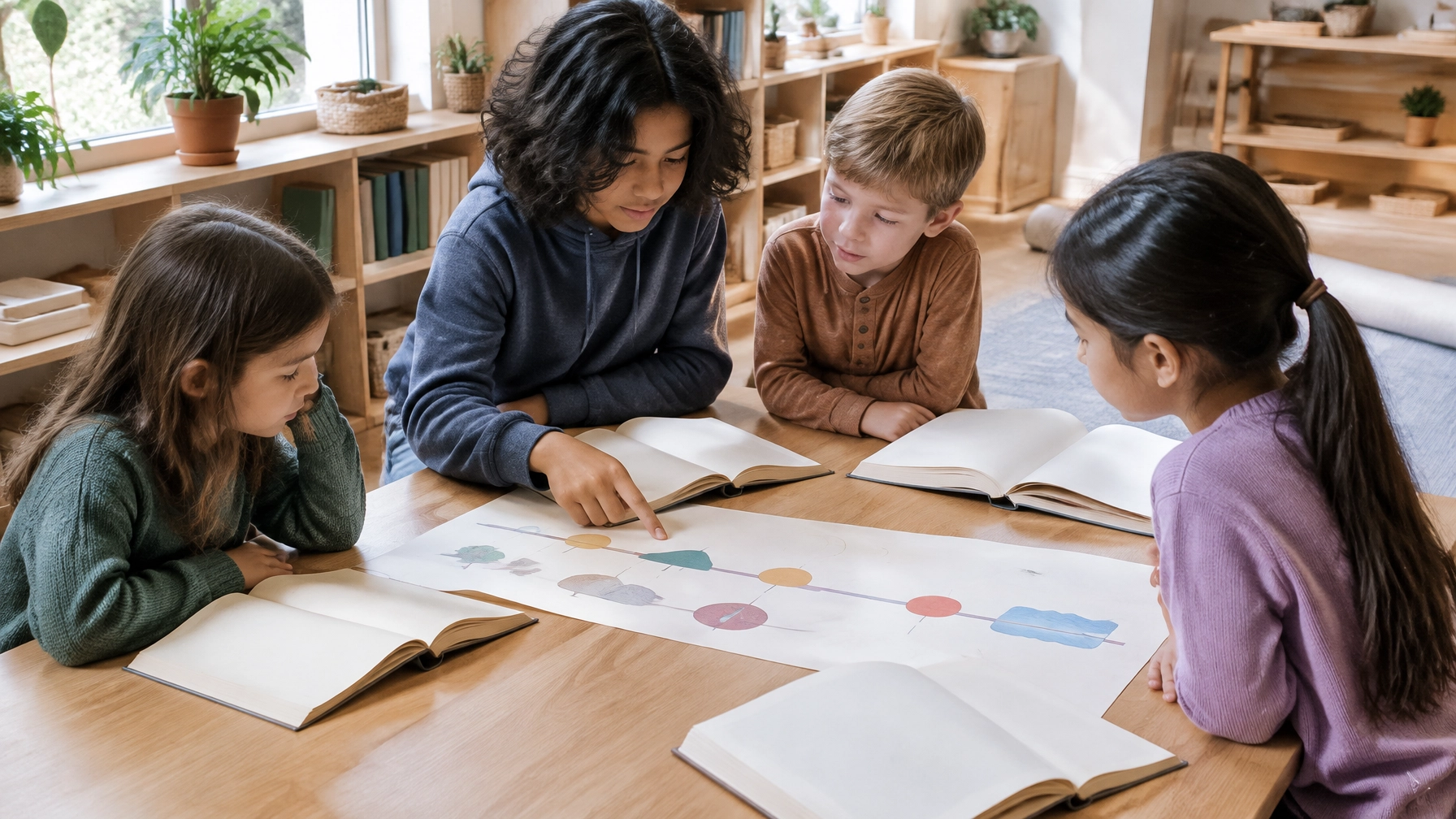
Elementary children care deeply about friendship, fairness, and belonging to a group, and they often love working together. Montessori classrooms make room for shared research, group projects, discussion, and collaborative problem-solving.

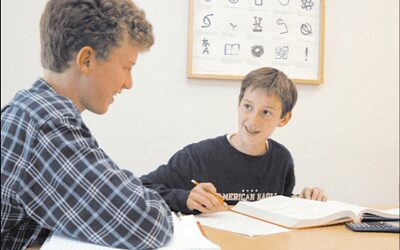
Two children share ideas as they work together.
Collaboration is not always smooth. Children disagree. One child does more of the work than another. Ideas compete, and plans fall apart. These moments are not failures of the classroom; they are part of the curriculum. Each one is a chance to practice communication, negotiation, responsibility, and respect. Teachers do not try to eliminate every disagreement. They help children grow steadily more capable of working problems out constructively.
Freedom With Responsibility
Parents sometimes hear that Montessori elementary children choose their own work and wonder whether that means a child can simply avoid subjects he dislikes. In a well-run program, the answer is no.
Children have real choices, and they also have real responsibilities. Teachers present the curriculum, set clear expectations, observe progress closely, and make sure every child receives instruction across all academic areas. Over time, children learn to plan their work, manage their time, finish what they start, and evaluate their own progress. Many classrooms support this with tools such as:
Work journals
Regular one-on-one conferences with the teacher
Weekly planning meetings
Individual work plans or contracts
The freedom is genuine. So is the expectation that children will use it well.
Going Out Into the World
Montessori elementary learning does not stop at the classroom door. Through what Montessorians call “Going Out,” small groups of children plan their own trips connected to their research, to a museum, library, business, garden, historical site, or community organization. The children prepare questions, help make the arrangements, gather information, and report back to the class.
These experiences connect academic work to the real world, and they give children authentic practice in planning, communicating with adults, and acting independently.

A child shares ideas with classmates during a presentation.
Why the Full Elementary Cycle Matters
Montessori elementary programs are usually divided into Lower Elementary, roughly ages six to nine, and Upper Elementary, roughly ages nine to twelve. Across those six years, children grow steadily more capable of sustained research, abstract reasoning, complex collaboration, and independent organization.
A seven-year-old and an eleven-year-old may explore the same topic at very different depths. The older child works with more advanced sources, builds more sophisticated explanations, and takes on more responsibility for the project. This continuity is one of the main reasons many families choose to stay in Montessori through the full elementary program: they want their children to reach the depth and independence the curriculum is designed to produce.
What Should Parents Expect?
A Montessori elementary education should be intellectually rich. Parents should expect their children to:
Develop strong skills in reading, writing, and mathematics
Gain substantial knowledge of science, history, geography, and culture
Learn to research, ask good questions, communicate ideas, and think critically
Build the habits needed for increasingly independent work
Parents should also expect the school to explain academic expectations clearly, assess progress regularly, identify difficulties early, and provide appropriate support.
Montessori is not an alternative to academic rigor. At its best, it is a different, and deeper, path to real understanding and capable scholarship.
The Joy of Discovering Connections
Imagine a child who starts by asking why volcanoes erupt. That question leads to the Earth’s inner layers, then to plate tectonics, then to earthquakes, then to the shapes of the continents, and finally to how human communities learn to live in the shadow of active volcanoes. One question becomes an extraordinary journey.
That is the spirit of Montessori elementary education. The goal is not simply to give children more answers. It is to help them become people who know how to ask worthwhile questions, and who have the knowledge, skills, and confidence to pursue them.