Related Posts


How to Look Beyond Progress Reports and Understand Your Child’s Growth

A calm conversation helps parents and teachers share what they have observed.
Snapshot
Fall parent conferences offer far more than an update on academic progress. They are a chance to learn how your child is developing independence, concentration, friendships, confidence, and a genuine love of learning. The most valuable conferences are true conversations, in which parents and teachers share what they have observed, ask thoughtful questions, and agree on how to support the child together.
It's fall conference season, and parents are arriving at school eager to hear how their children are doing. Some are hoping for reassurance. Others have questions about reading, mathematics, friendships, or behavior. A few are worried that their children aren't progressing as quickly as they expected, and many simply want to know what their children actually do all day.
A good Montessori conference should answer those questions, but it should also offer something more. It should help parents understand who their child is becoming.
More Than a Report Card
Many of us grew up thinking of parent conferences as a review of academic performance. How is the child doing in reading? How are the math skills? Is homework getting done? Is the child behaving?
These questions matter, but they capture only part of a Montessori education. Montessori teachers also observe how children approach their work, handle challenges, get along with classmates, make choices, and grow in independence. A child who is learning to concentrate, persevere, cooperate, and take responsibility is building abilities that will support learning for the rest of their life. A good conference makes these less visible aspects of development clear and understandable to parents.
Begin With the Child You Know at Home
Parents bring essential knowledge to the conversation. You see your child in situations the teacher may never observe: at bedtime, around the dinner table, with siblings and friends, in moments of excitement and in moments of frustration.
Before the conference, take a few minutes to reflect on questions like these:
What changes have you noticed since school began?
Has your child become more independent at home?
Have new interests emerged?
Are there concerns you'd like to understand better?
Have there been changes in family life, such as a move, a new sibling, or a loss, that might affect your child's experience at school?
You don't need to prepare a formal report. Jotting down a few observations and questions can make the conversation much more productive.
Ask About Concentration and Independence
Two of the most valuable questions a parent can ask are "How is my child's concentration developing?" and "What is my child learning to do independently?"
A teacher might describe a child who once moved quickly from one activity to the next but can now work with a material for twenty minutes. Another child may have relied on adult help in September but now solves problems on their own. An older child may have begun planning their own work and carrying out more complex projects. These developments matter a great deal, because they tell us about the child's growing capacity to learn.
Ask to See the Work
Whenever possible, ask the teacher to show you examples of your child's work. This might be a writing sample, a math problem, a drawing, a research project, a photograph of a science experiment, or the teacher's record of lessons presented. Seeing real work makes learning visible.
Don't look only at polished final products, though. Ask what the work reveals about your child's thinking. What was challenging? What did your child discover? How did they respond to mistakes? What comes next? In Montessori education, the process of learning is often just as important as the finished result.

Looking at a child's work can open a conversation about the learning process.
Understanding Academic Progress
You should absolutely expect clear information about your child's academic development. A Montessori education should never feel mysterious. Teachers should be able to explain what your child has learned, what they are working on now, and what comes next.
In the Children's House, this might include spoken language, sound awareness, letter-sound relationships, writing, early reading, number concepts, and work with the mathematics materials. In elementary, it may include reading comprehension, written expression, mathematics, research skills, and the integrated study of science, history, and geography. In adolescent programs, the conversation often turns to analytical thinking, organization, research, collaboration, and growing responsibility for one's own academic work.
You should leave the conference with a real understanding of your child's progress, not simply a reassuring comment that everything is fine.
Friendships and Belonging
Children spend a large part of their lives at school, and their social experiences matter. Consider asking:
Does my child seem to have friends?
How does my child participate in the classroom community?
What happens when disagreements come up?
Is my child comfortable asking for help?
A child doesn't need to be popular or surrounded by friends every moment of the day. But every child needs to feel a sense of belonging and respect, and to have opportunities to build satisfying relationships. If there are concerns, the conference is a good time to discuss them calmly and constructively.
When the Teacher Raises a Concern
Sometimes a teacher shares something you didn't expect. Perhaps your child is avoiding challenging work, having recurring conflicts with classmates, or developing reading or math skills more slowly than anticipated.
These conversations can be hard to hear. But a concern raised thoughtfully is not a judgment of your child or of your parenting. It is a sign that the teacher is paying close attention. Helpful questions include:
Can you give me some specific examples?
How often does this happen, and under what circumstances?
What have you tried so far, and what has helped?
What progress have you seen?
What support might help at school and at home?
The goal isn't to assign blame. It's to understand the difficulty clearly and agree on a sensible response.
Resist the Urge to Compare
It's natural to wonder how your child compares with classmates. But Montessori education is built around each child's individual development rather than constant competition.
That doesn't mean expectations disappear. Children still need appropriate challenges, careful assessment, and extra support when progress isn't sufficient. The most useful questions, though, focus on your own child. What has changed? What skills are emerging? What needs attention? What is the next appropriate challenge?
Include Your Child When It Makes Sense
Many Montessori schools invite elementary and adolescent students to take part in their conferences, sometimes leading part of the conversation by showing their work and reflecting on their goals. If your school does this, it can be a wonderful experience for your child. Even if it doesn't, consider asking your child before the conference what they are proud of and what they find hard, and share a few highlights with them afterward. Children grow when they see that the adults in their lives are working together on their behalf.

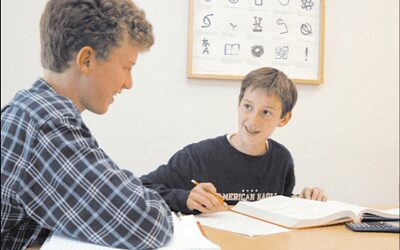
When children take part, they can share their own perspective on their learning.
Leave With a Shared Plan
A good conference ends with a clear sense of what happens next. Perhaps the teacher will offer additional reading support. Perhaps the family will establish a more predictable bedtime routine, give the child more chances to practice independence at home, or keep a closer eye on a social situation.
The plan doesn't need to be complicated. Two or three realistic steps are usually more helpful than a long list of recommendations. If something important is still unresolved, agree on when you will talk again.
A Partnership Centered on the Child
The teacher sees your child in a carefully prepared learning community. You see your child within the life of your family. Both perspectives are essential, and a successful conference brings them together.
You should leave knowing more than how your child is doing academically. You should come away with a fuller picture of their interests, strengths, challenges, friendships, and developing sense of self.
In the end, the most important question isn't simply "How is my child doing?" It's "What are we learning about this child, and how can we help them grow?"