Related Posts

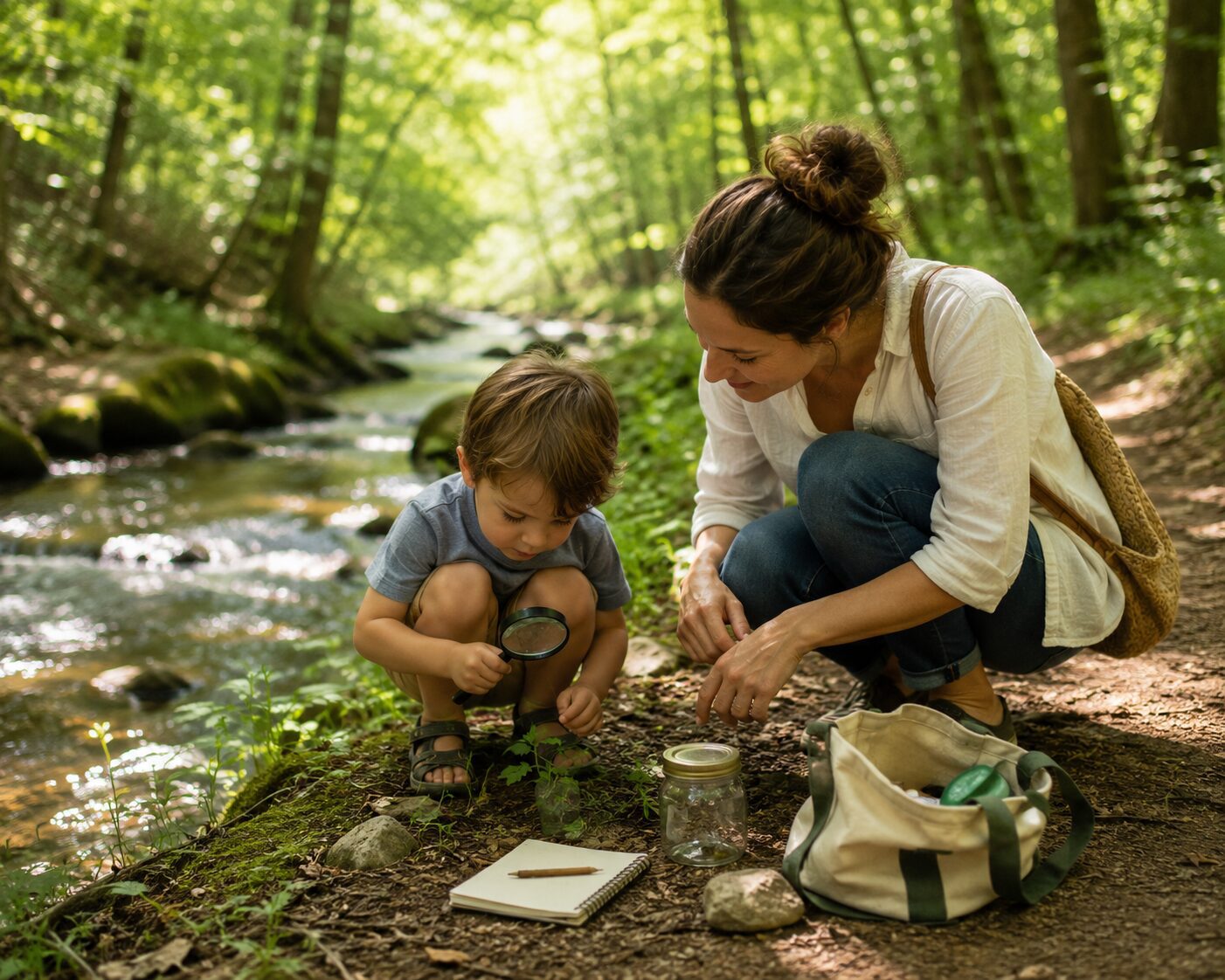
Montessori education places great importance on caring for and preserving our natural resources and the planet, and there is no better place to begin than in your own family life. In a Montessori-inspired home, spending time outside together is one of the simplest and most valuable things you can do. It strengthens your relationship with your child, and it helps him develop a real, lasting sense of connection to the natural world, one that may eventually grow into a genuine commitment to caring for it. Research consistently shows that children who spend regular time in nature tend to be calmer and more grounded than children who spend most of their time indoors with digital devices.
As a family, time outdoors is enjoyable, good for both physical and mental health, and often costs little or nothing at all. Most children love bringing home small treasures after a walk around the backyard, an afternoon at the local park, or a hike in the woods. If you have the space, consider setting up a nature area at home for displaying and collecting these finds. It can be as simple as a small table for photographs and objects, or as elaborate as an aquarium or terrarium for the bugs, beetles, frogs, and turtles your child brings home for a short visit before returning them to where they were found.
Every season brings something new to discover. If you live near a secluded beach, you and your child might find horseshoe crab eggs in the sand, and with a magnifying glass you can see the miniature crabs developing inside. Photographing the eggs each day until they hatch can become a wonderful shared project, and it teaches an important lesson about patience and care: not disturbing the process, and eventually letting the creatures go, the same way you would release a butterfly or a frog. Summer is an ideal time to gather and compare flowers, counting petals and stamens, or pressing flowers and leaves into a small scrapbook. Fall usually brings an abundance of fruits, nuts, and berries, and finding out which animals rely on them for food can become its own small adventure.
It helps to gather a few simple tools for your outings together: a magnifying glass, a bug box or jar, and a small field guide for identification. You might even sew or assemble your own collecting bag to carry them in.
As your child grows older, she may enjoy keeping a nature journal, whether written, photographic, or filled with drawings. A digital journal can even include short video clips tracking the passage of the weeks and months in your garden, from the day you plant your first basil seeds to the fully grown plant. Teaching your child to draw what she sees in nature is a wonderful, nearly lost skill worth reviving. People have long noticed that the act of drawing something forces us to notice small details we would otherwise miss. Encourage older children to write poems or short stories that capture their own sense of wonder, and to photograph everything from a sweeping landscape to a single leaf brought home for the nature shelf.
One simple way to build your child’s powers of observation is to go outside together, choose a single spot in your yard, and spend five quiet minutes really looking at it. Afterward, talk, write, or draw about what you noticed. Ask specific questions: What colors did you see in the grass? Did you spot any insects? What sounds did you hear?
If you have the room, a raised garden bed makes it much easier for a child to work comfortably alongside you, sitting on the ground or on a small stool while learning to plant and weed. We encourage families to try growing an organic garden, free of chemical fertilizers and pesticides, and perhaps to build or buy a small composting bin or even start a simple worm farm. Add a butterfly garden, and imagine the wonder on your child’s face, and the lift in everyone’s spirits, the first time real butterflies begin visiting your backyard. Add a few plants that attract hummingbirds, along with some bird and hummingbird feeders, and, once you have worked out how to keep the squirrels from raiding them, which is a small lesson in persistence all its own, you will have the quiet magic of songbirds, hummingbirds, and butterflies right outside your door.
Whether your family loves gardening, walking in the park, hiking in the woods, or simply observing the world up close in your own backyard, time spent together outdoors is good medicine for the soul.
Out and About: Infants, Toddlers, and Young Children (Birth to Age Five)
From birth to about eighteen months, infants need a great deal of hands-on care. They must be fed, carried or wheeled from place to place, dressed, and changed throughout the day. All of this can make leaving the house feel daunting, but with a little thoughtful planning, it becomes far more manageable.
Every baby is different. Some adapt easily to changes in routine, while others find any disruption difficult. Either way, there will be times parents simply need to take their infant along, whether for an essential doctor’s appointment, a trip to the grocery store, or just a change of scenery on a day when staying home has started to feel isolating.
In a Montessori-inspired home, parents try to show their child respect, empathy, and consideration from birth onward, in even the smallest daily decisions. Planning ahead before an outing is one simple way to put that respect into practice, making the experience as comfortable and pleasant as possible for everyone involved.
Before heading out with an infant, it can help to ask yourself a few questions. Why are you going out: is the trip necessary, or is it for pleasure? Whose needs will it meet, yours, your baby’s, or both?
If the outing is not essential, a few more questions are worth considering. Where will you go, and what will the weather be like? How long will it take to get there? How will you travel? What time will you arrive, and how does that line up with feeding and nap times? Will there be a place to feed and change your child once you arrive? What will you actually do while you’re there? Is this outing well suited to your child’s age? And how will you recognize the signs that your little one has had enough, whether that’s fussiness, or simply losing interest?
Once you’ve thought through these questions, you can prepare yourself and your child for whatever the outing calls for, whether it’s a short walk around the neighborhood or a longer trip to somewhere like the zoo.
Toddlers and young children up to age five often enjoy outings such as playdates at the park, time on a playground, picnics, or a morning at Sunday school or a parent-and-child class. This is often the age when children first begin to venture a little way from their parents, drawn to another child or a piece of play equipment. It’s important to keep a close eye on them for safety, while still allowing them the feeling of real independence. Most toddlers will wander a short distance and then circle back, just to make sure you’re still there. This is also the age when parents begin teaching the basics that will matter for years to come: staying within sight, holding hands to cross the street, and taking turns with other children.
A word about large amusement parks: a big, crowded park can be a genuinely difficult outing for an infant, toddler, or even a child between three and six. Little ones get hungry, thirsty, tired, or need the bathroom at the least convenient moments, and a day meant to be fun can quickly turn into a struggle for everyone. A smaller, closer option is often the better choice: a neighborhood park costs little or nothing, lets you head home the moment your child is ready, and usually offers exactly what a young family needs, whether that’s swings and slides or simply open space to run.
For younger children, a zoo, a petting farm, or a smaller, less overwhelming park can be entertaining without becoming overstimulating, and often offers a bit of learning along the way. A dinosaur-themed park, for example, with large models to explore, an area for digging up “bones,” and a shaded picnic spot, gives a young child a gentle, guided introduction to a new subject, built around movement, discovery, and rest in just the right proportions.