Related Posts
For parents of young children, indoor days can feel like an endless loop of restlessness, snack requests, and creeping screen time. The real challenge of indoor play is finding activities that hold attention, burn energy, and support learning and entertainment without turning the home into a classroom. Even well-meaning parents can get stuck rotating the same few ideas until everyone is bored or overwhelmed. With the right engaging learning methods, indoor time can feel calmer, more purposeful, and genuinely fun.
Quick Summary of Indoor Learning Fun
- Try simple science experiments to spark curiosity and build hands-on problem-solving skills.
- Cook together with kid-friendly tasks that build measuring skills, reinforce following directions, and boost kitchen confidence.
- Create arts and crafts projects that boost creativity while strengthening fine motor skills.
- Play educational board games that make learning feel like play while building thinking and turn-taking skills.
- Practice mindfulness exercises with children to support calm, focus, and emotional regulation indoors.
Build a 10-Minute Flashcard Game Kids Actually Want to Play
If the quick list left you wanting one activity you can pull out anytime, flashcards are a simple go-to that can feel like play instead of “work.” Parents can use flashcards to turn indoor learning into quick, hands-on games that build vocabulary, math skills, memory recall, and more: think rapid-fire Q&A, matching terms to definitions, or a “remember and repeat” round that gets kids practicing without realizing it. The key is keeping it engaging: short turns, lots of encouragement, and a light, game-like pace so it stays fun rather than pushy.
To make setup fast, an AI flashcard maker can help with the busywork by turning uploaded notes, PDFs, slides, and other study materials into organized digital flashcards. Instead of hunting for what to put on each card, it automatically pulls out key terms, definitions, formulas, and important concepts, so you spend your time playing the game, not formatting. Here’s one option to easily make flashcards from materials you already have.
Understanding Play-Based Learning
Play-based learning is the simple idea that fun can carry learning, as long as you tuck one small skill inside the game. That could be counting, turn-taking, letter sounds, or memory, while your child stays in charge of the play. A helpful play-based learning mindset keeps it light, but still intentional.
It matters because kids practice longer when they feel safe and interested, not pressured. Repeating a skill in a playful way strengthens attention and helps new information stick, which supports child cognitive development over time.
Think of it like hiding broccoli in mac and cheese. A scavenger hunt can look like pure fun, but you can quietly aim it at reading clues, sorting colors, or simple math. That mix is meaningful and engaging play that grows real skills. With that lens, choosing science, cooking, crafts, gardening, plays, hunts, photos, or calm breath games gets easier.
Choose Your Adventure: 9 Doable Indoor Activities (With Setup Tips)
Pick one playful “skill target” (mixing, measuring, storytelling, patience) and keep the rest light and fun, this is play-based learning in action. Use the ideas below like a menu: start small, repeat what works, and level it up as your child’s confidence grows.
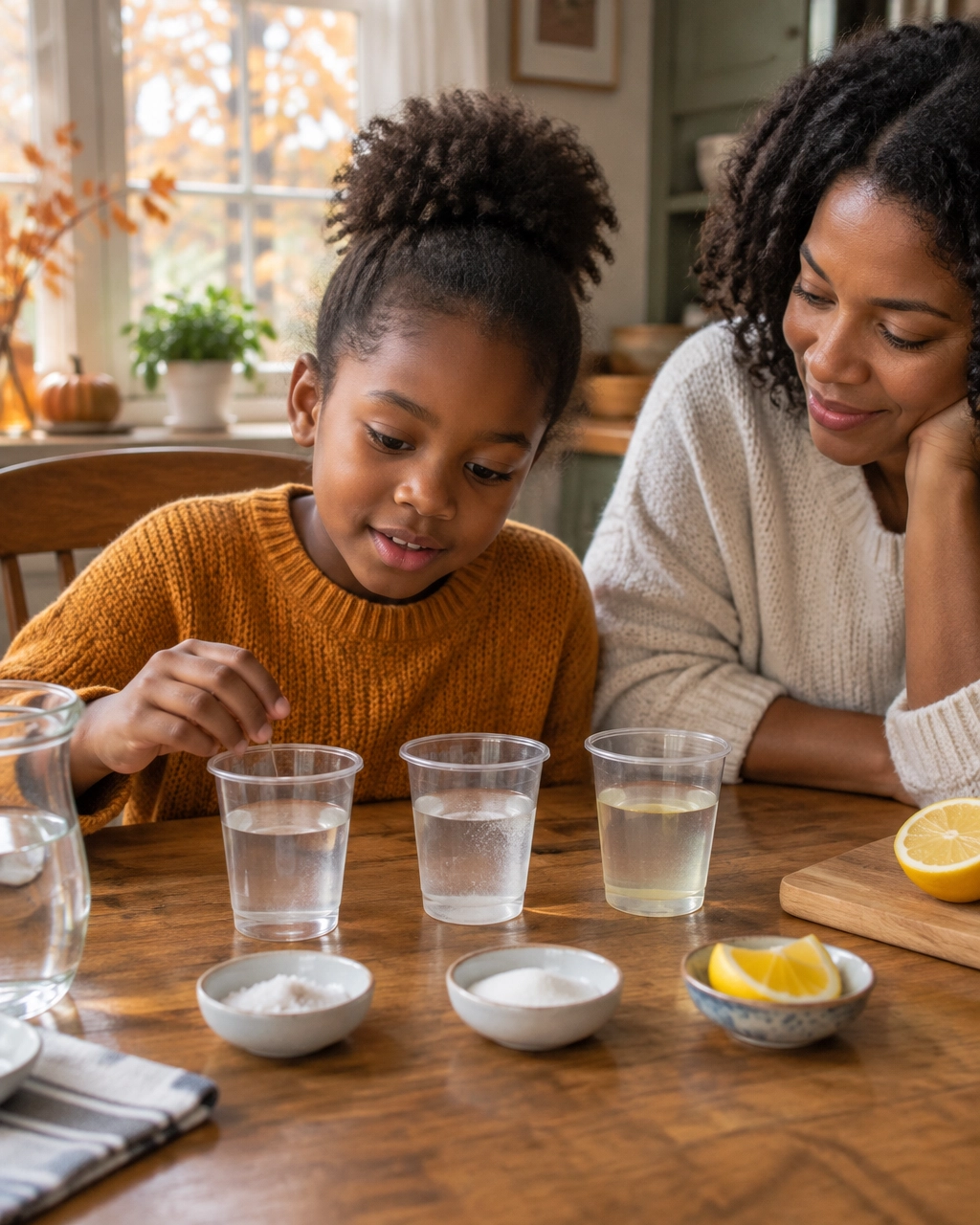
Try a 10-minute hands-on science experiment: Set out three cups of water and test what happens when you add salt, sugar, or a squeeze of lemon, then have your child predict, test, and describe what changed. This works because kids stay engaged when they feel like the “scientist,” and you’re sneakily practicing observation and vocabulary. If you want more structure, borrow the idea of S.T.E.A.M. learning by adding one question: “What could we change next time?” Younger tweak: use color mixing with food coloring. Older tweak: make a simple data chart.

A real kitchen task can build confidence along with measuring and sequencing skills.
Host a family cooking session with one real job per kid: Choose one recipe and assign roles: washer (produce), measurer, mixer, timer-checker, and taste-tester. Cooking naturally builds math and executive function because steps must happen in order, and kids care about the outcome because they get to eat it. Younger tweak: pour pre-measured ingredients and stir. Older tweak: read the recipe aloud and double or halve one ingredient.
Set up a “craft bar” with limits that spark creativity: Put out 5-7 materials (paper, tape, markers, recyclables, string) and one prompt: “Build something that solves a problem,” like a bookmark, a pet bed for a stuffed animal, or a paper bridge. Limiting choices prevents overwhelm while still giving them ownership. Younger tweak: pre-cut shapes. Older tweak: add a rule like “must stand on its own” or “only use 10 pieces of tape.”

An inviting, limited selection leaves room for a child’s own ideas.
Start an indoor gardening project in a clear cup: Line a cup with a damp paper towel, tuck seeds between the towel and the cup, and tape it to a sunny window so kids can watch roots appear. This is perfect play-based learning: it feels like magic, but you’re practicing patience, sequencing, and care-taking. Younger tweak: draw a face on the cup and “talk” to the seed. Older tweak: keep a 7-day photo log and note changes.
Put on a simple living-room play (no costumes required): Pick a familiar story and assign three roles, narrator, main character, helper, then act it out in 5–8 minutes. Kids learn story structure (beginning/middle/end) and emotional skills by stepping into a character. Younger tweak: use stuffed animals as the cast. Older tweak: change one plot point and discuss how it affects the ending.
Create a treasure hunt that practices one skill: Hide 5–10 clues that use what your child is working on: sight words, math facts, directions (“take 6 steps forward”), or simple riddles. The “mission” feeling keeps them motivated long enough to repeat skills without complaints. Younger tweak: use picture clues. Older tweak: add a map with a legend and one “decoy” clue.
Teach basic photography with a mini “photo story” challenge: Give a theme like “tiny details,” “things that are round,” or “my day in 6 pictures,” then have them choose their best three and explain why. This builds observation and communication, two big learning muscles, without feeling school-ish. Younger tweak: you take the photos while they direct. Older tweak: try a before/after series (messy room, then cleaned room).
Practice children’s relaxation techniques with a 3-minute routine: Try “smell the soup, cool the soup” breathing: inhale slowly, then exhale longer, repeating 5 times. Follow with two gentle stretches (reach up like a tall tree, fold like a sleepy cat). Younger tweak: breathe with a stuffed animal on the belly. Older tweak: add a 60-second “notice 5 things” grounding scan.
Choose the one that feels easiest to start today, keep it short, and repeat it later this week, kids build confidence fastest when success is predictable and shared.

Watching a seed change over time gives children something real to notice and care for.
Choose One Indoor Activity to Build Learning Confidence Together
When kids are cooped up and energy is high, it’s easy for indoor time to slide into screens, squabbles, and a parent’s nagging worry that learning is getting lost. The steady fix isn’t doing more, it’s choosing motivating indoor activities with simple parent encouragement strategies: invite, join in, and let progress be messy. With that mindset, family bonding through play starts to feel natural, and child learning confidence grows because effort gets noticed more than “being right.” One small playful win today builds a braver learner tomorrow.
Charlene Roth is the founder of Safetykid.info, a resource dedicated to helping parents and caregivers create safe, engaging, and skill-building environments for children. With a focus on practical advice and family-friendly projects, Charlene is passionate about fostering creativity and teamwork within the home while ensuring the well-being of every child.
Helping Our Children Grow into Thoughtful, Caring, and Responsible Citizens
SNAPSHOT
Whatever our political views, every election season raises a deeper question for parents: What kind of people are we raising our children to become? Beyond happiness and success, we want children who tell the truth, disagree without disrespect, notice when others need help, and believe they can make a difference. Drawing on Maria Montessori’s vision of education for peace, this article explores how citizenship begins in everyday family life. Children learn by watching how we treat others, questioning what they hear, sharing in family decisions, and discovering through real experience that their efforts can make the world a little better.
This week, millions of Americans voted to choose the people who will represent them in government. Some families are pleased with the results. Others may be disappointed or worried about what comes next. If you are reading this elsewhere in the world, the names, parties, and issues may differ, but the hopes and worries are probably much the same.
Whatever our political views, I believe one question deserves more of our attention as parents: What kind of people are we raising our children to become?
We think a lot about our children’s futures. We want them to be happy, healthy, and successful. We hope they find work they enjoy, build loving relationships, and have the chance to follow their dreams. We want them to be confident enough to stand on their own and wise enough to make good choices.
But I hope we want something more for them, too. I hope we want them to become people who:
- Tell the truth, even when it’s uncomfortable.
- Can disagree without being disagreeable.
- Notice when someone needs help and feel responsible for responding.
- Understand that they are part of a community and that their choices affect others.
And perhaps most importantly, I hope we want them to grow up believing they can make a difference.
I believe children need more than the knowledge and skills to succeed. They need to believe that their lives matter and that they have something worthwhile to give the world.
What Maria Montessori Hoped Education Could Do
When parents first discover Montessori, they’re often drawn in by what they see in the classroom. Young children are remarkably independent. They choose meaningful work, concentrate for long stretches, and take pride in doing things for themselves. Older children dive into research, group projects, and questions that fascinate them.
These are wonderful qualities. But Maria Montessori had something much bigger in mind.
She lived through two world wars and came to believe that education could help build a more peaceful world. She knew we couldn’t simply tell children to be peaceful and expect them to grow into peaceful adults. They needed real experiences to help them develop independence, self-control, compassion, and responsibility toward others.
That’s why everyday life in a Montessori classroom matters so much:
- A three-year-old learns to wait patiently while another child finishes using a material.
- A five-year-old sees a younger child struggling with a coat and offers to help.
- Elementary children work on a project together and discover that cooperation takes listening, compromise, and openness to other people’s ideas.
These may seem like small moments, but they begin something important. Children are learning to live in a community where their own freedom matters, and so does everyone else’s.
In a very real sense, that is where citizenship begins.
Our Children Are Watching Us
Children pay much closer attention to us than we often realize. They notice how we treat the people around us. They hear how we talk about our neighbors, our relatives, and people who see things differently. They watch how we handle frustration, whether we admit our mistakes, and how we act when things don’t go our way.
We may tell our children that honesty matters, but what do they learn when they hear us stretch the truth or make an excuse?
We may tell them to be kind, but what happens when they hear us speak with contempt about someone we disagree with?
We may tell them to take responsibility, but do we apologize when we’ve been impatient or unfair?
None of us is perfect, and children don’t need us to be. In fact, some of our best teaching moments come when we admit we were wrong. Imagine saying to your child:
“I was upset earlier, and I spoke to you more harshly than I should have. I’m sorry.”
That simple apology teaches more than any lecture about respect. It shows that everyone is responsible for their behavior, adults included, and that loving relationships can handle mistakes and forgiveness.
Children learn what we value by watching how we live.
Learning to Disagree Without Losing Respect
One thing that concerns me about public life today is how quickly disagreement turns into hostility. It has become easy to divide people into opposing teams, listen only to those who agree with us, and assume people with different views must be foolish, selfish, or dishonest.
People have always argued about how their communities should be run. But today’s fast, constant flow of news and social media can make those disagreements feel especially personal. Our children are growing up surrounded by these messages, and I believe we owe them a better example.
Strong beliefs aren’t wrong. I hope our children will develop principles they’re willing to stand up for. I want them to care about fairness, honesty, freedom, and human dignity, to recognize when something is wrong, and to have the courage to speak up.
But I also want them to understand that someone can see a complicated issue differently without being a bad person. We can help them learn to:
- Say “I disagree, and here’s why,” instead of “Anyone who believes that is an idiot.”
- Listen carefully enough to understand another person’s reasoning, even if they still aren’t convinced.
- See that respecting someone doesn’t mean accepting everything they say or do.
Some ideas are simply wrong. Some claims lack evidence. Some actions are cruel or unfair and need to be challenged. Respect should never excuse staying silent when someone is being mistreated.
But we can challenge an idea without humiliating the person who holds it. We can stand firm for what we believe without treating everyone who disagrees as an enemy.
This lesson begins in childhood, and many of us adults could use a refresher.
Helping Children Respect the Truth
Children also need to develop a deep respect for the truth. This has always mattered, but it may matter even more today. Information spreads so fast that it can be hard to tell solid facts from rumors, exaggeration, or deliberate falsehoods.
Not long ago, people had far fewer sources of information. Today’s children may come across hundreds of claims, pictures, and opinions in a single day, often stated with great confidence.
One of the best gifts we can give them is the habit of asking good questions:
- “How do we know that’s true?”
- “Where did that information come from?”
- “What evidence supports it?”
- “Could there be another explanation?”
These questions fit naturally with Montessori education, which encourages children to observe carefully, investigate, compare, and draw their own conclusions.
We can bring the same spirit home. Suppose your child comes home with a surprising claim about something happening in the world. Instead of agreeing or brushing it off, you might say, “That’s interesting. Let’s find out more.” Then look for reliable information together, compare different sources, and talk about why people sometimes reach different conclusions.
Just as important, let your children see you change your mind. There’s no shame in saying, “I thought I understood that, but I’ve learned something new.” Being willing to rethink our views when we learn more is a sign of maturity, not weakness.
I hope our children will grow into adults who care more about finding the truth than about winning an argument.
The Family Is a Child’s First Community
Long before children learn about elections or government, they learn what it means to belong to a community through family life. They discover that other people have needs and feelings, that no one gets their first choice every time, and that living together takes cooperation and shared responsibility.
That’s why it helps to include children in family decisions when it makes sense. You might talk together about:
- How to spend the weekend.
- How to share household chores.
- What your family could do to help someone in need.
A family meeting doesn’t have to be formal. It can simply be a conversation around the dinner table where everyone gets a chance to speak and be heard.
Of course, parents stay in charge of decisions about safety, money, and anything beyond a child’s understanding. Giving children a voice doesn’t mean handing them control. It means letting them experience what respectful participation feels like. They learn that their opinions matter, and so do everyone else’s. They learn that decisions sometimes involve compromise, and that being part of a family means thinking beyond what they want right now.
These experiences prepare children to take part in larger communities.
Children Need to Know They Can Make a Difference
Without meaning to, we sometimes teach children to see themselves mainly as people who are cared for. We feed them, drive them, entertain them, plan their schedules, and try to give them every opportunity. Caring for our children is one of our most important jobs. But children also need chances to care for others.
- A young child can help set the table or prepare food.
- An older child can help a younger sibling or an elderly neighbor, or join a community project.
- A teenager can get involved in a cause they care about by volunteering or helping organize an effort to meet a local need.

An everyday act of help shared between neighbors.
These experiences give children something that praise alone can’t: the discovery that they are truly useful. They can see that their efforts make someone’s life a little easier, their home a little warmer, or their community a better place.
Children often take great pride in doing something that genuinely helps. They don’t need a reward. Knowing they made a difference is reward enough.
This is an important part of what Montessori meant by independence. Independence doesn’t mean we don’t need other people. It means becoming more and more able to take care of ourselves while understanding that we are all connected and depend on one another.
We want our children to stand on their own two feet, and also to reach out a hand to someone else.
Rediscovering the Honor of Public Service
I would love to see our children grow up with a renewed respect for public service.
Politics is often presented as a game where one side wins and the other loses, and public officials are often talked about mainly in terms of their ambitions, mistakes, or fights. Holding leaders accountable is essential, and children should learn to recognize dishonesty and abuse of power. But I hope they will also come to see that serving the public can be an honorable calling.
Think of the people who keep our communities running: teachers, nurses, firefighters, librarians, social workers, public health workers, volunteers, and many more. Some work for the government. Others serve through nonprofits, neighborhood groups, faith communities, or simply by helping the people around them. Their work may not get much attention, but it matters enormously.
When children meet people who are devoted to serving others, they start to imagine what’s possible for their own lives. Your child might someday become a doctor who cares for families struggling to afford treatment, a teacher, a scientist, an environmental advocate, or a community leader. Or they might choose a career unrelated to public service and still spend their evenings and weekends helping others.
There are many ways to contribute. What matters is that children grow up understanding that a meaningful life is about more than personal success.
Giving Children Reasons to Hope
As adults, one of our jobs is to help children see the world honestly but with hope. That isn’t always easy. Wars, environmental problems, political conflicts, and injustices deserve our attention. Children may overhear troubling conversations or see upsetting images long before they’re ready to make sense of them.
We shouldn’t pretend the world has no problems. But we also shouldn’t tell children that everything is hopeless or that nothing can be done.
History is full of people who worked together to overcome challenges that seemed impossible. Around the world, people have fought to expand freedom, improve health, open up education, protect human rights, and create better opportunities for the next generation. Progress has never been automatic or easy. It has always depended on people who believed things could be better and were willing to act.
Our children need to hear those stories. They need examples of courage, perseverance, generosity, and principled leadership.
They also need chances to feel hope through their own actions:
- A child who helps bring a neglected garden back to life sees that a place can become beautiful again.
- A group of students who carry out a community project discovers what they can accomplish together.
- A teenager who joins a local effort begins to see that their voice and work can matter.

Children and adults caring for a shared garden.
Hope becomes far more powerful when children have experienced their own ability to make a difference.
What Montessori Families Share
Montessori families come from many countries, cultures, faiths, and political backgrounds. We don’t all agree on government, the economy, or how best to solve the problems facing our communities, and we shouldn’t expect to.
But I believe something important connects us. We have chosen an approach to education built on respect for the child and confidence in what people can become. We believe children can do much more than memorize facts and follow instructions. We want them to:
- Think for themselves.
- Develop good judgment.
- Care about others.
- Take responsibility for their actions.
- Experience freedom within a community where everyone matters.
And I hope we share Maria Montessori’s belief that education can help create a more peaceful, humane world.
These ideals don’t belong to any political party or country. They belong to all of us. We see them when a child helps a classmate, when a family welcomes a new neighbor, when people work together to solve a community problem, and when we treat someone with dignity despite our differences. We see them whenever we choose honesty over convenience, responsibility over selfishness, and the common good alongside our own interests.
None of this requires us to agree on every issue. It simply asks us to recognize that we share responsibility for the world our children will inherit.

Working side by side can help children experience service as a shared responsibility.
The Future Begins at Home
When I think about today’s children, I wonder what their lives will be like decades from now. What challenges will they face? What opportunities will they find? What decisions will they have to make?
Some will become leaders in their fields or communities. Others will make quieter contributions through their families, friendships, and daily work. All of them will have chances to touch other people’s lives.
I hope they will remember:
- Being listened to and taken seriously.
- Adults who treated them with kindness while still expecting their best.
- Learning that mistakes can be fixed, disagreements can be worked out, and helping others feels good.
Most of all, I hope they will carry into adulthood the belief that they have something worthwhile to give.
We can’t know what the future holds, and we can’t protect our children from every hardship. But we can help them build the character, compassion, courage, and judgment they’ll need to meet whatever comes. We can teach them to honor the truth, even when it’s inconvenient. We can show them how to stand by their principles without losing respect for others. And we can help them understand that being a citizen means more than voting or obeying laws. It means taking some responsibility for the well-being of the communities we belong to.
Above all, we can give them reasons to believe their efforts matter. I believe this is one of the greatest gifts we can give our children.
We are not just preparing them to succeed in the world as it is today. We are helping them become the people who will shape tomorrow’s world.
And that work begins in the ordinary, loving, sometimes imperfect moments of family life.
Helping Our Children Grow into Thoughtful, Caring, and Responsible Citizens
SNAPSHOT
Whatever our political views, every election season raises a deeper question for parents: What kind of people are we raising our children to become? Beyond happiness and success, we want children who tell the truth, disagree without disrespect, notice when others need help, and believe they can make a difference. Drawing on Maria Montessori’s vision of education for peace, this article explores how citizenship begins in everyday family life. Children learn by watching how we treat others, questioning what they hear, sharing in family decisions, and discovering through real experience that their efforts can make the world a little better.
This week, millions of Americans voted to choose the people who will represent them in government. Some families are pleased with the results. Others may be disappointed or worried about what comes next. If you are reading this elsewhere in the world, the names, parties, and issues may differ, but the hopes and worries are probably much the same.
Whatever our political views, I believe one question deserves more of our attention as parents: What kind of people are we raising our children to become?
We think a lot about our children’s futures. We want them to be happy, healthy, and successful. We hope they find work they enjoy, build loving relationships, and have the chance to follow their dreams. We want them to be confident enough to stand on their own and wise enough to make good choices.
But I hope we want something more for them, too. I hope we want them to become people who:
- Tell the truth, even when it’s uncomfortable.
- Can disagree without being disagreeable.
- Notice when someone needs help and feel responsible for responding.
- Understand that they are part of a community and that their choices affect others.
And perhaps most importantly, I hope we want them to grow up believing they can make a difference.
I believe children need more than the knowledge and skills to succeed. They need to believe that their lives matter and that they have something worthwhile to give the world.
What Maria Montessori Hoped Education Could Do
When parents first discover Montessori, they’re often drawn in by what they see in the classroom. Young children are remarkably independent. They choose meaningful work, concentrate for long stretches, and take pride in doing things for themselves. Older children dive into research, group projects, and questions that fascinate them.
These are wonderful qualities. But Maria Montessori had something much bigger in mind.
She lived through two world wars and came to believe that education could help build a more peaceful world. She knew we couldn’t simply tell children to be peaceful and expect them to grow into peaceful adults. They needed real experiences to help them develop independence, self-control, compassion, and responsibility toward others.
That’s why everyday life in a Montessori classroom matters so much:
- A three-year-old learns to wait patiently while another child finishes using a material.
- A five-year-old sees a younger child struggling with a coat and offers to help.
- Elementary children work on a project together and discover that cooperation takes listening, compromise, and openness to other people’s ideas.
These may seem like small moments, but they begin something important. Children are learning to live in a community where their own freedom matters, and so does everyone else’s.
In a very real sense, that is where citizenship begins.
Our Children Are Watching Us
Children pay much closer attention to us than we often realize. They notice how we treat the people around us. They hear how we talk about our neighbors, our relatives, and people who see things differently. They watch how we handle frustration, whether we admit our mistakes, and how we act when things don’t go our way.
We may tell our children that honesty matters, but what do they learn when they hear us stretch the truth or make an excuse?
We may tell them to be kind, but what happens when they hear us speak with contempt about someone we disagree with?
We may tell them to take responsibility, but do we apologize when we’ve been impatient or unfair?
None of us is perfect, and children don’t need us to be. In fact, some of our best teaching moments come when we admit we were wrong. Imagine saying to your child:
“I was upset earlier, and I spoke to you more harshly than I should have. I’m sorry.”
That simple apology teaches more than any lecture about respect. It shows that everyone is responsible for their behavior, adults included, and that loving relationships can handle mistakes and forgiveness.
Children learn what we value by watching how we live.
Learning to Disagree Without Losing Respect
One thing that concerns me about public life today is how quickly disagreement turns into hostility. It has become easy to divide people into opposing teams, listen only to those who agree with us, and assume people with different views must be foolish, selfish, or dishonest.
People have always argued about how their communities should be run. But today’s fast, constant flow of news and social media can make those disagreements feel especially personal. Our children are growing up surrounded by these messages, and I believe we owe them a better example.
Strong beliefs aren’t wrong. I hope our children will develop principles they’re willing to stand up for. I want them to care about fairness, honesty, freedom, and human dignity, to recognize when something is wrong, and to have the courage to speak up.
But I also want them to understand that someone can see a complicated issue differently without being a bad person. We can help them learn to:
- Say “I disagree, and here’s why,” instead of “Anyone who believes that is an idiot.”
- Listen carefully enough to understand another person’s reasoning, even if they still aren’t convinced.
- See that respecting someone doesn’t mean accepting everything they say or do.
Some ideas are simply wrong. Some claims lack evidence. Some actions are cruel or unfair and need to be challenged. Respect should never excuse staying silent when someone is being mistreated.
But we can challenge an idea without humiliating the person who holds it. We can stand firm for what we believe without treating everyone who disagrees as an enemy.
This lesson begins in childhood, and many of us adults could use a refresher.
Helping Children Respect the Truth
Children also need to develop a deep respect for the truth. This has always mattered, but it may matter even more today. Information spreads so fast that it can be hard to tell solid facts from rumors, exaggeration, or deliberate falsehoods.
Not long ago, people had far fewer sources of information. Today’s children may come across hundreds of claims, pictures, and opinions in a single day, often stated with great confidence.
One of the best gifts we can give them is the habit of asking good questions:
- “How do we know that’s true?”
- “Where did that information come from?”
- “What evidence supports it?”
- “Could there be another explanation?”
These questions fit naturally with Montessori education, which encourages children to observe carefully, investigate, compare, and draw their own conclusions.
We can bring the same spirit home. Suppose your child comes home with a surprising claim about something happening in the world. Instead of agreeing or brushing it off, you might say, “That’s interesting. Let’s find out more.” Then look for reliable information together, compare different sources, and talk about why people sometimes reach different conclusions.
Just as important, let your children see you change your mind. There’s no shame in saying, “I thought I understood that, but I’ve learned something new.” Being willing to rethink our views when we learn more is a sign of maturity, not weakness.
I hope our children will grow into adults who care more about finding the truth than about winning an argument.
The Family Is a Child’s First Community
Long before children learn about elections or government, they learn what it means to belong to a community through family life. They discover that other people have needs and feelings, that no one gets their first choice every time, and that living together takes cooperation and shared responsibility.
That’s why it helps to include children in family decisions when it makes sense. You might talk together about:
- How to spend the weekend.
- How to share household chores.
- What your family could do to help someone in need.
A family meeting doesn’t have to be formal. It can simply be a conversation around the dinner table where everyone gets a chance to speak and be heard.
Of course, parents stay in charge of decisions about safety, money, and anything beyond a child’s understanding. Giving children a voice doesn’t mean handing them control. It means letting them experience what respectful participation feels like. They learn that their opinions matter, and so do everyone else’s. They learn that decisions sometimes involve compromise, and that being part of a family means thinking beyond what they want right now.
These experiences prepare children to take part in larger communities.
Children Need to Know They Can Make a Difference
Without meaning to, we sometimes teach children to see themselves mainly as people who are cared for. We feed them, drive them, entertain them, plan their schedules, and try to give them every opportunity. Caring for our children is one of our most important jobs. But children also need chances to care for others.
- A young child can help set the table or prepare food.
- An older child can help a younger sibling or an elderly neighbor, or join a community project.
- A teenager can get involved in a cause they care about by volunteering or helping organize an effort to meet a local need.
An everyday act of help shared between neighbors.
These experiences give children something that praise alone can’t: the discovery that they are truly useful. They can see that their efforts make someone’s life a little easier, their home a little warmer, or their community a better place.
Children often take great pride in doing something that genuinely helps. They don’t need a reward. Knowing they made a difference is reward enough.
This is an important part of what Montessori meant by independence. Independence doesn’t mean we don’t need other people. It means becoming more and more able to take care of ourselves while understanding that we are all connected and depend on one another.
We want our children to stand on their own two feet, and also to reach out a hand to someone else.
Rediscovering the Honor of Public Service
I would love to see our children grow up with a renewed respect for public service.
Politics is often presented as a game where one side wins and the other loses, and public officials are often talked about mainly in terms of their ambitions, mistakes, or fights. Holding leaders accountable is essential, and children should learn to recognize dishonesty and abuse of power. But I hope they will also come to see that serving the public can be an honorable calling.
Think of the people who keep our communities running: teachers, nurses, firefighters, librarians, social workers, public health workers, volunteers, and many more. Some work for the government. Others serve through nonprofits, neighborhood groups, faith communities, or simply by helping the people around them. Their work may not get much attention, but it matters enormously.
When children meet people who are devoted to serving others, they start to imagine what’s possible for their own lives. Your child might someday become a doctor who cares for families struggling to afford treatment, a teacher, a scientist, an environmental advocate, or a community leader. Or they might choose a career unrelated to public service and still spend their evenings and weekends helping others.
There are many ways to contribute. What matters is that children grow up understanding that a meaningful life is about more than personal success.
Giving Children Reasons to Hope
As adults, one of our jobs is to help children see the world honestly but with hope. That isn’t always easy. Wars, environmental problems, political conflicts, and injustices deserve our attention. Children may overhear troubling conversations or see upsetting images long before they’re ready to make sense of them.
We shouldn’t pretend the world has no problems. But we also shouldn’t tell children that everything is hopeless or that nothing can be done.
History is full of people who worked together to overcome challenges that seemed impossible. Around the world, people have fought to expand freedom, improve health, open up education, protect human rights, and create better opportunities for the next generation. Progress has never been automatic or easy. It has always depended on people who believed things could be better and were willing to act.
Our children need to hear those stories. They need examples of courage, perseverance, generosity, and principled leadership.
They also need chances to feel hope through their own actions:
- A child who helps bring a neglected garden back to life sees that a place can become beautiful again.
- A group of students who carry out a community project discovers what they can accomplish together.
- A teenager who joins a local effort begins to see that their voice and work can matter.
Children and adults caring for a shared garden.
Hope becomes far more powerful when children have experienced their own ability to make a difference.
What Montessori Families Share
Montessori families come from many countries, cultures, faiths, and political backgrounds. We don’t all agree on government, the economy, or how best to solve the problems facing our communities, and we shouldn’t expect to.
But I believe something important connects us. We have chosen an approach to education built on respect for the child and confidence in what people can become. We believe children can do much more than memorize facts and follow instructions. We want them to:
- Think for themselves.
- Develop good judgment.
- Care about others.
- Take responsibility for their actions.
- Experience freedom within a community where everyone matters.
And I hope we share Maria Montessori’s belief that education can help create a more peaceful, humane world.
These ideals don’t belong to any political party or country. They belong to all of us. We see them when a child helps a classmate, when a family welcomes a new neighbor, when people work together to solve a community problem, and when we treat someone with dignity despite our differences. We see them whenever we choose honesty over convenience, responsibility over selfishness, and the common good alongside our own interests.
None of this requires us to agree on every issue. It simply asks us to recognize that we share responsibility for the world our children will inherit.
Working side by side can help children experience service as a shared responsibility.
The Future Begins at Home
When I think about today’s children, I wonder what their lives will be like decades from now. What challenges will they face? What opportunities will they find? What decisions will they have to make?
Some will become leaders in their fields or communities. Others will make quieter contributions through their families, friendships, and daily work. All of them will have chances to touch other people’s lives.
I hope they will remember:
- Being listened to and taken seriously.
- Adults who treated them with kindness while still expecting their best.
- Learning that mistakes can be fixed, disagreements can be worked out, and helping others feels good.
Most of all, I hope they will carry into adulthood the belief that they have something worthwhile to give.
We can’t know what the future holds, and we can’t protect our children from every hardship. But we can help them build the character, compassion, courage, and judgment they’ll need to meet whatever comes. We can teach them to honor the truth, even when it’s inconvenient. We can show them how to stand by their principles without losing respect for others. And we can help them understand that being a citizen means more than voting or obeying laws. It means taking some responsibility for the well-being of the communities we belong to.
Above all, we can give them reasons to believe their efforts matter. I believe this is one of the greatest gifts we can give our children.
We are not just preparing them to succeed in the world as it is today. We are helping them become the people who will shape tomorrow’s world.
And that work begins in the ordinary, loving, sometimes imperfect moments of family life.