Related Posts
Montessori teachers are trained to observe.
We notice the three-year-old who has suddenly begun settling into long periods of concentration. We see the five-year-old who is quietly becoming a leader in the classroom. We recognize the elementary child who once avoided writing but now fills page after page with stories. We watch friendships form, confidence grow, movement become more refined, and children take greater responsibility for themselves and their community.
We also see the struggles. The child who avoids certain kinds of work, who is easily discouraged, who has difficulty joining a group of friends, or who seems to understand a concept one day and lose it the next.

Careful observation is at the heart of Montessori education. But observation is only half of our responsibility. The other half is helping families understand what we see. Resources such as the Montessori Foundation’s observation checklist can support that work, but the deeper responsibility remains ours, to know the child and communicate that understanding clearly.
That is why parent conferences and narrative reports matter so much. At their best, they are not administrative obligations. They are opportunities to bring together parents, teachers, and eventually the child around a far richer question than “How is she doing?”
The real question is: Who is this child becoming?
And the question that follows: What can we do together to support what comes next?
What Parents Are Really Asking
When parents sit down at a conference and ask, “How is my child doing?” they are often asking many questions at once.
Is she happy? Does she have friends? Does her teacher really know her? Is he learning, and is he keeping up? Is she becoming more independent? Is there anything we should be concerned about? Are we doing the right things at home?
Underneath all of these, there is often one more: Did we make the right decision when we chose this school?
Montessori educators sometimes answer these questions in language that makes perfect sense to us and very little sense to parents. We speak of normalization, sensitive periods, control of error, abstraction, and the work cycle. Our professional vocabulary has real value, but a conference is not an oral examination in Montessori theory. Our job is to help parents understand their child.
Instead of saying, “Emma is becoming normalized,” we might say:
“At the beginning of the year, Emma tended to move quickly from one activity to another. Over the last several weeks, we have seen a real change. She now chooses her work more deliberately and sometimes stays deeply engaged for twenty or thirty minutes. She seems increasingly comfortable in the classroom and proud of what she can do on her own.”
Now her parents can see what we see. That is the goal.
A Conference Should Paint a Portrait
One of the quiet dangers of parent conferences is that they turn into a tour through a curriculum checklist. She has worked with the Pink Tower. He knows most of the Sandpaper Letters. She has begun the Golden Beads.
Those things matter, but the Montessori materials are means, not ends. A list of lessons presented tells parents what the teacher has done. It does not tell them who their child is.
Before meeting with a family, I encourage teachers to ask themselves: If I had five minutes to describe this child to a thoughtful educator who had never met them, what would I want that person to understand?
What interests this child, and what brings them joy? How do they approach a challenge, and what happens when something is difficult? How long can they sustain concentration? How independent are they becoming? How do they relate to other children and to adults? What do they understand well, and where are they still building understanding? What has changed since we last spoke? Where does their development seem to be heading next?
A good conference tells the story of a developing human being.
Tell Stories
Parents remember stories.
“Yesterday, Maya spent nearly forty minutes with the Moveable Alphabet. She could not remember one of the sounds she needed. Instead of asking us for help, she went back to the Sandpaper Letters, found the letter, traced it, and returned to her work.”
That small story tells us something about Maya’s literacy. It also tells us about her concentration, independence, persistence, memory, confidence, and her understanding of how to use the classroom to help herself learn.
A checklist cannot communicate all of that. A story can.
Observations, Not Labels
Good conferences and good narrative reports share one essential quality: they are grounded in evidence. Wherever an observation will do, avoid a label.
Instead of “He is lazy,” say: “During independent work periods, Noah often waits for an adult to suggest an activity rather than choosing one himself.”
Instead of “She has trouble socially,” say: “Isabella very much wants to be part of the group. When two or three children are already playing together, though, she sometimes has difficulty finding a way in. We are helping her practice words she can use to join an activity.”
Labels sound permanent. Observations describe something happening now, and something happening now can change.
This matters even more in writing. A narrative report is a formal school document that may become part of the child’s permanent record. It may someday be read by teachers who have never met the child and know nothing about our school. We should be able to substantiate everything we write, and we should be especially cautious about any statement regarding intelligence, ability, personality, or possible diagnosis that goes beyond what we have actually observed.
We are describing a child in development. We are not issuing a verdict.
Then, Now, Evidence, Next
One of the most useful ways to think about a child’s progress is through four simple questions: Where was this child before? Where is this child now? What evidence shows us that? What comes next?
“Sofia is doing well in reading” tells a parent almost nothing. Consider the difference:
“At the beginning of the fall, Sofia confidently identified individual letter sounds but was reluctant to blend them into words. She now regularly chooses phonetic reading activities and decodes unfamiliar words on her own. Just as important, she has begun choosing reading work without waiting for an invitation. Our next step is to help her build fluency and confidence with more complex text.”
Now we have a story of growth. Without a clear starting point, drawn from earlier observations and the previous report, it is very hard to talk meaningfully about progress.

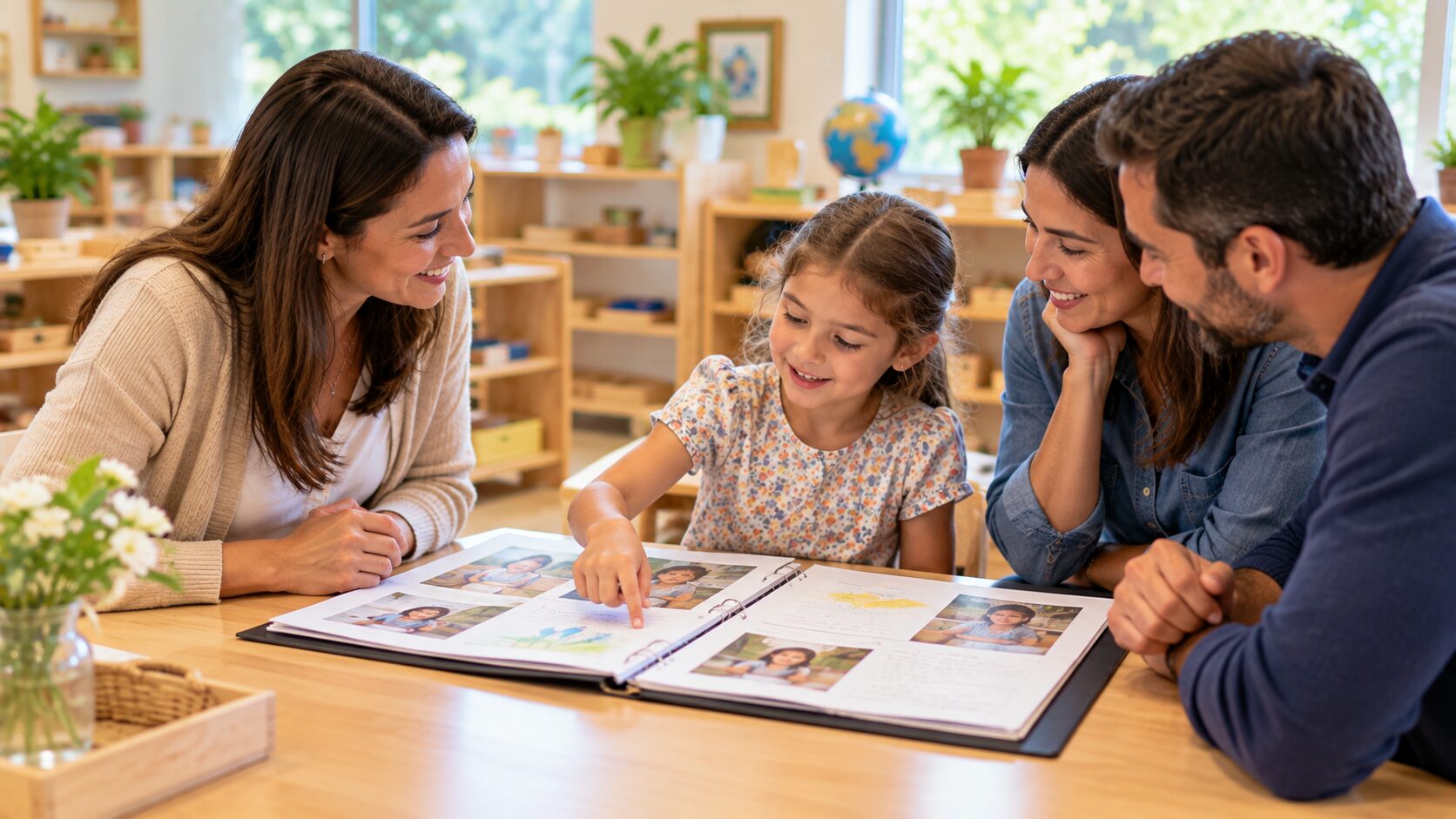
A teacher and parents look together at a portfolio of a child’s work during an unhurried conference.
Teachers Need to Prepare
A good conference should never begin with a teacher opening a child’s file for the first time.
Before the meeting, a teacher should review observation notes from the term, look at lessons presented and the follow-up work that came from them, reread the previous narrative report and the goals set at the last conference, and gather work samples and, where helpful, a few photographs. The teacher should also consider the whole child: social and emotional development, independence, concentration, movement, academic growth, interests, friendships, and challenges.
In Primary, that picture includes relationships, independence, motor development, the ability to follow a sequence, and early academic skills. In Elementary, it widens to include reading and writing, mathematical thinking, cultural studies, organization, initiative, creativity, leadership, and cooperation with peers.
Then step back from all of those details and ask: What are the four or five most important things I want these parents to understand about their child right now?
That single question keeps a conference from becoming a data dump.
Parents Should Prepare Too
Why should the teacher be the only one preparing? A few days before conferences, consider sending families a short set of questions. What changes have you noticed in your child recently? What does your child say about school? What seems to bring your child particular excitement or satisfaction? Is anything concerning you? Is there something you especially hope we will discuss?
This changes the character of the meeting before it begins. It tells parents that this is a conversation, not a report card being read aloud to them.
It also helps prevent the dreaded final two minutes: “Oh, by the way, there’s one other thing we have been really worried about.” That one other thing may be what the entire meeting needed to be about.
Let Me Show You
One of the most powerful things a teacher can say during a conference is, “Let me show you.”
Do not simply tell parents their child has grown. Show them. This is where a portfolio can transform a conference.
A portfolio should not be a scrapbook of the child’s prettiest work. It should tell a story of growth. A balanced portfolio might include something the child is proud of, something the child especially enjoyed, something that was genuinely difficult, an early attempt placed beside a later one, work still in progress, a special project, and, for older children, a written reflection.
Then the teacher can say, “Here was Daniel’s writing in September. Now look at this.” Or, “This was the first map she made, with a great deal of help. This is the one she finished on her own last week.”
Suddenly, progress becomes visible.

A portfolio makes a child’s growth visible through work samples, photographs, and reflections.
Photographs Capture What Paper Cannot
Photographs belong in a Montessori portfolio because so much of the most significant Montessori learning leaves no paper trail.
A parent cannot take home a child’s experience with the Golden Beads. There is no worksheet that shows the concentration it took to lay out a bead chain across the classroom floor. A collaborative research project may be taken apart at the end of the term. A careful construction goes back on the shelf ten minutes after it is finished. And how do we put independence, leadership, collaboration, or joy into a folder?
Sometimes a photograph tells the story.
This does not mean building a large photo archive for every child. Three or four well-chosen images are more powerful than fifty. “This is what we mean when we talk about concentration.” “This is the project I mentioned.” “Look how carefully she is helping that younger child.”
Let the Child Help Choose
As children grow older, involve them in deciding what to share. Before the conference, ask an elementary or adolescent student to select three things: something I am proud of, something that was difficult for me, and something that shows how I have grown.
Now the portfolio is no longer something adults have assembled about the child. It becomes something the student uses to understand and communicate their own learning.

An older student selects work that reflects pride, challenge, and growth.
Bringing the Child Into the Conversation
This leads to the voice most often missing from parent-teacher conferences: the child’s.
How much a child participates depends on age, maturity, personality, and willingness. A three-year-old does not need to sit through a thirty-minute discussion of their development. An older Primary child may enjoy joining briefly. Elementary children can often take part quite meaningfully. By adolescence, I believe students should play a central role in discussing their own learning.
Imagine inviting a child to join for ten or fifteen minutes and asking: What are you most proud of? What did you especially enjoy this term? What was hard for you? What do you think you have gotten better at? What would you like to learn next? Is there anything you would like your parents to know about school?
We learn a great deal from the answers. More importantly, children begin learning to observe themselves, which is profoundly Montessori.
In elementary and adolescent programs, part of the conference can become student-led. The student presents selected work, explains what they were trying to accomplish, describes what was difficult, and names goals for the coming months.
The child need not be present for the whole meeting. There may be matters that parents and teachers should discuss privately. A useful structure is for the adults to begin together, invite the child to join for the middle portion, and then allow a few minutes alone at the end if needed.
The point is not for the child to perform for the adults. It is to gradually give children greater ownership of their own development.
How Often and How Long
There is no single schedule right for every school, but for most Montessori programs, two substantial conferences a year, one in the fall and another in late winter or spring, is a sound starting point. Some schools prefer three.
What matters more than the number is that scheduled conferences never become a reason to delay important communication. If we have a serious concern about a child’s learning, behavior, or emotional well-being, parents should not discover it at a conference six weeks later. Parents should also hear good news along the way. The best conferences take place within an ongoing relationship, and they contain very few surprises.
As for length, twenty minutes may be enough to review a checklist, but it is rarely enough for a thoughtful conversation about a child. I generally recommend planning for thirty to forty-five minutes. Thirty minutes works well when the teacher is prepared and the conversation is focused. Forty-five may be appropriate when the child participates, a portfolio is shared, or there are significant issues to explore.
An hour for every family may sound generous, but a teacher with twenty-five or thirty students already invests a great deal of professional time in preparation and follow-up. Longer is not automatically better. The goal is a well-prepared, focused, unhurried conversation.
Don’t Hide Difficult Things
There is sometimes a temptation to keep conferences relentlessly positive. We want parents to feel good. We do not want to hurt feelings or make anyone defensive.
But if there is a genuine concern, parents deserve to understand it. The answer is not to hide concerns. It is to discuss them respectfully and specifically.
Do not say, “Lucas is aggressive.”
Say: “When Lucas becomes frustrated with another child, he sometimes reacts physically before he can find the words for what he wants. We have seen this several times over the past few weeks. We are helping him stop, step back, and tell the other child what is wrong. We would like to know whether you are seeing anything similar at home.”
A simple sequence helps. Describe what happened. Describe the pattern. Explain what the school is doing. Ask what the parents are seeing. Decide together what comes next.
Ending With Purpose
A conference should not end simply because the clock ran out. Reserve the last few minutes to pull everything together.
What are we seeing? What seems most important? What will the school do? What might be helpful at home?
Resist the urge to send parents away with twelve recommendations. One or two meaningful next steps are far more useful. Perhaps everyone needs to resist helping quite so quickly. Perhaps the child needs more chances to dress independently. Perhaps an elementary student needs a more predictable reading routine at home. Perhaps teacher and parents simply agree to watch something together for six weeks and then compare notes.
Parents should leave understanding five things: My child’s teacher knows my child. My child is growing in ways we can identify. There are one or two areas that still need development. The school has a thoughtful plan for what comes next. We are partners in helping our child grow.
The Narrative Report Continues the Conversation
A narrative report should reflect the same thinking that shapes the conference. It should read as though it was written by someone who genuinely knows this child.
When teachers have twenty or thirty reports to write, it is easy to slip into stock phrases: “Olivia is a joy to have in class.” “Ethan continues to make good progress.” “Jackson is developing nicely in all areas.” These sentences are pleasant, and they tell us almost nothing.
Here is a simple test: If we removed the child’s name from the narrative, would the parents still recognize their child?
They should.
A useful structure for a narrative builds on the same four questions that guide the conference. Who is this child in our community right now? What has changed since the last report? What have we actually observed? When developmentally appropriate, what does the child think about their own learning? What are we working toward now?
Written this way, a narrative turns assessment from a collection of marks into the story of a child’s learning, with strengths grounded in evidence, areas for growth framed as next steps, and a hopeful look ahead.
Write for Parents, Not Montessori Teachers
Words such as normalization, sensitive period, control of error, cosmic education, and even work mean something quite specific to us and something quite different to most parents. We do not need to abandon Montessori language, but we do need to explain it.
Clarity is not dumbing Montessori down. Clarity shows that we understand what we are trying to say.
Every Writer Needs an Editor
Narrative reports are professional documents, and they deserve professional care. Schools should establish shared expectations for organization, terminology, tone, and depth. Teachers should read one another’s narratives, and someone should proofread every one. After hours spent on a report, most of us simply stop seeing our own errors.
A colleague will also notice things spell-check never will:
“This sounds much harsher than I think you intended.”
“I’m not sure what this means.”
“Do we actually have evidence for this?”
“You’ve written four paragraphs about math and nothing about his social development.”
“This does not sound like the child I know.”
That is not interference. That is professional collaboration.
A Word About Artificial Intelligence
Artificial intelligence is quickly becoming part of this conversation. Used thoughtfully, it can help teachers organize observation notes, turn dictated notes into prose, catch repetition, correct grammar, smooth awkward sentences, and produce a clearer first draft.
But AI must never be the observer. The teacher is the observer. The teacher knows the child, and the teacher decides what matters.
Give an AI system three bullet points and ask it for a warm, five-hundred-word narrative, and it may produce a beautifully written report full of observations no human being ever made. That is unacceptable.
The standard is simple: AI may help us write what we know. It must never invent what we know.
Every sentence in a child’s narrative remains the professional responsibility of the teacher and the school.
More Than Reporting Progress
Montessori assessment should reflect Montessori values. We should never reduce a child to a number, a grade, a checklist, or a list of materials presented.
A narrative report can tell the story of development. A portfolio can make growth visible. Photographs can capture learning that leaves no paper behind. A conference can bring together the people who know the child from different vantage points. And, as children become ready, their own voices can become part of the conversation.
Together, these tools can offer a clear picture of what a child knows, what a child can do, and who the child is becoming.

A student presents selected work and reflects on learning with parents as part of a growing sense of responsibility.
So perhaps the best question to ask after finishing a narrative or walking a family to the door is not, “Did I tell them how their child is doing?”
It is: “Do they understand their child better because we had this conversation?”
And one more: “When the child is old enough to take part, do they understand themselves a little better too?”
If the answer is yes, then the conference and the narrative report have done something far more important than report progress. They have become part of the child’s education.