Related Posts



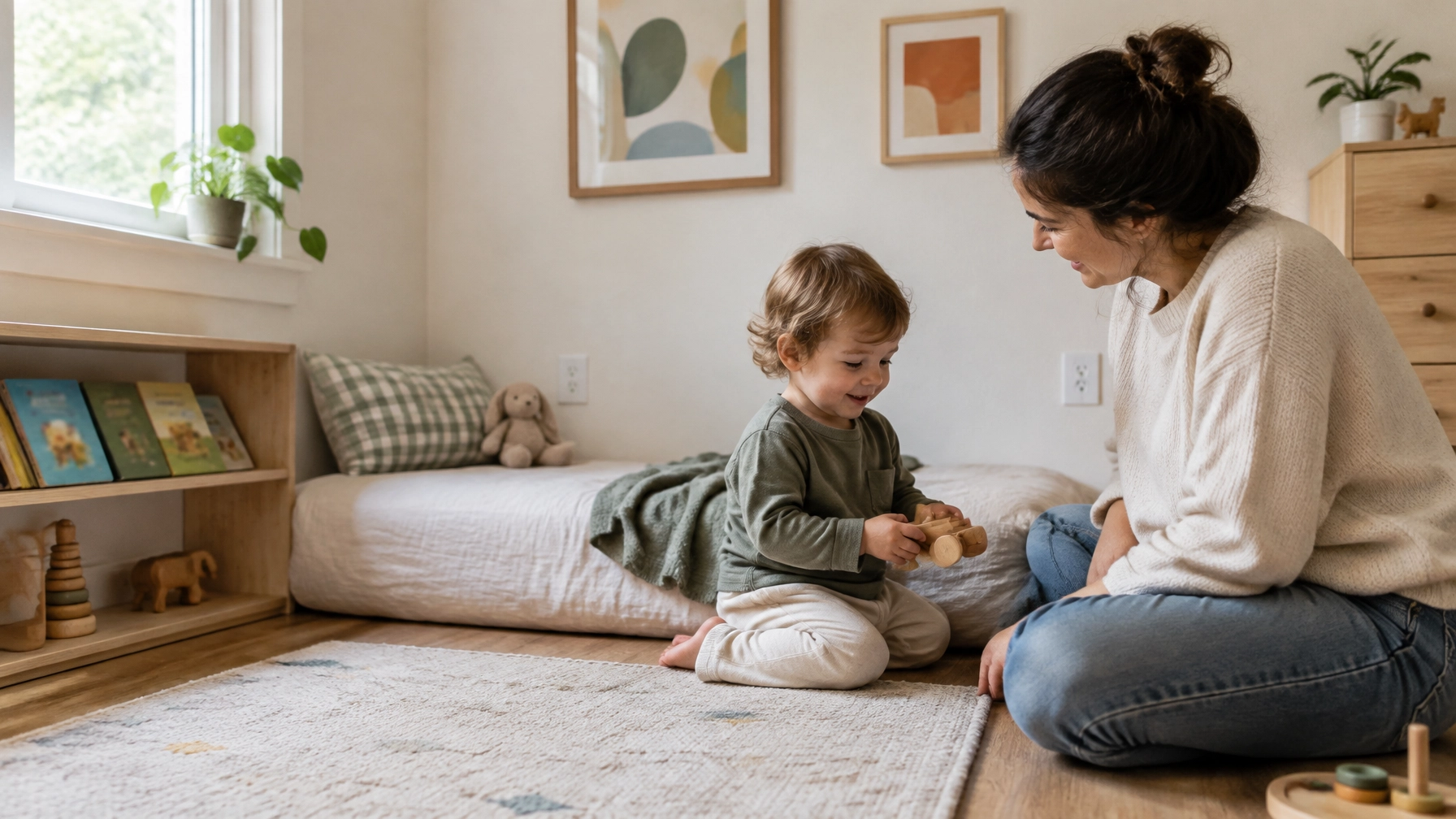
A calm, childproofed bedroom prepared for independent movement and rest.
The first time a patient’s mother described her toddler’s “floor bed” to me, I assumed she meant the kid had knocked the mattress off the frame again. I was wrong, and it turned into one of those exam-room stories that ends up reshaping how you think about a completely unrelated topic for the rest of the week.
A Montessori bed, or more accurately called a toddler floor bed, is a mattress placed directly on the floor instead of inside a crib or on a raised frame. That’s the entire physical definition. The philosophy behind it is where things get more interesting.
For families exploring Montessori at home, the question is not simply whether a floor bed looks appealing in a prepared bedroom. The more useful question is this. What kind of environment gives a toddler meaningful freedom while still asking the adults to prepare responsibly? That is the question I hear most often from parents, and it is also one that teachers and school leaders may recognize from conversations with families.
Where the idea actually comes from
Maria Montessori built her educational method around one core belief: children learn by doing, not by being managed. She was skeptical of a lot of standard childhood furniture, especially cribs, because it’s designed for parental convenience and control rather than a child’s development. A crib contains a child. A floor bed lets a child get in and out on their own, see their room at their own eye level, and make small decisions.
Maria Montessori did write about the low bed. In Lecture 18 of The 1946 London Lectures and in The Secret of Childhood, she described the child being put to bed “in a high cage that you could not get out of” and recommended that the child instead have a mattress on the floor, so the child can get up when finished sleeping. The point was not to promote a particular commercial bed design. It was to consider whether the child’s environment supports movement, participation, and growing independence.
In my years of experience dealing with pediatric patients I happen to agree that independence starts earlier than most of us assume, and the environment either supports it or works against it. A low bed is one small part of that environment. It cannot create independence by itself, but it can remove one unnecessary barrier.

A toddler practices independent movement in a prepared, childproofed room.
Why I don’t dismiss this as a parenting trend
Plenty of things marketed to exhausted parents don’t hold up to much scrutiny. This one mostly does, for a specific reason: it doesn’t ask a toddler to do anything developmentally implausible. Climbing in and out of a low bed is well within a walking toddler’s motor capability.
The floor bed also gives the child a different relationship with the room. The mattress is not an isolated object that the adult uses to contain the child. It becomes part of a carefully prepared space where the toddler can see, move, and make small choices at their own level.
That does not mean that every room is ready for a floor bed. The freedom that comes with leaving a crib also creates a responsibility for the adults. The room needs to be genuinely childproofed, not merely attractive in a photograph. Outlet covers, anchored furniture, and the removal of anything sharp, swallowable, or otherwise unsafe within reach are basic parts of the preparation.
The questions I actually get asked
“Isn’t this less safe than a crib?”
A floor bed removes fall risk from a raised surface, which is a real injury category I’ve seen plenty of. The tradeoff is that the room needs to be genuinely childproofed, because a mobile toddler now has the run of the space. Outlet covers, anchored furniture, nothing sharp or swallowable within reach.
Parents sometimes focus so intently on the mattress that they forget to look at the rest of the room from the child’s perspective. Kneel down. Look under furniture. Notice cords, unstable shelves, small objects, and anything that could become interesting during the night. A Montessori bed is not a substitute for thoughtful preparation; it makes that preparation more important.
“Won’t they just get up all night?”
Some do, especially the first week or two. This is a habit change, not a sleep fix. Kids who already sleep well tend to keep sleeping well from the floor. Kids who fight sleep will still fight it in just from a different spot on the floor.
That answer can be frustrating for parents hoping the bed itself will solve bedtime. It will not. A floor bed is an environmental choice, not a promise of uninterrupted sleep. The family still needs a consistent evening rhythm and a calm response when the child experiments with getting up.
“What age should we start?”
Most families I talk to make the switch somewhere between twelve and twenty-four months, and it’s usually driven less by a specific age than by a toddler who’s already climbing out of the crib.
Every child and family is different. Some toddlers show clear physical readiness, while others need more time with the transition. I would suggest that parents observe the child rather than treating a particular birthday as a deadline. Is the child walking confidently? Is the child beginning to test the limits of the sleeping space? Can the adults prepare the room and respond consistently to the new freedom?

An end-of-day reading moment keeps the parent at the child’s level without hovering.
What I’d actually tell a family considering one
Don’t do it because it’s trending on your Instagram feed. Do it if you’re comfortable with the actual tradeoff: more freedom for the child, more upfront work on room safety, and a short adjustment period where bedtime might get messier before it gets easier.
Start by looking at the room, not at the furniture. A mattress directly on the floor may be all that is required physically, but the prepared environment around it matters. A low shelf with a few books and quiet toys, artwork at the child’s eye level, natural light, a small rug, and simple wooden furniture can help the room feel orderly and accessible. None of these additions are what makes a Montessori bed a Montessori bed. The defining feature remains the low sleeping surface and the opportunity for the child to get in and out independently.
The adult’s presence matters, too. We want to support the child without hovering over every movement. Sitting or kneeling at the child’s level communicates availability while leaving room for the toddler to act. At bedtime, a parent might read quietly beside the mattress, offer a brief goodnight routine, and then allow the child to settle without turning every movement into a negotiation.

The prepared environment extends beyond the bed itself.
A Montessori bed is not a test of whether a parent is committed to Montessori. Families have different homes, schedules, children, and comfort levels. Some will decide that a crib remains the best choice for their situation. Others will find that a floor bed fits naturally with the way they want to support movement and independence.
The important thing is to make the decision deliberately. Observe your child. Prepare the room thoroughly. Expect a period of adjustment. Then pay attention to what happens rather than assuming that a particular piece of furniture will produce a particular result.
For more guidance on bringing Montessori principles into family life, parents can explore the Montessori Family Alliance and the broader resources of The Montessori Foundation. These conversations are most useful when they help families understand the reasoning behind an approach and adapt it thoughtfully to their own children.
Dr. Deepak Khanna, D.O. is a board-certified family medicine physician based in Philadelphia. He also runs Montessori Bed Company, where he writes and designs resources for families navigating the switch to floor beds.