Related Posts



September is usually a wonderful month in schools. The classrooms are freshly prepared. Teachers are energized. Parents are hopeful. Children arrive with new backpacks, new lunchboxes, and stories about new friends.
For families who have just enrolled, there is often a genuine honeymoon. They chose your school for a reason. They want this to work, and they want confirmation that they made the right decision.
Then October arrives, and the novelty begins to wear off.
A child who bounded into school in September announces over breakfast, “I do not want to go to school today.” Another tells her parents that nobody played with her. A parent asks, “What did you do at school today?” and receives the timeless reply: “Nothing.”
The teacher mentions that a child is having trouble listening at group time. A grandparent wants to know why no worksheets are coming home. A father peers through the classroom window and sees his four-year-old apparently wandering around while another child seems to be doing something much more “academic.”
Parents begin comparing notes. Is your child reading yet? What did your teacher say at your conference? Does your son like his teacher? What exactly are they doing all day?
And almost imperceptibly, the question in some parents’ minds begins to change. In August it was, “Isn’t this school wonderful?” By October it may be, “Did we make the right decision?”
Welcome to what I call the October Danger Zone.
Enrollment Does Not End When the Contract Is Signed
Schools tend to treat admissions and retention as separate processes. Admissions brings families in. Retention keeps them.
I do not think it works that way. A family keeps making its enrollment decision long after signing the contract. During those first months, parents are constantly collecting evidence. Some of it reassures them. Some of it raises questions. Most of it is small.
A teacher sends a photograph with a thoughtful explanation of what the child was doing. Confidence goes up.
A parent sends an email and does not hear back for four days. Confidence goes down.
A child suddenly begins dressing himself every morning. Confidence goes up.
A parent hears another parent complaining at pickup. Confidence goes down.
The teacher describes something remarkable she has noticed developing in the child. Confidence goes up.
The tuition payment leaves the checking account, and the child says, “We did not do anything today.”
Well, you get the idea.
Families rarely leave a school because of a single incident. More often, doubts accumulate until something finally tips the balance. That is why retention does not begin when a parent threatens to withdraw. It begins long before there appears to be a problem.
This is why authentic family partnership matters. The Montessori Family Alliance gives schools and parents a shared language for understanding children’s development, preparing for conferences, and strengthening the bridge between home and school.
The Problem of Invisible Learning
This matters especially in Montessori schools, because so much of what we value is not obvious to someone who has never been trained to see it.
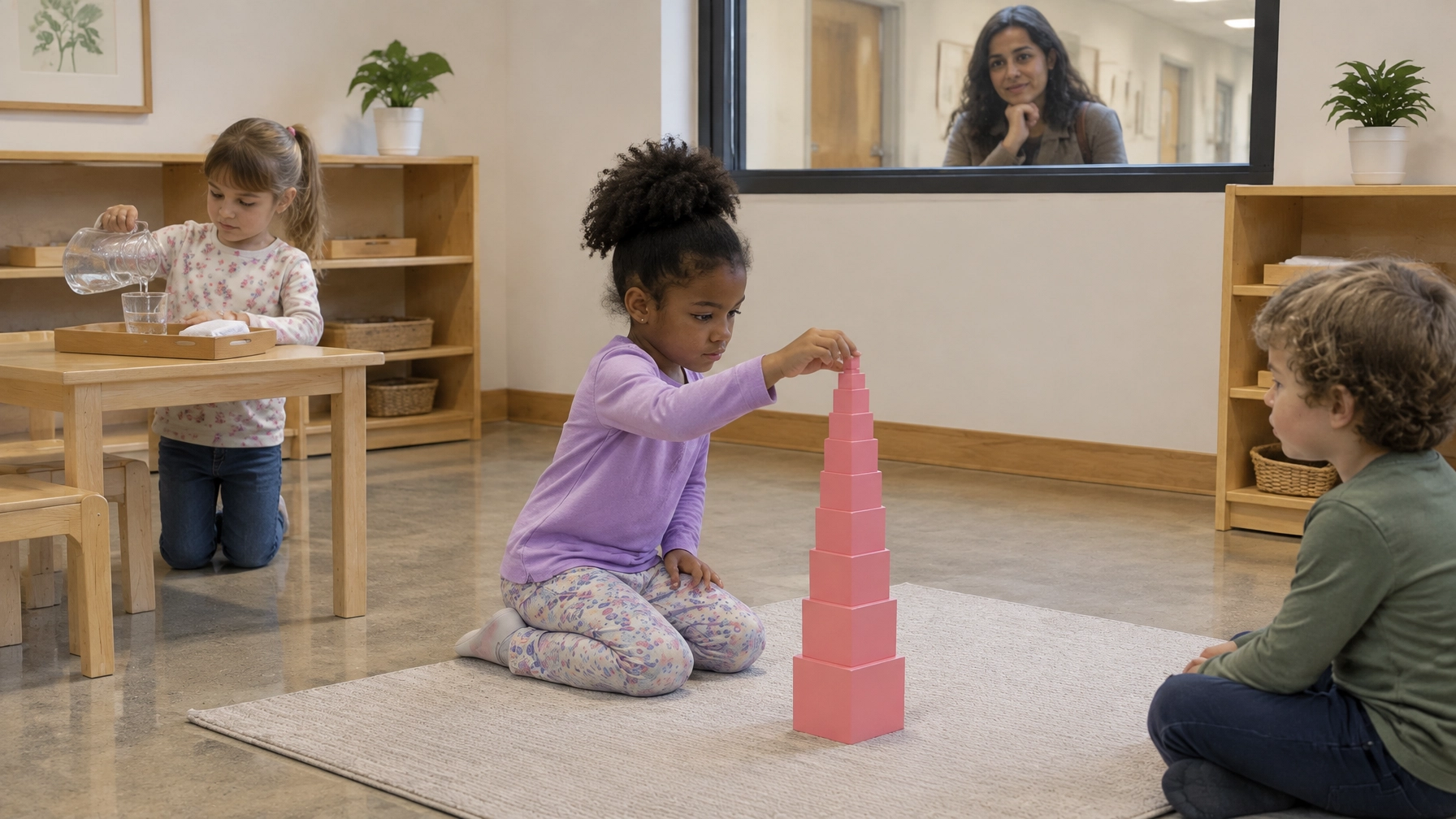
Imagine a parent looking through a classroom window. One child is polishing a mirror. Another is carrying a pitcher of water. A third is sitting on the floor arranging colored rods. Two children appear to be talking. One child is simply watching another work.
Meanwhile, a friend down the street has a child in a conventional preschool who comes home every day with a folder full of worksheets, alphabet pages, art projects, and papers covered in stars and smiley faces.
Which parent has more evidence that her child is learning?
We know the answer should not be measured by the thickness of the folder. But does the parent?

We see concentration developing, coordination becoming refined, and mathematical relationships being explored with the hands. We see children learning to make choices, persist through difficulty, control their impulses, care for their environment, and live peacefully within a community. We see the foundations of literacy and mathematics being built carefully and systematically.
But parents cannot value what they cannot see, and they cannot see what we have never taught them to recognize. That is one of the great challenges of Montessori parent education.
A parent may see a child pouring water and think, “That looks like play.” A Montessori guide sees controlled movement, sequencing, concentration, coordination, independence, and the child’s developing capacity to recover from a small mistake. Our responsibility is not to insist that parents already understand these details. It is to help them see.
The Montessori Foundation’s resources on observing in a Montessori classroom can help schools prepare families to look beyond the most obvious signs of learning.
What Are Your Teachers Giving Parents to Talk About?
Here is a question I think every school leader should ask the faculty: What happened in your classroom this week that parents would be excited to tell someone else about?
I call these bragging rights. I do not mean manufactured publicity or clever marketing claims. I mean authentic moments that show the value of what we are doing for children.
Imagine a parent saying, “My three-year-old started making his own breakfast.”
“My daughter concentrated on one thing for almost forty minutes yesterday. Six months ago I did not think she could focus for five.”
“The children actually learn to solve disagreements themselves instead of having an adult solve everything for them.”
“My five-year-old is doing multiplication with these amazing materials, and she understands what she is doing.”
“You would not believe how capable these children are.”
Now ask yourself what your parents say when someone asks, “Why do you send your child to that school?” If the answer is vague: “Oh, we really like it” or “The teachers are nice”. You have work to do. We want parents to understand their child’s experience well enough to explain why it matters.
We do not need to manufacture stories for families. We need to notice, interpret, and share the remarkable stories already unfolding in the classroom.
Do Not Just Tell Parents What Happened
Teachers sometimes assume that communicating more often will solve this problem. Not necessarily. More communication is not the same as better communication.
Suppose a teacher writes, “Oliver worked with the Pink Tower today.” A Montessori teacher understands that sentence immediately. Most parents do not.
Now imagine instead: “Oliver spent almost twenty minutes carefully building and rebuilding the Pink Tower, which consists of ten solid pink cubes. When he first joined us, he usually moved from one activity to another after only a few minutes. We are seeing a wonderful change in his ability to concentrate and persist with something that interests him.”
Suddenly the Pink Tower is not the story. Oliver’s development is.
Or consider: “Sofia worked with the Movable Alphabet today.” Perfectly accurate, and almost meaningless to an uninitiated parent. What if we wrote: “Sofia discovered today that she can write words even though she cannot yet form the letters easily with a pencil. Using the Movable Alphabet, she built several words herself. This is one of the fascinating things about Montessori: children can express their thoughts in writing before handwriting catches up with their imagination.”
Now the parent has something to tell Grandma.
The principle is simple: don't just tell parents what their child did. Help them understand why it matters.
Teachers Need to Learn to See the Story
Montessori teachers are trained to observe children. We also need to become skilled at recognizing the stories hidden inside those observations.
The observation is “Emma poured water.” The story might be: “Emma spilled the water, stopped, found the sponge, cleaned it up, refilled the pitcher, and tried again, without asking an adult to rescue her.” That is a story about independence, persistence, problem-solving, and self-confidence.
The observation is “Jack and Henry had an argument.” The story might be: “Jack and Henry disagreed about who could use a material. Instead of asking an adult to decide, they talked it through and found a solution.” That is a story about social development.
The observation is “Maya worked with the Golden Beads.” The story might be: “Maya held a 1,000 cube in her hands and compared it with a single unit bead. She is not memorizing that 1,000 is a large number. She is building a concrete understanding of our decimal system that she will carry into increasingly abstract mathematics.”
These moments happen constantly in good classrooms. But somebody has to notice them, and then somebody has to translate them.
That translation is not public relations. It is parent education. It is part of the guide’s work.
October Conferences Matter More Than We Think
This is also why the first parent conferences of the year are so important. Too often we treat conferences as reporting sessions: here is what your child is doing, here is what she likes, here is what she is working on, here are some concerns. Thank you for coming. See you in the spring.
A good conference accomplishes something more important. Parents should leave understanding their child more deeply than when they walked in. They should recognize growth they had not noticed, understand something about their child’s development, and know what the teachers are watching and why.
Even when there are genuine concerns, parents should come away feeling that the school knows their child, understands what is happening, and has a thoughtful plan for moving forward.
That is not spin. That is good teaching. Parents are our partners, and partners need enough information to understand what we are trying to accomplish together.

Listen for the Quiet Families
There is another danger at this time of year. School leaders naturally pay attention to parents who complain. I worry just as much about the ones who do not.
The dissatisfied parent who schedules a meeting is giving us an opportunity. The parent who quietly begins researching other schools is not. By the time that family tells us they are leaving, the decision may have been made months earlier.
So this month, I encourage school leaders to ask: Who have we not heard from? Which families seem less engaged than they did six weeks ago? Which children are having trouble separating in the morning? Where have teachers noticed a change in a parent’s demeanor? Which families arrived with particularly high or unrealistic expectations?
None of this means hovering over parents or trying to “sell” them on staying. It means paying attention. We observe children carefully. We should observe the health of our relationships with families with the same care.
Your Best Marketing Campaign May Already Be Happening
Schools spend enormous energy attracting new families. We redesign websites, buy online ads, hold open houses, post on Instagram, and worry about search rankings and conversion rates. All of that can matter.
But think about the families already enrolled. Every one of them has neighbors, friends, relatives, colleagues, playgroups, and social networks. Sooner or later someone will ask, “Where does your child go to school?” and then, “Do you like it?”
That conversation may be more powerful than any advertisement you will ever buy. What happens next depends on whether you have given that parent something meaningful to say. Not a slogan. Not your mission statement. A story.
“My daughter used to give up whenever something was difficult. Now I watch her keep trying.”
“My son is only four, but he has become amazingly independent.”
“My child comes home talking about Africa and South America.”
“They do not just tell children to be kind. They actually teach them how to live together.”
“I wish I had gone to a school like this.”
Those are the stories that build schools, and they begin with real experiences in real classrooms.
Before October Slips Away
As the honeymoon fades, do not panic. Pay attention.
Walk through your classrooms and ask what extraordinary things are happening that your families may not recognize. Ask each teacher to share one story a week that illustrates something important about children’s development. Look for families whose confidence may be slipping before they become dissatisfied. Prepare for conferences as opportunities to deepen understanding, not merely report progress.
And keep asking one deceptively simple question: What are we giving our parents to talk about?
The answer has implications far beyond marketing. When parents understand what we are doing, they become better partners. When they can see their children’s growth, their confidence in the school deepens. When they understand why the experience matters, they are more likely to stay. And when they can tell the story themselves, they become the most credible ambassadors a school could ever have.
The October Danger Zone is real. But it is also an opportunity. The excitement of September may have faded. Now we have the chance to replace excitement with something much stronger: understanding, confidence, and trust.
For more resources that help schools strengthen family relationships and help parents understand their children’s Montessori experience, visit the Montessori Family Alliance.