Related Posts



What Is Happening Inside the Brain of a Montessori Child?
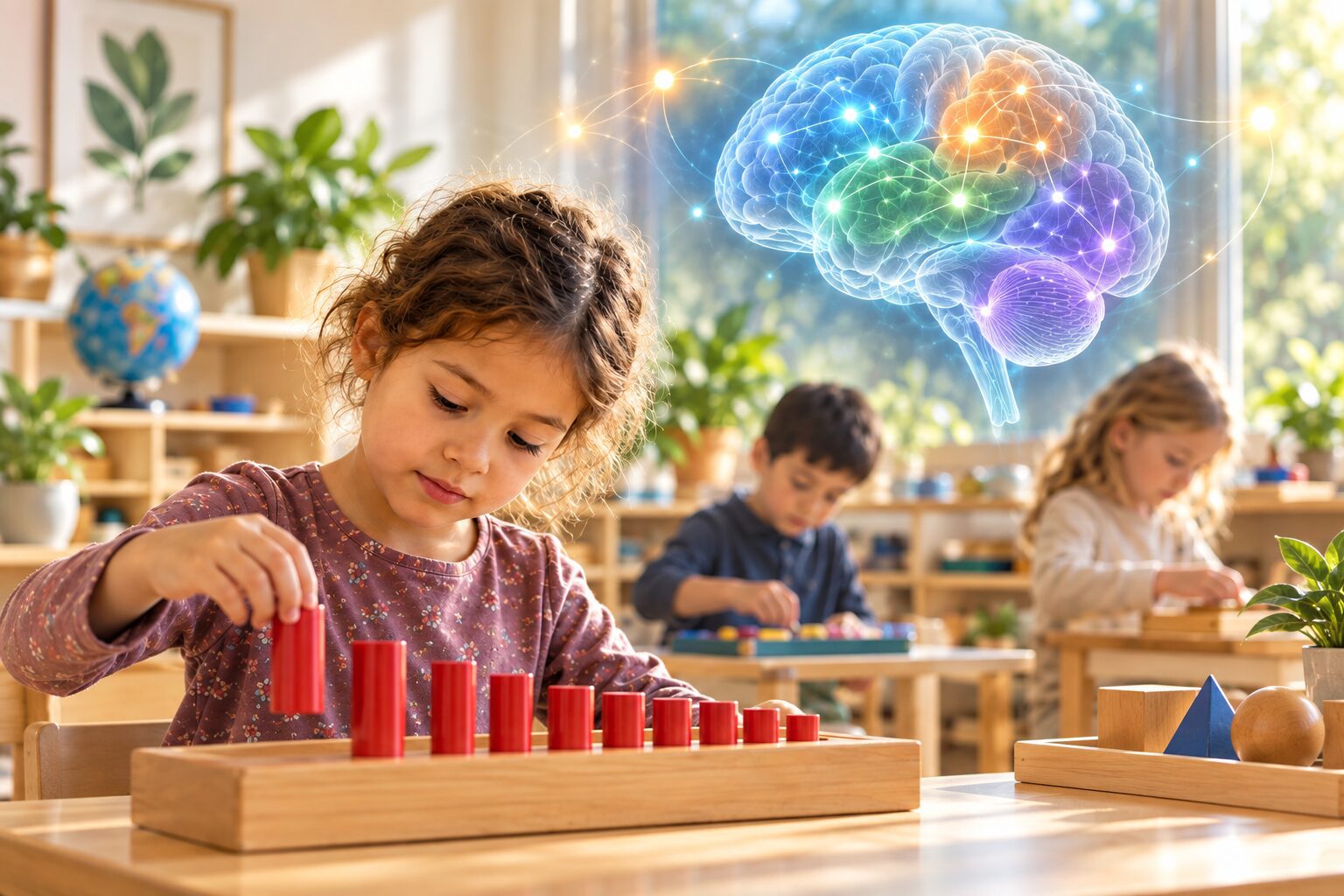
Every parent who has toured a Montessori school has watched something that looks almost too calm to be real. A four-year-old carries a tray across the room, settles onto a mat, and works with a set of materials for forty minutes. Nobody tells her to. Nobody is handing out stickers. When she makes a mistake, the material itself shows her, and she tries again.
Parents watching this usually ask the same question: what is going on in there? For more than a century, we have answered by describing what we see in the classroom and pointing to outcomes such as academic progress, creativity, and social skills. Now a research team in Switzerland has tried to look at the question from a different angle by examining the brain itself.
Researchers at Lausanne University Hospital and the University of Lausanne, led by Paola Zanchi and Solange Denervaud, published their findings in 2024 in the journal npj Science of Learning (Zanchi et al., 2024). They scanned the brains of 87 children and teenagers aged 4 to 18. Forty-two attended Montessori schools, and 45 attended high-quality traditional schools. Every child had followed the same approach since age four, or for at least the previous three years.
The researchers took care to make the two groups comparable. The children were similar in age, gender mix, family socioeconomic status, parents’ interest in education, and scores on a fluid intelligence test. That matters because families who choose Montessori can differ in many ways from those who do not, and the team wanted to reduce those differences as much as possible.
Each child lay in an MRI scanner for a short resting scan, about six minutes, looking at a cross on a screen and letting their mind wander. The researchers did not ask the children to solve a problem. They studied the brain’s background activity, the way its different regions coordinate with one another when nothing in particular is being demanded.
The team looked at two qualities of that background activity. The first is integration, meaning how well different brain systems communicate and work together. The second is stability, meaning how steadily the brain holds its patterns of activity over time. The authors connect integration to the ability to handle more complex thinking, and stability to the ability to stay engaged in a task.
On both measures, the Montessori students looked different from their traditionally schooled peers:
- Across the whole brain, Montessori students showed greater integration and greater stability.
- The extra integration was concentrated in the cerebellum, a region at the back of the brain.
- The extra stability showed up in five networks: the two attention networks, the network that connects the senses to movement, the network that supports planning and working memory, and again the cerebellum.
- No differences appeared in the networks for vision, emotion, or the mind-wandering “default mode” state.
It is just as interesting to note what did not differ. Both groups of children followed the same basic developmental path as they grew older. Montessori children did not have dramatically different brains. The differences were subtle, and they were found in the very networks that a Montessori classroom asks children to use.
The authors are careful to say this is a first look, not a final answer, but they offer thoughtful ideas about why these particular networks stood out.
Attention. The two attention networks help us focus on what matters and notice what is important (Corbetta & Shulman, 2002; Vossel et al., 2014). These networks are still developing during childhood and seem to respond to experience (Farrant & Uddin, 2015). The authors suggest that the way Montessori guides attention, through hands-on work with objects, self-direction, and long stretches of uninterrupted time, may be relevant. Their findings also fit with a recent review of studies concluding that Montessori education supports children’s attention (Demangeon et al., 2023).
Planning and self-direction. The network involved in working memory, focus, and regulating one’s own behavior (Marek & Dosenbach, 2018) showed greater stability in Montessori students. It is reasonable to wonder whether a classroom in which children choose their work, plan their time, and correct their own errors gives that network regular exercise.
Movement and the senses. The network linking sensation to action also showed greater stability. Maria Montessori insisted that children learn through movement and the senses, and the authors note that research reviews support the value of learning by doing and using multiple senses (Marshall, 2017).
The cerebellum. This was the most striking result. The cerebellum was once thought to be mainly about balance and coordination, but researchers now know it is also involved in language, learning, and memory (Buckner, 2013; Stoodley, 2012). Some scientists have described a close relationship between motor development and cognitive development (Diamond, 2000). Studies also show that fine motor skills in kindergarten predict later success in math and reading (Grissmer et al., 2010).
The pouring, spooning, threading, buttoning, and careful handling of materials that fill a Montessori primary classroom can look like simple daily practice. They may be doing far more than that. The authors say more work is needed to understand the cerebellar result, but Montessori educators have long trusted the connection between the hand and the developing mind.
This study builds on earlier work from the same research group. In a previous brain imaging study, Montessori students showed a different pattern of brain connectivity after making a mistake on a math task than traditionally schooled students did, which the authors interpret as a difference in learning strategies (Denervaud et al., 2020). Another study found that Montessori students scored higher on creativity tasks and showed differences in how their brain networks were organized (Duval et al., 2023).
Behavioral research has pointed in the same direction. A well-known study in Science found advantages for Montessori children in both academic and social skills (Lillard & Else-Quest, 2006). A later study of Montessori preschool programs found that they raised and equalized outcomes for children (Lillard et al., 2017), and researchers studying middle school students found higher motivation and quality of experience in Montessori classrooms (Rathunde & Csikszentmihalyi, 2005).
For years, parents and teachers have observed better focus, self-regulation, and independent thinking. What is new here is a first hint of how those qualities may look inside the brain.
What This Study Cannot Tell Us
I would be doing you a disservice if I stopped there, because good science comes with limits, and the authors are candid about theirs.
- The study is a snapshot, not a follow-through. It compared children at one point in time. Because families chose their schools, we cannot say that Montessori education caused the differences. Other factors about the families or their choices could have played a role.
- The sample is small and specific. The children came from one region of Switzerland and from families with relatively high incomes. The results may not hold for other communities.
- The researchers could not link the brain measures to individual children’s behavior. The method requires pooling data across many children, so they could not, for example, show that a child with a more stable attention network paid better attention.
- The authors call the evidence preliminary. They plan to follow these children over time and hope others will repeat the study.
So please be wary of any headline that claims Montessori “rewires” the brain, or that a brain scan can tell you whether your child is in the right school. This study does not say that, and neither would I.
What You Can Take Away From This Study
Whether or not your child attends a Montessori school, the study offers some encouraging food for thought. These are my own reflections, not conclusions of the researchers, but they follow the ideas the authors raised:
- Protect uninterrupted time. Long stretches of focused work, without constant interruption, seem to be a feature of the environment worth preserving at home as well as at school.
- Let your child choose and repeat. Repetition is not boredom. It is how children build concentration.
- Value hands-on activity. Cooking, gardening, building, sorting, pouring, and sewing are not distractions from learning. They may be part of it.
- Let mistakes teach. When children discover and fix their own errors, they practice the kind of self-monitoring that serves them for life. Resist the urge to correct too quickly.
- Ask schools thoughtful questions. If you are choosing a school, ask how much uninterrupted work time children have, how much they move and handle real materials, and how much choice they are given.
Maria Montessori had no brain scanner. She observed children patiently and carefully, and concluded that they build themselves through purposeful activity in an environment prepared for them. It is humbling, and I think a little wonderful, to see modern neuroscience beginning to explore what she saw over a century ago.
The Lausanne study is a first step and not a conclusion. If future research confirms it, we will have something parents have long asked for: evidence from inside the brain that how we educate children shapes how they think. Until then, keep watching your child at work. What you see in those quiet, absorbed moments is worth noticing.
References
Buckner, R. L. (2013). The cerebellum and cognitive function: 25 years of insight from anatomy and neuroimaging. Neuron, 80, 807-815.
Corbetta, M., & Shulman, G. L. (2002). Control of goal-directed and stimulus-driven attention in the brain. Nature Reviews Neuroscience, 3, 201-215.
Demangeon, A., Claudel-Valentin, S., Aubry, A., & Tazouti, Y. (2023). A meta-analysis of the effects of Montessori education on five fields of development and learning in preschool and school-age children. Contemporary Educational Psychology, 73, 102182.
Denervaud, S., et al. (2020). An fMRI study of error monitoring in Montessori and traditionally-schooled children. npj Science of Learning, 5, 11.
Diamond, A. (2000). Close interrelation of motor development and cognitive development and of the cerebellum and prefrontal cortex. Child Development, 71, 44-56.
Duval, P. E., et al. (2023). Creative thinking and brain network development in schoolchildren. Developmental Science, 26, e13389.
Farrant, K., & Uddin, L. Q. (2015). Asymmetric development of dorsal and ventral attention networks in the human brain. Developmental Cognitive Neuroscience, 12, 165-174.
Grissmer, D., Grimm, K. J., Aiyer, S. M., Murrah, W. M., & Steele, J. S. (2010). Fine motor skills and early comprehension of the world: Two new school readiness indicators. Developmental Psychology, 46, 1008-1017.
Lillard, A. S., & Else-Quest, N. (2006). Evaluating Montessori education. Science, 313, 1893-1894.
Lillard, A. S., et al. (2017). Montessori preschool elevates and equalizes child outcomes: A longitudinal study. Frontiers in Psychology.
Marek, S., & Dosenbach, N. U. F. (2018). The frontoparietal network: Function, electrophysiology, and importance of individual precision mapping. Dialogues in Clinical Neuroscience, 20, 133-140.
Marshall, C. (2017). Montessori education: A review of the evidence base. npj Science of Learning, 2, 1-9.
Rathunde, K., & Csikszentmihalyi, M. (2005). Middle school students’ motivation and quality of experience: A comparison of Montessori and traditional school environments. American Journal of Education, 111, 341-371.
Stoodley, C. J. (2012). The cerebellum and cognition: Evidence from functional imaging studies. Cerebellum, 11, 352-365.
Vossel, S., Geng, J. J., & Fink, G. R. (2014). Dorsal and ventral attention systems: Distinct neural circuits but collaborative roles. Neuroscientist, 20, 150-159.
Zanchi, P., Mullier, E., Fornari, E., Guerrier de Dumast, P., Alemán-Gómez, Y., Ledoux, J.-B., Beaty, R., Hagmann, P., & Denervaud, S. (2024). Differences in spatiotemporal brain network dynamics of Montessori and traditionally schooled students. npj Science of Learning, 9, 45. https://doi.org/10.1038/s41539-024-00254-6